Florida gives parents the ability to direct the education of their children. Today about half of all K-12 students in the state attend a school of choice, and 500,000 students participate in state educational choice scholarship programs.
Gov. Ron DeSantis accelerated these trends in 2023, when he signed HB 1 and made every student eligible for a scholarship. No school can take any student for granted, and state funding follows students to the learning options they choose.
Unfortunately, misleading claims amplified in the media have blamed this expansion of parental choice for school districts’ budget challenges.
Sarasota County Schools, for example, recently estimated that scholarships “siphoned” $45 million from its budget, a figure cited in a WUSF article. In reality, most of the $45 million represents funding for students that Sarasota was never responsible for educating, such as those already in private schools, homeschooling or charter schools. It also does not account for students who return to district schools after using a scholarship. Once those factors are considered, the actual impact is considerably smaller than the headline number suggests.
For the 2024-25 school year, Sarasota County lost just 330 public school students to scholarship programs, but only 245 of those students came from district-run public schools. If those students had stayed, they would have brought the district about $2 million, not $45 million. That figure still does not account for the students who returned to district schools after using a scholarship the prior year, so the real impact would be smaller.
Other districts have been vocal about their budget difficulties, often attributing them solely to growing scholarship demand, such as Leon County Public Schools, which in 2024-25 lost 240 students from district-run schools (0.8% of enrollment), and Duval County Public Schools, which lost 1,237 students (1.2% of enrollment).
Statewide, 32,284 students left public schools in 2024-25 to use a scholarship. That is only 1.1% of all public-school students in Florida, and even that total includes those who previously attended charter schools, university-affiliated lab schools, virtual schools, and other public-school options.
Looking at district-run schools alone, just 24,874 new scholarship students left for scholarship programs in 2024-25. Another 5,507 came from charters, and 1,897 came from virtual schools. In fact, as a percentage of their total enrollment, charter schools lost more students to scholarship programs (1.4%) than district-run schools did (1%).
This means that the expanded scholarship program may be having a bigger impact on charter schools than districts. Charter schools, however, haven’t been as vocal about vouchers, and that is likely because charters continue to grow enrollment while district schools have started to shrink.
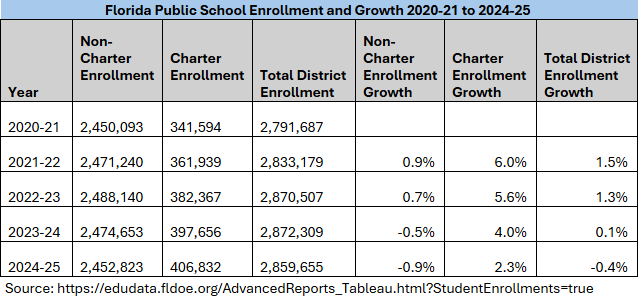
Enrollment declines in some districts have been real, even if the blame on scholarships is misplaced.
Declining enrollment is being driven by parent preferences – but also by shifting demographics and the ebb of the post-Covid population boom. Florida is one of the few states where overall K-12 population is expected to continue growing, but the growth will be uneven, and every school will have to compete for students.
Even as they face intense competition and demographic headwinds, Florida’s charter schools have kept growing. Some innovative district leaders have signaled a willingness to hear the demand signals from parents and create new solutions to meet their needs.
Understanding what parents seek in private and charter schools, and how new public-school models can better meet those demands, would be a good place for districts to start.
Pre-K and Voluntary Pre-Kindergarten (VPK) have also been major feeders for Florida’s scholarship programs. In 2024-25, 53,825 new scholarship students came from pre-K — somewhere between one-third and nearly half of all VPK students statewide.
Public schools have limited Pre-K offerings. Statewide, there are less than one-third as many Pre-K students as kindergartners enrolled in public schools. Private schools, by contrast, have used it as a key pipeline to recruit future students.
Districts have other avenues to respond to changing parent demands. Since 2014, when the Family Empowerment Scholarship for Students with Unique Abilities (FES-UA) was introduced as the Personal Learning Scholarship Accounts, districts have been allowed to offer classes and services to scholarship students.
The passage of HB1 in 2023 transformed every state scholarship into an education savings account. K-12 families now have more flexibility to use scholarships for “a la carte learning,” in which they pick and choose from a variety of educational options. By offering part-time instruction, tutoring, therapy, and other services, districts can win back students and the associated funding. So far, 21 of Florida’s 67 districts have taken advantage of this opportunity, with 10 more in the pipeline.
Florida’s enrollment shifts are real, but data shows the “voucher drain” narrative overstates the impact. The real challenge for districts is not money being “siphoned;” it is families choosing other options. Districts that adapt and compete for students will keep both enrollment and funding – leaving students, families and taxpayers better off.

