Students at the University of Austin are getting an overview of the nation’s rapidly expanding education choice movement, including its storied history in Florida.
The survey course includes guest lectures delivered by top national researchers and thought leaders, including Ron Matus, director of research and special projects at Step Up For Students. The nonprofit organization is Florida’s and the nation’s largest education choice scholarship funding organization. Matus, who spent 25 years as a journalist and eight years as the state education reporter at the Tampa Bay Times, has authored many white papers on education innovation in Florida for Step Up.
The topic of Matus’s lecture was “Freedom, Pluralism and School Choice: Competing Rationales and Contemporary Practice” and included a special emphasis on education innovation in the Sunshine State.
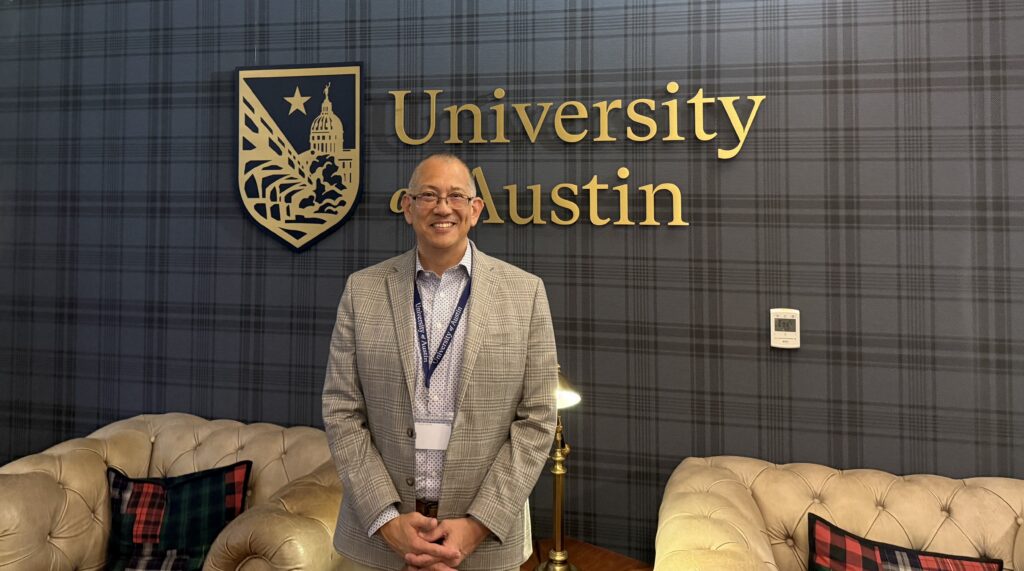
Matus shared the evolution of public education in Florida from its first model of neighborhood zoned district schools to the rise of charter schools, homeschooling, private school scholarships, educational savings accounts, a la carte learning, and even public schools now offering individual courses paid for with education savings accounts. He also described the many learning options now available, from traditional private schools to farm and forest schools to microschools and programs customized by families.
Matus also recommended reading that exposed students to various arguments in favor of education choice, including economist Milton Friedman’s 1955 groundbreaking essay “The Role of Government in Education,” which emphasized free markets and competition, and John E. Coons, a professor emeritus at the University of California, Berkeley, School of Law, who focused on dignity and fairness to all families regardless of income.
Erin Davis Valdez, executive director of the university’s Center for Education and Public Service, developed the course, which followed two K-12 practicums with rotations that began in the fall of 2025 at participating private and charter schools.
She describes the program as being in “the incubator phase,” and hopes to expand it into an academic minor.
“What we’re trying to do every term is offer a course for students interested in education policy as a career or in teaching as a career or something adjacent to it, like entrepreneurship,” she said. “But for now, students can take these as elective classes, and it builds their interest in the field.”
Valdez, who was homeschooled as a young child in Lakeland, Florida, a year before it became legal, said she chose the guest lecturers by looking for the best researchers and thought leaders in the movement. In addition to Matus, the list includes Eric Wearne, an associate professor in the Education Economics Center at Kennesaw State University and director of the Hybrid Schools Project. Wearne, who once described most traditional teacher prep programs as “thinly veiled arms of the HR department of the school district,” spoke on “Design Policy for New School Models.”
Others included Patrick Wolf, Distinguished Professor and 21st Century Chair in School Choice at the University of Arkansas, who spoke about the history of school choice policy, Jay P. Greene, senior fellow at the Defense of Freedom Institute, who spoke on the national responsibility of American universities; Katherine Bathgate, CEO and founder of SchoolForward, who spoke about economic foundations and emerging policy issues I education freedom; Mary K Wells, managing partner at Bellwether, who spoke on the last 30 years of education reform efforts; and Anita Scott, director of public policy for the Texas Home School Coalition, who spoke on connecting policy and practice in the homeschooling community.
Matthew Ladner, a senior adviser for education policy implementation at The Heritage Foundation’s Center for Education Policy and former executive editor of the NextSteps blog, is scheduled to lecture on June 1 about new directions in education choice and the question of accountability. The class will conclude June 8 with a lecture by Robert Pondiscio, a senior fellow at the American Enterprise Institute, whose topic is “The Last Days of Public School.”

