Florida's education choice movement has transformed learning for millions of families, but the next generation of reforms will require expanding options, modernizing funding and continuing to trust parents, a panel of state education leaders said Tuesday.
The discussion, hosted by the James Madison Institute, featured former Gov. Jeb Bush, who spearheaded the education choice movement that put Florida two decades ahead of other states that have recently established choice programs. Joining him were state Sen. Danny Burgess, R - Zephyrhills, whose three children are homeschooled, and Ron Matus, research and special projects director at Step Up For Students, a nonprofit organization that manages the state’s K-12 ed choice scholarship programs.
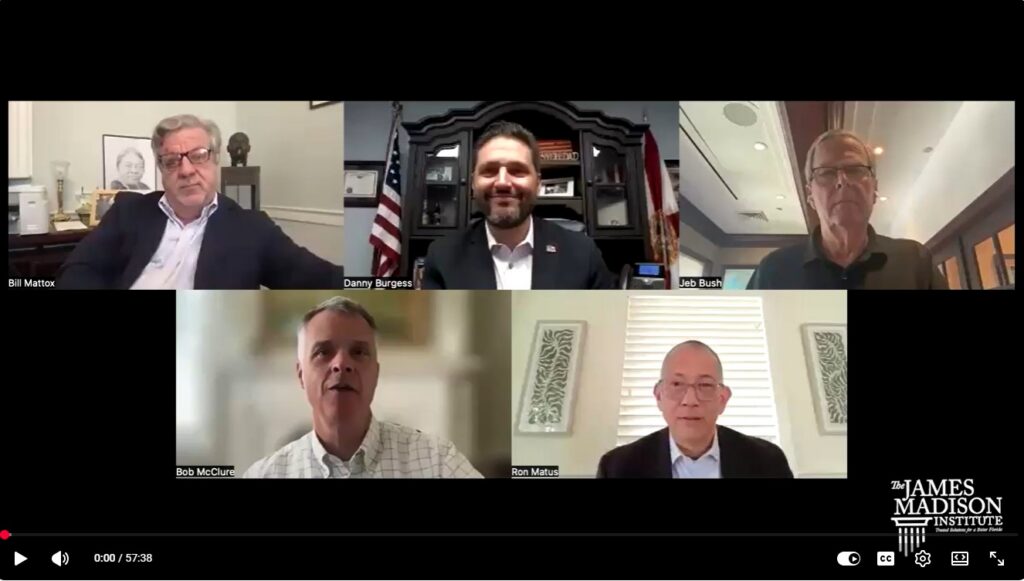
William Mattox, senior director of the James Madison Institute’s J. Stanley Marshall Center for Education Freedom, moderated the event, also sponsored by the Foundation for Florida’s Future (founded by Bush over 30 years ago) and Step Up For Students, to celebrate the 25th anniversary of the Florida Tax Credit Scholarship program. To see the full panel discussion, click here.
Bush recalled the early days of the ed choice movement, when he visited 250 schools during his campaign for governor and later established the state’s A-F grading system and a concurrent scholarship program for children in F-rated public schools. On the day Bush signed the bill, the Florida teachers union filed a lawsuit. (The state Supreme Court eventually struck down Bush’s scholarship program as violating the state Constitution's uniformity clause.)
The state also established the Florida Tax Credit Scholarship to ensure low-income students have access to options. That program ushered in an era of expanded choice that converted all scholarships to education savings accounts with universal eligibility. The change now empowers parents to customize their children’s education through a host of options, including private schools, microschools, homeschool hybrids, individual providers, online classes, and even individual public school courses. The long history of ed choice has made Florida the topic of many research studies with powerful results that show the programs are working and inform other states considering similar programs.
He said key findings include greater civic engagement, higher college attendance rates, academic gains, and improved outcomes for traditional public schools when parents have alternatives.
“Most importantly, Florida demonstrated that a child's ZIP code should not determine his or her future,” he said.
Matus, who was the statewide education reporter for the Tampa Bay Times as the movement took hold in 2004, covered the rise of charter schools, private school choice programs, Florida Virtual School (the nation’s first internet-based high school), and new forms of public school innovation.
However, meeting Black pastors in South St. Petersburg who strongly supported school choice particularly influenced his perception and challenged stereotypes about the movement.
“They simply wanted better options for the families they served,” Matus said. “That experience taught me that people support school choice for many reasons that often have little to do with the political narratives surrounding it.”
As the chief storyteller at Step Up, Matus has traveled the state to find evidence of how the rapid growth of learning options has allowed students and providers to flourish, including in Florida’s most rural areas.
“What I've seen is remarkable,” he said. “Today, roughly half of Florida's students participate in some form of educational choice. More than 500,000 students use scholarship programs. Hundreds of former public-school teachers have gone on to create their own educational options. Who could have imagined that 20 years ago?”
As for Burgess, he was a student sitting in class at Zephyrhills High School when the FTC was established 25 years ago and had organized a local Students for Jeb chapter when Bush was running for governor.
“I remain proud of my public school background,” he said. “But the educational landscape back then was very different.”
Choice was limited mainly to religious schools for those who could afford tuition. Homeschoolers were viewed as a fringe group.
Today, that has changed dramatically, he said.
Burgess and his wife use scholarship programs to customize the education of their three children through a rigorous hybrid classical Catholic program, piano lessons, and other enrichment activities.
“Watching our children thrive in that environment has been one of the greatest blessings of our lives,” he said. “The flexibility and opportunity we've been given through school-choice programs have made a tremendous difference for our family.”
Being a state lawmaker has given Burgess a front row seat to the evolution of ed choice.
As a House member in 2014, he saw changes that were largely incremental.
That changed in 2023, when lawmakers passed House Bill 1.
“When Florida embraced universal school choice, it represented the culmination of decades of work,” he said. “None of that would have happened without the foundation laid by Gov. Bush, the Tax Credit Scholarship Program, and the reforms that followed over the years.
“Today, Florida is leading the nation on universal school choice, and many other states are looking to follow that model.”
Universal came, but not without some important lessons that those in other states need to understand. Bush cited several:
“The tendency in government is always to solve problems by adding more rules,” he said. “You end up putting a blanket over the 99% of schools and providers that are working well because of problems caused by the other 1%.”
“Institutions that feel threatened by change will fight against it,” he said. “Policymakers pursuing these reforms need to understand that litigation is almost inevitable. If you're starting down this road in another state, you're going to get sued. I can virtually guarantee it.”
The panelists praised education savings accounts, which let parents direct funding to pre-approved uses spelled out in state purchasing guides, for empowering parents, who know what options best fit their children.
However, Burgess said some rules should be re-examined while leaving in place “reasonable safeguards.”
"Do we truly trust parents to make the right decisions for their children? I do. And I’m going to default to trusting parents every time.”
The conversation also turned toward equitable funding levels for different scholarship programs, the recommended removal of regulatory barriers that prevent innovation options such as microschools from opening and the need for school districts to see the benefits of sharing their underused school buildings with charter and private schools and allowing choice students to take individual district courses.
Bush challenged the assumption that if parents choose something other than a traditional public school, that public education suffers.
“We need a superintendent...that wakes up in the morning and says, ‘Every kid that is in my district...every child is my responsibility. I want to create an environment where parents have an abundance of choices, that kids are protected, that they dream big dreams, and when a school is successful as a microschool or homeschool option, or a hybrid option...or a traditional school or charter school or a Catholic school or a Jewish school, that I’m here to celebrate that success.’"

