Editor's note: This story is part of our series marking National School Choice Week. We also recognize Catholic Schools Week, which runs concurrently. The scholarship application season opens on Feb. 1. Visit Step Up For Students to learn more and apply.
In 1999, the former school choice scholarship student was 10 years old and living in the Deep South Navy town of Pensacola, Florida. He was being raised by a single mom who worked as a cashier; growing up in a tough neighborhood; and going downhill in a tough public school.

Then, all of a sudden, he was a student at Little Flower Catholic School.
Experiencing the school for the first time, he told me 20 years later, “felt like going to Disney.”
The cathedral was towering. The statue of St. Therese, exotic. Even the classrooms smelled different. “Like Glade,” he said.
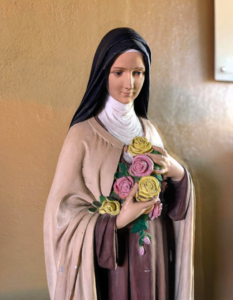
The former student didn’t know anything about the scholarship that allowed him to attend. He didn’t know why his mom enrolled him. He just knew that one day he was in third grade at a “bottom of the bottom” school, and then he and his too-big backpack were in fourth grade across town.
Just like that, he said, he went from playing dice and fearing he’d be called a “doofus” for studying, to collecting Pokémon cards and competing academically with the children of doctors and lawyers. For the next two years, the entire community at his new school — the teachers, the other kids, the other families — embraced him.
Two years, it turns out, was long enough for him to affix himself to a path no one else in his family had taken. To high school graduation. To a four-year college. To a good-paying job.
Without this little Catholic school, he said, none of it would have happened.
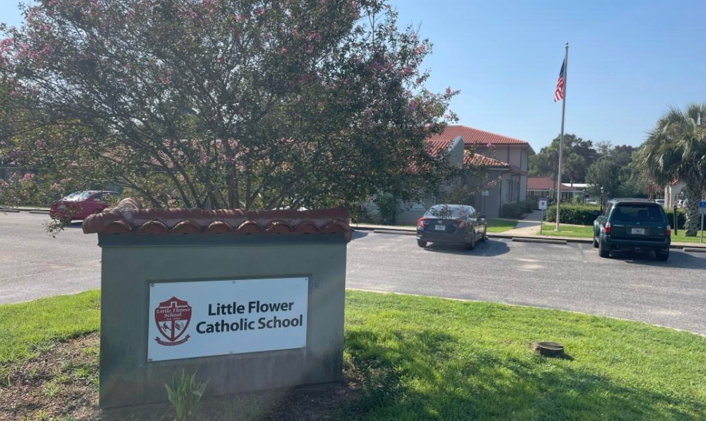
I met the former student in 2019. That was the 20th anniversary of Florida’s Opportunity Scholarship, the first, modern, statewide voucher program in America. I had set out to find some of the first “voucher kids” and see what happened to them.
Ultimately, I wrote about one of them, but not the kid from Little Flower. His story, though, seared into my brain.
It was uncanny how he so clearly described how this one, brief education intervention so radically changed the arc of his life. He said Little Flower showed him what school was supposed to be like, and, more importantly, what a family was supposed to be like.
A few years later, I would think of the student when choice opponents tried to demagogue scholarship programs because some low-income students use the scholarships only for a short time. They insinuated short-term use proved the poor quality of available private schools, rather than reflect student transience tied to income.
I continue to think about the former student today, as I continue trying to understand why some schools are so much more effective for low-income students. For half a century, we’ve known Catholic schools are among them. It’s another reason I’m grateful Catholic schools in Florida are growing again, and excited about the potential of school choice to reverse the trend lines in other states, too.
The “Catholic school advantage” has made the American Dream a reality for millions of working-class kids, usually at far less cost than public schools. But why?
“Catholic Schools and the Common Good” sought to answer that question. A classic in education research, it was published in 1993, just a few years before Florida launched its first scholarship program. It’s jarring how many school characteristics identified as central to Catholic school effectiveness are so basic.
An orderly environment. High expectations for every student. A focus on academics and character. And above all, pervasive warmth and hope, grounded in a faith that extended a “genuine sense of human caring” to every kid.
Why is it so hard to get more of that?
…
The kid was assigned to his neighborhood school. He and the school struggled. The man he grew up to be described the school and its outcomes this way:
The kids who went there, many of them are either dead or in jail or not successful. It was the bottom of the bottom in a sense. Kids who’ve been generation after generation in a certain mindset. The same cycle. Generational curse. Broken homes. A lost generation of kids with no fathers.
In first grade, he was held back.
“I don’t know if it was because he was slow at that time, or if the teacher didn’t take the time out to teach right,” his mom told me. “I went to school a couple times and asked, ‘What’s going on?’ They said, ‘He’s a good kid. He behaves. He’s trying.’”
But as time went on, the kid began hanging with tougher students. In hindsight, he said, he was “starting to go to a dark place.”
Just in the nick of time, the stars lined up.
Students were eligible for the Opportunity Scholarship if they attended a public school that earned two F grades in four years. The student in Pensacola attended one of those schools.
…
The kid’s mom couldn’t drive him to Little Flower every day. It was a long haul. Her car was unreliable. Her elderly friends volunteered to give her son rides.
They didn’t have much money, but sometimes they’d hand him a dollar for lunch. They told him he had an opportunity other kids didn’t have.
Study hard, they told him. … Stay away from the street … Make your mama proud.
The kid started at a second-grade level academically, even though he was in fourth grade. He said many of his classmates were already doing middle school work. But no one at Little Flower ever made him feel inadequate, he said. His teachers simply gave him more 1-on-1 attention so he could catch up.
Gratitude fueled him. He didn’t want to let down his mom. Or the “old heads” who gave him rides. Or a former teacher from his prior school, who sometimes took him to church and told him, “There’s something special in you.”
Competition fueled him, too. He knew he was behind many of his classmates but was determined not to stay there. Everything about the school, he said, told him he was just as capable.
The former student said he loved the diversity at Little Flower. Working class, middle class, upper class. Mostly white, but with a growing number of Asian students and, thanks to the choice scholarships, more Black students. Increasingly diverse, yet united as a community.
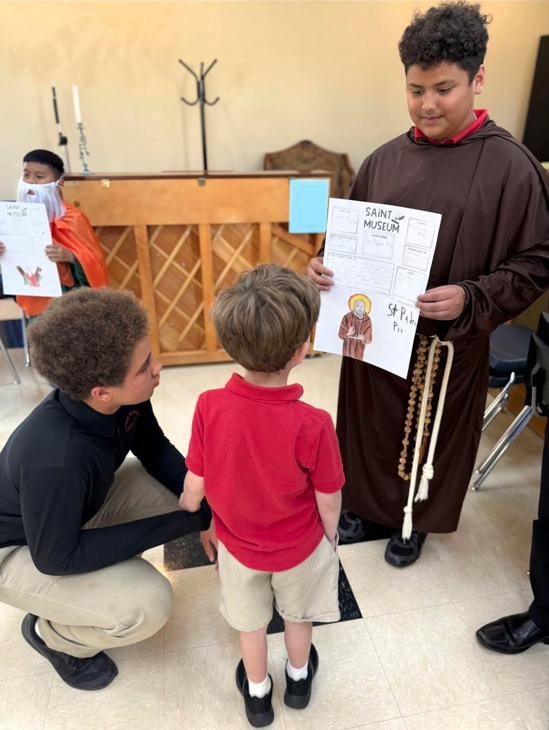
The kid said his new friends invited him into their lives, where he glimpsed a world he’d never seen. Comfortable homes. Nice things. Moms and dads.
“It opened up my mind to think different,” he said, “to understand that just because you come from a certain area, you don’t have to follow that line.”
…
The kid returned to his zoned school for middle school. He didn’t know why. His mom couldn’t remember.
But the lessons from Little Flower stuck with him.
He graduated from high school, attended a four-year college, and earned a bachelor’s degree. He said he loved college, and not just for academics. He was surrounded, he said, by students with “concrete families.”
Just like he was at Little Flower.
“I got to see what a family was,” he said. “A functional family. A healthy family. This is what a family feels like. It gives you spirit … inspiration … warmth … “
Today, the former scholarship kid has a good-paying job. He’s married with kids. He told me his “biggest mission in life is to raise a healthy family.”
Little Flower taught him that, he said, without ever having to say it.

