By Brandon Larrabee
News Service of Florida
The Broward County School Board voted Wednesday to move ahead with legal action against a sweeping new education law, an initial step toward a court clash over one of the legislative session's most controversial bills.
During a special meeting called to discuss the potential lawsuit, board members voted unanimously to allow the district to hire an outside lawyer to help handle the case. Broward County expects to be followed by other districts — including Miami-Dade County — in mounting a challenge to the law.
The legislation (HB 7069), signed by Gov. Rick Scott last month, would overhaul a vast swath of state education law. It deals with everything from mandatory recess for elementary school students and standardized testing to charter school funding and teacher bonuses.
In a memo given to the Broward County board ahead of the meeting, the board's general counsel outlined five grounds to challenge the 278-page, $419 million measure. The grounds include an argument that the massive legislation violates the Florida Constitution's requirement that each bill deal with a single subject.
But it also launches broadsides against some aspects of the legislation that are friendly to charter schools. The new law makes it easier for charter schools to open near academically struggling traditional public schools, something the Broward County board says infringes on its authority over schools.
The law, championed by House Speaker Richard Corcoran, R-Land O' Lakes, also requires school districts to share with charter schools construction funds raised by local property taxes, something that could weaken the districts' credit outlook. (more…)
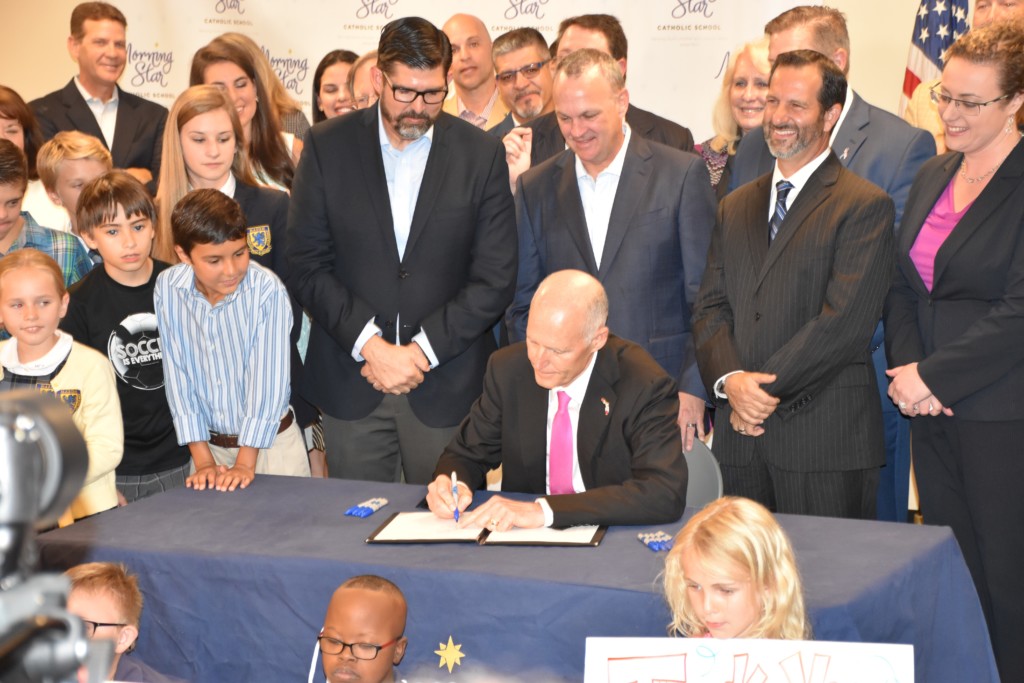
Gov. Rick Scott signs major education legislation during an Orlando ceremony, as state Reps. Manny Diaz, Richard Corcoran, Mike Bileca and Erin Grall look on.
ORLANDO, Fla. - Big changes are coming to Florida's public education system.
Flanked by House Republican leaders and special needs children, Gov. Rick Scott signed legislation that equalizes funding for Florida's charter schools, transforms the state's system for turning around struggling public schools, and boosts funding for special needs scholarships — among dozens of other provisions.
HB 7069 was at the center of a heated public campaign by parents, educators and political activists. The News Service of Florida reported this week that the governor had received 23,440 messages supporting the bill, and 22,734 calling for a veto.
Scott acknowledged the avalanche of "input" he'd received but said he's convinced the massive 274-page package will help students.
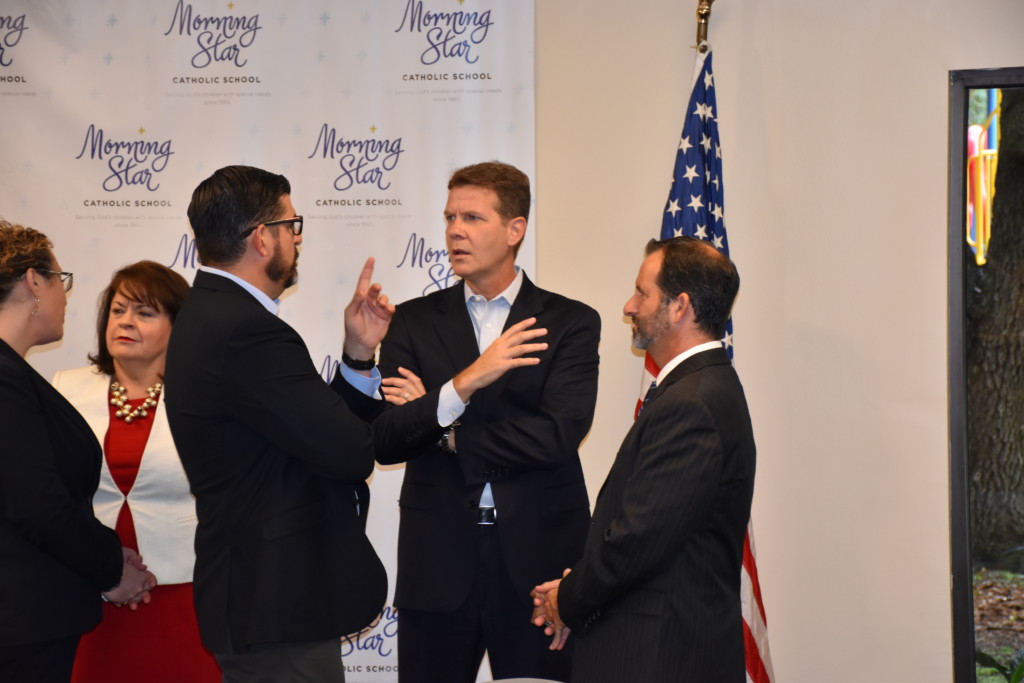
House Education leaders Manny Diaz, R-Hialeah and Mike Bileca, R-Miami confer with former Senate President Andy Gardiner of Orlando.
"It addresses lots of key issues in our education system, and paves the way for every Florida student to receive the world-class education that every student deserves," he said.
House Speaker Richard Corcoran and a host of lawmakers who worked on parts of the bill joined the governor at Morning Star Catholic School, which educates children with special needs.
Mike Bileca, R-Miami and chairman of the House Education Committee, said some of the biggest changes would come in areas where public schools have languished with low academic performance.
The new law speeds up the timetable for districts to turn around struggling schools. It also creates a new Schools of Hope grant program aimed at attracting high-performing charter schools to struggling areas. It could also fund traditional public schools that want to provide wraparound services or create charter-like, college-prep, academics-plus-character cultures.
"We're going to see our communities in high-poverty areas flourish, and we're fundamentally going to change the state of Florida for the better," Bileca said.
(more…)
Attempts to modify or remove funding from parts of a major piece of education legislation fizzled today in the Florida Senate.
As a result, all $419 million in House Bill 7069, including the House's signature program to draw top charter school operators to academically struggling areas of the state, will likely remain intact as Gov. Rick Scott evaluates the measure in the face of a heated public campaign.
Sen. David Simmons, R-Altamonte Springs and Senate education budget chief, set aside attempts to shift funding from the Schools of Hope grant program and a teacher bonus program into the main operating fund for public schools.
He had raised concerns about how the bill would be implemented and made clear today he still hopes those concerns will be addressed at some point.
During a debate on the Senate floor, Dennis Baxley, R-Ocala, gave a forceful defense of the measure. He sponsored an expansion of virtual education eligibility that was folded into the bill during the regular legislative session that concluded last month. He rejected the idea, espoused by opponents of the bill, that it was simply force-fed to some Senators "to make a deal" with the other chamber. (more…)
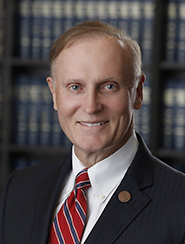
Simmons
The Florida Senate this morning has teed up debate on an overhaul of the school funding plan lawmakers approved last month.
Proposals on the agenda would strip all the funding out of House Bill 7069 — the wide-ranging, $419 million education measure that's been the center of controversy — except for one item: $30 million for Gardiner Scholarships, which provide education savings accounts to children with special needs. (Step Up For Students, which publishes this blog, helps administer the scholarships.)
And a key state Senator told reporters he hopes changes to the major education legislation won't end there.
Lawmakers returned to Tallahassee this week for a special session to meet three of Gov. Rick Scott's priorities. He wants them to steer more money into economic development, tourism promotion and public school funding. The governor freed up more than $400 million last week by slashing individual spending items out of the budget.
But the House and Senate are at odds over how, exactly, to fund the governor's priorities (and perhaps some priorities of their own). (more…)
The fate of the biggest education issues facing Florida this year could be decided late next week, as lawmakers return to Tallahassee for a special session.
Gov. Rick Scott vetoed the main, $11.5 billion state operating budget for public schools, as well as $409.2 million in other spending items. He issued a proclamation summoning lawmakers back to the state capital to make changes to their spending plan — including a $100-plus per-student increase for K-12 education.
The presiding officers of the House and Senate joined the governor at a Miami press conference earlier in the day. Scott said he's still "reviewing" HB 7069, a separate, massive education bill that contains funding issues crucial to charter schools, as well as $30 million in funding for special needs scholarships. (Step Up For Students, which publishes this blog, helps administer the Gardiner Scholarship program.)
The governor's office has been inundated with calls to sign and veto the bill, which would overhaul vast swaths of K-12 education policy. The latest media reports show supporters hold the lead in the official tally of calls and messages.
Scott refused to indicate what he would do with the bill, but pledged the final outcome would be "good for all students."
The governor's vetoes slashed individual education projects big and small. He vetoed $1.2 million in funding for KIPP Jacksonville, intended to pay for its extended school days.
In previous years, similar spending items for the school have passed muster with Scott. But this year, he wrote in his veto message that "the charter school receives operating funding through the Florida Education Finance Program (FEFP) like all other public schools, and it is not a statewide initiative." (more…)
Hillsborough County has joined the growing list of Florida school districts where charter schools might help absorb enrollment growth.
The Tampa Bay Times reports this has created some awkward politics around a massive piece of education legislation many district officials loathe.
The same district leaders who complain about the Legislature and call for a veto also say they need charter schools to accommodate population growth, as funds are scarce to build new schools. This is especially true in the southernmost part of the county, where approved developments that were dormant during the recession are now springing to life.
Some also recognize that charter schools can give a second chance to students who fall through the cracks in the district system. Board member Susan Valdes, speaking at the May 16 board meeting, described two such students, one who lost a parent to military combat and the other who had been ill.
"If the governor signs the bill," Valdes said, addressing administrators in the auditorium, "hey, life lesson that we should learn about really, truly taking care of our children — not just taking their money."
As Florida Gov. Rick Scott weighs the fate of a massive piece of education legislation in the face of a heated public campaign, parents of special needs children have emerged as a key group urging support. They're advocating for Gardiner Scholarships to help them better afford access to private schools, curriculum, therapy, and other support for their children.
The wide-ranging HB 7069 includes $30 million in additional funding for the scholarships. The state budget, which lawmakers approved separately, would provide $73.3 million next year – the same funding as the current year.
Step Up For Students, which publishes this blog, helps administer the scholarship program. Step Up administrators report that, as of Monday, 11,029 students have applied for a Gardiner Scholarship for next year. Hundreds, and potentially thousands, of families could be turned away from the program if the additional funding isn't approved. And many of them have contacted the governor to explain the stakes.
Anna Baumgaertner wrote a letter describing how her seven-year-old daughter was diagnosed with a brain tumor. The tumor disrupted her daughter's working memory. She was labeled as having a mental disability and struggled in school.
With the help of a scholarship, Baumgaertner wrote, "we have been able to provide Zoe with the tutoring, school and therapy she needs to progress at grade level with her peers." (more…)
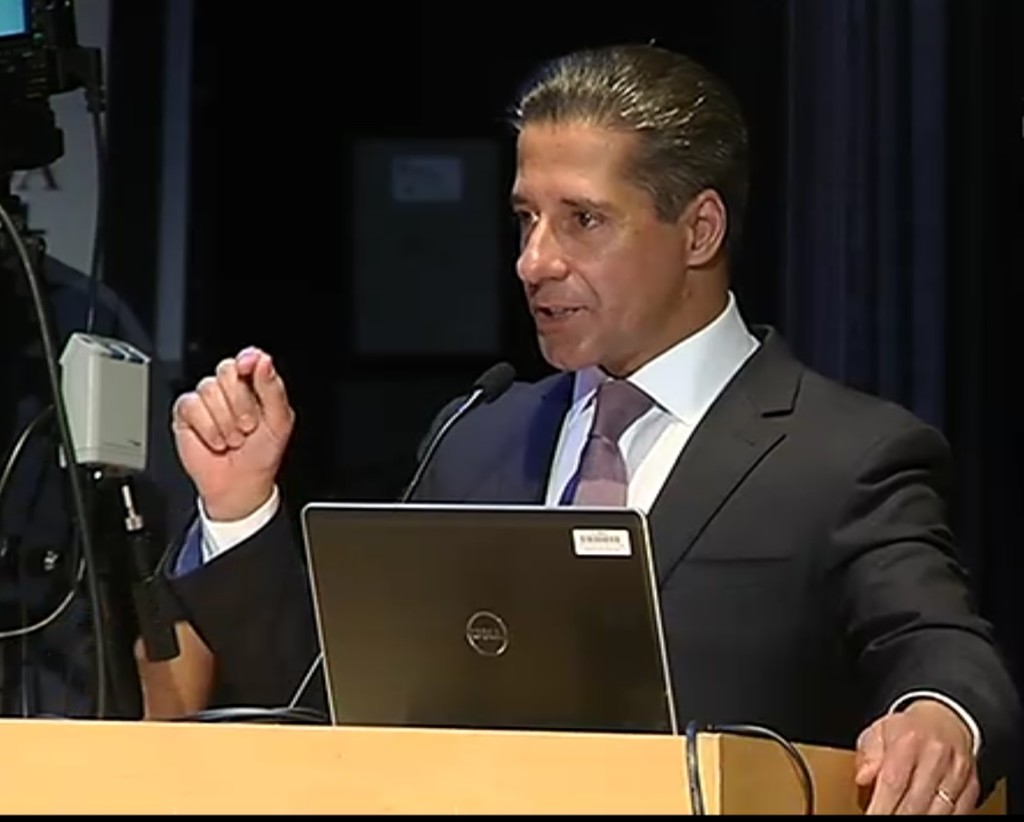
Miami-Dade County Public Schools Superintendent Alberto Carvalho addresses the Florida Board of Education.
The contentious bill, HB 7069, would steer an estimated $146 million to the state's charter schools. Nearly two-thirds of that money would come from district property taxes. Right now only a handful of districts share that money with charters. All of them would have to share it under the bill. The remaining $50 million would come from the state budget.
Without the bill, the money in the budget would be the only charter facilities funding left, matching the lowest statewide total in a decade. And the smaller pool of money would be spread among more students than ever. Right now, 556, or all but about 100 of Florida's charter schools, qualify for charter school capital outlay funding — a number that's risen every year.
That didn't sit well with Gary Chartrand, a Scott appointee to the state Board of Education and key backer of the effort to bring KIPP charter schools to Jacksonville.
"That's a dismal amount for charter schools that are growing at double digits," he said of the funding in the state budget. "I think it needs to be rectified somehow. I'm not exactly sure how, but the veto (of HB 7069) isn't exactly rectifying the situation for charter schools either." (more…)
By Brandon Larrabee
News Service of Florida
The chorus of voices calling for Gov. Rick Scott to veto a controversial education bill — and perhaps part of the state budget for public schools — grew Tuesday, even as supporters tried to push back.
Two of the state's major education organizations — the Florida School Boards Association and the Florida Association of District School Superintendents — sent letters to Scott on Tuesday asking him to nix a wide-ranging schools bill (HB 7069) unveiled on the next-to-last business day of the 2017 legislative session.
The superintendents went a step further and called on Scott to use his line-item veto to strike the Florida Education Finance Program, or FEFP, a move that would essentially force the Legislature to pass a new education budget. The FEFP comprises the majority of state and local funding that flows to public schools.
The letters from the two organizations came on top of calls from the Florida Education Association, the state's main teachers union, for Scott to take dramatic action on HB 7069, a sweeping measure covering everything from school uniforms and sunscreen to teacher bonuses and recess.
The measure is perhaps best known for its inclusion of a funding program for "schools of hope," including charter schools in areas with academically struggling traditional schools, and an expansion of the "Best and Brightest" teacher bonus system.
The school boards association was particularly blistering about the way that the bill was put together in budget negotiations between the House and Senate. The legislation emerged as a "conforming bill," tied to the budget and essentially subject only to an up-or-down vote. (more…)
The massive education bill Florida legislators approved on the final day of their annual session has stirred more passion than any in recent years.
Charter school advocates and House members are actively campaigning for HB 7069. School district leaders are calling on Gov. Rick Scott to veto it. Parents and education activists have spoken up on both sides.
A key theme binds many key concepts in the 278-page bill — a theme that has shaped education agendas in the Florida Legislature for several years, and defines battles that will continue after the politicking over this proposal subsides.
If approved, the bill would represent a power shift. It would move control away from district central offices and place it in the hands of individual school leaders. Charter schools would have more equitable funding. More district schools would have charter-like freedoms. In high-poverty schools, principals, not districts, would decide how to spend federal Title I funding to help their low-income students.
A key backer of the proposal, Rep. Manny Diaz, R-Hialeah, is a former public-school administrator. He recalls turnaround efforts, in which central office bureaucrats would stream in and out of the school building, looking over educators' shoulders, providing little in the way of actual "support."
He said districts should embrace a new approach. They need to hire high-caliber school leaders and make sure they're in sync with their communities. Then, stop micromanaging them. Let them control their own budgets. Give them the authority to pick the best teachers. (more…)

