Last week, just hours before news reports began to emerge about a teenager's murderous rampage through a Broward County high school, a bipartisan group of Florida Senators was preparing to tackle mental health funding.
They advanced SB 1434. Among other things, the bill would create a new mental health funding allocation for public schools. That proposal could take on new importance after the mass shooting, as questions emerge about gaps in the state's mental health system for students.
And it could soon be part of a much bigger legislative debate.
The same legislation would also change the state's rules governing public school facilities and charter school real estate transactions. And it appears poised to enter a larger fray over this legislative session's most far-reaching education bill.
The Senate Education Committee tomorrow will hear House Bill 7055. A strike-everything amendment filed by Senate Education Chairwoman Dorothy Hukill, R-Port Orange, would add the provisions from SB 1434. It would also make a number of tweaks to the bill the House has already approved.
Among them: (more…)
A Florida Senate proposal would re-examine several issues from a contentious education law passed last year.
SB 1434, which received bipartisan backing from the Education Appropriations Subcommittee, would allow more district-run public schools to qualify for grants under the new Schools of Hope Program.
It saw more revisions today that could help set the stage for negotiations with the House, which has advanced a new, wide-ranging education bill. A delete-everything amendment by Sen. Kathleen Passidomo, R-Naples and sponsor of the bill, eliminated a few contentious provisions, including one criticized by some charter school representatives because it restricted their real estate arrangements. Among other things, it would require charters to ensure their buildings returned to public ownership if the school ever closed. (more…)
A Florida House panel this morning approved legislation that would create a new funding stream for private school choice scholarships.
The bill would allow businesses to contribute to scholarship funding organizations and in return receive a full credit for sales taxes they collect, in a manner similar to Enterprise Zone job credits. Those contributions would be made to state-approved scholarship funding organizations, including Step Up For Students, which publishes this blog.
The provisions would raise up to $150 million. The money would help fund Gardiner Scholarships, which provide education savings accounts to children with special needs, or tax credit scholarships, which help low-income and working-class students pay private school tuition.
Demand for both programs has outstripped supply. Step Up For Students received 181,000 applications for tax credit scholarships this school year, but the program only had funding available for around 105,000.
Meanwhile, the Gardiner Scholarship program exhausted all of its available funding for the first time this school year. There are now 1,300 students on Step Up For Students' wait list for the program, and another 3,700 parents have expressed interest.
The program is funded through a line item in the state budget. Right now, both the House and Senate spending plans for next year would keep its funding at this year's levels, with just over $100 million for scholarships, or more than $60 million below the projected need. (more…)
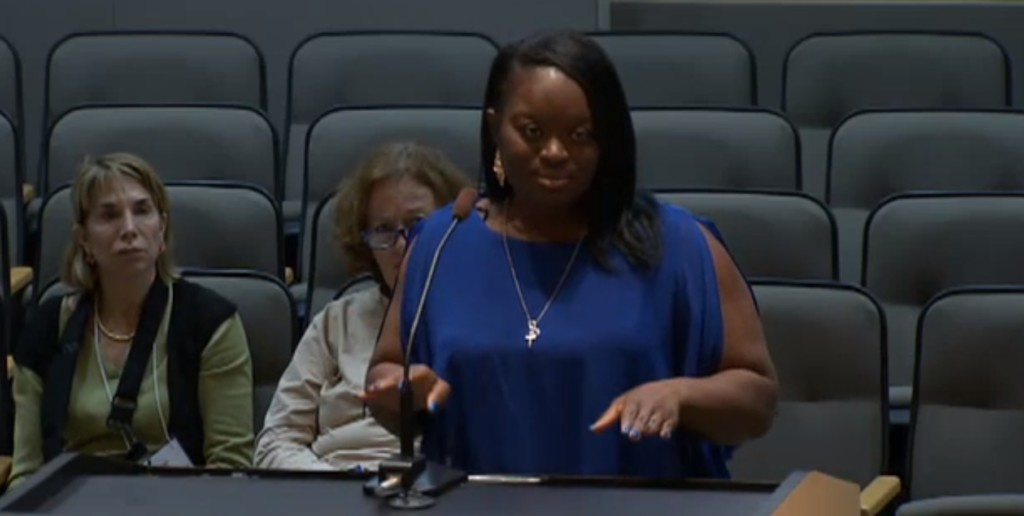
Chikara Parks addresses the Senate Education Appropriations Subcommittee.
A Florida Senate panel approved measures that would increase oversight existing private school choice programs and create a new option for children who are victims of bullying and violence.
A parent helped rebut opponents of the Hope Scholarship* proposal. SB 1172 would create the new program, which would allow victims to transfer to other public schools or receive scholarships to attend private schools.
Scott McCoy of the Southern Poverty Law Center told the Senate Education Appropriations Subcommittee that the concept relies on the "fallacy" that unlike public schools, "private schools are utopias" free of bullying.
But Chikara Parks, a mother of four from St. Petersburg, spoke after him. "I'm a big supporter of public schools," she said. After all, two of her children attend them. The other two used an existing scholarship program to attend Academy Prep Center, a private school focused on disadvantaged children. Parks wanted to get them away from bullying problems that she couldn't get school district officials to address. (more…)
As we noted earlier, the Florida House has a budget proposal that would insulate charter schools from lawsuits challenging the state's new funding system for their capital needs.
But there's an extra twist.
The chamber's budget plan, coupled with a contentious piece of legislation it's proposed, would also eliminate school districts' obligation to share local property tax revenue with charter schools — at least in the first year.
It would also help charter schools in districts like Pasco, Polk and Osceola where the new law, last year's HB 7069, raised little or no money for charter schools.
Here's how it would work. (more…)
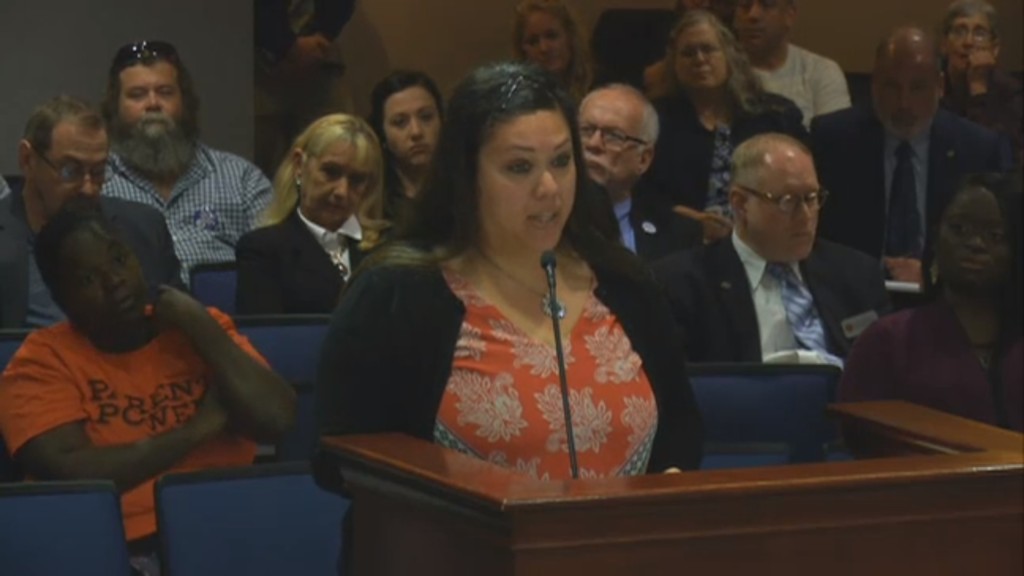
Evelyn Rivera was first in a long line of parents who addressed the House Education Committee on a proposed scholarship program for victims of bullying and violence.
Jacob Lebron is growing up with Aspergers Syndrome. In elementary school, his mother told a panel of state lawmakers, "he was different, so other kids called him weird."
Then, in middle school, it got worse.
At another parent's suggestion, his mother, Evelyn Rivera, applied for a Gardiner Scholarship*. She used the education savings account to pay his tuition at Temple Christian School in Titusville, Fla. There were no more bullies. New opportunities, like a chance to try out for the basketball team, opened up.
"It was such a turnaround," Rivera said. "He's made friends who accept him. He's been involved in all their activities."
Jacob himself asked lawmakers to support a new school choice program for children who are victims of bullying and violence.
"I want every student to have the same sense of acceptance as I do at my current school," he said. (more…)
The Florida House has combined a wide range of education initiatives into a single bill, triggering an intensely partisan debate over the future of public education.
The revised HB 7055, approved this morning by the Appropriations Committee, adds components the House has debated elsewhere to an already-substantial education bill.
Among other things, the initial bill would:
Some key additions include: (more…)
The two chambers of the Florida Legislature proposed different approaches to funding charter school facilities in their competing spending plans released late last week.
The ensuing negotiations could affect not only charter schools' bottom lines but those of nearly two-thirds of Florida's school districts.
A major education law passed last year, coupled with a trio of lawsuits aiming to block it, add extra layers of potential intrigue to the annual budget talks.
The current state budget provides $50 million in state funding for Charter School Capital Outlay and another $50 million for school districts.
The state Senate's plan for next year would largely keep that template, but it would shift the allocations. Charter schools would get $25 million and districts would get $75 million.
At first blush, that might look like a gift to districts at charters' expense, but it isn't quite that simple. (more…)
A Florida House panel gave bipartisan approval to a wide-ranging education bill after a contentious debate.
Much of the discussion centered on a proposal that would allow school boards to create autonomous, charter-like school networks within their districts, managed by star principals and overseen by independent governing boards.
Education Committee Chairman Mike Bileca, R-Miami, said over eight years in the Legislature, he's heard charter school critics call for more of the regulations that apply to district schools. He said he would rather go in the opposite direction, giving more charter-like freedoms to district schools. (more…)
Florida school districts would be able to form networks of "autonomous" public schools operated by top-performing principals under a proposal released Tuesday in the state House.
The concept combines elements of two ideas already making their way through the Legislature. The House has proposed expanding the state's existing principal autonomy program. Meanwhile, a Senate proposal would allow districts to create "franchise" schools.
The franchise concept would allow high-performing principals to adopt low-performing schools to help turn them around, while still operating their current schools at the same time.
The newest House proposal is set to come before the Education Committee Thursday morning. It would allow districts participating in the autonomy program to place principals in charge of not just one school, but an entire network of schools within the district. Districts would need to create an independent governing board to oversee the network. (more…)

