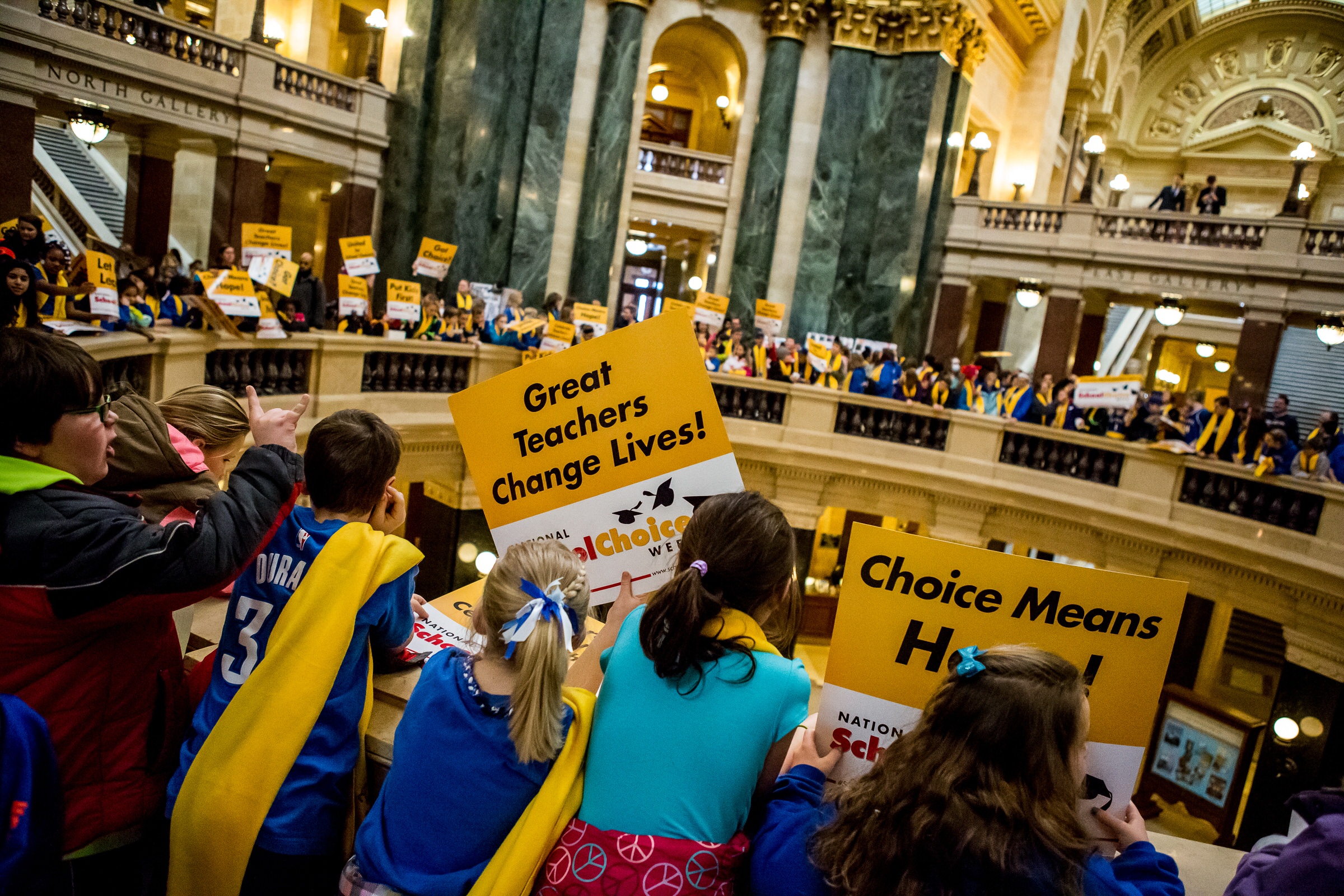
Wisconsin students celebrate National School Choice Week at the state capitol.
By George Mitchell
The parents of nearly 60,000 Wisconsin children choose to enroll them in one of the state’s private school choice programs.
Giving parents that choice is popular public policy. Polling shows voter support, across party lines, in all Wisconsin media markets.
Opposition is strong from the public education establishment and elected officials they support.
Exhibit A: Jill Underly, superintendent of the Department of Public Instruction (DPI). The Milwaukee Journal Sentinel reported earlier this year that “[S]he’d like to see the 35-year voucher program ultimately eliminated.”
Her position is directly at odds with the DPI’s ranking of schools. Official DPI Report Cards give the private schools higher marks despite funding at a fraction of public school levels,
A new analysis from School Choice Wisconsin (SCW) documents the striking productivity edge of private choice schools.
The SCW report relies solely on DPI data and uses conservative assumptions that negate possible school choice bias. For example, the report compares students from families with income eligibility limits with students from families of all incomes. Further, it understates a significant revenue advantage of traditional public schools by excluding federal aid.
The pioneering Milwaukee Parental Choice Program (MPCP) shows the greatest productivity advantage. While per pupil revenue in the Milwaukee Public Schools (MPS) is 38% higher than in MPCP schools, DPI’s Report Card ranking of MPS is 21% lower. See below.
| DPI Report Card Score (Scale 0-100) | Per Pupil Revenue | |
| MPCP* | 70.8 | $11,905 |
| MPS** | 55.7 | $16,442 |
* Eligibility limited to families at or below 300% of Federal Poverty Limit.
** MPS families of all income levels.
The following compares per pupil revenue and DPI Report Card scores for the Racine Parental Choice Program and the Racine Unified School District.
| DPI Report Card Score (Scale 0-100) | Per Pupil Revenue | |
| RPCP* | 72.7 | $11,905 |
| RUSD** | 61.3 | $14,629 |
* Eligibility limited to families at or below 300% of Federal Poverty Limit.
** RUSD families of all income levels.
Lastly, the following compares scores and revenue for the Wisconsin Parental Choice Program (students outside Milwaukee and Racine) with schools outside of Milwaukee and Racine.
| DPI Report Card Score (Scale 0-100) | Per Pupil Revenue | |
| WPCP* | 71.8 | $11,905 |
| Statewide Public** | 69.8 | $15,340 |
* Eligibility limited to families at or below 220% of Federal Poverty Limit.
** Families of all income levels. Excludes MPS and RUSD.
The SCW findings reinforce a 2019 study by Corey DeAngelis, Ph.D., a scholar whose research has appeared in: Social Science Quarterly; School Effectiveness and School Improvement; Educational Review; Peabody Journal of Education; Journal of School Choice; and Journal of Private Enterprise.
Separate scholarship, by Patrick Wolf, Ph.D., and DeAngelis, examined the effects of Milwaukee’s parental choice program on adult criminal activity and paternity suits. They found that “exposure to the program … is associated with a reduction of around 53 percent in drug convictions, 86 percent in property damage convictions, and 38 percent in paternity suits. The program effects tend to be largest for males and students with lower levels of academic achievement at baseline.”
A study for the Annenberg Institute at Brown University found: “As of 2018, [Milwaukee choice] students have spent more total years in a four-year college than their MPS peers. The MPCP students in the grade three through eight sample attained college degrees at rates that are statistically significantly higher than those of their matched MPS peers.”
George Mitchell is a School Choice Wisconsin volunteer.
References
DeAngelis, C.A. (2019, May 14). A wise investment: The productivity of public and private schools of choice in Wisconsin. School Choice Wisconsin. https://schoolchoicewi.org/news/research/return-on-investment/
DeAngelis, C.A., & Wolf, P.J. (2019, February 26). Private school choice and character: More evidence from Milwaukee. School Choice Wisconsin. https://schoolchoicewi.org/wp-content/uploads/2022/08/Private-School-Choice-and-Character-More-Evidence-from-Milwaukee.pdf
Meyerhofer, K. (2025, March 28). Wisconsin superintendent calls for cutting school choice. Her opponent is mum on program expansion. Journal Sentinel.https://www.jsonline.com/story/news/education/2025/03/28/wisconsin-superintendent-jill-underly-calls-for-cutting-school-choice/82652247007/
School Choice Wisconsin. (2023, August 30). The cost-effectiveness of Wisconsin’s private school choice programs. https://schoolchoicewi.org/wp-content/uploads/2023/08/The-Cost-Effectiveness-of-Wisconsins-Private-School-Choice-Programs.pdf
School Choice Wisconsin. (2025, August 12). Wisconsin’s Most Cost-Effective K-12 Platform. https://schoolchoicewi.org/wp-content/uploads/2025/08/Wisconsins-Most-Cost-Effective-K-12-Program.pdf
Wisconsin Department of Public Instruction. (2024, November 19). School & district report cards. https://apps2.dpi.wi.gov/reportcards/
Wolf, P.J., Witte, J.F., & Kisida, B. (2019, August 12). Do Vouchers Students Attain Higher Levels of Education? Extended Evidence from the Milwaukee Parental Choice Program. https://edworkingpapers.com/sites/default/files/ai19-115.pdf

Steve Malanga writing in City Journal recently made a rather chilling and well-documented case that a growing number of American men are not simply unemployed but are also unemployable. Malanga writes:
But the workforce woes run deeper. Ever more adults are unemployable because of worsening social dysfunction, changing youth attitudes toward work, and university and public school failures to prepare students for labor-market realities. Drug legalization has made it harder to find laborers who can pass drug tests—essential to work in industries like construction and transport—leading to worker shortages for key jobs, including truck drivers. A crime spike, meantime, will likely create a new generation of convicts, among the toughest people to employ when they reenter society. Soaring mental-health problems add to the ranks of the unemployable. And many firms hesitate to hire new college grads because they often lack basic skills, starting with knowing how to communicate and function within a group, and often have unrealistic expectations about pay and benefits.
The male academic disaster has been evident in outcome data for years. To be sure, our society has problems in addition to this disaster, but the deep failure of our education system to equip boys with the habits and knowledge necessary for success exacerbates all of them. POSIWID applies here: Stafford Beer, a British academic, coined the term that the “purpose of a system is what it does,” known as POSIWID for short. Beer explained that the stated purpose of a system is sometimes at odds with the intentions of those who design, operate, and promote it. “There is after all no point in claiming that the purpose of a system is to do what it constantly fails to do.”
The American education system constantly fails to educate boys.
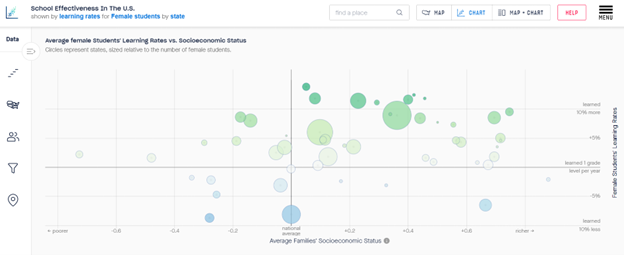
For example, below shows the average academic growth rate by state for female students in grades 3-8 between 2008-09 to 2018-19 from the Stanford Educational Opportunity Project. The horizontal center line denotes learning a grade level worth of math and reading in a year, dots are states, green dots are good, blue dots are bad.
And here is the same data for male students, who obviously learned a great deal less:

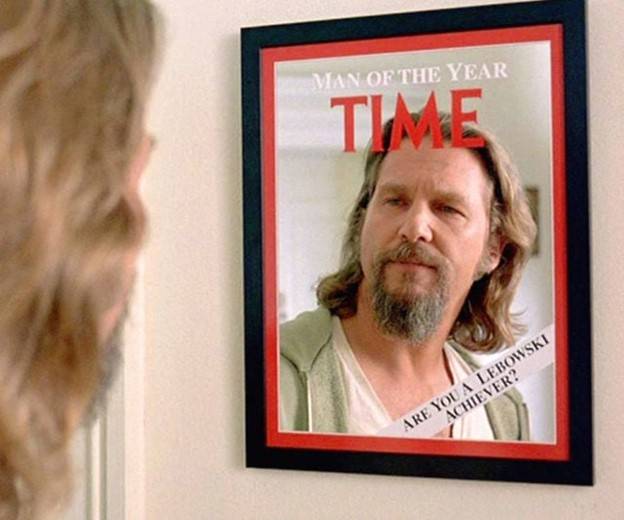
The regulatory capture of American school districts by unionized employee interests began in the 1960s and had more or less been completed by the 1980s. To be sure, some other interests, such as school construction firms, came along for the rent-seeking ride. Perhaps this was all fun and games until someone got hurt, and the now long list of the injured includes a rather large subgroup of students called “boys.”
The Big Lebowski should remain a comedy rather than a prescient documentary.
 Editor’s note: The Philadelphia Inquirer recently encouraged a debate between a local parent and veteran policy analyst and redefinED guest blogger Jonathan Butcher on the question of whether grading is necessary to keep students on track amid arguments that grades during the pandemic are ambiguous and unfair. Butcher argued in favor of the former. Here is his commentary.
Most of us will spend at least a dozen years in school starting at age 5. For an increasing share of young adults, the education experience lasts 16 years or more, as the percentage of 18- to 24-year-olds enrolling in college has risen from 35 percent to 41 percent since 2000.
Pandemics, mercifully, do not last as long as our school-age years.
Each school year builds on the prior one, so officials must prevent the 2019-20 school year from becoming a lost academic experience for Philadelphia students. Abandoning student grades during the pandemic would put everyone — policymakers, taxpayers, parents, teachers, and students — at a disadvantage next fall.
Thousands of students will return to physical, hybrid, or virtual city classrooms in August. Without some measure of how children finished the year, teachers will not be able to match instruction to each child’s needs.
Continue reading here.

 Editor’s note: Misinformation abounds across the education choice landscape, adding confusion to an already complex issue. The redefinED team is dedicated to shining a light and providing the facts. Today’s post debunks an oft-repeated misconception: Private schools that accept scholarships are not held accountable. You can see more myth busting here, or click the link at the top right-hand corner of this page.
Education choice critics have argued for years that voucher programs divert tax dollars from public schools to “unaccountable” private schools. That misperception has now become a popular talking point for opponents of Florida’s new Family Empowerment Scholarship.
A recent opinion piece in the Orlando Sentinel implies that voucher schools fail to hire qualified teachers, that they are unable to prove they’re educating students, and that they are not transparent with their finances.
The Ocala Star Banner opined that the FES “opened the door” to spending tens of millions of public dollars on schools with “no public accountability, no common testing procedures and generally no teacher certification parameters.”
Meanwhile, the Florida Education Association in a recently released report warns that the state’s new education bill could cause public schools to lose almost $1 billion in the next five years and references an Orlando Sentinel series that “revealed the lack of oversight and accountability over private schools operating in Florida.”
In truth, voucher schools are subject to two forms of accountability: the top-down regulatory model, albeit with a lighter touch than what public schools receive; and the kind you get from the bottom-up through parental choice, something few public schools face.
Florida devotes nearly 12,000 words of regulations governing the Tax Credit Scholarship. Among them: Schools must provide parents information about teacher qualifications; they must test students in grades 3-10 in reading and math on state-approved national norm referenced tests; and they must conduct annual financial reports if the school receives more than $250,000 from any scholarship source.
Schools also are subjected to health, safety, fire and building occupancy inspections. Starting in 2019-20, new participating schools must be inspected by the DOE before accepting any scholarship students. Read more here.
In addition to these external regulations, parents who are dissatisfied with their private schools can vote with their feet and take their scholarship students elsewhere. That ability represents the most immediate and direct form of accountability: If the schools can’t deliver, they lose students and the money that follows them.
That kind of accountability is in short supply in district schools, particularly in low-income areas, where parents generally can’t afford to move to a neighborhood with a better school or pay tuition for a private school.
 Florida’s school choice critics have long complained about Florida’s testing regime. They’ve even bundled this frustration with state testing, and other regulatory burdens, into their opposition to school choice programs like the Florida Tax Credit Scholarship or the new Family Empowerment Scholarship
But what if public schools were subjected to the same light-touch regulations on testing that private schools accepting scholarships enjoy? Would critics be more likely to support school choice? Would public school leaders in Florida support school choice if they could substitute the Florida Standards Assessments for national norm-referenced tests?
A new paper, “Deal or No Deal? The Effects of Deregulation on Public School Leaders’ Support for Private Choice in California,” by Corey DeAngelis and Lindsey Burke, suggests the answer might still be “no.”
Researchers grouped California public school leaders into one of five groups to test the impact that various deregulations might have on supporting a hypothetical private school voucher. One group served as the control where no deregulation was offered along with the hypothetical voucher program.
Hypothetical deregulation included eliminating state tests, not requiring schools to report test results, not requiring teachers be certified, and not requiring schools to provide transportation.
Of the over 7,000 school leaders sent questions, just 755 responded. The low-response rate may bias the results. Researchers also noted their respondents were underrepresented in large counties and cities, as well as elementary schools.
Researchers found strong opposition to a hypothetical private voucher program regardless of deregulation offered. Overall, 80 percent of public school leaders were “certain not to support” or “very little chance” they would support a voucher program.
Interestingly, researchers found that deregulating teacher certification and testing requirements for public schools actually increased opposition to the hypothetical voucher program.
The researchers speculate this increased opposition may be because regulations tend to benefit large firms (like public school districts) and reduce the effectiveness of small competitors (like private schools).
Future research may want to explore additional hypotheticals, such as allowing school-level autonomy, or even bundling several deregulations together such as autonomy and testing deregulation. Would the answers change, or opposition remain?
Researchers might also want to consider surveying public school leaders in states like Florida where more than 140,000 students are already using voucher-like programs.
Or perhaps ask the reverse? Would public school leaders support vouchers if private schools faced the exact same regulations? Given the opposition in Louisiana and Washington D.C. that answer might also be a “no.”
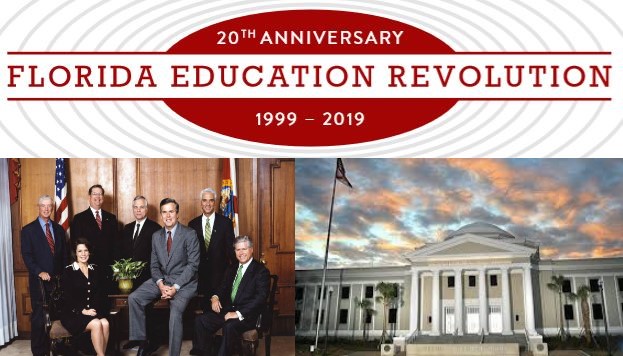
Gov. Bush's "A+ Plan" for accountability faced a long road of legal battles as soon as it began 20 years ago.
Editor’s note: March 2 marked the 20th anniversary of the legislative session in which Florida Gov. Jeb Bush launched a number of K-12 reforms that transformed education throughout the state. With the start of the 2019 legislative session earlier this month, redefinED embarked upon a series of articles that examine aspects of Bush’s K-12 education revolution and how it continues to reverberate. Today’s piece is the second of two retrospectives that chronicle the plan’s legislative roller coaster ride. You can read Part I here.
The critics strike back
With vouchers deemed constitutional by the First District Court of Appeal and with an appeal rejected by a 4-1 vote by the Florida Supreme Court, state leaders not only began to improve the A+ Plan; they birthed an entirely new scholarship program.
In the summer of 2001, Florida created the Florida Corporate Income Tax Scholarship, later renamed the Florida Tax Credit Scholarship, for low-income students. The prior year, the state had created the McKay Scholarship for students with special needs. Both programs swelled in size immediately, dwarfing the embattled school voucher, the Opportunity Scholarship Program (OSP). McKay served 8,000 students with special needs in 2002, while more than 55,000 low-income students applied for 15,000 corporate tax scholarships in its first year.[1]
The Florida Tax Credit Scholarship would eventually grow to become the largest private school scholarship program in the nation, serving 100,512 students in the 2018-19 school year. (The program is administered by non-profits such as Step Up For Students, which hosts this blog.)
The state also revised the A+ Plan’s accountability system in December 2001. Previously, schools were evaluated only on fourth-grade reading, fifth-grade math, and both tests in eighth and 10th grades. New rules based school grades on both math and reading tests in all grades between third and 10th. The new grading scale also gave a substantial weight to learning gains, with bonus points for significant gains for low-income students.
With the new rules in place, more schools received “F” grades, and enrollment in the OSP soared to 557 students in the next school year. Enrollment peaked at 788 students in 2004-05.
After a year away from the courtroom, the lawsuit resumed in the Leon County Circuit Court under a new judge, Kevin Davey, in the summer of 2002. Voucher opponents now argued the programs violated Florida’s “Blaine Amendment,” a constitutional ban on direct or indirect aid to religious institutions.
Voucher supporters were eager to argue the case as the U.S. Supreme Court just two weeks prior to the hearing had ruled an Ohio voucher program did not violate the U.S. Constitution’s “Establishment Clause.”
On Aug. 5, Judge Davey issued his ruling. “The language utilized in this provision is clear and unambiguous,” he wrote regarding Article I, Section 3 of the state constitution. Known as the “No Aid” clause, it bans “direct and indirect” aid to any church, or sect, or sectarian institution.[2]
School choice supporters appealed, claiming the ruling also threatened other religiously affiliated organizations such as several non-profit hospitals operating in the state.
The First District Court of Appeal would uphold the ruling 8-5 on Nov. 12, 2004. Scholarship supporters appealed to the Florida Supreme Court, knowing a loss could still be appealed to the U.S. Supreme Court.
Lawyers for both sides argued on the “No Aid” clause before the Supreme Court on June 7 2005. Lawyers representing parents argued the aid was to the student, not the school, as U.S. Supreme Court had reasoned in its 2002 Zelman decision.
On Jan. 5, 2006 the Florida Supreme Court in a 5-2 vote ruled the voucher program was unconstitutional, but for entirely different reasons than anyone expected.
The OSP "diverts public dollars into separate private systems parallel to and in competition with the free public schools that are the sole means set out in the Constitution for the state to provide for the education of Florida's children,” wrote the majority in a decision that completely contradicted its own ruling five years earlier.
Back in 2001, Justices Charles Wells, Harry Lee Anstead, Barbara Pariente and Fred Lewis voted 4-1 (against Peggy Quince) to decline jurisdiction on the case, which allowed the Circuit Court of Appeal decision to stand. That ruling found nothing within Article IX Section 1 of the state constitution prohibited vouchers or any other educational alternative created by the Legislature.
But with all other avenues of ruling the program unconstitutional now defeated or in jeopardy of being appealed to the U.S. Supreme Court, the Florida court suddenly reversed course. Not comfortable with its own ruling, the court invented its own definition of “uniformity” and declared vouchers “inevitably harmed” public schools without examining a single piece of evidence.
Clark Neily, a lawyer representing scholarship parents, condemned the decision as “among the most incoherent, self-contradictory and ends-oriented court decisions in recent memory.”
Chief Financial Officer Tom Gallagher agreed, called the ruling “a results-oriented decision.”
But Steve Gey, a law professor at Florida State University, believed the ruling “adhered closely to the text of the Constitution.”[3] Gey had co-authored a friend of the court brief in March 2005 entirely on the “No Aid” clause in support of the teachers union’s lawsuit.
Many legal critics, including the Harvard Law Review, would criticize the ruling.
While legal experts debated its merits, the impact of the ruling hit families the hardest.
Barbara Cruz used the scholarship to send her daughter to La Progresiva Presbyterian School in Miami. Her daughter would graduate using the scholarship, but Cruz still described the court ruling as, “so, so bad.”[4]
Many others were in limbo.
“I think [the ruling is] going to hurt a lot of students and their parents who can’t afford it, and they are forced to go to these public schools,” said Bobby Evans, whose daughter, Kiara, attended St Paul’s Catholic School in Jacksonville on the scholarship for the sixth and seventh grades. Kiara would finish out the year on the scholarship, but whether she could remain at St Paul’s remained unknown.[5]
School choice supporters worried the ruling might be used to target other programs.
“One of the attorneys for the plaintiff made it very plain,” said Sen. John McKay, sponsor of the state’s McKay Scholarship. “If they succeeded with this case, they will be going after children with disabilities next.”
Opponents celebrated.
“I think this spells the end of this diversion of public monies to private education programs in Florida,” said Ronald Meyer, the lawyer representing the teachers union in the case.
When asked about challenging the tax credit scholarship or McKay Scholarship, Meyer told Education Week, “The significance of this travels well beyond the state of Florida.” He hinted that the ruling could help overturn vouchers in other states as well.[6] A few months later, Meyer would deny that the teachers union had any interest in challenging either scholarship program.[7]
Bush promised to save the program.
In mid-February, Gov. Bush stood before a rally of thousands of parents and students, most of them black, wearing t-shirts stating “Save Our Students,” and promised to get a constitutional amendment passed to rescue the voucher program.
“This is a fundamental right, this is a civil right, this is American as apple pie,” Bush said to a cheering crowd.[8]
Bush and Senate President Tom Lee moved to pass a constitutional amendment that would save the OSP and protect other private scholarship programs. The amendment would need to pass the Senate and the House by three-fifths votes before being approved by voters in November 2006.
Those efforts collapsed when Sen. Majority Leader Alex Villalobos, Sen. Nancy Argenziano, Sen. Dennis Jones, and Sen. Evelyn Lynn joined Democrats to oppose the amendment. Bush came up one vote shy of the three-fifths threshold. Villalobos would be stripped of his power as a result.[9] Today, Villalobos works for the legal firm headed by Ronald Meyer, the teachers union’s lead counsel.
Bush and Sen. Lee brushed off the defeat and moved to a new plan, passing a bill to allow the remaining OSP students to transfer to the tax credit scholarship program.[10] Tensions were high with just a few days left in the session. Democrats’ best hope for defeating the bill was to stall. Senate Democratic Leader Les Miller demanded the full text of bills be read aloud, a parliamentary trick that brought the legislative process to a grinding halt.[11] The House eventually ran out of time to vote on the bill.[12]
The OSP’s private scholarship was finally dead.
The end
Although the legal case that ended the OSP, known as Bush v. Holmes, faced considerable criticism from legal experts at the time, scholarship supporters worried that copycat lawsuits would upend voucher programs around the country.
But the case was never successfully duplicated. And despite threats from the teachers’ union, the case even failed to overturn significantly larger scholarship programs in Florida. At the time of the Holmes ruling, the tax credit scholarship enrolled more than 14,000 low-income students in private school, while the McKay Scholarship enrolled more than 15,000 children with special needs. Combined, both programs cost $136 million that year.[13]
The Opportunity Scholarship’s private option ended in 2005-06 with 734 students. During the program’s seven-year lifespan, the state spent a mere $11.2 million for 2,848 scholarships. Ninety-five percent of the students on the program were black or Hispanic, and 70 percent participated in the free or reduced-price federal lunch program.
None of the worries conjured by critics, including Sen. Betty Hozendorf’s claim the scholarship was a “lynching of the civil rights movement,” ever proved true.
The Opportunity Scholarship Program continues today, though students may only choose to attend another public school. Enrollment and the students who are eligible fluctuate annually. OSP enrollment peaked with 4,424 students attending new public schools in 2011-12 and had a low of 1,280 in 2008-09. In 2017-18, the latest data available, the program served 3,074 students.
Despite its small size, the OSP started a massive fight over how to educate Florida’s students. Today, its history is half-forgotten and half-confused, but its legacy reshaped Florida’s educational landscape forever.
[1] Balona, Denise-Marie. “Tax Vouchers Trigger Rush; More than 15,000 Kids Received Private-School Scholarship From Corporate Taxes; Many Children Are On Waiting List,” Orlando Sentinel, March 21, 2003.
[2] Flannery, Mary Ellen and Kimberly Miller. “Judge Rejects School Vouchers,” Palm Beach Post, August 6, 2002.
[3] Matus, Ron and Steve Bousquet. “Court throws out vouchers,” St Petersburg Times, January 6, 2006.
[4] Matus, Ron and Steve Bousquet. “Court throws out vouchers,” St Petersburg Times, January 6, 2006.
[5] Mitchell, Tia. “Student’s life in limbo with end of vouchers; the Florida Supreme Court ruled Opportunity Scholarships violated the state Constitution,” Florida Times-Union, January 9, 2006.
[6] Richard, Alan. “Florida Supreme Court Finds State Voucher Program Unconstitutional,” Education Week, January 6, 2006. https://www.edweek.org/ew/articles/2006/01/05/18voucher_web2.h25.html (accessed 3.25.19)
[7] Klas, Mary Elen, “Senate moves to keep vouchers; The state Senate advanced a proposal to fix the constitutional weakness of Florida’s first voucher program. It comes up for a vote today,” Miami Herald, May 3, 2006.
[8] Follick, Joe. “Thousands rally to push lawmakers on vouchers,” Sarasota Herald-Tribune, February 16, 2006.
[9] Cotterell, Bill. “Party-switching votes doom tuition vouchers,” Tallahassee Democrat, May 2, 2006.
[10] Klas, Mary Elen, “Senate moves to keep vouchers; The state Senate advanced a proposal to fix the constitutional weakness of Florida’s first voucher program. It comes up for a vote today,” Miami Herald, May 3, 2006.
[11] Kennedy, John. “Democrats try to stall revival of vouchers,” Orlando Sentinel, May 4, 2006.
[12] Kaczor, Bill. “Bush’s Prized School Voucher Plan Looks to Be Out of Time; House Has No Plans to Vote On Program,” Sun Sentinel, May 6, 2006.
[13] Stockfish, Jerome and Marilyn Brown. “Court Rejects School Vouchers,” Tampa Tribune, January 6, 2006.
Editor’s note: Today, redefinED continues to review pieces published previously on school accountability. This post, which originally appeared in June 2016, features former Florida Gov. Jeb Bush in an interview conducted by a student who attended school on a tax credit scholarship.
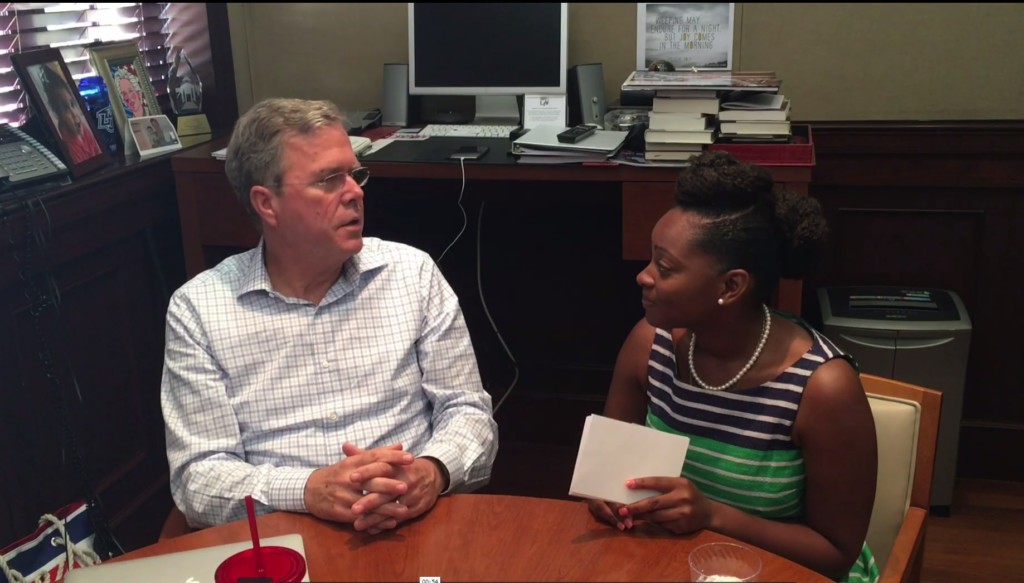
Denisha Merriweather interviews former Florida Gov. Jeb Bush on school choice, education politics and more.
All parents should have access to "consumer reports" on schools in their area — public or private, magnet or charter — and be able to choose among them. Once their children are enrolled in a school, they should get meaningful updates on how well they're doing.
It might seem simple, but for too many parents, that's not how the school system works, former Florida Gov. Jeb Bush says in a new interview.
The former Florida governor has returned to his role as chairman of the Foundation for Excellence in Education, and has recently begun outlining a national education agenda.
He sat down recently in his Miami office with Denisha Merriweather, a former tax credit scholarship student, who is now seeking a master's degree in social work at the University of South Florida. (Step Up For Students, which publishes this blog, helps administer the scholarship program.)
Merriweather asked how schools could help low-income parents make better decisions about where to send their children.
"There ought to be a report card for any school that has any government money, directly or indirectly, going to it, and the report card ought to be easy to understand," Bush said.
Parents, he said, should also receive detailed information on how well their children are doing, not just in subjects like reading and math, but on other skills like staying on task.
This might seem like an obvious prescription. But only a few school systems in the country have created the kind of system that really allows parents to make informed choices from the full range of potential options. In communities like New Orleans, which have created such systems, parents often take the opportunity to shop around, and many choose move their children to different schools.
"That information is not available for most parents, particularly for low-income parents. But if they had it, they'd make the right choice for their kids, all the time," Bush said. "I trust a parent, irrespective of their level of income, over a massive school district. It's not that the people inside the school systems are bad, but they're not the parent. They're not the mom."
"We should already be doing this," he added. "This is 2016, for crying out loud ... We have the tools to do this. The system resists it, because there's a lot of economic interests at stake."
See Bush's full answer in the clip below.
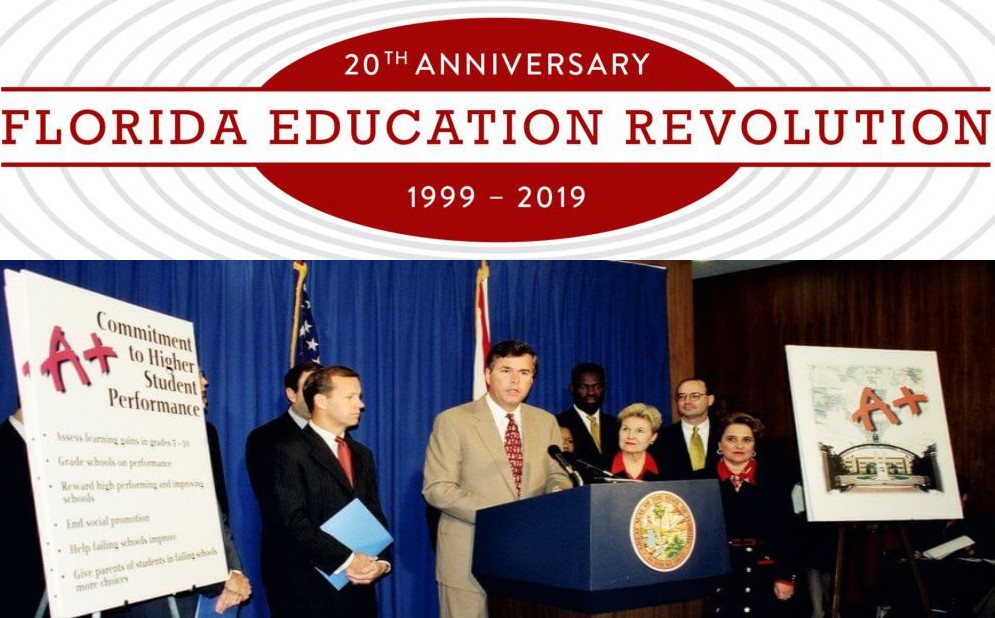
Gov. Bush's "A+ Plan" for accountability faced a long road of legal battles as soon as it began 20 years ago
Editor’s note: March 2 marked the 20th anniversary of the legislative session in which Florida Gov. Jeb Bush launched a number of K-12 reforms that transformed education throughout the state. With the start of the 2019 legislative session earlier this month, redefinED embarked upon a series of articles that examine aspects of Bush’s K-12 education revolution and how it continues to reverberate. Today’s piece is the first of two retrospectives that chronicle the plan’s legislative roller coaster ride. Part II is available here.
OPPORTUNITY AWAITS
In January 1999, Gov. Jeb Bush’s recently announced “A+ Plan” was generating bipartisan praise. Democrats, school district leaders, and even the teachers union said positive things about letter grades for schools, annual testing, and increased accountability.
“The only negative is the voucher piece,” said Florida Education Association spokesman David Clark.[1]
That “voucher piece,” the Opportunity Scholarship Program (OSP), never served more than 57 students during its first three years, and never more than 788 students in any year. But as the first statewide voucher program in nearly a half-century, it also became the most controversial educational program in Florida’s history. Despite the tiny size, the stakes were huge. Supporters and opponents alike spent millions to sway public opinion while the nation watched a titanic legal battle rage for nearly seven years to decide the fate of the little scholarship program.
The program as initially envisioned had critics and opponents at every level.
“It’s a great plan – except for the opportunity scholarship,” said Connie Milito, a lobbyist for Hillsborough County.[2]
“I can’t complain if Bush is supporting Democrat proposals,” said Senate Minority Leader Buddy Dyer from Orlando, who supported everything in the A+ Plan except the opportunity scholarship.[3]
Private schools remained skeptical, too. The Miami Herald surveyed 300 schools in South Florida in 1999 and found only three willing to participate. A follow-up survey would find only 50 the next year. Private schools seemed to think the law came with too many strings attached.
Eligible students would come from public schools receiving two “F” grades within a four-year window. Private schools would get between $3,400 and $3,800 and couldn’t charge more to cover tuition. Schools could not use academic or religious admission requirements, and oversubscribed schools required a lottery to admit scholarship students. Students also could not be compelled to attend religious classes or prayer.
“I think the only schools that are going to take these students are schools that are badly under-enrolled or schools that are already low-performing,” Sherry Ryan, the owner of Vista School in Coral Springs, told the Herald.[4]
Sister Mary Caplice, the superintendent for the Diocese of Pensacola-Tallahassee, was a little more optimistic. “There continue to be things that we have to work out, but there’s room for negotiation in the law,” she told the Herald.[5]
Newspapers were split, too.
The Orlando Sentinel complained the voucher program would “ultimately steal money from public schools and punish public schools for conditions over which they have no control.”[6]
But the Florida Times-Union in Jacksonville editorialized in favor of the voucher program, though it called the concept “embarrassingly modest” when compared to Ted Forstmann’s and John Walton’s $100 million Children’s Scholarship Fund.[7]
By mid-March 1999 supporters had raised $1.3 million to help push for vouchers, while the Florida Education Association, the state's teacher union, had already spent more than $1 million on an advertisement campaign to derail vouchers in the Legislature.[8]
GETTING STARTED
On March 26, 1999, the House passed the “A + Plan” 71-49, with seven Republicans breaking ranks to vote “no” while seven Democrats voted in favor
“This is the day that will go down in the annals of Florida history as the day we abandoned the public schools and the day that we abandoned, more importantly, our children,” complained then-Rep. Debbie Wasserman Schultz.[9]
Rep. John Cosgrove of Miami called the program “a grand theft of public education dollars,” while House Democratic Leader Lesley Miller of Tampa worried the voucher would become “a fast track toward resegregation.”[10]
Passage in the Senate would take a bit longer, passing 25-15 on April 30, 1999. Critics fumed again.
“Vouchers are the 20th-century equivalent of ‘Let them eat cake’,” said Latha Krishnaiyer, president of the Florida PTA.[11]
“Vouchers in this bill are the lynchings of the civil-rights movement,” claimed Sen. Betty Hozendorf of Jacksonville.[12]
Jeb Bush would sign the A + plan into law on June 21.
Students at two elementary schools, Spencer Bibbs and A.A. Dixon Elementary, in Escambia County were the first to be eligible for the Opportunity Scholarship. That first year just 57 students attended one of four Catholic Schools and one Montessori school.
THE LAWSUIT
"This will kill public education, and we're not going to let it happen," Leon Russell, chairman of the Florida Chapter of the NAACP, said after the voucher passed the Senate. "We'll go to court. We'll fight on every battlefield there is."[13]
The day after Bush signed the bill, opponents sued as promised. Opponents included school board members, Citizens’ Coalition for Public Schools, the Florida Chapter of the NAACP, a teacher, and parents of three students in Escambia County. Opponents claimed the voucher program violated three sections of the Florida Constitution and the U.S. Constitution.
The lawsuit would last nearly seven years and result in a contentious ruling that was widely criticized by legal scholars at the time.
While the lawsuit continued, opponents ran a public relations campaign under a group calling itself “Citizens Committee for Public Information on School Vouchers.” With backing from mystery donors, the group spent $75,000 on full- and quarter- page ads in several newspapers around the state, ran the website www.stopvouchers.org, and encouraged visitors to call a toll-free number, “1-877-901-OUCH,” to learn more.[14]
Lawyers for both sides met to discuss the case in Leon County Circuit Court under Judge Ralph Smith on Feb. 24, 2000. Smith’s remarks spelled immediate trouble for the voucher program.
“All children aren’t entitled to a private education,” he said. Smith even seemed to blame struggling students for public school failures when he remarked, ”The students who have been at the school and who may be the reason that the school has failed are now going to get a private education.”
In early March, lawyers from the Institute for Justice (IJ) representing scholarship parents moved to have Judge Smith removed from the case, noting his son was engaged to the daughter of Jack Carbone, deputy chief of staff for the Florida Education Association. Carbone and his daughter denied the engagement, and Judge Smith remained on the case. Smith’s son and Carbone’s daughter later wed on Oct. 9, 2000. The First District Court of Appeal later removed Judge Smith from the case on Sept. 4, 2001.
But back on March 14, 2000, without hearing any evidence, Judge Smith ruled the program unconstitutional under Article IX, Section 1 of the Florida Constitution. Smith reasoned that because the constitution mandated that funding free public schools was a “paramount duty,” it was “in effect a prohibition on the Legislature to provide a K-12 public education in any other way.”
“The ruling sent teachers unions and other voucher foes to their fax machines declaring victory,” wrote Miami Herald reporters Lesley Clark and Analsia Nazareno.[15]
But Dermita Merkman, the mother of a 5-year old daughter on the scholarship, took the judge’s remarks personally. “I’m just wondering how this is unconstitutional, us wanting a better education for our kids?” she told the Miami Herald.[16]
Lawyers representing scholarship parents appealed the decision.
Supporters remained hopeful. John Kirtley, now chairman of Step Up For Students, which runs four scholarship programs and hosts this blog, donated $500,000 to the Children’s Scholarship Fund to provide grants to inner-city private schools willing to accept students from the Opportunity Scholarship Fund.[17] Billionaire Ted Forstmann offered to pick up the $185,000 tuition tab for the 52 students remaining on the scholarship program.[18]
Both donations came within a week of Judge Smith’s ruling.
By the end of May, the number of schools willing to participate in the scholarship program jumped nearly fourfold to 101 private schools across the state.[19] However, the number of eligible students did not expand, as many public schools saw sufficient improvement on the writing portion of the state test.
While scholarship opponents breathed a sigh of relief, Gov. Bush touted the results as proof that competition worked. Indeed, multiple studies over the next few years showed that the threat of a voucher alone was enough to modestly improve the lowest performing schools in the state.
However, a research paper in 2013 would later reveal that at least some of the improvement was due to schools gaming the system by reclassifying the lowest-scoring students as “limited-English proficiency,” which exempted the scores from the school’s letter-grade evaluation.
On Oct. 3, 2000, a unanimous decision by the District Court of Appeal reversed Judge Smith.[20] “Article IX does not unalterably hitch the requirement to make adequate provision for education to a single, specified engine, that being the public school system,” wrote the justices.
Opponents appealed to the Florida Supreme Court, but on April 24, 2001, the court declined to hear the case on a 4-1 vote, thereby upholding the Court of Appeal’s decision. The voucher program was constitutional.[21] For now.
SOURCES
[1] Silva, Mark and Daniel de Vise. “Bush Plan For Schools Draws Praise,” Miami Herald, January 26, 1999.
[2] Talev, Margaret and Marilyn Brown. “Bush unvels lesson plan for schools,” Tampa Tribune, January 26, 1999.
[3] Ibid.
[4] De Vise, Daniel. “Voucher Plan Finds Limited Support 24 Private Schools Willing to Commit,” Miami Herald, January 30, 2000.
[5] Ibid.
[6] Editorial. “Opportunity For Whom?, There Are Plenty of Things Wrong With an Education Plan Zipping Through the Florida House of Representatives,” Orlando Sentinel, March 7, 1999.
[7] Editorial. “Education Help for the need,” Florida Times-Union, March 5, 1999.
[8] Pedreira, David. “Pro-voucher group not short on cash,” Tampa Tribune, March 12, 1999.
[9] Saunders, Jim. “House gives Bush big win,” Florida Times-Union, March 26, 1999.
[10] Kaczor, Bill. “House passes school voucher bill in partisan vote,” Associated Press, March 26, 1999.
[11] Kleindienst, Linda. “Florida became the first state to approve vouchers to attend private schools. Critics vow to fight in court,” Orlando Sentinel, May 1, 1999.
[12] Ibid.
[13] Ibid.
[14] Nazareno, Analisa. “Tuition voucher foes launch pricey campaign to sway public opinion,” Miami Herald, February 16, 2000.
[15] Clark, Lesley and Analisa Nazareno. “School voucher program ruled unconstitutional Gov. Bush’s private tuition benefit diverts public money, judge decides,” Miami Herald, March 15, 2000.
[16] Ibid.
[17] Hegarty, Steven. “With money and fight, Kirtley pushes for school choice,” St. Petersburg Times, May 21, 2000.
[18] Clark, Lesley. “Billionaire offers to pay way for voucher students,” Miami Herald, March 18, 2000.
[19] Mark, David. “School Choice Group Raises $2 Million,” Tallahassee Democrat, April 21, 2000.
[20] Hagarty, Steven. “Appeal court finds school voucher law constitutional,” St Petersburg Times, October 4, 2000.
[21] O’Connor, Lona. “All Sides Welcome Voucher Decision,” Sun-Sentinel, April 26, 2001.
COMING UP: The court’s ruling paved the way for scholarship expansion throughout the state, but also saw a doubling down of voucher opponents. A surprise Supreme Court decision ensued. Read Part II here.

Private schools were less likely to participate in a voucher program with more regulations, according to a recently released study.
Editor’s note: redefinED continues its journey through the archives, reviving on Saturdays interesting posts on various topics that deserve a second look. Throughout March, we’re featuring pieces on school accountability. In today’s post, which originally appeared in October 2018, Step Up For Students’ public affairs manager Patrick Gibbons interprets a study that examined the impact of three potential regulations on a hypothetical voucher program.
Ramping up regulations on a hypothetical school choice voucher program results in fewer private schools opting to participate, and lower quality among those that do, according to a new study released this week.
The study is based on responses from private school leaders in Florida.
“The Effects of Regulations on Private School Choice Program Participation: Experimental Evidence from Florida” is spotlighted in the latest edition of Education Next. It examined the impact of three different potential regulations on a hypothetical voucher program: standardized testing, open-enrollment, and the prohibition of charging tuition beyond the voucher amount.
Researchers Corey A. DeAngelis, Lindsey Burke and Patrick J. Wolf emailed 3,080 private schools in Florida and received 327 completed surveys. Of the responding schools, 57 percent were religious, 70 percent accepted the Florida Tax Credit Scholarship for lower-income students, 65 percent accepted the McKay Scholarship for students with disabilities, and 54 percent accepted the Gardiner Scholarship, an education savings account for students with special needs such as autism and Down syndrome. Step Up For Students helps administer the Florida Tax Credit and Gardiner Scholarships, and publishes this blog.
Schools were randomly assigned to one of four groups, including a control group whose leaders were asked if they’d participate in a hypothetical voucher program worth $6,500 and came with no additional regulations. The other groups were assigned one of the three regulations.
Private schools were 17 percentage points less likely to participate with an open-enrollment requirement, and up to 11 percentage points less likely to participate with a state standardized test requirement. (Standardized testing is required for the Florida Tax Credit Scholarship, but participating schools are allowed by law to choose from a range of state-approved tests beyond the Florida Standards Assessment required for public schools.)
For every $1,000 increase in private school tuition, there was a corresponding decrease of 1.4 percentage point participation when a state standardized testing mandate was offered.
Prohibiting private schools from charging tuition beyond the voucher amount also had a negative effect, but the result was not statistically significant.
All three of these regulations are present in Louisiana’s voucher program, which drew a fair amount of unflattering publicity because of negative, short-term impacts on test results. Some researchers have hypothesized that the regulations may have reduced the number and quality of participating private schools.
Florida needs a better system for determining quality and imposing regulatory accountability. School grades are a one-size-fits-all solution. We can do better.
The state of Florida’s latest annual report on the performance of students receiving tax credit scholarships contained these facts: 22.9 percent of scholarship students came from public schools rated “D” or “F” in the prior school year, while 30.3 percent of came from public schools rated “A” or “B.”
School grades are intended to inform parents about the effectiveness of district and charter schools, but tax credit scholarship parents aren’t impressed. Apparently, most of these low-income and working-class parents are using other means to determine which schools will work best for their children.
I was skeptical when Florida first started grading schools.
Schools are not a monolith. As any teacher will attest, there at least five or six distinct mini-schools within a typical district high school. Even smaller elementary schools have several diverse subcultures. Yet schools are assigned a single grade that is supposed to signify a school’s effectiveness for all children.
I was also skeptical because of the strong positive correlation between standardized test scores and family income. Higher-income children, on average, have higher standardized test scores than lower-income students. Since Florida’s school grades are based on standardized test scores, I knew schools serving higher-income students would have the highest test scores and, therefore, the highest grades.
Sure enough, when Florida’s school grades first appeared, schools in affluent communities received As and Bs, while schools in low-income communities received Ds and Fs. To address this issue, the state quickly modified its grading formula to include annual test score gains so schools serving low-income students could increase their grades through gains, even if their absolute scores were still much lower than their peers in the affluent schools.
This modification did help reduce the number of schools receiving Ds and Fs. But it didn’t address the misconception that school grades are an accurate measure of how well a school will meet the needs of every student.
I finally came to appreciate school grades when I realized their true value had nothing to do with helping parents find the best schools for their children. Instead, state government was using these grades to coerce school districts into focusing more attention and resources on under-performing students, most of whom were from low-income families with little political power.
This was a use I could support. School grades have forced school districts to put more resources and effort into helping low-income and minority children, and the results have been impressive. Compared to their peers, low-income and minority students in Florida have made some of the biggest gains in the nation over the past 20 years. The state led the country in reading and math gains on the most recent National Assessment of Educational Progress, and according to an Urban Institute analysis, Florida ranks No. 1, No. 1, No. 3 and No. 8 on the four core NAEP tests, once adjusted for demographics.
Florida’s Advanced Placement test results are also noteworthy. Even though the state has one of the nation’s highest rates of students eligible for free- or reduced-price lunch, it ranks fourth in the percentage of graduating seniors passing AP exams.
Florida – and school grades – deserve credit.
At the same time, we can’t overlook the limitations of a one-size-fits-all regulatory system.
Florida’s low-income fourth graders now rank No. 1 in the nation in reading, after being near the back of the pack 20 years ago. But being No. 1 in reading still means only 30 percent of Florida’s low-income fourth graders are proficient. We can and should celebrate Florida’s pace-setting progress while acknowledging it’s nowhere near enough.
Flaws in school grades have also helped generated ongoing conflict.
I sympathize with teachers who reject evaluation systems that use inadequate and, often, inappropriate data to judge their effectiveness. Holding teachers responsible for student achievement in subjects they aren’t teaching makes no sense. Meanwhile, many middle- and upper-class parents resent the excessive test prep and increased focus on basic skills. It’s not the state’s fault if school districts are not customizing teaching enough to provide remediation for those who need it and enrichment for those who don’t. But a system built on standardization is prone to standardized responses.
Florida needs a better system for determining quality and imposing regulatory accountability. School grades are a one-size-fits-all solution in a pluralistic world. We can do better.
The future of public education is customization. Soon, public education will be able to continuously provide every child with customized learning options. Some of these options will occur in schools; others in venues such as libraries, museums, nature parks, and online. Faced with this plethora of options, parents, students, and teachers will need to access information that will help them choose the best learning options at any given moment. This is the information system that will replace school grades.
Once all parents have the power to choose and pay for their child’s learning options, and once they have the information they need to make good choices, Florida’s state government will no longer need to use school grades to coerce school districts to address the needs of disadvantaged children. Until then, state government should keep using school grades to maintain the political pressure on school districts.
We can and should appreciate the progress school grades have helped spur, particularly for our most disadvantaged students. At the same time, we should acknowledge that better systems are coming – and push to get them here with all deliberate speed.
Editor’s note: redefinED continues its journey through the archives, reviving on Saturdays interesting posts on various topics that deserve a second look. Throughout March, we’re featuring pieces on school accountability. In today’s post, which originally appeared in August 2018, Step Up For Students president Doug Tuthill suggests we can do better than the one-size-fits-all approach of school grades in determining quality.

