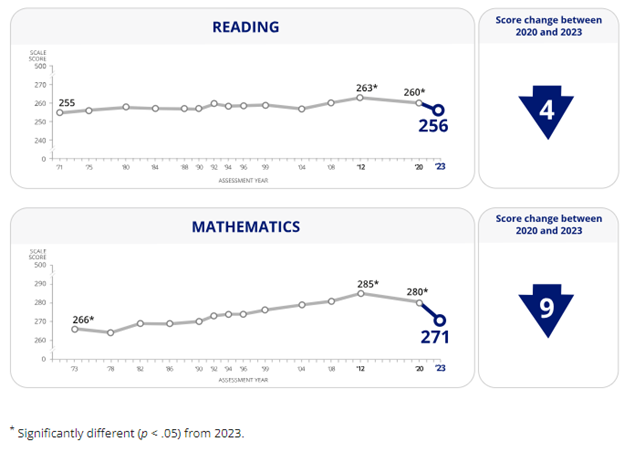
The National Assessment of Educational Progress released Long Term Trend data for 13-year-old students last week. On these exams, 10 points approximately equals a grade level worth of average academic progress. Mathematics achievement has dropped 14 points and reading seven points since 2012. The COVID-19 pandemic accelerated a pre-existing decline. Real spending per student was 160% higher in 2019-20 than in 1969-70, but reading scores are statistically identical (255 in 1970, 256 in 2023). Since 2019, spending has gone to record highs while achievement to near record lows.
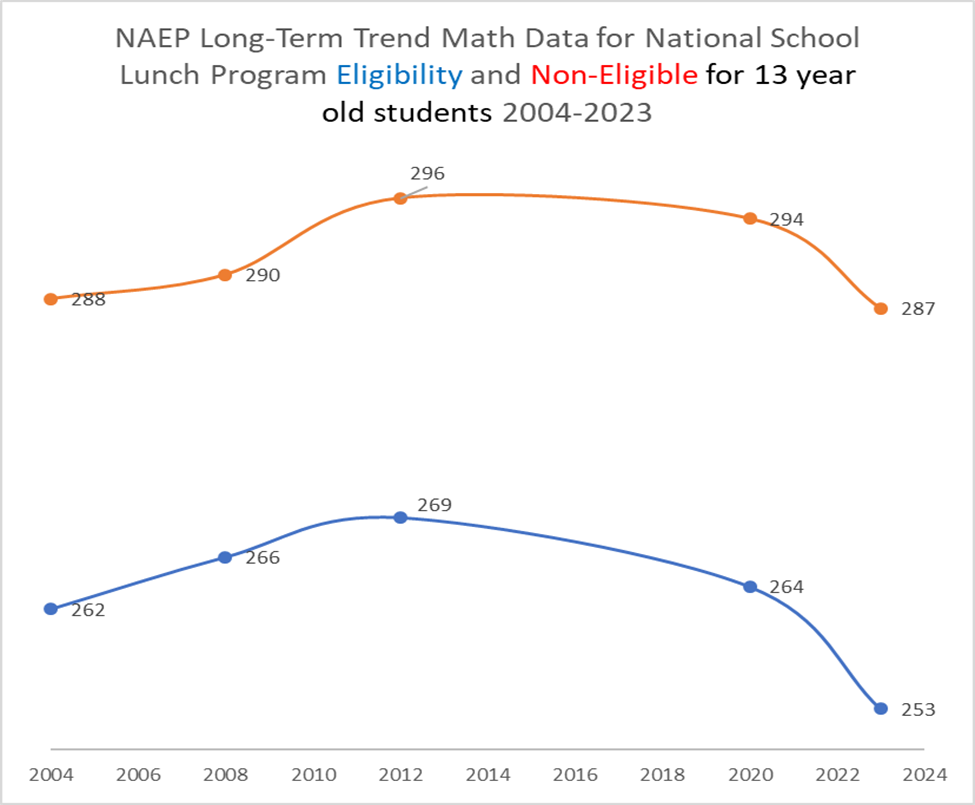
The news gets worse when you examine achievement gaps. The chart below shows the mathematics trend by free or reduced lunch eligibility status. The smallest gap stood at a still appalling 24 points in 2008. In 2023 the gap stood at 34 points, the largest on record.
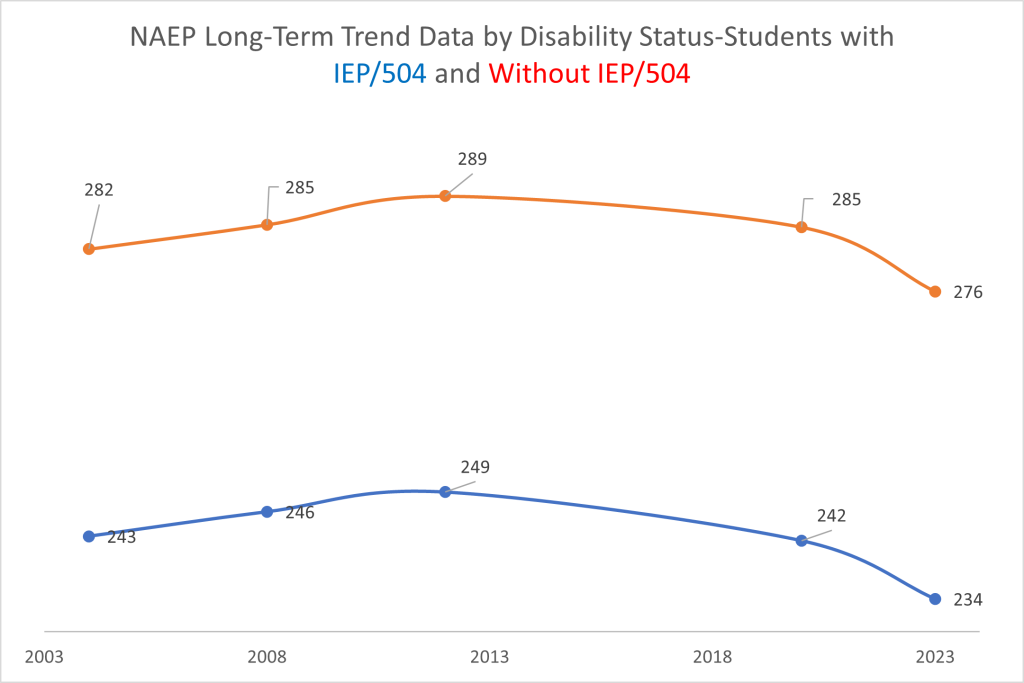
Similar story by disability status- bad for both, worst for IEP/504 plan students.
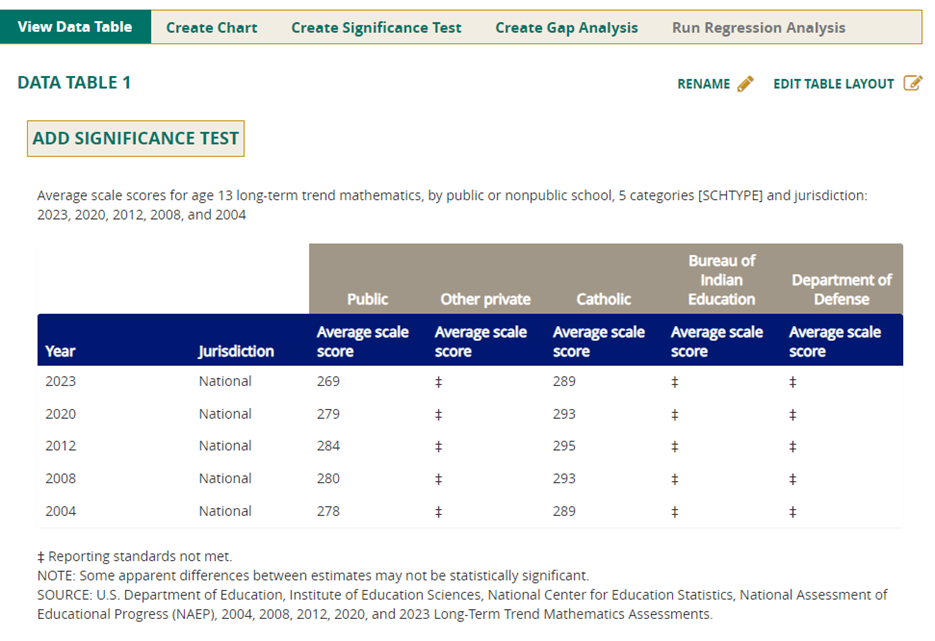
The gap between public school and Catholic school students increased from 11 points in favor of Catholic school students in 2004 to a 20-point advantage in 2023. The advantage for Hispanic students in Catholic schools stood at 23 points higher than their public-school peers.
Now it could be that you are not overly concerned about your child or grandchild learning civics, mathematics or reading. If so the union captured district system has growing numbers of empty seats just for you! As an added bonus, your special little ones can indirectly serve as funding units for some of the most reactionary special interests in American politics today!
Not your particular cup of tea? Well then consider making alternate plans. Millions before you have already done so, and the flight to freedom is just getting warmed up.
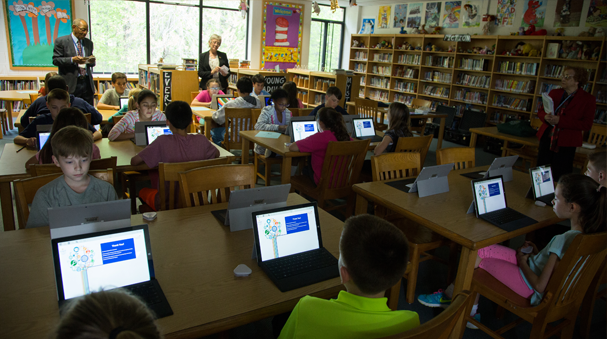
NAEP released 2022 state and large urban district data early this morning. Scores dropped in all four tested subjects (fourth and eighth grade math and reading) almost across the board. Nationally the drops were -3, -3, -5 and -8 points on fourth grade reading, eighth grade reading, fourth grade math and eighth grade math, respectively, from 2019. On these exams 10 points approximately equals a grade level of average progress, and the scores in 2019 were also generally down.
Florida’s scores fell in both math exams, held steady on fourth grade reading and declined modestly on eighth grade reading.
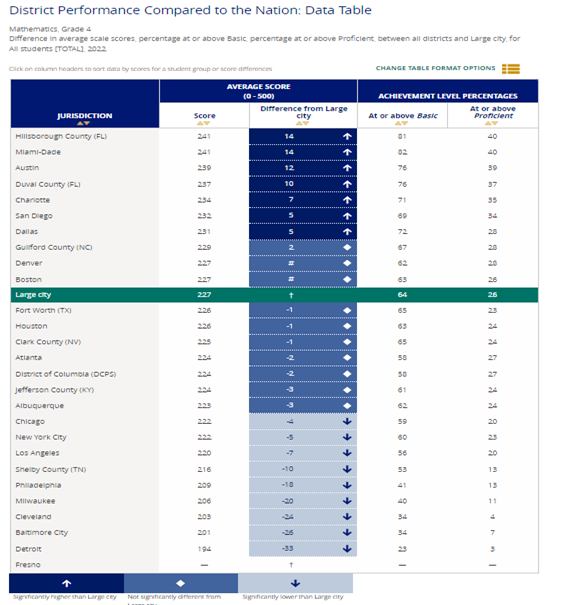
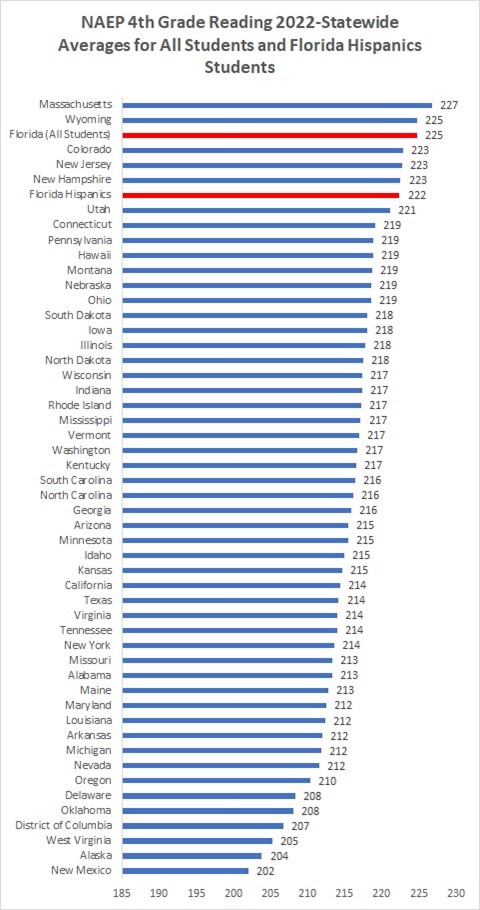
Some bright spots: Florida’s fourth grade reading performance still shines. For example, on the Trial Urban District Assessment (TUDA- the NAEP for select large urban districts) the three Florida districts ranked first, second and third with differences 14, 14 and 10 points above the national average for large cities nationwide. Florida students ranked third on fourth grade reading in 2022, and if Florida’s Hispanic students ranked seventh compared to statewide averages for all students.
Charter school students and students with disabilities also appear to be relative bright spots for Florida, but the overall challenge on the math front is considerable. And nationally the news is nothing short of a catastrophe, as you can see in the chart below by state:
If there is a silver lining here, it is that math is not as difficult to remediate as reading. Given these huge deficits and the even more gigantic amounts of unspent COVID-19 funding, let’s just say that a sense of urgency has been noticeably lacking. If you have children or grandchildren, I would advise you to get them to a math tutoring service ASAP- don’t give the system the chance to let them down again. Florida pioneered a micro-grant for the purposes of reading remediation; lawmakers would do well to do the same for mathematics.
 I read the new American Federation for Children/Step Up for Students study on choice for Black students in Florida, and found a bit of inspiration in the following charts:
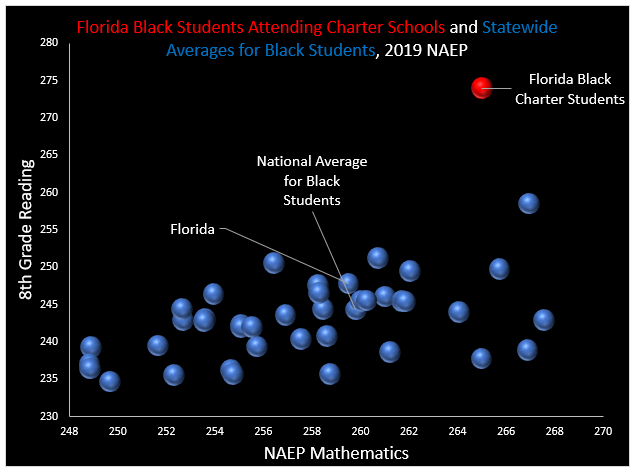
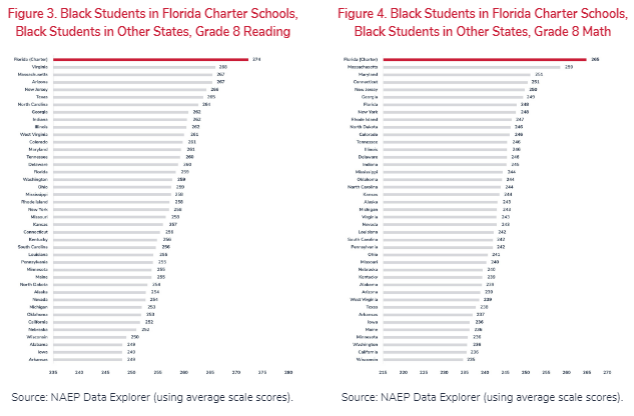 These charts compare the NAEP scores for Black students attending Florida charter schools to those of statewide averages for Black students. I asked myself, “Self, how would this look if we combined these two charts into one chart?”
In the chart below, 10 points approximately equals an average grade level worth of work on these exams, so Florida charter students were looking good in 2019.
 Next, I said to myself, “Self, what if we compared the scores of Florida Black charter school students to statewide averages for white students?”
Here’s what that looks like:
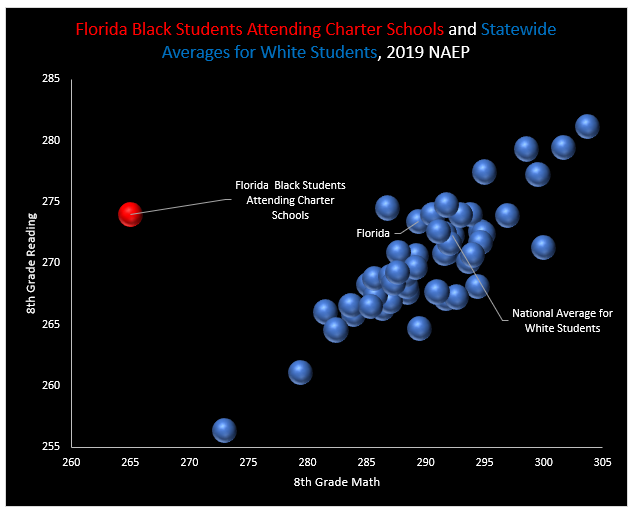 So, a couple of things to note: Florida’s Black charter students had a level of reading achievement similar to white students nationally as well as in Florida. Second, a large achievement gap remains in math.
So, put it all together and it looks like this:
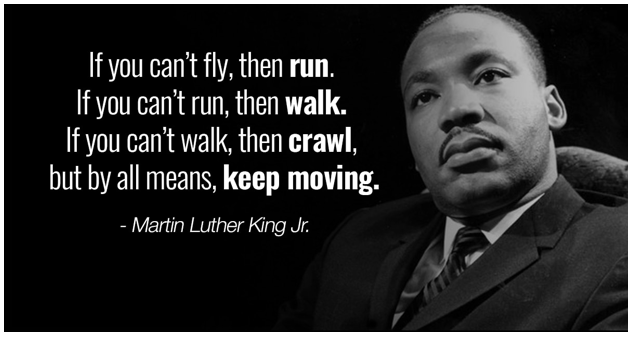
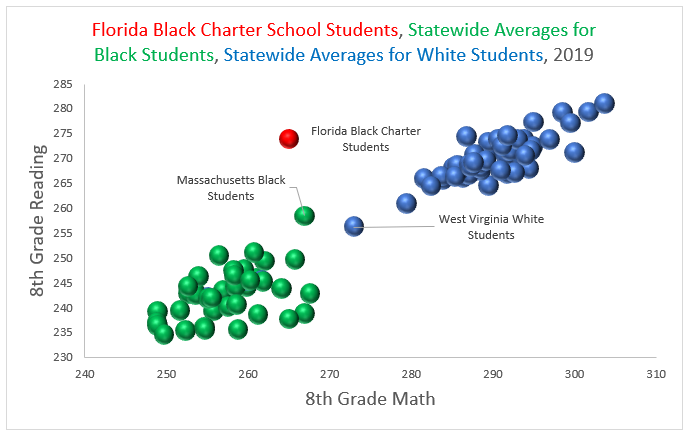 We clearly have a great many miles to go. Some will crawl, others will walk. Some, like Florida, relatively speaking, have been running.
As Dr. King said: Keep moving.
The Economist published an interesting article recently titled, “How Chile combines competition and public funding.” The piece included a graphic demonstrating how Chilean students fared on the Program for International Student Assessment, an international test that every three years measures reading, mathematics and science literacy of 15-year-olds. The assessment also includes measures of general or cross-curricular competencies, such as collaborative problem solving.
The graphic revealed how the PISA scores of Chilean students compared to those of students in nearby countries, provided the Organisation for Economic Cooperation and Development average, and showed the market share for various schooling sectors.
Here is the summary graphic:
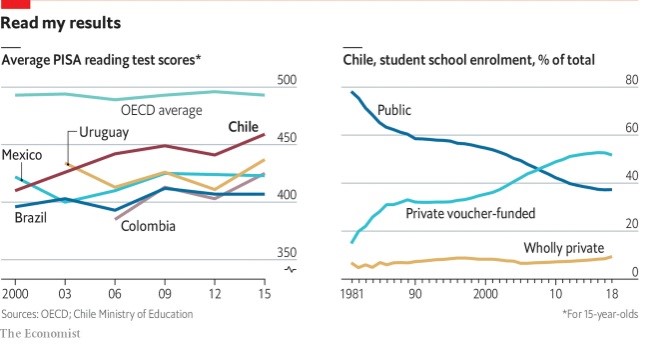
Chile created a national voucher program in 1981, and lawmakers have made significant revisions to improve equity in recent years. Argentine scholar Mariano Narodowski performed a deep dive on the Chilean voucher program in 2018.
So, when you are an edu-nerd like me and you see something like this, it makes you say, “Hmmm … I wonder how Chile compares to student subgroups in the United States?” Well wonder no more!
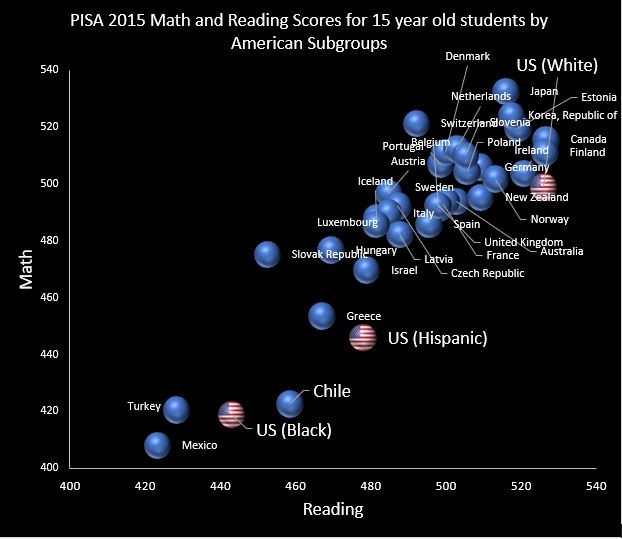
Soak up that achievement gap, America, and note for the record that Chilean students attending school in a developing nation outscored American black students – after at least a decade and a half of Chilean improvement.
Greece represents American Hispanic’s nearest international achievement neighbor. American Anglo students, meanwhile, sit comfortably toward the top among the higher performing European and Asian systems but still get beat by countries like Estonia.
If I were feeling unusually cruel, I would look up the average spending per pupil in Chile, Estonia, Greece and the United States. Well, I can tell I’m not fooling you, dear reader; we all know how cruel I can be, so here goes:
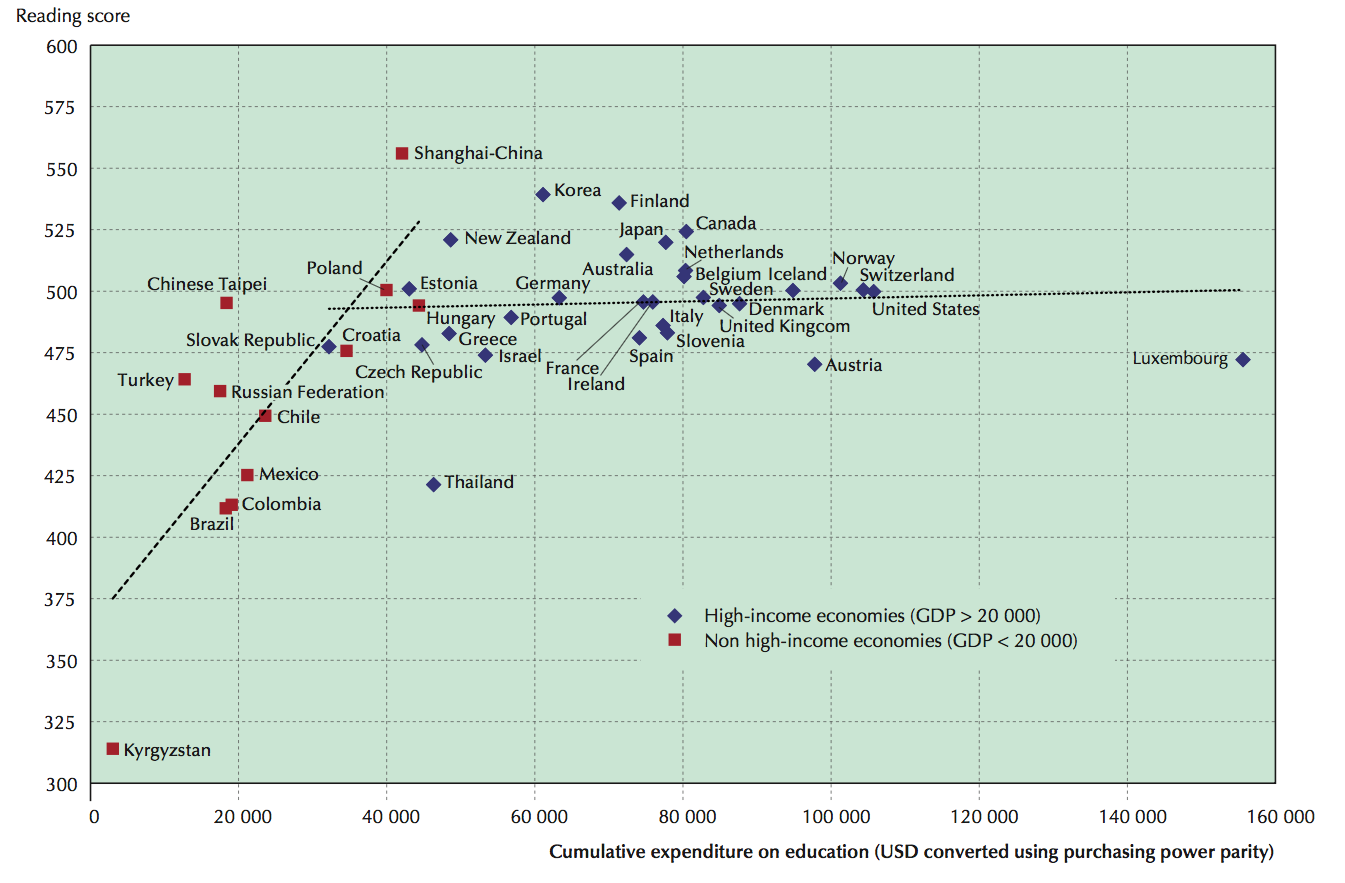 Chileans surpassed the average scores for American black students on PISA despite an average per-pupil spending well below half the American average. American Hispanic students score in the vicinity of Greece, which spends more than Chile, but again a mere fraction of the spending in the United States.
Estonia spends less than Greece, and well below half the level of the United States, but outscores America’s highest scoring racial/ethnic subgroup. Estonia, by the way, also has an extensive system of public and private school choice.
Low-performing students have the most to gain from choice, but even relatively high-performing American subgroups may be underperforming their potential. A universal system of choice with a significant funding advantage for low-income families could help students of all backgrounds flourish.
Charter schools: Three years and a court battle later, Odyssey Space Coast Charter Academy wins approval to open another popular “green-school” in Brevard County. Florida Today. The Lee County School Board votes in favor of suing a closed charter school for $99,793. Fort Myers News-Press.
 Florida Virtual School: Julie led FLVS through the ebbs and flows—and some turbulent waves—of the political cycles in Florida and kept the school growing at each turn, writes Michael Horn for Forbes. FLVS's Global School is expanding STEM options and more, writes Alison Anderson at Getting Smart. When it comes to innovations in learning, keep eye out for Julie Young’s next move, writes Tom Vander Ark for Getting Smart.
Private schools: Jazz musician Bob Dorough performs at the Montessori School of Pensacola. Pensacola News-Journal. Hillsborough's Corpus Christi Catholic School celebrates its 50th anniversary. The Tampa Tribune. As the administrator of Title I funds for all schools in Duval County — public, private and parochial — Duval's schools superintendent has a responsibility to all students who fall under that program, writes Gerald Robichaud for the Florida Times-Union.
District schools: Students at this Brevard County high school learn about forensics with the help of chicken carcasses. Florida Today. Brevard high school students prepare for the National Ocean Science Bowl. Florida Today. Lee County's superintendent lead efforts for the BYOD policy, which will allow teachers to integrate lesson plans with students' mobile devices. Naples Daily News. Pinellas County will expand its summer school program to allow even more students to continue their studies. The Tampa Tribune. The Manatee County School Board plans to expand voluntary pre-kindergarten programs and bring in data teams to analyze student performance at all grade levels, kindergarten through high school. Bradenton Herald.
Achievement: Spending more than $440 million for voluntary pre-kindergarten and stopping the practice of “social promotion” are two ways Florida has been able to move the needle in education achievement, says the chairman of the state Board of Education. Florida Times-Union.
STEM: It’s time for those who lead our K-12 schools to start talking with university professors in math, science and engineering about what needs to be done to give more students access to careers in these fields, writes Paul Cottle for the Tallahassee Democrat.
School grades: Education Commissioner Pam Stewart unveils her plan to revamp school grades. The Buzz.
Teachers: Teachers line up against legislation to overhaul the state's $132 billion pension system. The Buzz. Private donors offer $40 million in incentive pay for teachers at struggling Jacksonville schools. Florida Times-Union. A new Florida Education Association poll finds a supermajority of Floridians rate their children’s teachers positively and an overwhelmingly majority approve of the job their public schools are doing. The Florida Current.
AP: The state ranked fifth in the nation for the percentage of 2013 graduates who had passed at least one AP exam. Sun Sentinel. Florida has the highest rate of low-income students of any state in the Top 10, at 56 percent. redefinED. More from the Tampa Bay Times, and Associated Press.
Catholic schools: Catholic leaders hail small growth in school enrollment as a hopeful sign. Florida Times-Union. Publicly funded, private school choice programs in Florida are a big reason for the increase. redefinED.
Charter schools: A charter school company in Lee County gets a second chance at opening a school this fall after coming close to a district denial. Fort Myers News-Press.
Magnet schools: Pinellas County school leaders need to ensure reopening shuttered schools as magnet-style schools doesn't widen the gap between the lottery winners and the remaining students, writes the Tampa Bay Times. Pinellas school officials hope reopening those schools as technology magnets will reclaim students who left for private schools or are on waiting lists for other choice programs. The Tampa Tribune.
Traditional schools: The Hillsborough County School Board moves forward with a plan to buy new school busses and offers orientation for new principals. Tampa Bay Times.
Education budget: Florida Gov. Rick Scott says his recommendation for lawmakers to increase education spending would be enough to push it to a record high of $18.84 billion. The Buzz. More from the Tallahassee Democrat, News Service of Florida, Fort Myers News-Press, Palm Beach Post and Sun Sentinel.
Common Core: Brevard residents rally against the new education standards during a Republican Liberty Caucus of Eastern Florida forum. Florida Today.
Charter schools: A Florida House subcommittee looks at having the state Department of Education review charter applications before they go to the districts for approval. redefinED. More from The Buzz. Lawmakers also talk about possible legislation looking at allowing charter schools access to underutilized district buildings. Herald/Times. The draft bill may help ease the way for out-of-state charter groups that want to open high-performing schools in Florida. Tampa Bay Times.
Digital learning: Miami-Dade County school district plans to roll out 100,000 laptops and tablets to students by August 2015. Miami Herald. K12 Inc. focuses on expanding and using technology-based learning programs from pre-kindergarten through college on a global basis. Businessweek.
Homeschooling: Palm Beach County homeschoolers participate in National Geographic Bee. Sun Sentinel.
School construction: Agriculture Commissioner Adam Putnam will launch a statewide awareness campaign next week to create a new revenue source for construction and renovations at schools, colleges and universities. The Buzz.
Petition: Civil rights groups target Florida with a petition drive and grassroots movement to overturn the state's race-based educational achievement goals. Reuters.
Common Core: Cursive writing could survive in Florida schools after all, thanks to newly implemented education standards. Sun Sentinel. Students in Hillsborough County schools will field test the multi-state Partnership for Assessment of Readiness for College and Careers test this year, despite state leaders rejecting the exam. StateImpact Florida.
Extended day: A new state report finds that a majority of selected schools that added an extra hour of reading instruction in 2012-13 showed improvement. Tampa Bay Times.
Teachers: The Education Foundation - Champions for Learning names its 25 Teachers of Distinction in Collier County. Naples Daily News. State funding helps Polk public schools and USF put on a two-day training program to entice minority and male college students to become local elementary teachers. The Ledger.
Between 2003 and 2012, the number of low-income graduating seniors passing at least one AP exam climbed from 32,523 to 120,254. That’s an increase of 270 percent. That’s amazing.
Every few months, a major media outlet writes an expose about Advanced Placement classes. The stories (like this one and this one and this one) question the success of large-scale campaigns to expose minority and low-income students to the rigors of AP, using a jumble of numbers to make their case. Unfortunately, they’re often unfairly selective and tend to ignore an undeniably inspiring trend: More poor students are taking and passing AP courses than ever before.
I covered the AP push as a reporter in Florida. There’s plenty that merits scrutiny. I don’t think AP is the end-all, be-all. But on balance, the evidence suggests it has been a good thing - and the kind of good thing public school champions should be the first to highlight.
In the Florida case, public schools showed they can be responsive to low-income kids. For decades, and for no good reason, low-income kids were denied access to college-caliber AP classes, the nearly exclusive domain of white kids in the ‘burbs. So better late than never, schools in the Sunshine State opened the doors, raised expectations and gave students and teachers extra support.
I don’t know off-hand what the AP numbers are like from state to state; I don’t doubt some states have done a better job than others. But the national numbers, like the ones I got to know pretty well in Florida, suggest a lot of positive.
So I’m stumped as to why many stories are so negative – and why they leave out key numbers. The recent Politico story noted that between 2002 and 2012, the pass rate on AP tests fell from 61 percent to 57 percent. That’s true. But the story minimized the fact that because of vastly higher participation rates – and the success of so many of those new participants – hundreds of thousands of additional students are not just taking the tests every year, but passing them.
Forgive me while I highlight my own jumble of numbers: In 2002, 305,098 graduating seniors in the U.S. had passed at least one AP exam. By 2012, the number was 573,472. That’s an 88 percent increase. That’s excellent.
The numbers for low-income students are even more impressive. Between 2003 and 2012 (2002 figures were not available from the College Board), the number of low-income graduating seniors passing at least one exam climbed from 32,523 to 120,254. That’s an increase of 270 percent. That’s amazing.
Passing an AP test is a pretty good indicator those kids are college ready. More important, it shows they belonged in those classes all along. (more…)

Tuthill: The obstacles we face trying to improve public education, especially those related to generational poverty, are daunting. But I’m optimistic about the progress we’re making.
The latest Florida Department of Education report on the tax credit scholarship program, and my summer discussions with scholarship parents, students and teachers, have led me to some conclusions. These thoughts are not new, but sometimes it’s important to remind ourselves of things we know but occasionally forget.

Any fair and objective reading of the actual data in Florida public education has to begin with this acknowledgement: over the past 15 years, the state has made extraordinary progress across numerous key academic indicators.
Between 2011 and 2012, the number of Florida high school graduates passing college-caliber Advanced Placement exams jumped from 36,707 to 39,306 – a robust 7.1 percent. The increase wasn’t an anomaly. Florida ranks No. 4 in the country in the rate of grads passing AP exams. Over the past decade, it ranks No. 2 in gains.
These AP results are but one of the encouraging indicators of academic progress in Florida schools. But you wouldn’t know it from some of the media coverage, which often overlooks them and ignores or distorts the context. The same goes for a good number of critics. Many of them continue to be quoted as credible sources, rarely if ever challenged, despite assertions that are at odds with credible evidence.
In the wake of Education Commissioner Tony Bennett’s departure, some particularly harsh spotlights have been put on Florida’s school grading system and on former Gov. Jeb Bush, who led the effort to install it. I can’t defend some of the recent problems with grading (the errors, the padding) and I do wonder whether there should be more value put on progress than proficiency.
But I have no doubt, from years of reporting on Florida schools, that school grades and other Bush-era policies nudged schools and school districts into putting more time, energy and creativity on the low-income and minority kids who struggle the most. I also have no doubt that those efforts, carried out by hard-working, highly skilled teachers, moved the needle for those students and the system as a whole. To cite but one example: Between 2003 and 2011, Florida comes in at No. 9 among states in closing the achievement gap, in fourth-grade reading, between low-income students and their more affluent peers. In closing the gap in eighth-grade math, it comes in at No. 6. But don’t believe me. Take it from Education Week, where those rankings come from.
To those who approach education improvement with an open mind: Isn’t it troubling that such stats are rarely reported? And isn’t it odd that they’re rarely commended by teachers unions, school boards and superintendents who should be claiming credit? (more…)

