 Education reform, for some of us, is full of tough calls. And for some of us, there can be particular agony in the gray area where race, poverty and both types of accountability – parental choice and regulatory – intersect.
Last week, the school board in Pinellas County, Fla., voted 4-3 against their superintendent’s recommendation to begin the process of closing a charter school in the city of St. Petersburg. The Imagine elementary school, serving predominantly low-income, African-American kids, had just earned its third F grade in four years of operation because of painfully low standardized test scores. Only 29 percent of its students were reading at grade level, according to the state test; only 13 percent were reaching the bar in math. Only one school in the district had performed worse – another charter – and the board had already voted to shutter it.
In the case of Imagine, the board was knotted by a a number of entangling factors, including a vote two months ago – before the release of school grades – to renew the school’s contract. Before the second vote, nearly 20 parents, teachers, administrators and company officials pleaded with the board to keep the school open. They were passionate, thoughtful, respectful – and collectively powerful. We thought their comments were worth sharing, and we excerpted a number of them below. (You can see the speakers on this video here; their presentations begin just before the 41 minute mark. The board debate begins at 3:18:39).
As you weigh the pros and cons, a few points to keep to mind: Black students in Pinellas perform worse than black students in every other urban district in Florida. The number of charter schools has grown rapidly in Pinellas, but not in neighborhoods with large numbers of low-income families of color. The district still isn’t home to a known quantity like KIPP or YES Prep with a record of success with minority kids. And the school board, like many of its counterparts across Florida, recently passed a resolution critical of standardized testing.
Here are the excerpts, edited for length:
Qiana Scott, parent: “You can’t make a decision to close down an institution that is there for the kids based on a standardized test. Because all of our kids are not standard. Kids learn differently. They are taught differently. And at Imagine, that is something that is definitely recognized. So the teachers take that extra time and the extra care to say, “You learn this way, I will teach you the way that you learn best.” So therefore, our kids are learning. It definitely hurts a lot of the parents and a lot of the staff because everybody has worked so hard all year, and to hear that Imagine could possibly be closed down – that’s like splitting up a family. And that’s what we are at Imagine. We are family.“ (more…)
Some charter schools aim to save kids. Some aim to save cultures – and the kids along with it.
A new report from Harvard education researchers highlights three charter schools that offer cultural immersion for Native American students, including a K-8 charter on a Seminole Indian reservation in Glades County, Fla. The school’s name, Pamayetv Emahakv, means “our way,” which sums up the school’s goal: Preparing more than 200 students for the higher education they’ll need to succeed anywhere in the 21st century while at the same time holding on to Seminole culture and values.
“We turned our back on our way to go and learn the other way,” Michele Thomas, a school administrator and parent, told the researchers when they visited earlier this year. “So, now with this school we have to look back this way now. We have the education down, we have lots of college education in this community, but our language has suffered, our young people are not fluent speakers.”
Some education researchers think the approach of the Seminole charter and the two others in the report could help Native American students elsewhere who are not faring well in traditional public schools. According to the report, which was prepared for the National Indian Education Association, American Indian students have the highest absentee rate among minority students and the second-highest suspension and dropout rates.
“These three schools … all share a broader vision of transformative community change,” wrote the Harvard researchers, Eve L. Ewing and Meaghan E. Ferrick. “The establishment of a school serves as a means for mobilizing and empowering the local communities to assess their own needs and determine their own solutions. By doing so, community members not only improve educational outcomes for their children – they are also making a profound expression of self-determination and tribal sovereignty.”
The motto of the Seminole school boldly echoes that: “Successful learners today, unconquered leaders tomorrow.” (The Seminoles call themselves “the unconquered” because even after three wars with the federal government, over half a century, they never surrendered.)
The charters in the Harvard report are part of a national movement by Indian and other native communities to use charter schools to help resurrect and maintain their indigenous cultures. (more…)
If Florida deserves applause for its recent academic progress, the Miami-Dade school district deserves a standing ovation. The five-time finalist for the prestigious Broad Prize is a standout district in a standout state. Between 2000 and 2010, no big district in Florida made more progress in reading and math, even though Miami-Dade has a greater rate of low-income (70 percent) and minority kids (91 percent) than any of them. Over roughly the same period, no big district in Florida made a bigger jump in graduation rates, going from far below the state average to slightly above it.
Against that hopeful backdrop, U.S. Rep. Frederica Wilson, D-Miami, (pictured here) offered some particularly biting assessments of Florida’s education reforms last week. In an op-ed for the Miami Herald, the former principal and state lawmaker said school grades were “madness” and “ridiculous” and “nothing but hoodwinking parents and the community.” Then she added:
“Every time a young black male commits murder in Miami, or even at times a lesser crime, I check their school records to see if they have a diploma. Most of them are casualties of the FCAT. I call them the FCAT kids.”
It’s fair to say Florida’s public education system has far to go, even after 14 years of heady change, even after being a national leader in academic gains for much of that time. There are still far too many kids not being educated to their potential, in an evolving system that is still searching – and sometimes fumbling - for the best ways to maximize its potential.
It’s also reasonable to debate how much the FCAT and school grades have contributed to the progress. Miami-Dade has had two hard-charging, highly acclaimed superintendents in a row. It probably benefitted more from the class-size reduction amendment than many districts in Florida. Compared to the other big districts, it has among the highest percentages of students enrolled in charter schools and in private schools via tax credit scholarships. I think – and these are just the hunches of a layman -- that those factors and many others made a difference.
But I don’t think it can be credibly denied that the FCAT and school grades were essential parts of the mix. (more…)
There is no defense for the latest blemish on Florida’s school accountability system. And it’s incumbent upon those who have built and supported that system to quickly acknowledge oversight and management issues within the state Department of Education and ensure the proper steps are taken for a fix.
After the problems with the state writing test in May, it’s hard to believe what has now been widely reported: The state got more than 200 school grades wrong, evidently because it forgot to calculate one of the new elements in its revised grading formula. With all due respect to the hard-working, well-intentioned people in DOE, that’s a bit maddening. To make matters worse, the state announced the grade changes in a press release, emailed after 10 p.m. Friday, that didn’t own up to errors but instead referred to “preliminary revisions” discovered during a “continuous review process.”
A state that has rightly set a high bar for its schools, its students and its teachers obviously has to set a high bar for its own piece of the education bureaucracy. Florida’s education leaders have given more than lip service to terms like “data driven” and “evidence based” and “no excuses.” But in this case, the data isn’t right. And the evidence suggests that honest mistake is no longer a credible excuse.
Critics are using this mishap to shore up their call for a roll-back of Florida’s ed reforms. What a shame for Florida’s kids if they succeed. Standardized tests and school grades are imperfect tools. But in Florida, they’ve been used effectively to put a bigger spotlight and more focus on student achievement, particularly for low-income and minority kids. For years now, one credible, independent analysis after another has found Florida students in the national vanguard in terms of academic progress. Three positive reports have surfaced in the past six weeks alone (see here, here and here).
It’s not fair that DOE’s successes are overlooked and its mistakes amplified. It’s not fair that its critics are held to a lower standard. But this is the environment that Florida’s ed reformers live in, and it’s not likely to change any time soon. At the end of the day, they should continue to be guided by the evidence, no matter how much it is ignored by critics. Or, in this case, how much it points to their own shortcomings.
Editor’s note: Doug Tuthill responds today to a post I wrote yesterday about the failure of school districts and teachers unions to enact meaningful differential pay plans for teachers – and how that’s indicative of a bigger failure to help low-income students.
Ron, you raised some excellent points in your blog post about the unwillingness of the Pinellas County, Fla. school district to provide each student with equal access to a quality education. For nine years, I received supplemental pay to work in a magnet program that served the district’s academic elite, and for 11 years I was a leader in the local teachers union, which was complicit in the district’s refusal to provide equal opportunity. So your criticisms stung, but they were accurate.
This may be self-serving, but I’m convinced the cause of this leadership failure is not bad people, but an organizational structure and culture that favors the politically strong over the politically weak.
Growing up in Pinellas, I attended segregated public schools. When the federal courts finally forced the school district to desegregate, the focus was on ratios and not learning. The district closed most of the black neighborhood schools and bused those children to schools in the white neighborhoods because busing white students into black neighborhoods was too politically difficult. But white flight meant some forced busing of white students was necessary, so the district created a rotation system that bused low-income/working class white students every two years to schools where the black population approached 30 percent. (The court order said no Pinellas school could be more than 30 percent black.)
While working-class white neighborhoods lacked the political clout to prevent their children from being bused every two years, their protests were loud enough to force the school board to look for alternatives. In the early 1980s, the district started creating magnet programs to entice white families to voluntarily attend schools that were in danger of exceeding the 30 percent threshold.
These magnet programs were designed to provide white students with a superior education. Class sizes were small, textbook and materials budgets seemed unlimited, professional development opportunities were extraordinary and special pay supplements to attract the best teachers were impressive. In my case, when I quit my job as a college professor to teach in the International Baccalaureate (IB) at St. Petersburg High School (SPHS), my annual salary increased 28 percent.
The magnet strategy worked - especially the IB program. Affluent white families began voluntarily busing their children to attend our program, and in many cases students got on buses at 5 a.m. and rode over 50 miles per day to attend.
Unfortunately, desegregation via magnet schools increased the resource inequities that desegregation was suppose to reduce. (more…)
Beyond the boos for his vow to undo President Obama's health care overhaul, Republican president Mitt Romney stressed school choice in his speech to the NAACP today, talking up charter schools and suggesting Obama’s ties to teachers unions hampered his efforts to help disadvantaged kids.
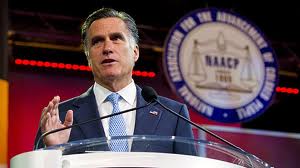 “If equal opportunity in America were an accomplished fact, black families could send their sons and daughters to public schools that truly offer the hope of a better life,” he said, according to his prepared remarks. “Instead, for generations, the African-American community has been waiting and waiting for that promise to be kept. Today, black children are 17 percent of students nationwide – but they are 42 percent of the students in our worst-performing schools.”
“Our society,” he continued, “sends them into mediocre schools and expects them to perform with excellence, and that is not fair. Frederick Douglass observed that, “It is easier to build strong children than to repair broken men.” Yet, instead of preparing these children for life, too many schools set them up for failure. Everyone in this room knows that we owe them better than that.”
Media coverage of today's event in Houston is focusing heavily on the negative reaction Romney received for his plans to scuttle "Obamacare." The Republican candidate got a more polite response to his education positions.
Romney noted his support for charter schools as governor of Massachusetts, despite opposition from teachers unions and Democratic lawmakers.He also pitched his plan to allow federal education funding to follow the student to the school of the parents’ choosing, including private schools “where permitted.”
The dig at Obama's education agenda came without mentioning the president’s name. (more…)
 In Florida, we love the bizarre. We cultivate gator-eating pythons and face-eating zombies and transvestites who inject women’s derrieres with Fix-a-Flat. So maybe it makes complete sense that our education debates are so often detached from reality, too.
It’s strange but true: Some of the same people who say Jeb Bush and like reformers are out to trash public schools are the ones, in fact, who often trash public schools themselves. In their haste to throw stones, they put themselves in the position of dismissing the hard work of teachers and the hard-won gains of low-income students.
I know that sounds harsh. But the past few weeks have yielded some notably brazen examples.
In the wake of the FCAT writing fiasco, Fund Education Now, the Orlando-based parents group that has become a grassroots powerhouse, said the test results were “proof that Tallahassee’s ‘education reforms’ are an unmitigated disaster.” The group’s founders said “Bush’s policies have created the impression that Florida schools are failing,” according to StateImpact Florida, a group affiliated with National Public Radio. In an op-ed, co-founder Kathleen Oropeza argued that “fourteen years of unproven, expensive ‘reforms’ have not produced the rumored ‘Florida Miracle.’ “
Meanwhile, Roy Miller, president and founder of the Tallahassee-based Children’s Campaign, also took aim at ed reform in Florida, saying a new report “casts doubts on claims about the progress being made based on FCAT.” An Orlando Sentinel reporter, also inspired, used the report to sarcastically refer to “Florida’s much ballyhooed progress in student achievement.”
Here’s what all these statements have in common: a complete refusal to acknowledge that Florida students have made some of the most dramatic improvements in the nation in the past 14 years. NAEP results show this. AP results show this. Graduation rates show this. In the 1990s, one academic indicator after another showed Florida kids wearing dunce caps in the nation’s academic cellar. But in the last four years no less a respected arbiter of education quality than Education Week has ranked Florida No. 11, No. 8, No. 5 and No. 11, respectively, among all 50 states. It must be emphasized that the gains have been especially strong for low-income and minority students. Reform supporters have rightly lauded the trend lines, rightly noted there are miles to go, and, again and again, rightly thanked the talented, driven teachers who were essential to making it happen.
Some critics, though, act as if nothing has changed – or that things have gotten worse. The statements from Fund Education Now are richly ironic. This same organization has repeatedly painted a portrait of hobbled and dysfunctional public schools. In fact, Fund Education Now is the lead plaintiff in a pending lawsuit that charges the state with failing to live up to its constitutional duty to provide “high quality” schools. This detail wasn’t mentioned in the StateImpact story. (more…)
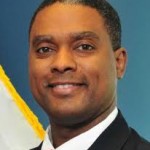 Do critics have a double standard when it comes to scrutinizing school choice options like charter schools and vouchers? Florida Education Commissioner Gerard Robinson suggested as much in an interview published today by the Tampa Bay Times’ Gradebook education blog.
In response to a question from the Times editorial board, Robinson noted that charter schools that struggle academically and/or financially can be shut down (in Florida, that has happened many times) but that same ultimate penalty is rarely leveled at traditional public schools (off hand, we can’t think of any examples in Florida). “For the bad charter schools that aren’t working, they should close,” Robinson said. “But for the traditional schools that have also failed a number of our kids, we don’t see the same level of righteous indignation.”
Robinson has deep roots in the school choice movement, having once served as president of the Black Alliance for Educational Options. And interestingly enough, the editorial board's questions focused mostly on choice options. Here are some other excerpts:
On testing accountability in voucher schools: “The private school curriculum isn't aligned to what we test on the FCAT (the Florida Comprehensive Assessment Test). So you're comparing apples to oranges. At the same time, there are the Stanford tests, there are Iowas, there are other tests you can take. So I'm not against assessment. What I am saying is, simply saying because they don't take the FCAT therefore they're not accountable is not correct.... “
On charter schools vs. magnet schools: “Charters and magnets both are theme schools. Charters and magnets both are public. And charters and magnets both take money. You often find magnets cost more than charters. But yet people say charters take money from public schools. People say charters are creaming the best and brightest kids. I can tell you from looking at the scores, that's not the case. And yet the magnet schools … are taking the best and brightest students … Magnet schools historically have been the largest public school choice program in the country, but also been more exclusive than other programs. And yet, all the angst we put on charters.”
On closing the achievement gap: “I've often said what you don't have is a political gap problem as much as you have a political crap problem. … If white kids are reading better than black, Latino, Hispanic or Native American kids, that's not a reading problem. We know what it takes to get kids proficient in reading. The question is, are we willing to make the tough decisions, political decisions, to get the right resources - human and financial - into the schools or after-school programs … to make it happen?”
 If you read the papers, you know the story. People who like vouchers and tax credit scholarships are right-wingers. They don’t like public schools. They’re corporate pawns.
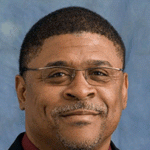
Now meet the Rev. Manuel L. Sykes.
He’s a Democrat. He’s president of the NAACP in St. Petersburg, Fla. He thinks public schools did a fine job with his kids.
Privatizing schools? Mention the idea to Sykes, who is pastor of Bethel Community Baptist Church, and you’ll get a slow burn about elitism, resegregation and crony capitalism.
But Sykes, 55, also supports vouchers and tax credit scholarships. And for folks who think they see a contradiction, he offers a quip and a laugh: “Stereotyping is a function of a lazy mind.”
Sykes isn't a leader in the school choice movement, but like thousands of others he quietly defies the story line. In that respect, he is symbolic of the new face of public education. It’s not public or private. It’s not liberal or conservative. It’s pragmatic.
“You can’t plant roses in every environment,” Sykes told redefinED. “You have to find the right environment for that flower. Or that orange tree. Or that apple tree. If we’re wise enough to know that with trees, why don’t we have the same common sense with children?” (more…)
It’s a common refrain in ed reform debates: If only more parents would do the right thing, schools would be a lot easier to fix. Especially, it seems, black parents.
Whenever I wrote a newspaper story about struggling black students, it was guaranteed to make the web site’s “most commented” list. Scores of angry people would write in to berate and belittle black parents, often in blatantly racist terms. Bill Cosby makes similarly hard-line arguments in a tough-love kind of way. So do some media personalities, like nationally syndicated columnist Bill Maxwell.
In his column last Sunday, Maxwell takes on a faith-based group in Pinellas County, Florida called FAST, which stands for Faith and Action for Strength Together. FAST recently made headlines for urging the Pinellas County School Board to do something about abysmal reading scores in 20 high-poverty schools, many of them with predominantly black student populations. In a public meeting, 3,000 members of the group called on the board to adopt a “direct instruction” approach.
As he has done before, Maxwell called for more accountability from black parents. He suggested it was a waste of time to focus on what schools may or may not be doing. He said the district’s web site had plenty of good tips.
Maxwell is right to stress how much parents matter. Nobody in their right mind disagrees. But like many things in education, this isn’t a case of either-or. (more…)

