Teaching to the test. The FEA is rallying members to a petition started by UFS Professor/blogger Sherman Dorn. Gradebook.
Charter schools. In a vote along party lines, the House Choice and Innovation Subcommittee approves a bill that would allow charter schools to move into unused district buildings. redefinED. Coverage also from the Palm Beach Post, Tallahassee Democrat, Gradebook, StateImpact Florida.
Poverty. South Florida Sun Sentinel: "More than half a million kids under 18 in Broward, Palm Beach and Miami-Dade counties live in low-income households that earn up to 200 percent of the Federal Poverty Guidelines, the National Center for Children in Poverty at Columbia University reports. For a single mom and child, that translates into an income of $30,260 a year or less."
School security. A jury orders the Palm Beach County School Board to pay $1.7 million in a case involving a mentally challenged, 3-year-old girl who was sexually attacked by a 15-year-old ninth grader on a school bus in 2007, reports the South Florida Sun Sentinel. More from the Palm Beach Post. A Hernando County middle school teacher on paid administrative leave since last April is on a keep-off-campus list generated by district officials after the Newtown tragedy, reports Hernando Today. Osceola will beef up police presence at elementary schools, reports SchoolZone. The video of a girl beating another girl on a Pasco school bus gets posted on Facebook; arrests ensue, reports the Tampa Bay Times. An 11-year-old, special needs student in Duval either falls or jumps out of a school bus and sustains life threatening injuries, reports the Florida Times Union.
Teacher evaluations. The Florida Times-Union files suit against the Department of Education to force the release of teacher evaluation data. (more…)
For the fifth year in a row, Florida’s public school system ranks among the best in the country, according to the latest annual analysis by Education Week.
Released this morning, the highly anticipated “Quality Counts” report puts Florida at No. 6 among states this year, trailing only Maryland, Massachusetts, New York, Virginia and Arkansas. In the previous four years, Florida came in at No. 11, No. 8, No. 5 and No. 11, respectively.
"For Florida to be a global leader in job creation and economic growth, we have to provide our students with a quality education," Gov. Rick Scott said in a written statement. "Today's news that Florida has moved into the top ten in the nation for overall quality of education reinforces that we're taking the steps needed to ensure our students succeed."
The consistently strong showing is at odds with public perception and with steady criticism from those opposed to a series of far-reaching education changes spurred by former Gov. Jeb Bush. To be sure, it’s tough to determine which factors – including a heady expansion of parental school choice - have had the most impact. But the EdWeek reports are another credible sign that Florida students and teachers are no longer cramping at the back of the pack.
They’re also another sign that nobody should be satisfied. Florida earned a B- overall in the latest report. And in the category that matters the most – student achievement – it managed a C-.
Quality Counts looks at policy and performance in six broad categories with multiple indicators. Each year, the researchers behind the report update three of them. This year, they updated the school finance and “transitions and alignment” categories, and something called the Chance-for-Success Index.
Florida’s rank on the index is unchanged from 2011, coming in at No. 34. On transitions, it climbed from No. 14 to No. 4. On finance, it fell from No. 31 to 39 (and from C- to a D+). The reason for the latter: historic cuts in education spending that had yet to be tempered by 2010, which is the data year EdWeek uses for the new report. (more…)
 Florida: Tony Bennett is selected the state's new education commissioner (redefinED). He tells reporters afterwards that he champions school choice first and foremost because of the social justice component (redefinED). A new group headed by T. Willard Fair, co-founder of the state's first charter school, aims to create a pipeline of black executives and entrepreneurs to help lead private and charter schools (redefinED). The Miami-Dade school district ranks No. 10 in the country for school choice, according to a new report from Brookings (redefinED). A Catholic school in Tampa is at the heart of a University of Notre Dame project to revitalize Catholic schools, particularly for Hispanic students. (redefinED).
Louisiana: Voucher parents are worried in the wake of the legal ruling that puts the program in limbo (advertiser.com). Gov. Bobby Jindal makes a pitch for vouchers at a Brookings Institution event in Washington D.C. (Huffington Post).
Washington: More than 150 teachers, parents and administrators attend a charter school conference in the wake of the successful passage of a charter school ballot initiative (Tacoma News Tribune). (Full disclosure: The conference was sponsored by the Washington Charter School Research Center, which was founded by Jim and Fawn Spady. Fawn Spady chairs the board of directors at the American Center for School Choice, which co-hosts this blog.)
Michigan: The education adviser to Gov. Rick Snyder presents the governor's sweeping public school choice proposal to business and education leaders (Grand Rapids Business Journal). (more…)
More on teacher evaluations. Problems with teacher evaluation data this week are the latest in a string of mistakes involving the DOE, writes Gradebook. Lower-profile reports are dogged with inconsistencies, too, though it’s not always the state’s fault, notes StateImpact Florida. Ultimately, the revised numbers released Thursday aren’t much different from the numbers originally released Wednesday morning – or from the out-of-whack numbers under the old system. If nearly 97 percent of teachers are rated effective or highly effective, has Florida made accountability too easy? asks EdFly Blog. More from Tampa Bay Times, Lakeland Ledger, Florida Times Union, Fort Myers News Press, Naples Daily News, Hechinger Report.
 Too much reform on the runway? School Zone. (Image from pictureboston.com)
Achievement gaps in vocabulary. Gradebook. School Zone.
Tony Bennett’s views on Florida’s reforms. StateImpact Florida. Testing Is Not Teaching isn’t a fan of the former Indiana state superintendent, reports the South Florida Sun Sentinel.
Charter conversion. Parents of an A-rated school in Miami-Dade are pressing to convert it into a charter so they can more quickly remedy a problem with aging buildings, reports the Miami Herald.
Teacher evaluations. Errors mar the release of new teacher evaluation data. Coverage from Tampa Bay Times, Miami Herald, Orlando Sentinel, South Florida Sun Sentinel, Florida Times Union, Lakeland Ledger.
More on race-based achievement goals. NPR interviews Emily Richmond from the Education Writers Association about these goals in Florida and elsewhere. She offers context and nuance. Here’s her recent piece in The Atlantic that also mentions Florida.
Marco Rubio talks school choice. At the Jack Kemp Foundation dinner Tuesday night, he touts charter schools and tax credit scholarships. Full remarks here.Why did Florida settle? That’s the question Americans United for Separation of Church and State is asking after the Department of Education settled with Florida Christian College over whether its students can receive Florida Resident Access Grants.
Charters, competition and empty school buildings. EdFly Blog.
Charter school growth in southwest Florida. Florida Weekly.
Boundary jumpers. The Palm Beach school board delays a rezoning decision amidst parental angst and accusations of boundary jumpers, reports the Palm Beach Post.
 The decade-old No Child Left Behind Act is the epitome of top-down ed reform, and in some ways it parallels Florida’s test-heavy accountability system for public schools. So it was noteworthy today when one of Florida’s top education leaders referred to it in less than glowing terms.
Florida Board of Education Chairman Gary Chartrand said when it comes to closing achievement gaps between white and minority students, No Child Left Behind has been a “colossal failure.”
Chartrand shared the sentiment during a workshop in Boca Raton where Gov. Rick Scott made a rare appearance. Chartrand did not go into detail, and we could not reach him for comment later. But he made the point during a brief discussion about the state’s race-based achievement goals.
Last month, the board unveiled a strategic plan that sets different achievement goals for students based, in part, on race and ethnicity. The plan sparked accusations of racism in Florida and beyond even though the goals included steeper rates of improvement for minority students.
Scott called for the board to revise the plan, saying it “must clearly and sincerely acknowledge that all students are capable of performing at grade level regardless of their race or background.”
“How are we going to close the achievement gap?’’ Chartrand asked the governor Monday. “We need to do things differently.’’ Maybe Florida students need longer school days, or maybe districts need to assign the best principals and the best teachers to the worst schools, he continued. Perhaps a change in culture, with more discipline and parental involvement would make a difference.
Scott, who attended the workshop to explain his education agenda, didn’t offer any specific suggestions. “We should have the same expectations for every child,’’ he said.
Scott also offered little detail about his new plans, which include the possibility of district-run charter schools.
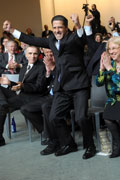
Miami-Dade Superintendent Alberto Carvalho reacts to the award announcement.
More Broad Prize coverage. As we noted yesterday, the Miami-Dade school district won this year’s Broad Prize, which goes to the urban district with the most academic progress. More from the Orlando Sentinel, Christian Science Monitor, Associated Press, Education Week. The Palm Beach school district was a finalist, which is also impressive. All this is more reason to routinely compare achievement data district by district in Florida. Also worth noting: Miami-Dade is a poster child for the new definition of public education, with a broad menu of learning options and huge numbers of parents embracing them.
Charter school issues in Volusia. The Volusia school board approves improvement plans for two F-rated charter schools, reports the Daytona Beach News Journal.
PTA doesn’t like it. The Florida PTA pans the Board of Education’s decision to set steeper improvement goals for low-income and minority students, reports the Gradebook blog.
More on Amendment 8. The Tampa Bay Times gets credit for going into detail about the legal case that’s at issue here – a case that has nothing to do with vouchers. ICYMI, our take on Amendment 8 here and here.
So the Democrat supports vouchers? In this state senate race in Central Florida, yes, notes the Orlando Sentinel.
Florida’s public schools were handed another solid but overlooked report card this week from another respected, independent source.
The 27-page, data-stuffed, “Decade of Progress” progress report from the Southern Regional Education Board is yet more evidence that Florida’s public schools are making steady progress despite the claims of some critics. The trend lines are often especially strong for low-income and minority students.
For example, between 2003 and 2011, the percentage of low-income eighth-graders scoring at the basic level or above on the reading portion of the National Assessment of Educational Progress rose from 55 to 65 percent in Florida – a 10-point gain. Over the same period, the percentage of more affluent eighth-graders who reached the bar rose 5 percentage points, from 78 to 83 percent.
For each of its 16 member states, the SREB looked at a wide array of academic indicators to see how much the needle moved over the past decade, and how those gains or losses compared nationally and regionally. Besides commonly cited indicators like NAEP scores, graduation rates and AP results, the board looked at less-publicized statistics like college enrollment rates, ninth-grade “enrollment bulges” and grade-level progression in high school.
According to the report, the percentage of recent high school graduates enrolling in college in Florida increased from 57 to 71 percent between 2000 and 2010. Nationally, the numbers rose from 56 to 67 percent. Meanwhile, the percentage of college freshmen in Florida who returned for a second year remained steady at 86 percent.
The SREB report comes as Florida faces mounting criticism for its testing and accountability regimen, which many critics, including local school board members and parent groups, say has been ineffective. Despite that backdrop, the report was all but ignored by Florida media (an exception here), as was this recent report that found Florida’s graduation rates are among the fastest-rising in the nation.

