 Florida continues to be a leader in both performance and progress on college-caliber Advanced Placement exams.
The state ranked No. 5 in the nation last year in the percentage of high school graduates who passed at least one Advanced Placement exam, according to a College Board report released Tuesday.
With a rate of 27.3 percent, the Sunshine State was behind only Maryland (29.6 percent), Connecticut (28.8 percent), Virginia (28.3 percent) and Massachusetts (27.9 percent). The national average was 20.1 percent. Florida ranked No. 4 last year.
Florida has the highest rate of low-income students of any state in the Top 10, at 56 percent. It also has the biggest differential between its AP performance rank and its rank in percentage of students eligible for free- and reduced-price lunch. In FRL rates, Maryland is No. 17; Connecticut, No. 5; Virginia, No. 7; Massachusetts, No. 4; and Florida, No. 43.
In terms of AP progress, Florida again ranked No. 2, with a 12 percentage point increase between 2003 and 2013. Connecticut was No. 1, with Maryland, Virginia and Massachusetts rounding out the Top 5.
The report shows 41,149 Florida graduates passed at least one AP exam in 2013, up from 39,306 in 2012 and 28,667 in 2008.
Among Florida's low-income graduates, 12,774 passed at least one AP exam in 2013, up from 10,897 in 2012, a 17.2 percent increase. (more…)
Move over AP and IB. Another rigorous college prep program is catching on in high schools across Florida and adding to the state’s pace-setting expansion of school choice.
 The nonprofit Cambridge International Exams, now in more than 100 Florida schools, is tied to the prestigious University of Cambridge in England. That makes it attractive to parents and students looking for a competitive edge in college admissions offices. It also sounds good to education leaders wanting to promote their schools in an environment where more than 40 percent of Florida students now attend a school other than their zoned school.
Cambridge students are exposed to an international curriculum and can earn up to 45 college credits with an “AICE diploma,’’ an Advanced International Certificate of Education that is recognized by all Florida public college and universities, and some private schools.
Cambridge is promoted as somewhat less costly and time-intensive for schools to implement than International Baccalaureate, the larger, better-known program with a similar design. With its focus on critical thinking, in-depth problem-solving and strong writing skills, supporters say Cambridge also dovetails nicely with the state’s newly-adopted education standards.
“We are attempting to spread the word,’’ said Sherry Reach, Cambridge’s international manager for the Americas, who is based in Panama City. “The course and assessment program we are offering helps develop skills important in the language arts for Common Core.’’
Bay County was the first Florida district to try Cambridge in 1994. In 2000, after the state Department of Education studied it, the Legislature deemed it effective for use statewide the following year. Since then, more than 100 Florida schools have signed on with Cambridge, which offers programs for students ages 5 and up. Of those, 78 are high schools, said spokeswoman Jamie Mongiovi. Nationally, the program is in 240 elementary and secondary schools in 27 states, up from 80 schools in 2009.
“A lot of that growth has happened the last few years,’’ Reach said. (more…)
As a rising high school sophomore in St. Petersburg, Fla., last summer, Curtis Brown III needed to brush up on the algebra he took more than a year earlier. But instead of hiring a tutor or reviewing textbooks, Curtis signed up for a MOOC – a massive, open, online course offered by a nearby community college.
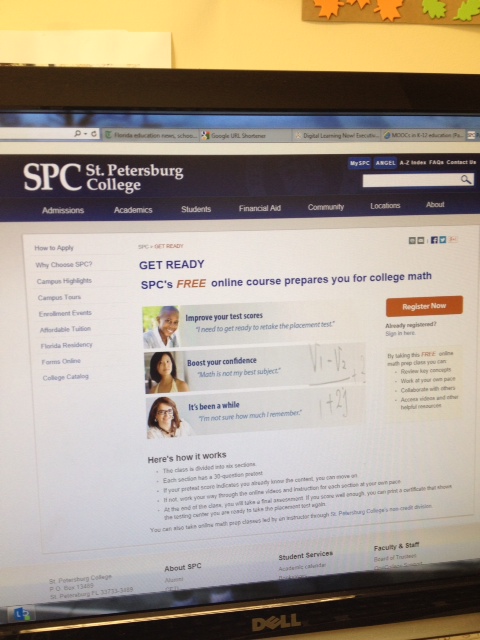
Local high school students can sign up for a MOOC offered by St. Petersburg College.
And even though he only made it half-way through the free, self-paced course, it was more than enough, he said, to prepare him for more complicated math when the school year began. Now he’s ready to tackle pre-calculus.
“It did help,’’ said Curtis, who hopes to graduate high school with a diploma and an associate’s degree. “I used it as a refresher.”
MOOCs have been all the rage in higher education. And despite plenty of debate, they’re finding a place in K-12, too.
Supporters say much like colleges and universities, high schools can use MOOCs to more easily and cost-effectively supplement their curriculum. MOOCs offer classes with unlimited enrollment, potentially help students customize their learning and provide an opportunity to increase digital learning skills. They can also be another tool to help determine if high school students are ready for college-level courses and, if they’re not, to get them help before they spend time and money on remediation in college.

Dr. Jesse Coraggio
“The way we envision it, it’s in our best advantage to have these kinds of support tools,” said Jesse Coraggio, associate vice president of research and grants at St. Petersburg College, which is piloting a math MOOC for high school students and rolling out reading and writing MOOCs later in the school year.
Like other online platforms, such as Florida Virtual School, MOOCs allow students to work independently at their own pace. But while FLVS assigns teachers to students and offers live learning sessions, MOOCs typically feature recorded lectures and provide little or no interaction with instructors. Students usually don’t pay for a MOOC or receive credit for the course, though some colleges and universities are experimenting with the concept.
In Florida this year, lawmakers authorized MOOCs in high school subjects with end-of-course exams like Algebra I and Geometry. Providers must be approved by the state Department of Education and courses must be taught by Florida-certified teachers.
While those MOOCs are being developed, four Florida school districts, including Pinellas County, where St. Petersburg College is located, are testing MOOCs in other areas. (more…)
Between 2003 and 2012, the number of low-income graduating seniors passing at least one AP exam climbed from 32,523 to 120,254. That’s an increase of 270 percent. That’s amazing.
Every few months, a major media outlet writes an expose about Advanced Placement classes. The stories (like this one and this one and this one) question the success of large-scale campaigns to expose minority and low-income students to the rigors of AP, using a jumble of numbers to make their case. Unfortunately, they’re often unfairly selective and tend to ignore an undeniably inspiring trend: More poor students are taking and passing AP courses than ever before.
I covered the AP push as a reporter in Florida. There’s plenty that merits scrutiny. I don’t think AP is the end-all, be-all. But on balance, the evidence suggests it has been a good thing - and the kind of good thing public school champions should be the first to highlight.
In the Florida case, public schools showed they can be responsive to low-income kids. For decades, and for no good reason, low-income kids were denied access to college-caliber AP classes, the nearly exclusive domain of white kids in the ‘burbs. So better late than never, schools in the Sunshine State opened the doors, raised expectations and gave students and teachers extra support.
I don’t know off-hand what the AP numbers are like from state to state; I don’t doubt some states have done a better job than others. But the national numbers, like the ones I got to know pretty well in Florida, suggest a lot of positive.
So I’m stumped as to why many stories are so negative – and why they leave out key numbers. The recent Politico story noted that between 2002 and 2012, the pass rate on AP tests fell from 61 percent to 57 percent. That’s true. But the story minimized the fact that because of vastly higher participation rates – and the success of so many of those new participants – hundreds of thousands of additional students are not just taking the tests every year, but passing them.
Forgive me while I highlight my own jumble of numbers: In 2002, 305,098 graduating seniors in the U.S. had passed at least one AP exam. By 2012, the number was 573,472. That’s an 88 percent increase. That’s excellent.
The numbers for low-income students are even more impressive. Between 2003 and 2012 (2002 figures were not available from the College Board), the number of low-income graduating seniors passing at least one exam climbed from 32,523 to 120,254. That’s an increase of 270 percent. That’s amazing.
Passing an AP test is a pretty good indicator those kids are college ready. More important, it shows they belonged in those classes all along. (more…)

Any fair and objective reading of the actual data in Florida public education has to begin with this acknowledgement: over the past 15 years, the state has made extraordinary progress across numerous key academic indicators.
Between 2011 and 2012, the number of Florida high school graduates passing college-caliber Advanced Placement exams jumped from 36,707 to 39,306 – a robust 7.1 percent. The increase wasn’t an anomaly. Florida ranks No. 4 in the country in the rate of grads passing AP exams. Over the past decade, it ranks No. 2 in gains.
These AP results are but one of the encouraging indicators of academic progress in Florida schools. But you wouldn’t know it from some of the media coverage, which often overlooks them and ignores or distorts the context. The same goes for a good number of critics. Many of them continue to be quoted as credible sources, rarely if ever challenged, despite assertions that are at odds with credible evidence.
In the wake of Education Commissioner Tony Bennett’s departure, some particularly harsh spotlights have been put on Florida’s school grading system and on former Gov. Jeb Bush, who led the effort to install it. I can’t defend some of the recent problems with grading (the errors, the padding) and I do wonder whether there should be more value put on progress than proficiency.
But I have no doubt, from years of reporting on Florida schools, that school grades and other Bush-era policies nudged schools and school districts into putting more time, energy and creativity on the low-income and minority kids who struggle the most. I also have no doubt that those efforts, carried out by hard-working, highly skilled teachers, moved the needle for those students and the system as a whole. To cite but one example: Between 2003 and 2011, Florida comes in at No. 9 among states in closing the achievement gap, in fourth-grade reading, between low-income students and their more affluent peers. In closing the gap in eighth-grade math, it comes in at No. 6. But don’t believe me. Take it from Education Week, where those rankings come from.
To those who approach education improvement with an open mind: Isn’t it troubling that such stats are rarely reported? And isn’t it odd that they’re rarely commended by teachers unions, school boards and superintendents who should be claiming credit? (more…)
Editor’s note: Most discussions of school choice today are focused on newer options – charters, vouchers, tax credit scholarships – that are intended to empower parents without the ability or means to access the right school. But Catherine Robinson, a Tampa mother and assistant director of outreach for the Step Up For Students scholarship program, writes that old-fashioned methods can work as well.

School choice time again with the Robinsons.
I’ve been through this before. Many times.
Searching for the right school for my children has never been easy, but since we all know the importance of education in determining a good future, every few years, I skip some happy hours and dedicate myself to finding the best choice for my twin sons.
Ten years ago, Jacob and Zachary were ready for preschool and over the course of several months, I researched local providers. I consulted trusted friends, official “studies” and interviewed administrators in ways that put Senate confirmation hearings to shame.
I finally decided on a school 45 minutes away from our home. Quite a drive, but my husband deferred to me in this area, as I was a teacher at the time, the way I deferred to him, as the father, when deciding which coaches to ignore at T-ball practice.
Our children did well in preschool and precedent was established.
A few short years later, in preparation for their elementary years, I conducted similar research. I looked at school grades, asked around, and visited facilities at drop off and pick up times before choosing a wonderful public school, this time only a half-hour drive from our home.
The Big Recession threw us some unexpected curve balls and we relocated to Colorado Springs. Where it snows. In May. Within a year, we high-tailed it back to Tampa. This was 2008, the height of the economic crisis, and so we rented a home rather than buy.
I didn’t realize then what a blessing that would be. (more…)
School technology. StateImpact Florida takes a look at the One Laptop Per Child program.
 Accelerated classes. In Pasco, enrollment is climbing fast in AP, IB and dual enrollment. Tampa Bay Times.
FCAT. Gains not as good as they sound, writes Shanker Blog. Three Pinellas elementary schools have among the worst math scores in the state, reports Gradebook.
Parent trigger. A distraction and faddish. Sherman Dorn.
Superintendents. The new Lee super is Naples High Principal Nancy Graham, but it's not clear whether she's temporary, reports the Naples Daily News. Tony Bennett's a fan of Pinellas' Mike Grego, reports Gradebook.
Ed summit. Speaking of Grego, he's among the speakers at the Florida Sterling Council's annual summit. StateImpact Florida.
Gifted students. Pinellas is eliminating programs for gifted students at a few schools in lieu of offering gifted services at all elementary schools. Tampa Bay Times.
School spending. Broward gets no legislative funding help for its technology and building needs, reports the Miami Herald. More from the South Florida Sun Sentinel. Broward wants to charge a developer $3.6 million in impact fees for four students, the Sun Sentinel also reports. (more…)
Charter schools. Brooksville's first charter school, one with a STEM focus, will open this fall, reports the Tampa Bay Times. Competition from charter schools is forcing the Palm Beach County school district to think harder about its needs and priorities, reports the Palm Beach Post. Charters are also sparking debate among Palm Beach school board members about how much help they should give struggling charters, the Post also reports. An op-ed in the Miami Herald raises concerns about charter schools' diversity and financial incentives. The Sarasota Herald-Tribune profiles the principal of the Imagine charter school that is trying to break free from the parent company.
Magnet schools. The Tampa Tribune applauds the Hillsborough school district for creating a magnet tied to the maritime industry.
Alternative schools. Troubled girls get a fresh start at a sheriffs' youth ranch in Polk County. Orlando Sentinel.
 Tax credit scholarships. Great back-and-forth between scholars Kevin Welner at NEPC and Jason Bedrick at Cato, with Florida's program a big part of their debate. Cato at Liberty.
School choice. It's often partisan. Sunshine State News.
Parent trigger. Education Commissioner Tony Bennett raises a constitutional question. The Florida Current. (more…)
State of the State. Gov. Rick Scott gives props to teachers and pushes for a boost in ed funding. Coverage from Gradebook, Tampa Bay Times, Orlando Sentinel, SchoolZone, Palm Beach Post, Gainesville Sun, Tallahassee Democrat, The Florida Current, StateImpact Florida. A special spotlight for a Temple Terrace teacher, reports the Times/Herald Capital Bureau.
 More on the legislative session. An education issue overview from StateImpact Florida. A roundup of school choice bills from redefinED.
Virtual schools. Pasco drops a challenge to a proposed Florida Virtual Academy charter. Tampa Bay Times.
McKay vouchers. Another reason Texas should adopt them. EdFly Blog.
AP tests. Should Florida students get paid for passing them? Gradebook.
School spending. The Brevard school board revises its $30 million list of cuts in response to community input, reports Florida Today. The Flagler school board moves towards putting a tax referendum on the ballot for next spring, reports the Daytona Beach News Journal. An audit committee in Manatee sees progress in how the district is responding to budget errors that led to a $3.4 million deficit, reports the Bradenton Herald. More from the Sarasota Herald Tribune. (more…)
 For the second time this week, a credible, independent analysis shows Florida students leading the pack in progress.
Between 1992 and 2011, Florida students made bigger gains than students in four other “mega states” in fourth- and eighth-grade reading and fourth-grade math, according to a report released Thursday by an arm of the U.S. Department of Education. In each case, they moved from below the national average to meeting or exceeding it. Low-income and minority students in particular showed traction.
“There is something real going on there,” said Jack Buckley, commissioner of the National Center for Education Statistics, according to Education Week.
The center’s comparison followed Wednesday’s College Board report that showed Florida continues to climb the charts on Advanced Placement exams. The Sunshine State now ranks fourth in the percentage of high school graduates passing AP exams. Over the past decade, it ranks second in progress.
Broken-record alert No. 1: Florida’s trend lines shouldn’t be a surprise, given reports like this, this, this, this and this in the past year alone. Yet there remains a lingering perception, cultivated by critics, that Florida’s public schools are sub par and stagnant.
For Thursday’s report, the center for the first time compared scores from Florida, California, Texas, New York and Illinois – the states with the biggest student populations and arguably the biggest challenges. It used results from the National Assessment of Educational Progress, a battery of tests better known as “The Nation’s Report Card” and considered the gold standard among standardized assessments.
In eighth-grade math, Florida students made gains but remain below the national average. Elsewhere in the report, they were singled out often. (more…)

