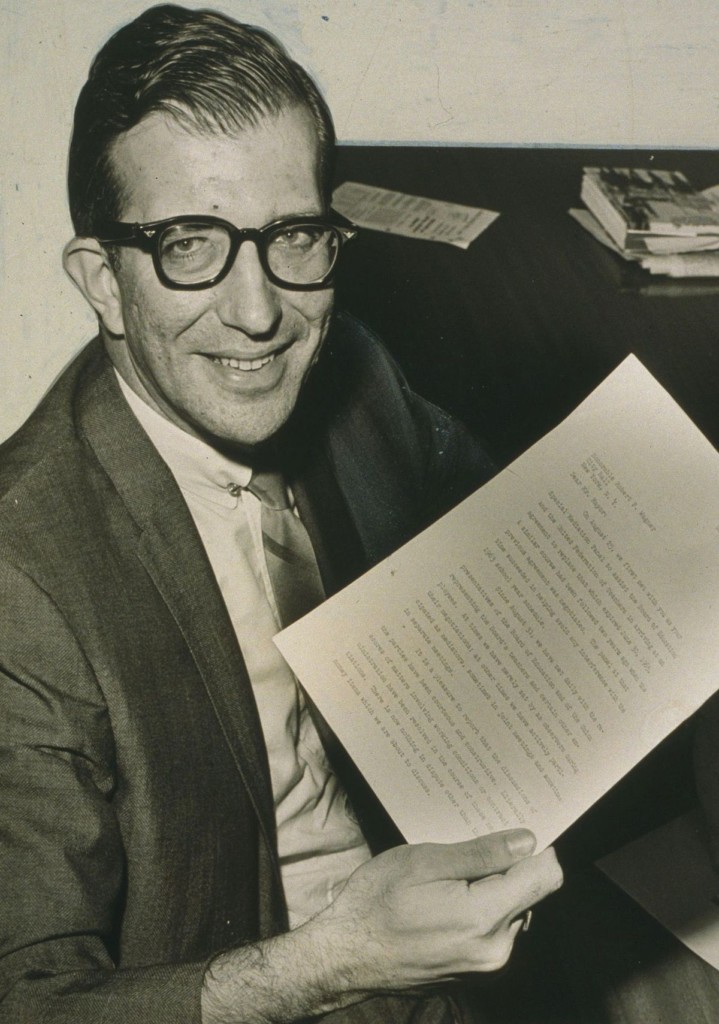
In 1989, Albert Shanker wrote a scathing critique of the public education system in the New York Times. He called for allowing Bush Administration "merit schools" to wave most regulations, and give each school total control over its budget, with no interference from school boards.
Who said the following?
“It’s time to admit that public education operates like a planned economy, a bureaucratic system in which everybody’s role is spelled out in advance and there are few incentives for innovation and productivity. It’s no surprise that our school system doesn’t improve: It more resembles the communist economy than our own market economy.”
“… After decades of failure, even the Soviet bloc seems to have concluded that only markets work, that a system without incentives and rewards drives out the good and favors the mediocre.”
Ronald Reagan? Rush Limbaugh? Milton Friedman?
Today, it’s hard to imagine that those words could be penned not by a right-winger, but by the liberal leader of a national teachers union.
Albert Shanker was president of the American Federation of Teachers when he wrote that scathing critique of the public education system in his weekly advertorial in The New York Times, July 23, 1989 (“Put Merit in Merit Schools”). Although he proceeded to criticize Republican President George H.W. Bush’s proposal to spend $500 million on rewarding “merit schools” that had improved academically in one year, he did so not from a partisan perspective or by dismissing it out of hand for ideological reasons. Rather, he feared the plan didn’t go far enough. (more…)
 Again on Sunday, the pages of the New York Times managed to confuse the nature and history of school reform. The op-ed by Richard Kahlenberg and Halley Potter credits the late Albert Shanker with "The Original Charter School Vision." Now, however one judges the weight of Shanker's nimble ideology, charters were not his baby until late in the game. Nor do the authors appear to grasp even what the idea of charters was - and is. They see this "vision" as "freeing up teachers and integrating students"; an apparition said to have been delivered to Shanker during a 1987 visit to Germany.
Charters, of course, do "free up" teachers, but only insofar as they free up parents to choose them. They are merely an obvious (and much older) suggestion of one legal form that "voucher" schools may take. They are, first and foremost, about lower-income families and the crying need to give back to them the authority and liberty enjoyed by the best of us. Charters are a way to privatize schools that nominally remain in the public sector and - so far - are forbidden to teach religion.
Schools that are privately owned and operated in the "public" sector were part of the discourse of the 1960s. Their specific terms and structure were exemplified in a 1971 volume by Stephen Sugarman and myself, published by the Institute of Government Studies. There ensued a sad story that is worth a brief telling.
Following the passage of California's Proposition 13, in the early summer of 1978, a Democratic congressman who had read our new volume, "Education by Choice," invited Steve and myself to dinner to discuss the political possibilities for school vouchers. That evening we agreed to draft a family choice initiative for the 1978 California ballot; he would do the necessary political stuff and raise the money after the campaign for the November elections. We completed the drafting. Leo Ryan did get re-elected. But then he was murdered in Jonestown.
Already deeply committed, we proceeded on our own, imagining that the libertarians at least would finance the effort. To our dismay, Milton Friedman effectively opposed our effort as being overregulated and our own initiative evaporated as a political possibility.
Who should care about such a scrap of history? (more…)

