A new poll of New York State voters shows Democrats are nearly evenly divided on key school choice issues.
A recent poll of New York state shows the Democratic Party's divide on school choice is for real.
The Quinnipiac University survey (hat tip: Jason Bedrick) shows New York voters largely side with the teachers union in its recent pitched battles with Gov. Andrew Cuomo. They don't support evaluating teachers based on student test scores, or using tenure in evaluation decisions.
On school choice, however, it's a different story:
New York State voters say 51 - 41 percent that there should be more charter schools. Support is 58 - 35 percent in New York City, with upstate voters divided 46 - 44 percent and suburban voters divided 47 - 44 percent.
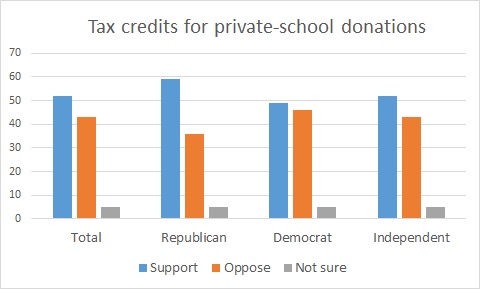
Voters support 52 - 43 percent providing state income tax credits to individuals or companies which donate money to private schools, including religious schools.
By a larger 65 - 32 percent, voters support a $500 state income tax credit for parents with an annual income of $60,000 or less who pay tuition for their children to attend private schools, including religious schools. Support is strong among all groups.
by Darla Romfo
Romfo
For the last several months, the New York legislature has been debating a tax credit scholarship bill that would have increased charitable funding to help more children from low- and moderate-income New York families obtain a quality education in both public and non-public schools. Unfortunately, this week, we learned it did not make it into the final agreement reached by Gov. Andrew Cuomo and our state’s legislative leaders.
This disappointment comes despite forceful advocacy from Cuomo, who barnstormed the state in support of the plan, and the backing of 150 organizations that spanned the political spectrum and included police, firefighter, construction and other trade unions.
This was the first time anywhere in the country that such a diverse group joined a Democratic governor to support a program aimed at helping disadvantaged students attend the same private schools as their better-off peers.
Instead, legislative leaders approved spending $250 million to reimburse non-public schools for government-mandated services, including reporting daily attendance, administering state exams, and buying technology.
While the funds are welcome, they will not help families who are struggling financially to keep their children enrolled in a private or parochial school, or are desperate to make that choice, but can’t afford tuition.
Under pressure from the New York State United Teachers and the New York City United Federation of Teachers, many Democrats in the Assembly abandoned their support for the Education Tax Credit and blocked its passage, even though every one of them represents many families the legislation was designed to help. (more…)
by Kevin P. Chavous

Hillary Clinton
At the :17 second mark of the video, a mother is featured discussing how her family is moving so her daughter, who is starting Kindergarten in the fall, can attend a quality school. While thought to be an uplifting story, this family’s predicament is something that millions of families across the country face. This family is fortunate enough to be able to move to a better school district; however, many families, especially low-income families, are trapped in their current schools that do not work for their children with no alternatives in sight.
The reality is if Hillary supported school choice, this family would not have to pack all of their belongings and uproot their lives to ensure their child receives a great education. They would be able to attend the school of their choice without making a drastic move or placing more strain on their budget. They would be empowered with the ability to make education decisions for their child without being restricted solely by their ZIP code. (more…)
A bipartisan plan to bring tax-credit scholarships to one of the nation’s largest and bluest states has fallen short, at least for now.The provision did not survive the $142 billion annual spending budget that New York lawmakers adopted early this morning, leaving supporters instead to push for its adoption this summer in the regular session.
The “Education Investment Tax Credit” had been tied to the Dream Act, which would provide state college aid to undocumented immigrants, in a political deal that unraveled in the final days of budget deliberations. Neither survived.
Among those expressing regret was Cardinal Timothy Dolan, the Archbishop of New York, and his reaction was pointed: “Our elected officials must cease allowing public school teachers unions intent on creating a government school monopoly to continue dictating education policy in our state. We turn again to our leaders to do the right thing, and pass the education tax credit, not for any interest group, but for the children of our state.”
That the effort came so close, though, speaks to both its future possibilities and the changing politics surrounding private school choice.
In New York, supporters of the scholarship program have assembled a broad coalition led by prominent Democrats, including Gov. Andrew Cuomo, and supported by organized labor. Both Cuomo and the state Senate proposed the Education Investment Tax Credit in their budgets. Though the Assembly did not include the plan in its budget, a majority of its members have signed on as co-sponsors.
 National Coalition for Public Education
The Federal Title I program provides funds to school districts in order to improve the education of economically disadvantaged students in grades K-12. Senator Lamar Alexander (R-TN) wants to amend Title I funding so that the money is “portable,” allowing the funds to follow low-income students to their new public school.
The National Coalition for Public Education strongly opposes this idea and provides three reasons in an open letter to the Senator:
1) Ensuring the Title 1 money goes to the school where the impoverished child enrolls will lead to vouchers.
Put the tinfoil away. Ensuring that schools enrolling poor kids receive extra funding does not lead to vouchers.
2) It hurts the district’s ability to take advantage of “Economies of scale” to combine resources and help students.
 Title I funding was created because there are serious problems in schools with high concentrations of poverty. To take maximize of “economies of scale” (the way the coalition argues) districts would need to keep economically-disadvantaged students concentrated in high-poverty schools, sustaining the problems Title 1 hopes to address.
3) It takes away from district’s ability to direct resources to public schools with high concentrations of poverty.
According to the left-of-center New America Foundation, $6.4 billion (or 45 percent of Title I funding), is distributed through the “Basic Grant Formula.” That formula requires districts to have a mere 2 percent economically disadvantaged student population. That low threshold means that pretty much every district is eligible for Title I funding. If funding high-poverty schools was the coalition’s real priority, why send the money through the districts first? The money should go where the needs are.
It makes one wonder if public-school organizations are less concerned with whether this money helps kids than they are with who (them) decides what to do with it.
Look past New York's political intrigue here, as a popular Democratic governor creates distance between himself and New York City's newly elected Democratic mayor. The more remarkable takeaway are the words of Gov. Andrew Cuomo, one of the nation's leading elected Democrats. Close your eyes and these animated remarks about school choice could just as easily been spoken by, say, Jeb Bush, who according to presidential polls remains one of the nation's leading Republicans.
On charter schools: "We are here today to tell you that we stand with you; you are not alone. We WILL save charter schools."
On teacher unions: "Education is not about the districts and not about the pensions and not about the unions and not about the lobbyists and not about the PR firms. Education is about the student and the students come first."
On change: "We need new ideas. Einstein said insanity is doing the same thing over and over and over again and expecting a different result. The education industry has said the same thing for decades: more money, more money, more money, little change. We spend more money per pupil than any state in the nation. We’re No. 32 in results. It’s not just about putting more money in the public school system. It’s trying something new, and that’s what charter schools are all about."
California: A parents group in Los Angeles is using the state's landmark parent trigger law to force the school district to reform a low-performing school. (Los Angeles Times). More from the Associated Press and Education Week. A national report finds the state continues to lead the nation in charter school growth, despite funding disparities and access to facilities (Huffington Post). Oakland district officials say the American Indian Model Schools, a charter network touted for its academic successes, suffers from "corrupt fiscal practices" and should be shut down (Oakland Tribune).
 Michigan: A new report finds the typical Michigan charter school student school gained more learning in a year than a district school peer, amounting to about an additional two months of reading and math learning (The Detroit News).
Texas: Key state lawmakers are looking at the franchise tax on businesses as a vehicle to fund private-school scholarships for low-income students (Austin Business Journal). Critics of a proposed voucher program say all it will strip the public school system of funding and state leaders should instead restore $5.4 billion cut from education in 2011 (KUT News). Similar arguments in stories from KX11.com and the Associated Press.
Florida: Magnet schools continue to grow on the school choice landscape (redefinED). A new bill would require emergency response agencies to notify private schools just like they do public schools (redefinED). In response to the Newtown tragedy, private schools and charter schools are considering additional security measures too (redefinED).
Georgia: Tax credit scholarships are used at private schools that bar gay students (New York Times). (more…)

