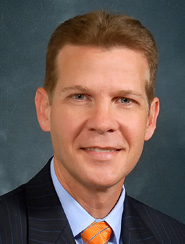
Florida Senate President Andy Gardiner
It was an emotional day in the Florida Senate, as lawmakers approved a suite of bills aimed at creating what Senate President Andy Gardiner described as a "pathway to economic independence" for children with special needs.
Part of the package, approved unanimously today, would expand the state's newest educational choice program.
SB 602 would allow 3- and 4-year-olds, children with muscular dystrophy, and more children with conditions on the autistic spectrum to qualify for Personal Learning Scholarship Accounts (or PLSAs).
The accounts are administered by scholarship funding organizations like Step Up For Students, which co-hosts this blog and employs the author of this post.
As with several other bills in the package, all members of the Senate signed on to the PLSA legislation as co-sponsors.
Other bills passed by the Senate would expand higher education options for special needs children, increase their employment opportunities, and allow families to create tax-free savings accounts to help people with disabilities cover living expenses. (more…)
Florida Senate President Andy Gardiner
More Florida students will be able to access the state's new Personal Learning Scholarship Accounts under legislation now ready for floor votes in both chambers.
The bills, approved unanimously by House and Senate panels this week, would allow more students to qualify for the accounts, which help parents pay for tutoring, therapies, private school tuition and other education-related expenses for special needs children. The House proposes $31.9 million for 2015-16 and the Senate proposes $50 million. For the first year, the state appropriated $18.4 million.
This school year, two scholarship organizations have awarded more than 1,700 student accounts. One of those organizations, Step Up For Students, co-hosts this blog and employs the author of this post.
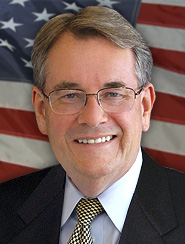
Sen. Don Gaetz
A Florida Senate panel on Wednesday unanimously approved legislation making tweaks to the state's second-in-the-nation program that provides scholarship accounts for students with special needs.
Key changes in SB 602 would make Personal Learning Scholarship Accounts, which were signed into law eight months ago, available to more children with conditions on the autistic spectrum and speed the flow of money into the accounts.
The bill's sponsor, Sen. Don Gaetz, R-Niceville, indicated more changes could be ahead, like requiring more detailed reporting on the program's results.
Several Democrats who supported the legislation sought other changes to the program. Sen. Dwight Bullard, D-Miami, wanted assurances that parents, especially those of children with the most severe conditions, would be informed about the program so that "everyone will have access, especially those with greatest need." He also proposed an amendment requiring annual reports on the program's effectiveness.
"We know it's helping those students who are probably most in need, but it would be amazing if we have (more transparency and) some level of reporting done," Bullard said. (more…)
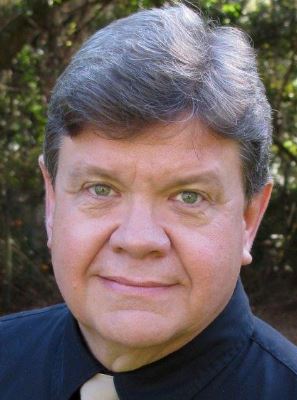
John Kurnik
Wonks and politicos weren’t the only attendees at the Jeb Bush education summit in Tallahassee this week. Parents who support educational choice were also there, including John Kurnik of Tampa, Fla., who has a 12-year-old son with autism.
A college professor, Kurnik introduced Florida Senate President Andy Gardiner, and for good reason. Gardiner led the legislative charge last year for creation of Personal Learning Scholarship Accounts, a new ed choice program for students with significant special needs. Kurnik and his wife Mary secured a PLSA for their son, and have become vocal and visible supporters.
We thought Kurnik’s prepared remarks were worth posting in full. They’ve been edited slightly for length and clarity.
Good afternoon! My name is John Kurnik, and I am honored and humbled to be speaking to you today about high-quality education for the children in our state.
First, on behalf of my son John who has autism, my wife and family, the Florida PLSA recipients and the thousands of family members, friends, neighbors, and all those who will be touched in a positive and hope-filled way … thank you ... from the bottom of our hearts.
Thank you for knowing that the educational paradigm for special needs education requires early and effective intervention if we are to help these young people maximize their special gifts in a timely manner. And until now, many families including my own, have had to triage psychologist- and physician- recommended therapies and treatments according to those available services and the family budget. Or more times than not, completely go without.
Many thanks for helping these young people and their families with the hope of overcoming hurdles to success, and giving them the possibility of a productive, full, and happy life with the blessing of the PLSA. They will benefit from the PLSA. And when they benefit, all of us – our neighborhoods, our communities and our state – will benefit too.
I congratulate you for recognizing that special needs includes hope for the parents, siblings, friends, and relatives of a special-needs child who needs 24-7 care and attention by a wonder woman or superman parent or caregiver.
Thank you for trusting us as those caregivers for our special kids to make the best decisions possible on their behalf as good stewards of these funds which allow great things to happen. Believe that the vast majority of us play by the rules, and we agonize over the best use of this precious gift. (more…)
Headlines in the days leading up to Jeb Bush's closely watched visit to Tallahassee promised there would be protests. As it turned out, there were two demonstrations, one supporting private school choice programs and one opposing them.
On Tuesday, a phalanx of nearly 20 protesters gathered in a barricaded area outside a Foundation for Florida's Future event where the former governor spoke. They included current and former teachers, who railed against standardized testing and privatization. A few wore red t-shirts signaling their affiliation with the Badass Teachers Association, whose members are among the most virulent critics of Bush's education reforms.
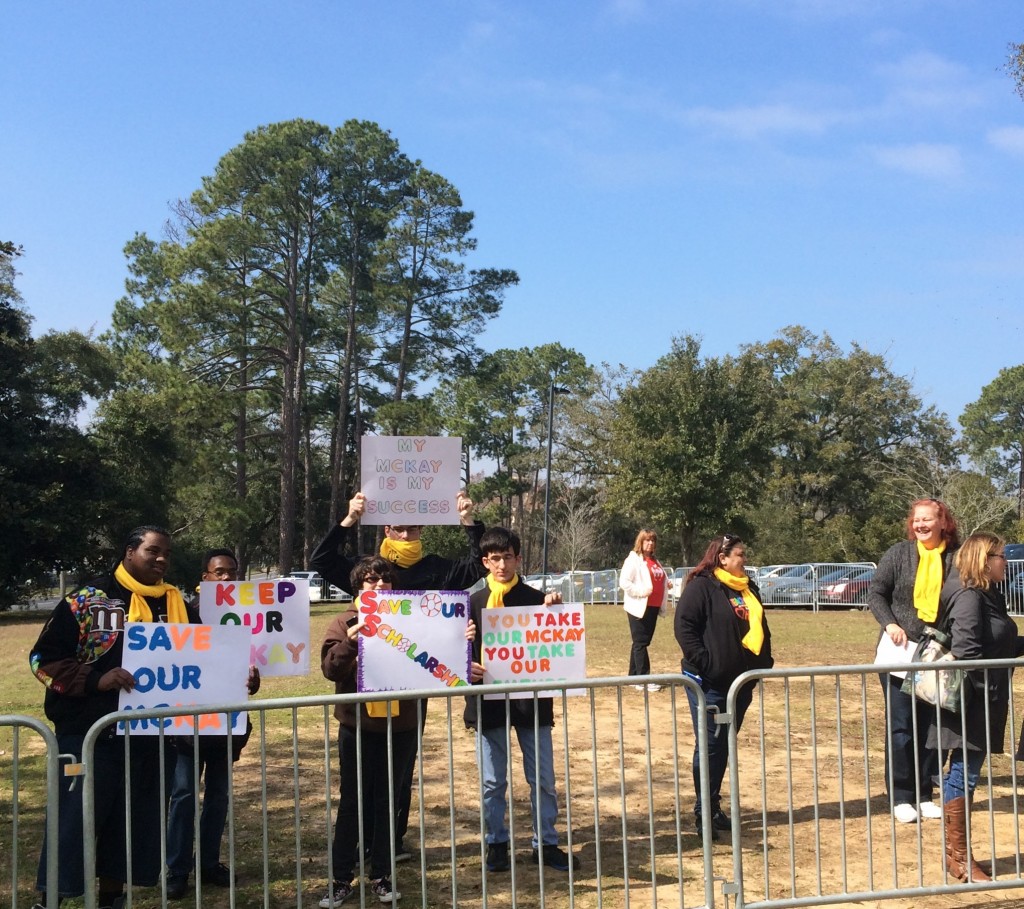
Students and parents who rallied for school choice scholarships in Tallahassee.
Before the event, a contingent of students, parents and teachers staged a separate demonstration in favor of school choice. Many of them were supporters of McKay Scholarships for special needs students, one of Florida's three private school choice programs (another of those, the tax credit scholarship program, is administered by Step Up For Students, which co-hosts this blog and employs the author of this post).
Wendy Blair is a teacher at the Arbor School of Central Florida in Winter Springs, which caters to students with special needs. She said that without McKay scholarships, its services would likely be out of reach for most of the children who attend. She said the program poses no threat to public education, pointing to studies showing it has saved school districts money.
Alexandria Forsh said her son attends Atlantic Inclusive Academy in Cocoa, a private school that accepts school choice scholarships. She said she had nothing against public schools, but parents often have a hard time advocating for special needs children and negotiating Individualized Education Programs, or IEPs, with their school districts.
The legal cloud over Florida's new special needs scholarship accounts has lifted, as the Florida Education Association has announced it won't appeal a judge's ruling dismissing a lawsuit challenging legislation that created the program.
The union announced the move Thursday in a statement posted by Florida political observer Saint Petersblog and the Scripps/Tribune Tallahassee Bureau.
In it, FEA Vice President Joanne McCall said the union decided not to appeal the ruling after beginning a "dialogue" with Andy Gardiner, who is president of the state Senate and a key backer of the Personal Learning Scholarship Accounts Program, on issues ranging from standardized testing to special needs students.
“I am pleased to see the FEA drop their lawsuit," Gardiner said in a statement. "The families of the more than 1,300 students with unique abilities currently awarded Personal Learning Scholarship Accounts can now rest assured that they will have access to school choice options that are best suited to their unique needs.”
In the lawsuit, the union argued the Legislature acted improperly when it combined multiple provisions, including the creation of the new scholarship accounts and an expansion of eligibility for tax credit scholarships, into a bill that dealt with other education issues. Both programs are administered by nonprofits like Step Up For Students, which co-hosts this blog.
Late last month, a Leon County judge ruled the case should be dismissed because the plaintiffs, including public-school parents and teachers, could not show they had standing to bring the case, in part because they could not show that expanding the tax credit program would harm funding for public schools.
The move comes a day after McCall posted an online video vowing to continue a separate lawsuit challenging the tax credit scholarship program, and to fight that case all the way to the Florida Supreme Court, if necessary.
McCall is the lead plaintiff in that second case, which both scholarship parents and lawyers for the state are arguing should be dismissed for much the same reasons as the challenge to Senate bill 850.
Coverage elsewhere:
Times/Herald. Saint Petersblog. Scripps/Tribune. Palm Beach Post.
Florida Senate President Andy Gardiner
Florida's experiment with personalized accounts that help parents meet the educational needs of their special needs children is only beginning. In coming years, it could support a key priority for the incoming president of the state senate: Helping more of those children gain access to a college education.
Senate President Andy Gardiner told a room full of education advocates and pro-reform lawmakers in Washington D.C. Thursday that he wants to work with colleges and universities to expand higher education options for special needs students. He hopes parents who use Personal Learning Scholarship Accounts for special needs students will be better able to take advantage of those options.
The accounts, created by legislation signed into law this year, allow parents of students with specific special needs to use state education funds to pay for a mix of private school tuition, therapies, home-school curriculum, and other educational expenses. They can also use the accounts to start saving for college. The program is administered by organizations like Step Up For Students, which co-hosts this blog.
Gardiner, who is the father of an 11-year-old with Down syndrome, said college often seems out of reach for parents of special needs students. They must overcome a belief that "in the eyes of society, they're not going to be able to get to that point."
He said he wants that to change. Some Florida colleges are already creating programs aimed at special-needs students, and Gardiner, who eschews the term "disabilities," hopes to create more of them.
"We'll come forward with a plan for a post-secondary option for individuals — not with disabilities, but unique abilities," he said during a panel discussion at the Foundation for Excellence in Education's annual summit.
Personal Learning Scholarship Accounts. Florida's incoming Senate President criticizes a lawsuit against school choice legislation, writing that empowering parents has helped special needs students improve achievement. Tampa Tribune.
 School choice. More Southwest Florida parents are seeking out alternatives to traditional public schools. Fort Myers News-Press.
Dual enrollment. Hillsborough Community College plans to open a satellite location at a high school to give students more access to college-level courses. Tampa Tribune.
Performance. Pinellas looks to improve performance at some of the state's most struggling schools. Tampa Tribune. Manatee County improves its performance relative to other districts. Bradenton Herald.
Campaigns. Manatee's superintendent fears an upcoming election could affect his future with the district. Sarasota Herald-Tribune. The Manatee teachers union weighs in on races. Bradenton Herald. The Tampa Bay Times recommends an incumbent Hillsborough school board member be replaced. Political consultants get involved in school board races. Orlando Sentinel. A teacher and son of Palm Beach County's first black board member challenges an incumbent. Palm Beach Post. Gubernatorial hopeful Nan Rich continues to mention vouchers in her primary challenge against Charlie Crist. Tampa Tribune.
Facilities. A K-8 magnet school is building a new outdoor learning center. Winter Haven News Chief. School playgrounds will have to stop using beach sand. Panama City News Herald.
Florida's teachers union announced a lawsuit Wednesday aiming to block a new law that, among other things, expands eligibility for tax credit scholarships and creates the second-in-the-nation personal learning scholarship accounts program.
The suit doesn't argue the programs themselves are unconstitutional. Like a recent challenge of Alabama's tax credit scholarship program, it focuses on how the law was passed.
The six-page complaint filed in Leon County Circuit Court argues lawmakers violated the state's "single-subject" rule by combining the school choice measures into a larger education bill that expanded collegiate high schools, created an "early warning system" for struggling middle school students, and grew incentives for schools to offer career education programs.
"It is an outrage that corporate voucher expansion was tacked into an unrelated bill and slipped into law on the final day of session," Florida Education Association Vice President Joanne McCall said, as reported by the Tampa Bay Times/Miami Herald.
The lawsuit drew a sharp response from Patricia Levesque of the Foundation for Excellence in Education, who tried to put the focus on the students who would benefit from the new options.
"There are those who believe families should have options and trust parents in those decisions for their kids," she said in a statement. "And sadly there are those who find educational choices threatening to their political power."
That's what at stake. But since the lawsuit itself is about the nuances of legislative procedure, here's some background.
The single-subject rule. Florida's constitution requires every law to "embrace but one subject and matter properly connected therewith, and the subject shall be briefly expressed in the title." The union's legal complaint argues the various provisions of SB 850 "are not related to each other, except in the broad sense that all have something to do with education." (more…)
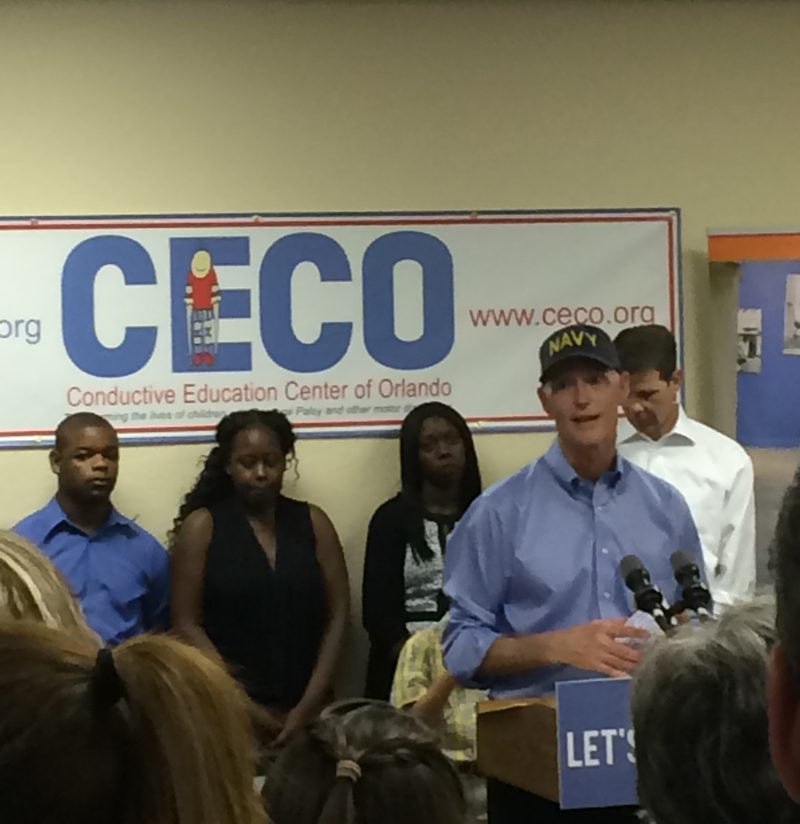
Gov. Scott spoke Thursday at the Conductive Education Center of Orlando
Last week, Gov. Rick Scott signed legislation creating a second-in-the-nation scholarship account program and doing away with special diplomas for students with disabilities.
But during a campaign appearance Thursday with the incoming senate president at an Orlando special education center, he said there would be more to come.
"Going forward, I want to do more," Scott told reporters afterward. "I want to expand the scholarship accounts. I want to make sure individuals with disabilities can get a job. I want to make sure providers aren't stuck with regulation that doesn't make sense."
The goal of the Personal Learning Scholarship Accounts is to allow parents of students with certain disabilities to use public money on a wide array of education-related services, rather than just tuition at a single school. Some parental choice advocates see these types of "education savings accounts" as part of the next wave in customizing education. (The Florida accounts will be administered by scholarship funding organizations like Step Up For Students, which co-hosts this blog.)
Scott, who is in the midst of a tough re-election battle, addressed a group of parents, special needs advocates, and former foster children at the Conductive Education Center of Orlando, in the backyard of Andy Gardiner, R-Orlando, who is set to become senate president after the November elections.
The center caters mostly to children with conditions like cerebral palsy. It's part of the international conductive education movement, but apart from an offshoot in Sarasota, there is no other option like it in Florida.
As a result, it draws parents from all over the country, who seek out its intensive programs that help their children develop cognitive and motor skills. "We moved from Oregon just to come to this school," said Rhonda Canfield, whose daughter has learned to walk with the help of a walker and to ride an adaptive bike.
One factor in the decision, Canfield said, was the state's McKay scholarship program, which helped her afford tuition. When children with cerebral palsy have access to therapies that enable them to leave their wheelchairs, she said, "their quality of life can be so much better."
Joseph Raymond helped start the center 12 years ago. He said that for many students, the program is intended to help them develop skills that allow them to attend public schools. But its uniqueness also helps underscore why scholarship programs should give parents flexibility. (more…)

