 Florida now trails only Maryland and Connecticut, states with far lower rates of low-income students, in the percentage of graduating seniors who have passed college-caliber Advanced Placement exams.
Thirty percent of Florida’s Class of 2014 found success on at least one AP exam, moving Florida ahead of high-flying Massachusetts and in a tie with Virginia, according to results recently released to states by the College Board, the nonprofit that oversees the AP program.
The national success rate was 21.6 percent.
Florida’s performance is especially noteworthy given its demographics. In fact, no state has a bigger disconnect between AP results and rate of low-income kids. (See chart at the end of this post.)
Florida ranks No. 44 in the percentage of students eligible for free- and reduced-price lunch, at 57.6 percent, according to the most recent federal figures. Massachusetts ranks No. 3, with 35.1 percent; Connecticut No. 5, with 35.7 percent; and Virginia No. 9, with 39.2 percent. Maryland comes in at No. 17, with 41.8 percent.
Despite its challenges, Florida continues to be a pace-setter in AP progress, too, coming in at No. 2 in improved performance over the past decade. Between 2004 and 2014, the percentage of graduating seniors in Florida passing at least one AP exam rose 13.7 percentage points, far surpassing the national rise of 8.9 points. Only Connecticut improved more.
The Florida story isn’t happenstance. In 2000, the state forged a partnership with the College Board to widen the doors of access to low-income and minority students, who had too often been shut out of AP classrooms. At the same time, it better identified potential AP students, better grounded them for tougher courses and better prepared AP teachers for more diverse classrooms.
Success skyrocketed. In 2000, Florida students passed less than 40,000 AP exams; last year, they passed roughly 150,000.
The trend lines have been especially steep for minority students: (more…)
 Florida public schools don't get much attention or credit when they finish in the Top 5 or 10 on key indicators of academic progress. Maybe being No. 1 will turn some heads.
The latest College Board report on Advanced Placement exams, released Tuesday, show Florida schools No. 2 in the percentage of graduating seniors who took at least one AP exam, No. 5 in the percentage passing at least one and No. 2 in progress on that passing percentage over the last decade. Those impressive rankings didn't translate into many headlines or congratulatory press releases, but there's another compelling one behind them.
Florida, it turns out, is No. 1 when it comes to the differential between its rank in AP performance (No. 5) and its rank in percentage of low-income kids (No. 43). See the chart below.
Now trying to pick the one state that's doing the best job with low-income students and AP success is tough (go to page 37 of the College Board report to see why), so the No. 1 here is eh, gimmicky. But at the least, Florida's AP results suggest that it is, to a praiseworthy extent, transcending the challenge of its demographics on exams that are widely considered good signs of college readiness.
This isn't coincidence. Florida education leaders pushed hard to open the doors of AP classrooms to low-income and minority students who were long shut out.
And this is the result: Over the past decade, the percentage of low-income, graduating seniors in Florida who passed at least one AP exam rose from 1,403 to 12,774, an 810 percent increase. In 2003, low-income students made up 7.2 percent of those AP-passing seniors. Last year, they made up 31 percent. The national rate was 22 percent, and only three states (Texas, California and New Mexico) had higher rates.
Three cheers for Florida!
 Florida continues to be a leader in both performance and progress on college-caliber Advanced Placement exams.
The state ranked No. 5 in the nation last year in the percentage of high school graduates who passed at least one Advanced Placement exam, according to a College Board report released Tuesday.
With a rate of 27.3 percent, the Sunshine State was behind only Maryland (29.6 percent), Connecticut (28.8 percent), Virginia (28.3 percent) and Massachusetts (27.9 percent). The national average was 20.1 percent. Florida ranked No. 4 last year.
Florida has the highest rate of low-income students of any state in the Top 10, at 56 percent. It also has the biggest differential between its AP performance rank and its rank in percentage of students eligible for free- and reduced-price lunch. In FRL rates, Maryland is No. 17; Connecticut, No. 5; Virginia, No. 7; Massachusetts, No. 4; and Florida, No. 43.
In terms of AP progress, Florida again ranked No. 2, with a 12 percentage point increase between 2003 and 2013. Connecticut was No. 1, with Maryland, Virginia and Massachusetts rounding out the Top 5.
The report shows 41,149 Florida graduates passed at least one AP exam in 2013, up from 39,306 in 2012 and 28,667 in 2008.
Among Florida's low-income graduates, 12,774 passed at least one AP exam in 2013, up from 10,897 in 2012, a 17.2 percent increase. (more…)
 Another year, another report, another Top 10 academic ranking for Florida's oft-criticized public schools.
The Sunshine State ranks No. 7 in K-12 achievement this year, up from No. 12 last year, says Education Week in its latest annual “Quality Counts” report.
Released Thursday morning, the report for the first time since 2008 did not include overall grades or ranks for each state. (Florida ranked No. 11, No. 5, No. 8, No. 11 and No. 6 over those years.) It did, though, continue to offer grades and ranks for six separate categories, including the one that matters the most.
In K-12 achievement, Florida earned a C, up from a C- last year. Massachusetts and Maryland earned the highest grade, a B; New Jersey, a B-; and the others ahead of Florida, a C+. The nation as a whole earned a C-.
Florida has a far greater percentage of low-income students than the states ahead of it or immediately behind it (roughly 10 to 30 percentage points more). It also stands out because of how aggressively it has pursued school choice and top-down accountability.
Gov. Rick Scott credited teachers: “Today’s news that Florida jumped to 7th nationwide in K-12 achievement is the result of great work by our teachers," he said in a written statement. Florida families depend on an education system that provides every student with a quality education, and that’s why in our last budget we fought to provide our teachers with a pay raise and secured more than $1 billion in additional investments for K-12 education.”
As a rising high school sophomore in St. Petersburg, Fla., last summer, Curtis Brown III needed to brush up on the algebra he took more than a year earlier. But instead of hiring a tutor or reviewing textbooks, Curtis signed up for a MOOC – a massive, open, online course offered by a nearby community college.
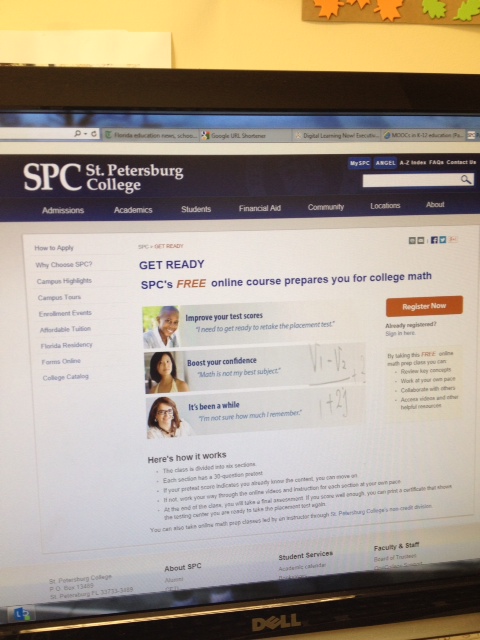
Local high school students can sign up for a MOOC offered by St. Petersburg College.
And even though he only made it half-way through the free, self-paced course, it was more than enough, he said, to prepare him for more complicated math when the school year began. Now he’s ready to tackle pre-calculus.
“It did help,’’ said Curtis, who hopes to graduate high school with a diploma and an associate’s degree. “I used it as a refresher.”
MOOCs have been all the rage in higher education. And despite plenty of debate, they’re finding a place in K-12, too.
Supporters say much like colleges and universities, high schools can use MOOCs to more easily and cost-effectively supplement their curriculum. MOOCs offer classes with unlimited enrollment, potentially help students customize their learning and provide an opportunity to increase digital learning skills. They can also be another tool to help determine if high school students are ready for college-level courses and, if they’re not, to get them help before they spend time and money on remediation in college.

Dr. Jesse Coraggio
“The way we envision it, it’s in our best advantage to have these kinds of support tools,” said Jesse Coraggio, associate vice president of research and grants at St. Petersburg College, which is piloting a math MOOC for high school students and rolling out reading and writing MOOCs later in the school year.
Like other online platforms, such as Florida Virtual School, MOOCs allow students to work independently at their own pace. But while FLVS assigns teachers to students and offers live learning sessions, MOOCs typically feature recorded lectures and provide little or no interaction with instructors. Students usually don’t pay for a MOOC or receive credit for the course, though some colleges and universities are experimenting with the concept.
In Florida this year, lawmakers authorized MOOCs in high school subjects with end-of-course exams like Algebra I and Geometry. Providers must be approved by the state Department of Education and courses must be taught by Florida-certified teachers.
While those MOOCs are being developed, four Florida school districts, including Pinellas County, where St. Petersburg College is located, are testing MOOCs in other areas. (more…)
Between 2003 and 2012, the number of low-income graduating seniors passing at least one AP exam climbed from 32,523 to 120,254. That’s an increase of 270 percent. That’s amazing.
Every few months, a major media outlet writes an expose about Advanced Placement classes. The stories (like this one and this one and this one) question the success of large-scale campaigns to expose minority and low-income students to the rigors of AP, using a jumble of numbers to make their case. Unfortunately, they’re often unfairly selective and tend to ignore an undeniably inspiring trend: More poor students are taking and passing AP courses than ever before.
I covered the AP push as a reporter in Florida. There’s plenty that merits scrutiny. I don’t think AP is the end-all, be-all. But on balance, the evidence suggests it has been a good thing - and the kind of good thing public school champions should be the first to highlight.
In the Florida case, public schools showed they can be responsive to low-income kids. For decades, and for no good reason, low-income kids were denied access to college-caliber AP classes, the nearly exclusive domain of white kids in the ‘burbs. So better late than never, schools in the Sunshine State opened the doors, raised expectations and gave students and teachers extra support.
I don’t know off-hand what the AP numbers are like from state to state; I don’t doubt some states have done a better job than others. But the national numbers, like the ones I got to know pretty well in Florida, suggest a lot of positive.
So I’m stumped as to why many stories are so negative – and why they leave out key numbers. The recent Politico story noted that between 2002 and 2012, the pass rate on AP tests fell from 61 percent to 57 percent. That’s true. But the story minimized the fact that because of vastly higher participation rates – and the success of so many of those new participants – hundreds of thousands of additional students are not just taking the tests every year, but passing them.
Forgive me while I highlight my own jumble of numbers: In 2002, 305,098 graduating seniors in the U.S. had passed at least one AP exam. By 2012, the number was 573,472. That’s an 88 percent increase. That’s excellent.
The numbers for low-income students are even more impressive. Between 2003 and 2012 (2002 figures were not available from the College Board), the number of low-income graduating seniors passing at least one exam climbed from 32,523 to 120,254. That’s an increase of 270 percent. That’s amazing.
Passing an AP test is a pretty good indicator those kids are college ready. More important, it shows they belonged in those classes all along. (more…)
School technology. StateImpact Florida takes a look at the One Laptop Per Child program.
 Accelerated classes. In Pasco, enrollment is climbing fast in AP, IB and dual enrollment. Tampa Bay Times.
FCAT. Gains not as good as they sound, writes Shanker Blog. Three Pinellas elementary schools have among the worst math scores in the state, reports Gradebook.
Parent trigger. A distraction and faddish. Sherman Dorn.
Superintendents. The new Lee super is Naples High Principal Nancy Graham, but it's not clear whether she's temporary, reports the Naples Daily News. Tony Bennett's a fan of Pinellas' Mike Grego, reports Gradebook.
Ed summit. Speaking of Grego, he's among the speakers at the Florida Sterling Council's annual summit. StateImpact Florida.
Gifted students. Pinellas is eliminating programs for gifted students at a few schools in lieu of offering gifted services at all elementary schools. Tampa Bay Times.
School spending. Broward gets no legislative funding help for its technology and building needs, reports the Miami Herald. More from the South Florida Sun Sentinel. Broward wants to charge a developer $3.6 million in impact fees for four students, the Sun Sentinel also reports. (more…)
Charter schools. Brooksville's first charter school, one with a STEM focus, will open this fall, reports the Tampa Bay Times. Competition from charter schools is forcing the Palm Beach County school district to think harder about its needs and priorities, reports the Palm Beach Post. Charters are also sparking debate among Palm Beach school board members about how much help they should give struggling charters, the Post also reports. An op-ed in the Miami Herald raises concerns about charter schools' diversity and financial incentives. The Sarasota Herald-Tribune profiles the principal of the Imagine charter school that is trying to break free from the parent company.
Magnet schools. The Tampa Tribune applauds the Hillsborough school district for creating a magnet tied to the maritime industry.
Alternative schools. Troubled girls get a fresh start at a sheriffs' youth ranch in Polk County. Orlando Sentinel.
 Tax credit scholarships. Great back-and-forth between scholars Kevin Welner at NEPC and Jason Bedrick at Cato, with Florida's program a big part of their debate. Cato at Liberty.
School choice. It's often partisan. Sunshine State News.
Parent trigger. Education Commissioner Tony Bennett raises a constitutional question. The Florida Current. (more…)
State of the State. Gov. Rick Scott gives props to teachers and pushes for a boost in ed funding. Coverage from Gradebook, Tampa Bay Times, Orlando Sentinel, SchoolZone, Palm Beach Post, Gainesville Sun, Tallahassee Democrat, The Florida Current, StateImpact Florida. A special spotlight for a Temple Terrace teacher, reports the Times/Herald Capital Bureau.
 More on the legislative session. An education issue overview from StateImpact Florida. A roundup of school choice bills from redefinED.
Virtual schools. Pasco drops a challenge to a proposed Florida Virtual Academy charter. Tampa Bay Times.
McKay vouchers. Another reason Texas should adopt them. EdFly Blog.
AP tests. Should Florida students get paid for passing them? Gradebook.
School spending. The Brevard school board revises its $30 million list of cuts in response to community input, reports Florida Today. The Flagler school board moves towards putting a tax referendum on the ballot for next spring, reports the Daytona Beach News Journal. An audit committee in Manatee sees progress in how the district is responding to budget errors that led to a $3.4 million deficit, reports the Bradenton Herald. More from the Sarasota Herald Tribune. (more…)
 For the second time this week, a credible, independent analysis shows Florida students leading the pack in progress.
Between 1992 and 2011, Florida students made bigger gains than students in four other “mega states” in fourth- and eighth-grade reading and fourth-grade math, according to a report released Thursday by an arm of the U.S. Department of Education. In each case, they moved from below the national average to meeting or exceeding it. Low-income and minority students in particular showed traction.
“There is something real going on there,” said Jack Buckley, commissioner of the National Center for Education Statistics, according to Education Week.
The center’s comparison followed Wednesday’s College Board report that showed Florida continues to climb the charts on Advanced Placement exams. The Sunshine State now ranks fourth in the percentage of high school graduates passing AP exams. Over the past decade, it ranks second in progress.
Broken-record alert No. 1: Florida’s trend lines shouldn’t be a surprise, given reports like this, this, this, this and this in the past year alone. Yet there remains a lingering perception, cultivated by critics, that Florida’s public schools are sub par and stagnant.
For Thursday’s report, the center for the first time compared scores from Florida, California, Texas, New York and Illinois – the states with the biggest student populations and arguably the biggest challenges. It used results from the National Assessment of Educational Progress, a battery of tests better known as “The Nation’s Report Card” and considered the gold standard among standardized assessments.
In eighth-grade math, Florida students made gains but remain below the national average. Elsewhere in the report, they were singled out often. (more…)

