 Charter schools. An Orange County charter that served dyslexic students is closing after seven months because of financial problems, reports the Orlando Sentinel. The parents of a charter in Miami-Dade are in limbo after a church decides unexpectedly to end the school's lease, reports the Miami Herald.
Virtual charter schools. In a repeat of last year, the charter school appeals commission sides with the Orange and Seminole school boards in their rejection of applications for Florida Virtual Academy schools. The state Board of Education will make the final call. SchoolZone.
Parent trigger. Two civil rights groups in Florida, LULAC and the NAACP, are opposed. StateImpact Florida.
Magnet schools. Parents plead with the St. Lucie County School Board to not close an arts magnet because of budget cuts, reports TCPalm.com. A new elementary school arts academy is in the works in Okaloosa, reports the Northwest Florida Daily News.
Career and technical. A bill filed by Sen. John Legg, R-Port Richey, would allow students to substitute industry certifications for other graduation requirements, reports Gradebook. More from the Orlando Sentinel. The Pinellas school district plans to create several new career academies for middle schools and put STEM labs in every elementary school in an effort to boost career education, reports the Tampa Bay Times. River Ridge Middle School in Pasco is realigning its curriculum to better reflect career education, the Times also reports. (more…)
AP results. Florida students rank No. 4 in the nation in the percentage of graduates passing an AP exam. redefinED. Tampa Bay Times. Miami Herald. Tallahassee Democrat. Orlando Sentinel. CBS Miami. Florida Today. Associated Press. Fort Myers News Press.
Tutoring oversight. The Tampa Bay Times elevated a handful of bad actors to taint the overall tutoring effort in Florida and ridicules a program championed by the late Sen. Ted Kennedy to help low-income families, writes Steve Pines, executive director of the Education Industry Association, in an op-ed response to the Times series and editorial.
Teacher evals and school grades. Despite the concern of Education Commission Tony Bennett and others, the two systems are not meant to be in sync. Shanker Blog.
More conspiracy! Now in Education Week.
Class size flexibility. There's bipartisan support for a bill to provide that. StateImpact Florida.
Common Core. Florida Education Commissioner Tony Bennett talks more about the why's behind Plan B. Education Week. (more…)
Florida students ranked No. 4 among the 50 states last year in the percentage of high school graduates who passed a college-caliber Advanced Placement exam, according to a national report released Wednesday.
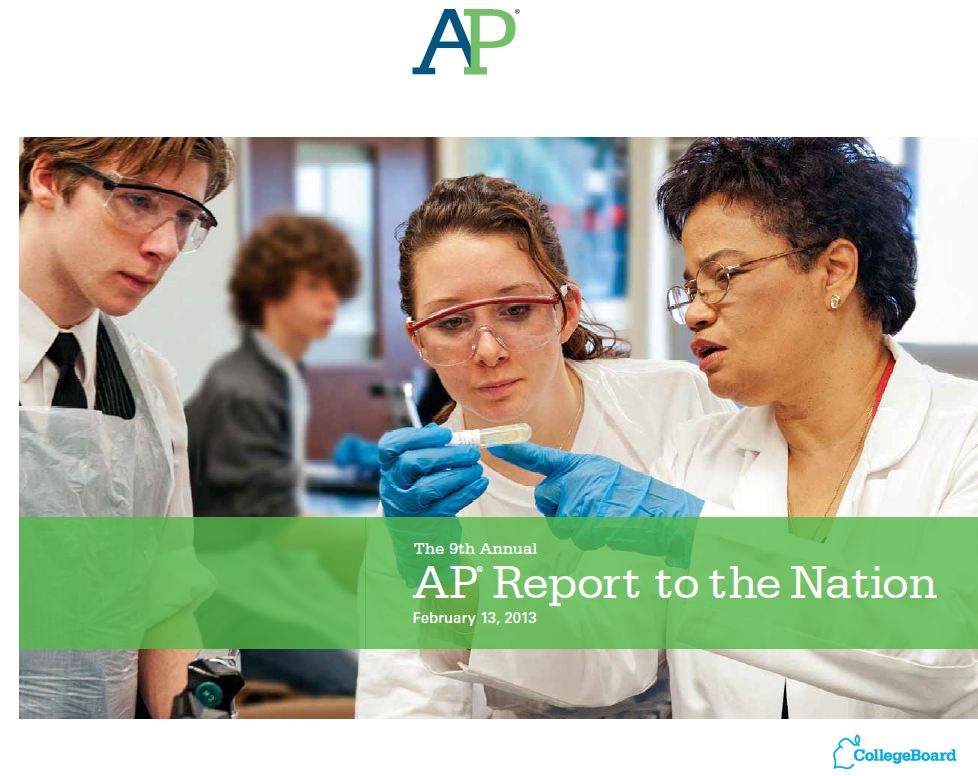 Over the past decade, the report also shows, Florida students ranked No. 2 in gains.
Administered by the nonprofit College Board, AP exams are tied to rigorous AP courses and widely considered to be good predictors of college success. Between 2002 and 2012, the percentage of Florida graduates who passed at least one rose from 14.4 percent to 27.3 percent. Over the same span, the national rate rose from 14.3 percent to 19.5 percent.
The raw numbers better show the scale of impact. In 2002, Florida had 17,256 graduating seniors with AP success on their transcripts. In 2012, it had 39,306.
Florida’s AP success is among the most compelling signs that Florida’s once barrel-bottom public education system is progressing, particularly for low-income and minority students.
For years, AP classes were the near-exclusive domain of white and Asian students in the ‘burbs. But under former Gov. Jeb Bush, Florida began a sustained effort to give low-income and minority students more access. Higher expectations were coupled with better preparation for students, professional development for teachers and targeted investments in funding. Some districts, particularly Hillsborough, got even more radical, aiming to make AP the new normal in schools where AP courses could be counted on one hand.
The result at the school level: In 2002, students at East Bay High in rural Hillsborough took 63 AP exams and passed 36. Last year, they took 770 and passed 323.
The result at the state level: Florida outpaces wealthier, less diverse and - in the education realm - more highly regarded states like Virginia and Connecticut, and now trails only Maryland, New York and Massachusetts.
Update at 2:46 p.m.: DOE press release here. Tallahassee Democrat story here.
 Tony Bennett has a tough, tough job ahead, and the way education in Florida is covered is not going to make it any easier. The big news last week is a case in point.
Besides Bennett’s selection as the state’s new education commissioner, the top story was how Florida fourth-graders scored on a respected international test called PIRLS , which stands for the Progress in International Reading Literacy Study. In case you missed it, Florida students ranked second in reading, behind only their peers in Hong Kong. Virtually none of the state’s major daily newspapers (the Orlando Sentinel being a notable exception) covered this development, but CNN did. It interviewed interim Education Commissioner Pam Stewart live, next to an all-caps headline that read, “FLORIDA STUDENTS SCORE BIG.”
This wasn’t a one-time oversight. Over the past 10 to 15 years, Florida students and teachers – its public school students and teachers - have made impressive academic gains, whether it’s on national math and reading tests, or on college-caliber Advanced Placement tests, or in graduation rates as determined by credible, independent experts. For four years running, Education Week, looking at both performance and progress, has ranked Florida among the leading states in K-12 achievement (to be specific, at No. 7, No. 7, No. 6 and No. 12 over that span). And yet, flattering reports about Florida’s progress rarely get more than passing mention, while those who oppose the state’s accountability and school choice initiatives are often allowed to deny that such progress even exists. Even stranger, the more outrageous their statements get, the more often they seem to get quoted. (more…)

Shirley Ford
The mom on stage described how she and other low-income parents rode a bus through the darkness - six hours, L.A. to Sacramento, kids still in pajamas - to plead their case to power. In the halls of the legislature, people opposed to the idea of a parent trigger accused them of being ignorant, of not understanding how schools work or how laws are made. Some called them a “lynch mob.”
Then, Shirley Ford said, there was this sad reality:
“I would have thought that the PTA would have been beside me,” Ford said. But it wasn’t. “I’m not PTA bashing when I say this,” she continued. “To see that the PTAs were on the opposite side of what we were fighting for was another level of awareness of how the system is.”
Ford is a member of Parent Revolution, the left-leaning group that is advocating for parent trigger laws around the country. She spoke last week at the Jeb Bush education summit, sharing the stage with former California state Sen. Gloria Romero and moderator Campbell Brown. Her remarks, plain spoken and passionate and sometimes interrupted by tears, touched on a point that is vital and obvious and yet too often obscured.
Parents are not a monolith.
The divides are as apparent as the different dynamics that play out in schools on either side of town. In the affluent suburbs, a lot is going right. There is stability in the teaching corps. The vast majority of kids don’t have issues with basic literacy. The high schools are stocked with Advanced Placement classes. And there, behind it all, are legions of savvy, wonderfully dogged, politically connected parents who know how to mobilize when their schools are shortchanged.
The view is starker from the other side of the tracks. A parent in a low-income neighborhood is more likely to see far more teacher turnover in her school – along with far more rookies, subs and dancing lemons. She’ll see far more students labeled disabled and far fewer AP offerings. Issues like these plague many high-poverty schools, yet they don’t get much attention from school boards or news media or, frankly, from established parent groups like the PTA. (more…)
Elia
Teacher’s aides put on leave. Five of them, in Hillsborough, as the district investigates the death of a special needs middle school student and a PE coach accuses them of slacking on the job, reports the Tampa Bay Times. Says Hillsborough Superintendent MaryEllen Elia: "We have to do everything we can to retain and regain the confidence of parents who entrust us with their children." In Broward, meanwhile, the district plans to fire a bus attendant accused of choking an autistic student, the South Florida Sun Sentinel reports.
Privatization gone wrong. At the Department of Education, within the Division of Blind Services, editorializes the Tampa Bay Times. The paper uses the issues there to take a dig at charter schools: “Ever since then-Gov. Jeb Bush took office in 1999, state government has been moving more toward hiring private vendors to do state business — from handling state park reservations to opening private prisons. And Gov. Rick Scott, a former health care executive, has only accelerated that push, for instance by making it easier for charter school companies to qualify for money that used to be dedicated to public schools.”
AP Honor Roll: Eleven Florida districts are among 539 nationwide on the College Board’s latest annual Honor Roll, awarded to districts that increase access to AP classes at the same time they maintain or improve AP test pass rates. Among the 11: Pinellas, which was the subject yesterday of an oddly critical story. (Hat tip, Orlando Sentinel School Zone blog)
Tony Bennett watch. Comments from acting Florida ed commissioner Pam Stewart.
Charter watch. From the Sentinel ed blog late last night: “The Orange County School Board approved one charter school application, rejected two others, and agreed on a contract with a school that the state forced the school district to accept.”
 AP pass rates. The Tampa Bay Times looks at pass rates by high school in the Pinellas school district and concludes “AP test success remains elusive.” The story includes a lot of stats, but doesn’t note the actual numbers of students and/or tests passed at each school and how that number has risen (or not) over time. For what it’s worth, the numbers of students passing AP statewide has skyrocketed (even though pass rates have dipped) because so many more students have been given the opportunity and support to succeed. Over the last five years, according to this report, the number of passed AP tests in Florida climbed from 87,852 to 136,265 - an increase of 55 percent.
Investigation into overspending. A probe begins into why the Manatee school district ended up $3.4 million in the red, reports the Sarasota Herald Tribune.
Interim education commissioner Pam Stewart is widely respect, but hasn’t applied for the permanent job, notes State Impact Florida.
 In Florida, we love the bizarre. We cultivate gator-eating pythons and face-eating zombies and transvestites who inject women’s derrieres with Fix-a-Flat. So maybe it makes complete sense that our education debates are so often detached from reality, too.
It’s strange but true: Some of the same people who say Jeb Bush and like reformers are out to trash public schools are the ones, in fact, who often trash public schools themselves. In their haste to throw stones, they put themselves in the position of dismissing the hard work of teachers and the hard-won gains of low-income students.
I know that sounds harsh. But the past few weeks have yielded some notably brazen examples.
In the wake of the FCAT writing fiasco, Fund Education Now, the Orlando-based parents group that has become a grassroots powerhouse, said the test results were “proof that Tallahassee’s ‘education reforms’ are an unmitigated disaster.” The group’s founders said “Bush’s policies have created the impression that Florida schools are failing,” according to StateImpact Florida, a group affiliated with National Public Radio. In an op-ed, co-founder Kathleen Oropeza argued that “fourteen years of unproven, expensive ‘reforms’ have not produced the rumored ‘Florida Miracle.’ “
Meanwhile, Roy Miller, president and founder of the Tallahassee-based Children’s Campaign, also took aim at ed reform in Florida, saying a new report “casts doubts on claims about the progress being made based on FCAT.” An Orlando Sentinel reporter, also inspired, used the report to sarcastically refer to “Florida’s much ballyhooed progress in student achievement.”
Here’s what all these statements have in common: a complete refusal to acknowledge that Florida students have made some of the most dramatic improvements in the nation in the past 14 years. NAEP results show this. AP results show this. Graduation rates show this. In the 1990s, one academic indicator after another showed Florida kids wearing dunce caps in the nation’s academic cellar. But in the last four years no less a respected arbiter of education quality than Education Week has ranked Florida No. 11, No. 8, No. 5 and No. 11, respectively, among all 50 states. It must be emphasized that the gains have been especially strong for low-income and minority students. Reform supporters have rightly lauded the trend lines, rightly noted there are miles to go, and, again and again, rightly thanked the talented, driven teachers who were essential to making it happen.
Some critics, though, act as if nothing has changed – or that things have gotten worse. The statements from Fund Education Now are richly ironic. This same organization has repeatedly painted a portrait of hobbled and dysfunctional public schools. In fact, Fund Education Now is the lead plaintiff in a pending lawsuit that charges the state with failing to live up to its constitutional duty to provide “high quality” schools. This detail wasn’t mentioned in the StateImpact story. (more…)
One of the big, untold stories in Florida education over the past decade has been the rising academic achievement of Hispanic students. As researcher Matt Ladner has pointed out, on the fourth grade NAEP reading test, Hispanic students in Florida now tie or outscore the statewide average for ALL students in a majority of states. Meanwhile, in high schools, Hispanic students - who made up 25 percent of all Florida graduates last year - made up more than 25 percent of all graduates who passed at least one Advanced Placement exam.
Why doesn't this make a bigger splash in Florida, where some demographers say Hispanics could be the majority in a few decades? I’ll save my conspiracy theories for another day. The bottom line is, this trend is not only a hopeful sign for the state's future, it's more evidence that public schools here are rising to huge challenges.
Now, that being said, it's also true that the overall numbers still aren't where anybody wants them to be, and that some school districts are making bigger gains than others. Among those with flatter trend lines: the Pinellas and Hillsborough districts right here in Tampa Bay.
I bring this up because Pinellas and Hillsborough counties also happen to be the next stop for an innovative program aimed at improving Catholic schools, particularly for low-income Hispanic students. (more…)

