
"I don't know who you are. I don't know what you want. If you are looking for ransom, I can tell you I don't have money, but what I do have are a very particular set of skills. Skills I have acquired over a very long career. Skills that make me a nightmare for people like you. If you let my daughter go now, that'll be the end of it. I will not look for you, I will not pursue you, but if you don't, I will look for you, I will find you, and I will kill you." — Liam Neeson
Arizona’s passage of universal ESAs leads to the question, “What’s next?” Some feel concerned that any number of rando grifter types will attempt to open private schools. Perhaps so, but then they will be snuffed out by an education sector that has developed a very particular set of skills acquired over a very long period of competitive K-12 policy. They will look for the students of grifter schools, they will find them, and they will kill schools that fail to satisfy parents. It’s all happened before, and it will all happen again. Saddle up; keep your cool; give it time. The ending here is as predictable as Taken.
Arizona started down the road to K-12 choice in 1994 with a liberal charter school law and a law forbidding open enrollment tuition. In 1997, lawmakers passed the first scholarship tax credit program, which was expanded multiple times. In 2011, Arizona lawmakers passed the first Education Savings Account program.
Most Phoenix area K-8 students do not attend their zoned district schools. District schools both lose and gain enrollment in the process. Low demand charter schools tend to fold quickly. Low demand district schools often go through a radioactive half-life as mostly empty zombie schools, but eventually school boards close or consolidate them. Zombie schools drain resources from teacher compensation, but school boards are famously cowardly when it comes to making painful adjustments opposed by angry mobs of parents. More district than charter students are affected by school closures overall, but the process grinds on year to year.
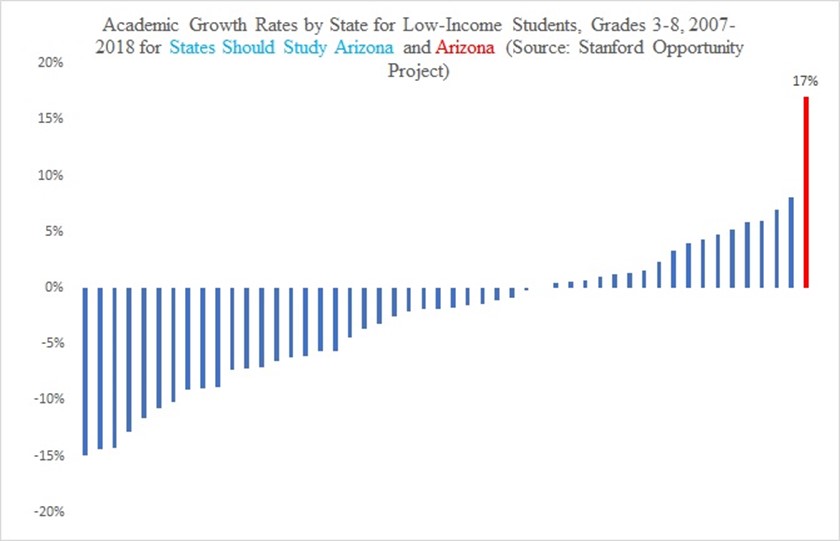
The survivors of 28 years of this process have developed a very particular set of skills. Numbered among these: driving the nation’s highest rate of academic growth as documented by the Stanford Educational Opportunity project. Below is a chart showing the rate of academic growth for economically disadvantaged students by state:
What is the “very particular set of skills” that makes me confident that Arizona educators will crush grifters? Three decades of working with families to figure out what they want for starters. Advanced experience dealing with real-estate, zoning and debt markets and recruiting teachers and training them up to achieve the above results. If you can imagine a type of school, an Arizona charter or district has probably either already tried it, discarded it, or else is running it. Demand discovery has been underway for almost three decades. The ESA program creates a new tool for these and other educators to employ.
I have never seen “Taken,” but put me down but as “all-in” on Liam Neeson putting down the bad guys. It will take time. There will be complaints and headlines. New models that satisfy parents will emerge. For decades now if you wanted to open a school in Arizona you had to bring an A-game. Nothing has changed on that front.
Arizona educators have dispatched grifters before. Watch them do it again. I can’t wait to see what America’s apex educators make with their new tool.
Word began to leak yesterday that the Save Our Schools group had misrepresented the number of signatures gathered in an effort to thwart Arizona’s universal ESA expansion. It now appears all but certain/official that they did not gather the needed 118,000 petition signatures required to freeze the expansion and hold a vote on the measure. So, what happens next?
Contra the fears of opponents, the Arizona sky will not rain frogs. Arizona already has universal access to district schools, universal access to charter schools and universal access to a limited pool of tax credit funds. The current size of the program looks to approximately double, based upon the number of applications received, but up to about 2% of the K-12 total. Where it goes from there will depend upon supply and demand. The profound change will be that the program is available to the family of any student who feels in need of it.
James Glassman’s excellent profile of Governor Doug Ducey rightly begins this tale in the early 1990s. Gov. Fyfe Symington and fellow pioneers such as Lisa Graham Keegan, Tom Patterson and Armando Ruiz passed the initial charter school and district open enrollment in 1994. Patterson recalls a legislative debate in which he called for district open enrollment, and his opponent claimed it was “the craziest thing I’ve ever heard.”
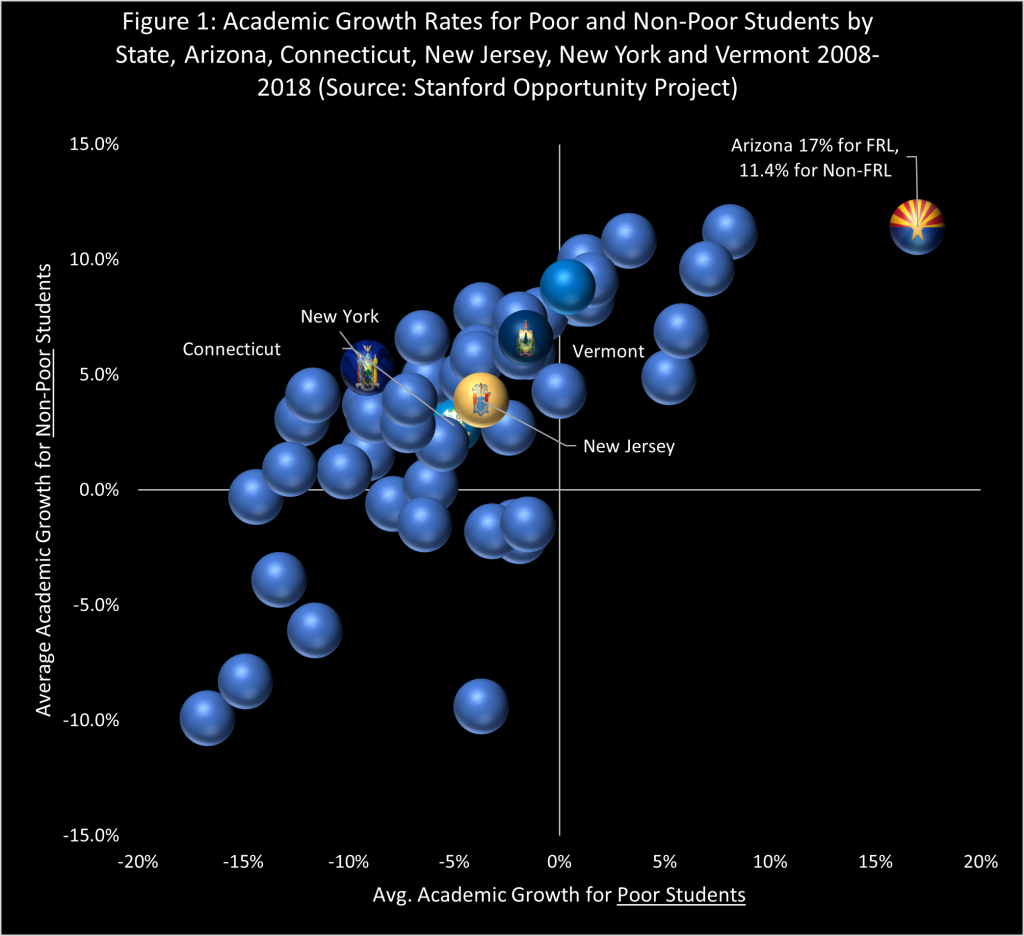
Decades later, we learned that a majority of Phoenix area K-8 students don’t attend their zoned district school. Stanford data (shown above) shows Arizona led the nation in the rate at which students learned between 2008 and 2018, leaving behind northeastern states that spend much more per pupil. Patterson was crazy all right, crazy like a fox.
Over the past three decades, Arizona’s choice policies have allowed an amazing group of educators the opportunity to flourish. An amazing diversity of schools bloomed in the desert, and a huge amount of expertise developed. Families have decided which schools to reseed and which to pull like weeds. The survivors of this process are the most effective group of educators in the nation judging by academic growth, and before the pandemic they lacked a close second. They have a new tool now. This isn’t like Russia conscripting unwilling blokes from the pub, more like NATO giving advanced weaponry to Ukrainian special forces.
Arizona pioneers deserve our praise and thanks, but so to does this generation of leaders. Ducey is ending his eight years as governor having expanded freedom, slashed red tape and strengthened the state’s economy. Well done and many thanks! Legislative leaders such as state Rep. Ben Toma were absolutely fearless in pursuit of education freedom, as was outgoing state Senate Education Committee Chairman Paul Boyer. The advocacy efforts of the American Federation for Children, the Goldwater Institute, and the Center for Arizona Policy achieved this feat faster than I believed possible. I have never been so happy to eat a plate of crow!
Many trials lie ahead. Arizona’s undaunted commitment to freedom and self-determination in schooling has already been richly rewarded. I feel confident we will surmount every difficulty. “'Tis the business of little minds to shrink,” Leonardo da Vinci wrote “but they whose heart is firm, and whose conscience approves their conduct, will pursue their principles unto death.”
Firm your hearts, Americans. The families in your states need this as well.
"Horse racing" by Paolo Camera is licensed under CC BY 2.0.
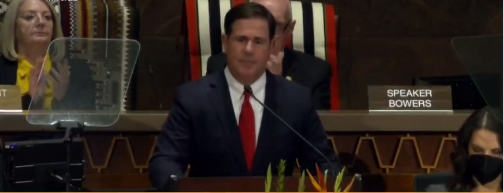 By now, education choice enthusiasts – and detractors as well – know that Arizona Gov. Doug Ducey has signed into law the nation’s first universal education savings account program, creating the most expansive school choice initiative in the nation.
House Bill 2853, sponsored by Rep. Ben Toma, allows education savings accounts to be available to all 1.1 million-plus K-12 students in Arizona, incorporating other reforms into the program, such as allowing families to use education savings account funds for transportation, computers, and other education related expenses.
Families will receive scholarships by re-directing their current education tax dollars at an amount expected to be approximately $7,000 per student per year when the bill takes effect later this fall.
Here is what Ducey had to say at the bill-signing:
This is a monumental moment for all of Arizona’s students. Our kids will no longer be locked in under-performing schools. Today, we’re unlocking a whole new world of opportunity for them and their parents. With this legislation, Arizona cements itself as the top state for school choice and as the first state in the nation to offer all families the option to choose the school setting that works best for them.
Every family in Arizona should have access to a high-quality education with dedicated teachers. This is truly a win for all K-12 students. I commend Sen. President Karen Fann, House Speaker Rusty Bowers, Rep. Ben Toma, and all the lawmakers who voted for this important legislation and put students first.
Here are remarks from bill sponsor Toma:
In Arizona, we fund students, not systems, because we know one size does not fit all students. It was my privilege to sponsor the most expansive school choice law in the nation, opening Empowerment Scholarship Account eligibility to all school-age children without restriction. I appreciate Gov. Ducey for his strong support to help Arizona become the first state with a truly universal ESA program, delivering educational freedom to more than 1.1 million students.
From Drew Anderson, senior pastor of First Watch Ministries and Legacy Christian Center in South Phoenix:
Our kids have been crying out for better schools to be open to them. We broke open those doors and saved our children. As a pastor I’ve seen too many of our black and brown children struggling; going to fast food restaurants just to connect to Wi-Fi or just looking for some guidance on homework. I’m grateful to Gov. Ducey and the Legislature for putting our kids first by expanding the Empowerment Scholarship Account program. We avoided a crisis for our children and helped them achieve greatness.
From Jenny Clark, founder of Love Your School, a resource for Arizona families looking for the best schooling options for their children:
My five children benefit from the Empowerment Scholarship Account program. Because of the program, our kids had access to wonderful curriculum, resources, and special education that they needed. It has been life changing. Every Arizona child now has access to the same opportunities – unbound by their parents’ income. Thanks to the hard work of Gov, Ducey and the Arizona Legislature, all Arizona students have equitable access to a great education.
From Steve Smith, Arizona state director, American Federation for Children:
This is a historic moment for all families in Arizona, especially those who have been demanding more education options for their children in the wake of the massive learning loss and school closures from COVID. For more than a decade, AFC has worked to expand education freedom in Arizona, and now today, every family truly has that freedom that they are entitled to. We could not ask for a better partner than Gov. Ducey, a stalwart champion for kids, and the Republican lawmakers who refused to give up on this effort. We look forward to continuing our work to ensure all children, especially those from lower-income families, will receive full access to the opportunities now available to them through the ESA program.
From Tommy Schultz, CEO, American Federation for Children:
Arizona leaders just created a Sputnik moment for education freedom that should inspire lawmakers in every other state to launch their own massive school choice policy expansions. We appreciate the enormous task ahead of us to spread education freedom and opportunity to millions of children across the nation still stuck in schools failing to meet their needs. Every child in America deserves the opportunity to thrive and achieve his or her potential through a high-quality education, and we will continue fighting for families in Arizona and across the country until that day comes.
From Corey DeAngelis, senior fellow, American Federation for Children:
With the signing of this bill, Gov. Ducey and Arizona Republicans freed thousands of families from government-run schools that aren't meeting their needs. Arizona families will no longer be forced to send their children's taxpayer-funded education dollars to government-run schools regardless of their choices. All Arizona families will finally be able to direct their children's taxpayer-funded education dollars to the education providers that best meet their needs, whether it be a public, private, charter, or home-based educational option. Arizona has figured out how to fund students instead of systems, and now solidly leads the nation in educational freedom.
From Jason Bedrick, research fellow, Center for Education Policy at The Heritage Foundation:
Arizona lawmakers are right to trust families. Arizona has long been a pioneer in education choice—enacting nation’s first tax-credit scholarship policy in 1997, in addition to the first ESA—and the investment in education choice is paying off. Despite doomsday predictions about the effects that education choice would have on student performance, Arizona has led the nation in gains on the National Assessment of Education Progress over the past two decades. When families are empowered to choose the learning environment that works best for their children and that aligns with their values, everyone benefits. Once again, Arizona is setting an example that other states should emulate.
From Patricia Levesque, executive director, ExcelinEd in Action:
Today, Arizona lawmakers boldly passed a historic piece of legislation that will give families more educational options for their students. More than 11,000 students now use the Arizona Empowerment Account Program. If the expansion is signed into law, all of the approximately 1.1 million Arizona students will have access to public and private options to better meet their individualized needs. We are extremely grateful to the leadership of Rep. Ben Toma and members of the Arizona Legislature for their courage in providing additional avenues for every student to succeed in school and beyond.
From Matt Beienburg, director, Van Sittert Center for Constitutional Advocacy and director of education policy at the Goldwater Institute:
Opponents have once again pledged to fight against ESA expansion, and state lawmakers still have to notch the final win for academic transparency in 2023 after SB 1211, which would require public schools to disclose online all instructional materials being used in their classrooms, also cleared the state senate and came just a single vote short of final passage in the house. But in both cases, one can see a growing consensus among Arizona lawmakers that meaningful reforms are needed by families across the state, and that now is the time for greater educational freedom and academic transparency for students across the nation.
From the Wall Street Journal editorial board:
The school choice movement continues to gain support, and the latest breakthrough is legislation in Arizona that will expand the availability of education savings accounts for any K-12 student in the state who wants one.
From USA Today columnist Ingrid Jacques:
It didn’t surprise me when I heard that Arizona passed what’s being called the most expansive school choice plan in America. After all, the state has long been a trailblazer in educational freedom.
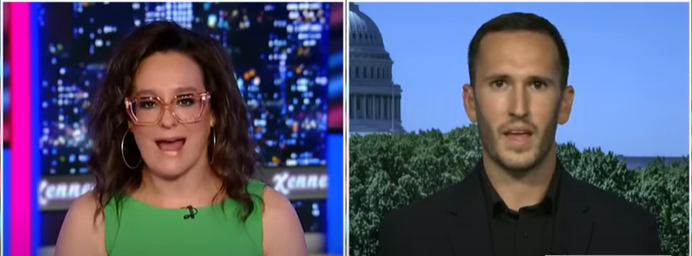 Editor’s note: DeAngelis is national director of research at the American Federation for Children. He recorded this interview Tuesday.
We’re super pumped up in the school choice movement. In 2021 we were calling it the year of school choice because 19 states expanded or enacted programs to fund students as opposed to systems. But Arizona just one-upped them all. This is the gold standard of education freedom, and Arizona just cemented itself as the No. 1 state for school choice.
This is obviously the clearest, biggest victory for school choice in U.S. history. Every single family, regardless of income, can take their children’s taxpayer funded education dollars to the education provider of their choosing. That could be a public school, a private school, or a home-based educational option. This is the way to do it, and other states should follow.
Another thing could be just political indoctrination that’s happening in the classroom. Families want kids to learn the basics as opposed to political and politically divisive topics. That could be another reason why families want school choice.
The reality is school choice is a rising tide that lifts all boats. If families have opportunities, they’ll take their kids to the schools that align with their values and best meet their needs in so many different ways. And then the public schools can up their games in response to competition
The evidence on this is clear. Twenty-five of 28 studies find that school choice competition leads to higher outcomes in the public schools. They up their game in response to competition.
Look, this is the purest form of accountability, the strongest form. Under-performing private schools shut down. Under-performing government-run schools get more money. They say, ‘We’re failing because we don’t have enough money. We saw this with the pandemic. They said, ‘We were closed because we needed more money,” and they got billions and billions of dollars in ransom payments. Then they tried to stay closed going into 2022.
This will be up to other legislators in other states. Republicans in particular have called themselves the parents’ party all across the nation. But in Arizona, the Republicans just proved it. The only way to truly secure parental rights in education is to fund students directly and empower families to choose. If you really want to be the party of parents, here’s the way to do it.
 I recently published a white paper on K-12 funding equity in Arizona. The news was not great.
Back in 1980, Arizona lawmakers were concerned about a Serrano vs. Priest-style lawsuit from California (won by education choice icons Jack Coons and Stephen Sugarman, by the way!). The lawmakers went and did what the plain language of the Arizona Constitution requires, equalizing public school funding.
It didn’t stick, so today, 61 of Arizona’s 207 school districts spend twice as much or more per-pupil education as the lowest-funded district. Charters receive less on average than district students per pupil, and students are not funded equitably across schools in the same district.
For example, Tucson Unified:
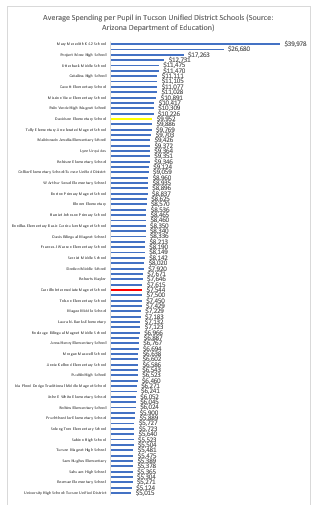 Don’t focus on the top of the chart (the top two lines are unusual), but rather, at the bottom. Every Tucson Unified school above the red line received 50% or more funding per pupil as the lowest funded school, and every school above the yellow line received twice or more per pupil funding than the lowest funded school.
Hawaii funds schools in such a way that would make these sorts of inequities impossible. Lawmakers implemented weighted student funding during the 2006-07 school year. Between 2007 and 2019, Hawaii doubled or tripled the national average for progress on the four main NAEP examinations (fourth and eighth grade Reading and Mathematics).
While it is impossible to prove that weighted student funding was the sole, or even primary, cause of this level of improvement, a general trend toward decentralization seems to have served the state well. As shown below, Hawaii’s improvement on NAEP approximately equals that of Arizona during the 2007-2019 period.
In defying a general trend of malaise in achievement seen nationally, both Arizona and Hawaii seem to be doing something right. Interestingly, they seem to be doing different things right.
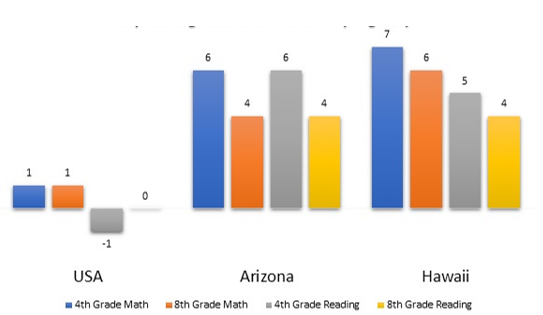
NAEP GAINS by subject, 2007-2019 for USA, Arizona and Hawaii
Hawaii’s academic gains could be of particular interest to Arizonans, because if they were induced by policy change, it is a possible source of improvement that Arizona has yet to adopt.
The state of Hawaii operates as a single school district, and also has a relatively modest charter school sector. While Hawaii ranked last in a 2020 study among states for K-12 parental choice, Arizona ranked first. State rankings in this study had a positive impact on academic gains. States with greater options for parents had statistically significant gains relative to states without it, all else being equal after controlling for other factors.
In Hawaii, however, it seems that all else was not equal. Hawaii has achieved respectable academic gains in a fashion different from Arizona. Yet Hawaii’s reform strategy is not mutually exclusive from Arizona’s. In other words, Hawaii could open more charter schools and pass private choice programs and Arizona could adopt weighted student funding.
Florida, by the way, also has a law on the books called the Equity in School Level Funding Act that prevents the sort of funding inequities seen in Tucson Unified. The law requires districts to allocate 90% of their funds to campuses as a whole, the “central office” thus employing up to 10% of funds, but no more. It also requires that no individual school receive less than 80% of their formulaic share.
Additionally, it Includes local rather than solely state funding, a crucial element in many districts heavily funded by local property taxes, such as those in Florida and Arizona. Such a provision in Arizona statute would make it illegal for the district cited above to fund a school at a $5,015 per student level, setting a floor for a minimum level of funding per campus.
The act also allows school principals to carry over funds year to year at the campus level without having them revert back to the district. This provision encourages school leaders to consider opportunity costs and avoids a “use it or lose it” perverse incentive, which creates a powerful incentive for administrators to spend money on almost anything rather than lose it entirely. But with carry overs, school administrators have the incentive to engage in longer-term planning.
A quick perusal of funding per pupil between campuses in Florida reveals that this act either has some sort of loophole or it is being routinely ignored. Perhaps Florida should say “Aloha” to funding equity as well.
 Matthew Ladner, director of the Arizona Center for Student Opportunity and executive editor of reimaginED, appeared as this week’s guest on the Ricochet Audio Network.
Ladner talked with host Jon Gabriel about Arizona’s improvements in education, made possible by the state’s robust school choice options which include charter schools and open enrollment.
Referencing studies from the Educational Opportunity Project at Stanford University, Ladner points out that Arizona students have the fastest rate of improvement in the country, both overall and across subgroups, including low-income; in other words, Arizona students are learning more per year than students in any other state.
Additionally, Ladner notes, an active system of open enrollment transfers between and within school districts are offering what’s most important to Arizona families: meaningful access to various types of schools.
You can access the interview here.
 Deadweight loss, also known as excess burden, is a cost to society created by market inefficiency. It occurs when supply and demand are out of equilibrium. Mainly used in economics, it can be applied to any deficiency caused by an inefficient allocation of resources.
Here is how Wikipedia defines deadweight loss:
A measure of lost economic efficiency when the socially optimal quantity of a good or a service is not produced. Non-optimal production can be caused by highly concentrated wealth and income (economic inequality), monopoly pricing in the case of artificial scarcity, a positive or negative externality, a tax or subsidy, or a binding price ceiling or price floor such as a minimum wage.
One way we can think of the education reform movement is to view it as an attempt to lessen an artificial scarcity of different school models. Left to their own devices, teachers and families might develop all sorts of different schools.
The development of the American public-school system involved a local, publicly funded monopoly, widespread standardization, and regulatory capture. The K-12 choice movement has changed this in a limited way.
Only a tiny handful of state charter school laws have grown robust enough to provide tension in the system. The same would be the case if charters, private choice, and homeschooling practices are considered in combination. Ergo, deadweight loss in K-12 education, with an artificial scarcity of diverse schools, endures.
Two studies ranked cumulative choice. The first debuted in 2000 and was followed by another study 20 years later. Arizona ranked first in both studies.
The Arizona of 2000, with a liberal but still small charter sector and a single, small private choice program, seems quaint by today’s standards. To maintain the No. 1 ranking, Arizona lawmakers expanded the nation’s first scholarship tax credit, created three new ones, passed the first education savings account program, and created a charter school sector that currently educates 22% of public-school students.
Perhaps most consequential, Arizona’s choice programs induced a very active open enrollment process within and between school districts.
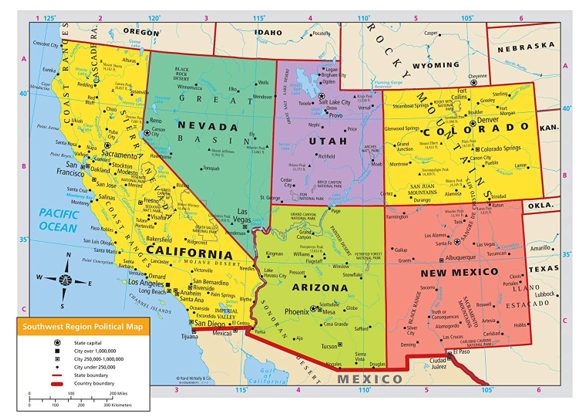
The Educational Opportunity Project at Stanford University linked state testing data across all 50 states, with current data covering 2008-18 for grades 3-8. The chart below compares Arizona with its five border states – California, Colorado, Nevada, New Mexico and Utah – showing academic growth for poor and non-poor students.
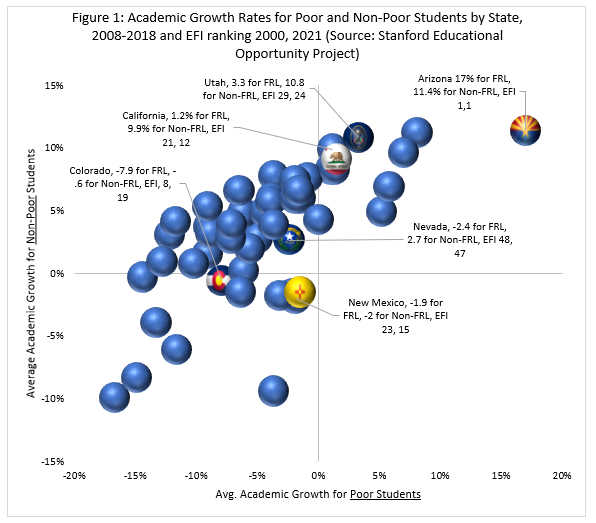 These states have demographic similarities, and all have been marked by the large increase in Hispanic students over the past 40 years.
A noteworthy point: California has the second highest EFI rating in the Southwest. California’s large charter sector has a lot to do with this, but sadly, politics recently have surfaced to create an artificial shortage of seats.
Figure 2, below, presents the same Stanford data:
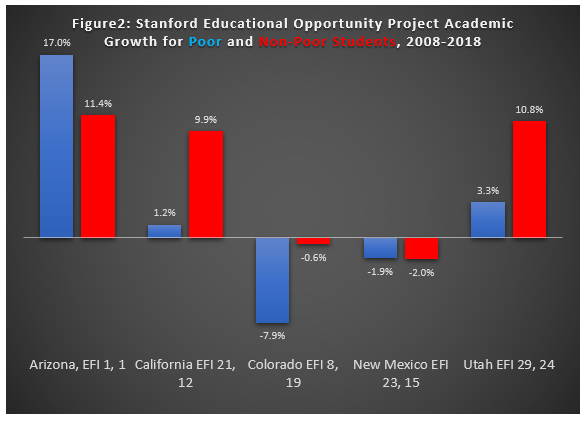 The Education Freedom Index studies demonstrated a statistical association between education freedom scores and academic trends. The Stanford data shows that although Arizona has the highest rate of academic growth for middle/high income students, there are a few other states in their neighborhood, including California and Utah.
When it comes to academic growth for low-income students, Arizona has no peer either inside or outside of the Southwest. We don’t fully understand what drives academic growth, but outside the very active system of choice, Arizona’s K-12 policies are fairly typical, and the state’s student demographics are not wildly different from neighboring states.
So, what is so different about the K-12 system for low-income kids in Arizona? In a word: access.
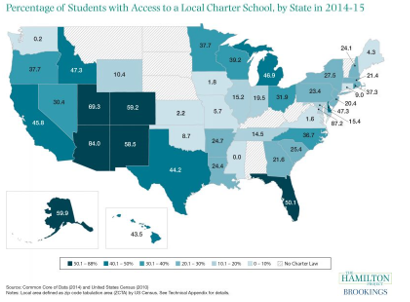 Poor children in Arizona have greater access to charter schools. They also have access to leafy suburban districts:
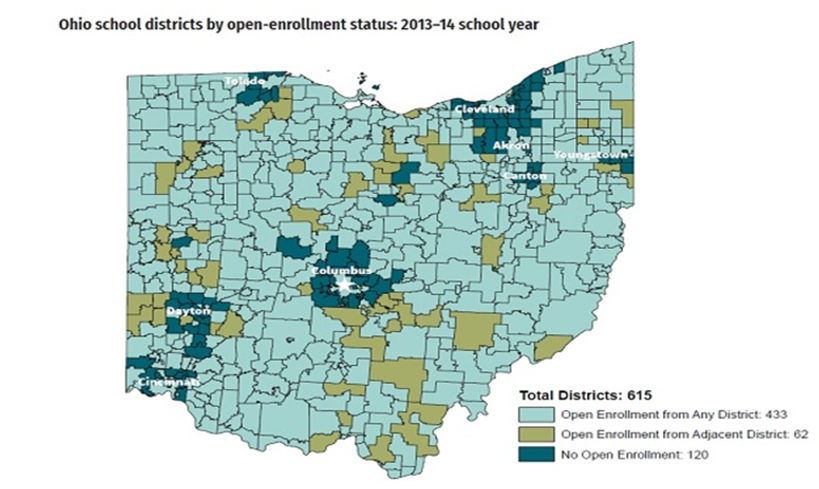
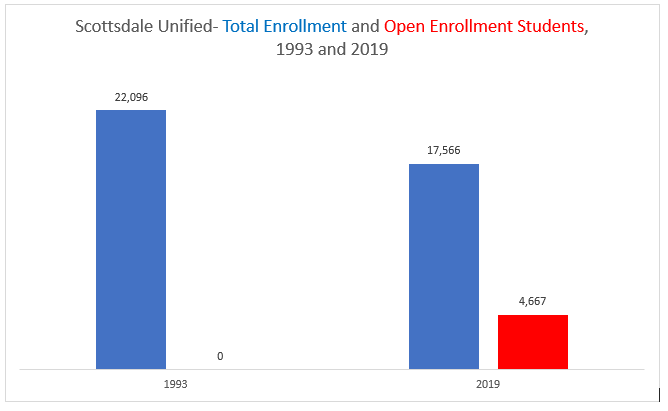 The 9,000 students who live within the boundaries of Scottsdale Unified but attend school elsewhere probably have a great deal to do with the access provided to the open enrollment kids. Just as a reminder of how unusual this is, see if you can locate the fancy suburb in Ohio participating in open enrollment at all:
 Finally, four different scholarship tax credit programs and the Empowerment Scholarship Account program increase the accessibility of low-income families (and others) to attend private schools. It appears to me that with access comes accountability: charters with low demand close quickly. District schools with low demand persist longer, shuffling along before eventually being closed.
This is far from ideal, as zombie schools draw resources from other schools in the same district.
Rationally, districts should expand high-demand schools and close low-demand schools. While politics rather than reason rules the affairs of districts in Arizona and elsewhere, the incentives are pointed in the right direction.
Arizona families seem pretty good at picking schools with which to entrust with their children. Meanwhile, rather than viewing high-demand schools as a fixed and scarce asset, Arizona policies have created incentives for educators to open new ones.
As these circumstances unfolded over time, deadweight loss lessened. The kids who start with the least gained the most from this process. Let there be more of it.

