Arizona ESA families rallied at the state capitol Monday to oppose Gov. Katie Hobbs' proposals to “reform” the Empowerment Scholarship Account program. Lawmakers who spoke at the event pronounced the Hobbs proposals “dead on arrival” to the cheers of parents and students at the event.
Perhaps the sentiment of the families could be summed up on a student's sign that read:
Keep Katie’s Hands Off of My Future
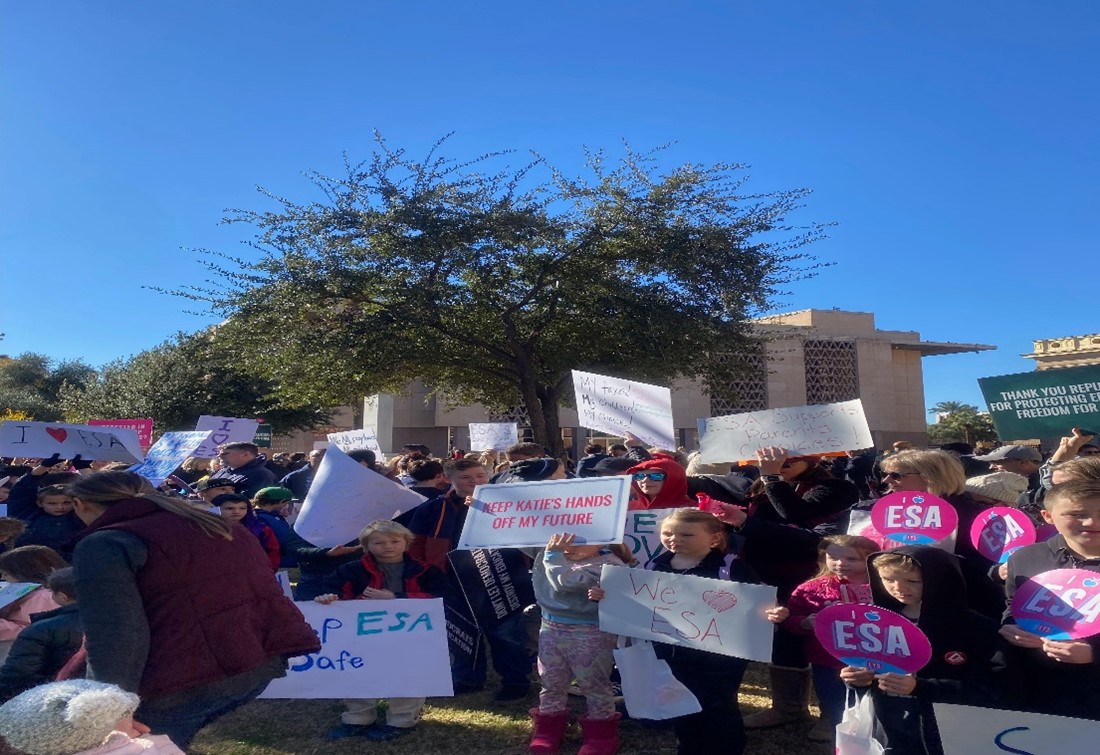
A few hours later, Hobbs made it clear in her State of the State address that she does not intend to keep her hands off the ESA program:
We have seen a steady stream of news coverage around unacceptable and sometimes downright outrageous use of taxpayer money under this program, including water park admissions, ski passes, and luxury car driving lessons.
It is our responsibility as stewards of this state to put in place guardrails to ensure taxpayer dollars dedicated to education are used properly. Without these guardrails, waste, fraud, and abuse take root and thrive.
We can deliver common sense solutions like ending the luxury spending, keeping our children safe by requiring background checks for educators, and expanding the authority of the auditor general. Additionally, let's require recipients to have attended a public school for at least one hundred days, a reasonable standard that would save our state a quarter billion dollars.
My message to parents across Arizona, whether your family takes part in this program or not: Now is the time to advocate for accountability and for transparency, not a blank check. If we fail to do so, the current projected price tag of one billion dollars is only the start.
Hobbs’ comments display a deep misunderstanding of the Empowerment Scholarship Account program. Lawmakers structured the program as a contract between a family and the state, with mutual obligations and benefits. Once signed, ESA funds are no more “taxpayer dollars” than the salaries paid to state employees. No one in Arizona is the least bit concerned with “luxury purchases” made by state employees, nor should we be; they are none of our business. Parents are bound by their contract to follow program rules; thus, the Arizona Department of Education decides which purchases are within the boundaries of the statute. Most of the ESA purchases opponents complain about were made during the tenure of the previous head of the Arizona Department of Education. Former state Superintendent of Public Instruction Kathy Hoffman, a Democrat, did not support the ESA program, but she made a good faith effort to follow the statute.
Taxpayers provide ESA students with approximately 50% of the funds that a child would receive in a district and get more flexibility in the spending of those funds. Far from “lacking accountability,” the ESA program hugely enhances the most meaningful form of accountability: an exit option. No one can know for certain why Stanford University scholars found Arizona students had the fastest rate of K-8 academic growth. The state’s pervasive choice however is a much more plausible explanation than highly proficient technocracy emanating from state bureaucracies and unknown to other states.
Arizona private schools already perform background checks, and state statute already requires them to do so. Mandating 100 days of public-school attendance would cost taxpayers billions of dollars, as it would double fund students if they landed in public school enrollment counts. It would also prove cruelly disruptive to students and schools to force thousands to leave the ESA program and enroll in a public school to be eligible to re-enroll in the ESA program.
Last year, Hobbs called for an outright repeal of the ESA program. This year she has made a disingenuous set of proposals designed to achieve a similar purpose. Arizona’s ESA families and lawmakers seem ready to fight. Stay tuned for further developments.
Americans started a Baby Bust in 2008 (on behalf of Gen-Xers-welcome you to the club youngsters!) In addition, the public school system seems determined to do their best imitation of Side-Show Bob marching over rakes since 2020, prompting a great many American families to make other schooling plans. Peak school district enrollment clearly lies in the past. In the states having created or expanded private choice policies, advocates should be prepared to have attempts made to scapegoat choice programs for district school closures. For example, last week in Arizona:
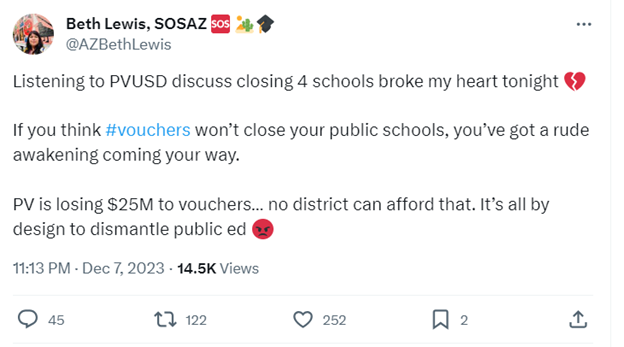
The Arizona Department of Education put out open enrollment reports by districts in 2022 and reported where residents of the Paradise Valley Unified School District attended school. In addition, the Department reported ESA enrollment by quarter, so the final quarter of 2022 is included below.

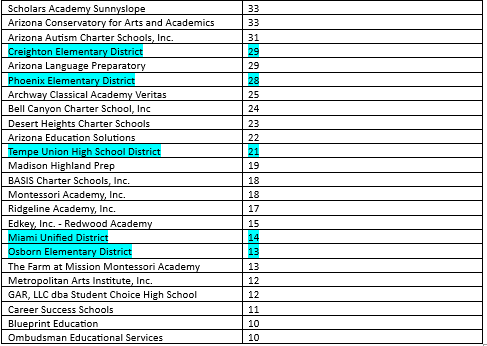
Scottsdale Unified, which borders Paradise Valley Unified, is the biggest “drainer” of students residing within the boundaries of Paradise Valley Unified, if you are misguided enough to see students as indentured peons. If however you view students as human beings with agency and dignity, you might look at the above table and think “wow- that’s a lot of diversity, variety and pluralism!”
2022 was before the universal ESA expansion fully took effect, and the 2023 ESA report has 2,712 residents of Paradise Valley Unified School District enrolled in ESA. As you might discern from the above table, these students had tons of options on where to go to school other than their local district. Moreover, if we add up the total number of kids attending other school districts (marked in light blue) from 2022 and compare it to the number of 2023 ESA students, the numbers look like this:
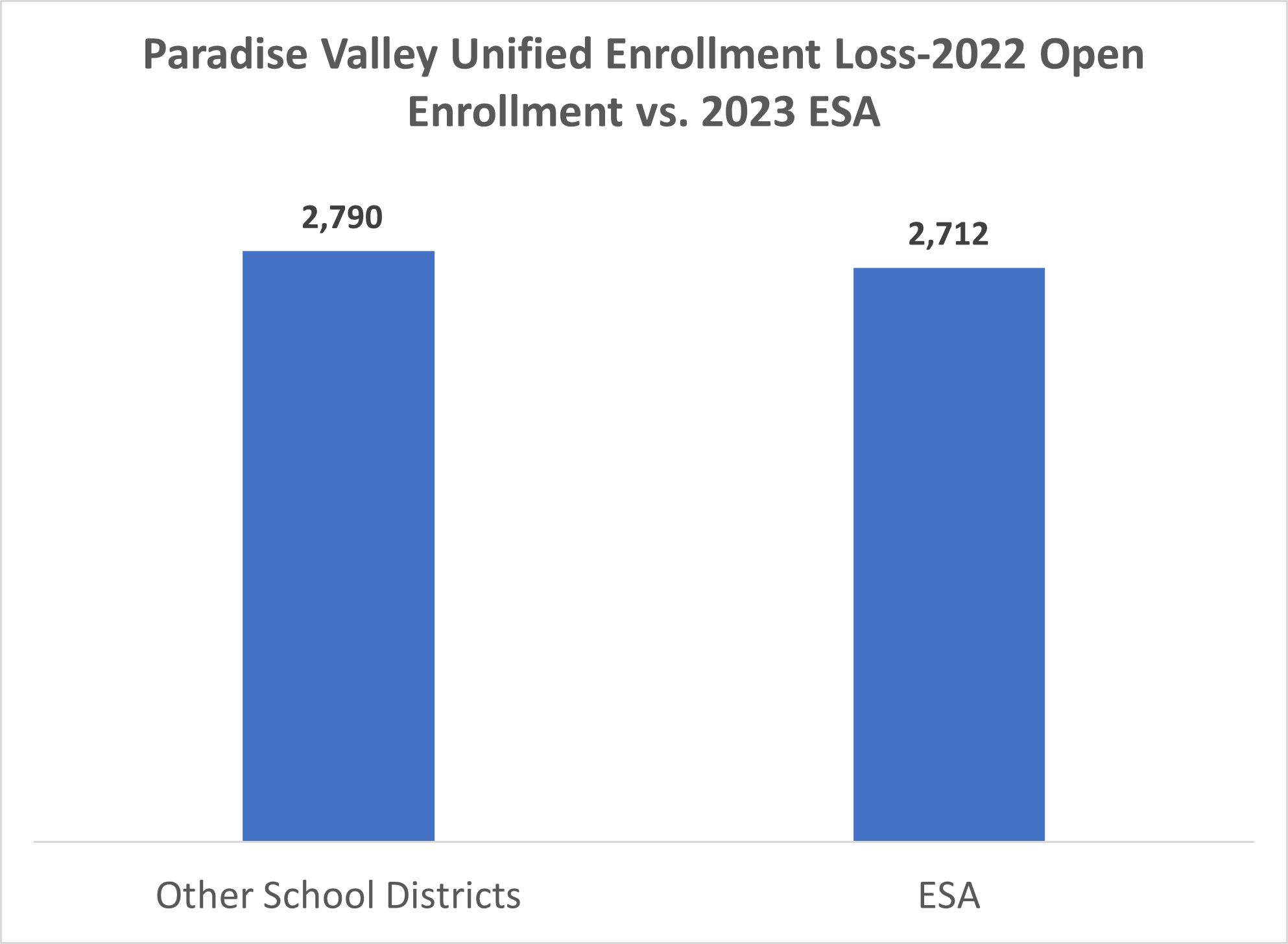
Note that Paradise Valley has been losing students to other districts for decades, whereas the ESA program is a relative newcomer. Right about now you might be asking yourself “Self, why don’t choice opponents ever complain about open enrollment?” I can’t be certain, but it might have something to do with the fact that kids transferring between unionized districts doesn’t bother them overly much, but that would be speculation on my part.
In any case, Arizona is 15 years and counting into a Baby Bust, and the state has millions of square feet in unused or underutilized district school space. School closures seem inevitable, raising the question who should decide? Arizona families should carry on voting with their feet on which schools endure, which replicate or expand, and which to close.
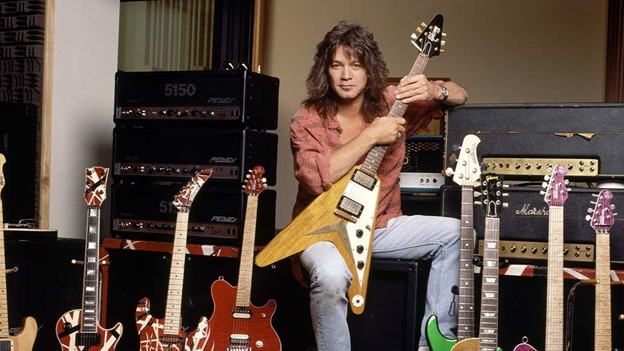
Edward Van Halen gave a fascinating interview at the Smithsonian Institution a few years before his death in a program, “What It Means to be an American.” Van Halen’s parents married in Indonesia when it was a Dutch colony; his father was a Dutch musician, and his mother was Indonesian. Immigrating to America after World War II, the Van Halens helped pay their boat fare to America by playing the piano for other passengers. Van Halen describes how he revolutionized guitar playing despite never learning to read music.
He explained that the instrument would not do what he wanted it to, so he had to change it through years of experimental instrument engineering, destroying many vintage guitars in the process. Van Halen earned three patents and developed a playing style that required a new form of musical notation (which Van Halen confessed to being unable to read more than standard musical notation). Van Halen was equally innovative with his playing techniques and revolutionized popular music with stuff like this. The interview is a window into the mind of a creative genius, and we could use more of this in school choice.
The first account-based choice program passed in 2011, debuting with approximately 150 Arizona students. Significant strides have been made in the number and inclusiveness of such programs, and many companies have entered the space to assist officials in program administration. The task of administering these programs is very complex and will need an Eddie Van Halen-level commitment to innovation to push them to their full potential.
The original hope of the Arizona Empowerment Scholarship Account creators had been to use debit cards and plug into a pre-existing system of vendor and product codes. Vendor codes prevent purchases at unapproved vendors (think Caesar’s Palace), and product codes prevent the purchase of prohibited items (think poker chips). The program administrators issued debit cards but have yet to be able to adopt product codes. A system of family receipt submission and review followed. As detailed by a first Arizona Auditor General review, it did not go entirely smoothly but had a far lower overall misuse of funds rate than other programs at around 1%.
Later, the Arizona authorities requested proposals for a digital vendor to facilitate account transparency and purchases but retained the debit card function as an option for families. Arizona ESA families have fought hard to keep the debit card as an option.
Arizona is currently the only ESA program with a debit card mechanism, and those cards have successfully implemented vendor codes. As detailed by the Arizona Auditor General’s Special Audit of the Empowerment Scholarship Program:
Our review of all 168,020 approved transactions identified in the Department’s Program account transaction data between October 31, 2018, and October 30, 2019, found only 1 successful marketing at an unapproved merchant totaling $30.
That 168,019 to 1 ratio represents a resounding success for vendor codes. We won’t know how well product codes work until someone tries them (preferably with anti-fraud chips common in credit cards but rare in SNAP). Arizona ESA debit cards have yet to be perfected, and yet no one in any other state has tried them. The instrument, in other words, is not yet quite doing what the player wants, and we require further innovation.
Debit cards with vendor and product codes are not mutually exclusive with online platforms, and these two mechanisms could be linked in a fashion like private debit cards and bank account websites. If linked platforms and optimized cards can be achieved, it would still be necessary for administrators to decide which products can and cannot be purchased. Administrators will read statutory language and make rulings on purchases regardless of the technologies used.
The Arizona Department of Education recently ruled on whether an Arizona ESA family could purchase an advanced bow to teach their student archery. Public schools have long included archery lessons in physical education classes. In consulting educators involved in archery, however, they determined that advanced bows were not used in teaching students. The Arizona Department of Education used this as a rational basis for denying the purchase of an advanced bow with an ESA.
We should greatly prefer a rational basis over an arbitrary basis for allowing or denying purchases. Hopefully, the broader universe of choice administrators is like Van Halen in his studio, going through trial and error to develop a more potent instrument.
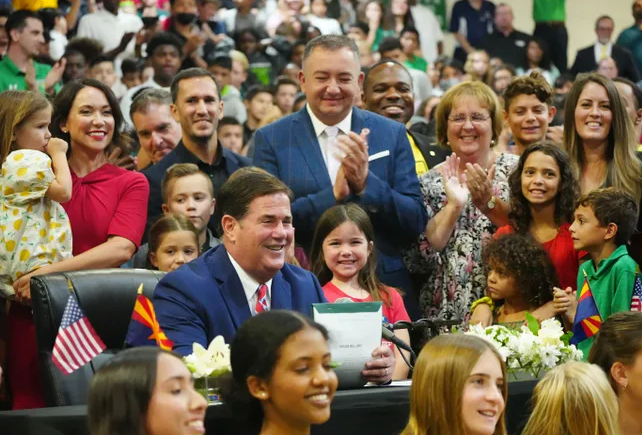
Arizona Gov. Doug Ducey at signing ceremony for bill that massively expanded education savings accounts
Editor's note: This post was originally published on realcleareducation.com. The author, Jude Schwalbach, is an education policy analyst at Reason Foundation.
After an Arizona citizens’ referendum failed to block the state’s massive expansion of Empowerment Scholarship Accounts last month, the Grand Canyon State now leads the nation in education customization.
Arizona’s education savings account (ESA) expansion was a critical school-choice success, but the story should not stop here. Policymakers can do two things that go beyond Arizona’s reforms to truly revolutionize a state’s education system: make ESAs the default option for all students and eliminate residential assignment in public schools.
First, policymakers should not limit ESAs to those opting out of public schools but rather make these accounts the default funding system for all students. Instead of funding school districts based on factors such as property wealth, local tax effort, and complex formulas, state and local education funds would be streamlined and deposited into each student’s account.
Under this system, these accounts would not just be used for private school tuition payments. Parents who enroll their children in public schools would pay these schools directly and could also use education savings accounts to pay for tutoring, courses at a community college, classes at a nearby public school, transportation, and more.
To continue reading, go here.

"I don't know who you are. I don't know what you want. If you are looking for ransom, I can tell you I don't have money, but what I do have are a very particular set of skills. Skills I have acquired over a very long career. Skills that make me a nightmare for people like you. If you let my daughter go now, that'll be the end of it. I will not look for you, I will not pursue you, but if you don't, I will look for you, I will find you, and I will kill you." — Liam Neeson
Arizona’s passage of universal ESAs leads to the question, “What’s next?” Some feel concerned that any number of rando grifter types will attempt to open private schools. Perhaps so, but then they will be snuffed out by an education sector that has developed a very particular set of skills acquired over a very long period of competitive K-12 policy. They will look for the students of grifter schools, they will find them, and they will kill schools that fail to satisfy parents. It’s all happened before, and it will all happen again. Saddle up; keep your cool; give it time. The ending here is as predictable as Taken.
Arizona started down the road to K-12 choice in 1994 with a liberal charter school law and a law forbidding open enrollment tuition. In 1997, lawmakers passed the first scholarship tax credit program, which was expanded multiple times. In 2011, Arizona lawmakers passed the first Education Savings Account program.
Most Phoenix area K-8 students do not attend their zoned district schools. District schools both lose and gain enrollment in the process. Low demand charter schools tend to fold quickly. Low demand district schools often go through a radioactive half-life as mostly empty zombie schools, but eventually school boards close or consolidate them. Zombie schools drain resources from teacher compensation, but school boards are famously cowardly when it comes to making painful adjustments opposed by angry mobs of parents. More district than charter students are affected by school closures overall, but the process grinds on year to year.
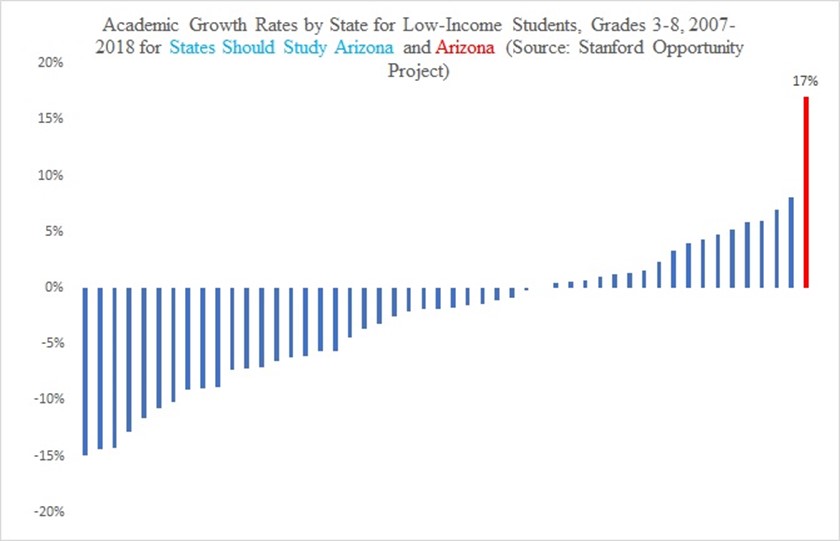
The survivors of 28 years of this process have developed a very particular set of skills. Numbered among these: driving the nation’s highest rate of academic growth as documented by the Stanford Educational Opportunity project. Below is a chart showing the rate of academic growth for economically disadvantaged students by state:
What is the “very particular set of skills” that makes me confident that Arizona educators will crush grifters? Three decades of working with families to figure out what they want for starters. Advanced experience dealing with real-estate, zoning and debt markets and recruiting teachers and training them up to achieve the above results. If you can imagine a type of school, an Arizona charter or district has probably either already tried it, discarded it, or else is running it. Demand discovery has been underway for almost three decades. The ESA program creates a new tool for these and other educators to employ.
I have never seen “Taken,” but put me down but as “all-in” on Liam Neeson putting down the bad guys. It will take time. There will be complaints and headlines. New models that satisfy parents will emerge. For decades now if you wanted to open a school in Arizona you had to bring an A-game. Nothing has changed on that front.
Arizona educators have dispatched grifters before. Watch them do it again. I can’t wait to see what America’s apex educators make with their new tool.
Word began to leak yesterday that the Save Our Schools group had misrepresented the number of signatures gathered in an effort to thwart Arizona’s universal ESA expansion. It now appears all but certain/official that they did not gather the needed 118,000 petition signatures required to freeze the expansion and hold a vote on the measure. So, what happens next?
Contra the fears of opponents, the Arizona sky will not rain frogs. Arizona already has universal access to district schools, universal access to charter schools and universal access to a limited pool of tax credit funds. The current size of the program looks to approximately double, based upon the number of applications received, but up to about 2% of the K-12 total. Where it goes from there will depend upon supply and demand. The profound change will be that the program is available to the family of any student who feels in need of it.
James Glassman’s excellent profile of Governor Doug Ducey rightly begins this tale in the early 1990s. Gov. Fyfe Symington and fellow pioneers such as Lisa Graham Keegan, Tom Patterson and Armando Ruiz passed the initial charter school and district open enrollment in 1994. Patterson recalls a legislative debate in which he called for district open enrollment, and his opponent claimed it was “the craziest thing I’ve ever heard.”
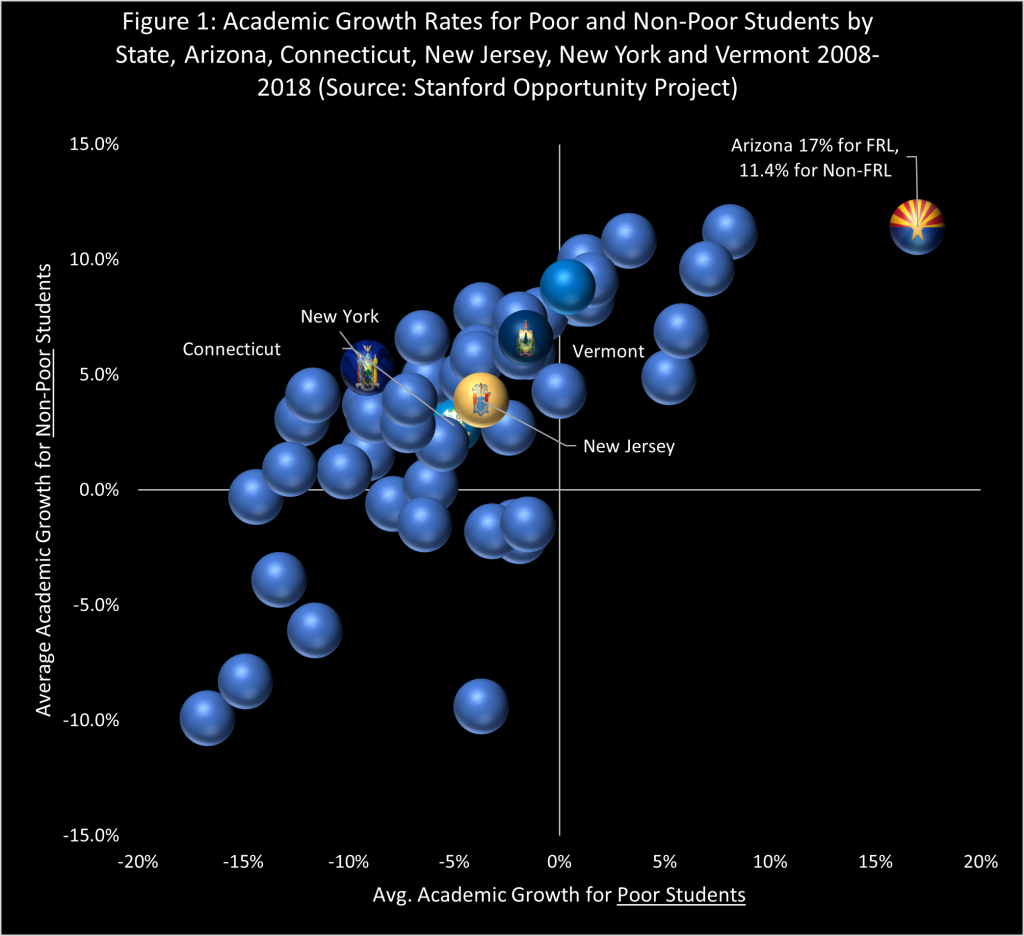
Decades later, we learned that a majority of Phoenix area K-8 students don’t attend their zoned district school. Stanford data (shown above) shows Arizona led the nation in the rate at which students learned between 2008 and 2018, leaving behind northeastern states that spend much more per pupil. Patterson was crazy all right, crazy like a fox.
Over the past three decades, Arizona’s choice policies have allowed an amazing group of educators the opportunity to flourish. An amazing diversity of schools bloomed in the desert, and a huge amount of expertise developed. Families have decided which schools to reseed and which to pull like weeds. The survivors of this process are the most effective group of educators in the nation judging by academic growth, and before the pandemic they lacked a close second. They have a new tool now. This isn’t like Russia conscripting unwilling blokes from the pub, more like NATO giving advanced weaponry to Ukrainian special forces.
Arizona pioneers deserve our praise and thanks, but so to does this generation of leaders. Ducey is ending his eight years as governor having expanded freedom, slashed red tape and strengthened the state’s economy. Well done and many thanks! Legislative leaders such as state Rep. Ben Toma were absolutely fearless in pursuit of education freedom, as was outgoing state Senate Education Committee Chairman Paul Boyer. The advocacy efforts of the American Federation for Children, the Goldwater Institute, and the Center for Arizona Policy achieved this feat faster than I believed possible. I have never been so happy to eat a plate of crow!
Many trials lie ahead. Arizona’s undaunted commitment to freedom and self-determination in schooling has already been richly rewarded. I feel confident we will surmount every difficulty. “'Tis the business of little minds to shrink,” Leonardo da Vinci wrote “but they whose heart is firm, and whose conscience approves their conduct, will pursue their principles unto death.”
Firm your hearts, Americans. The families in your states need this as well.
"Horse racing" by Paolo Camera is licensed under CC BY 2.0.
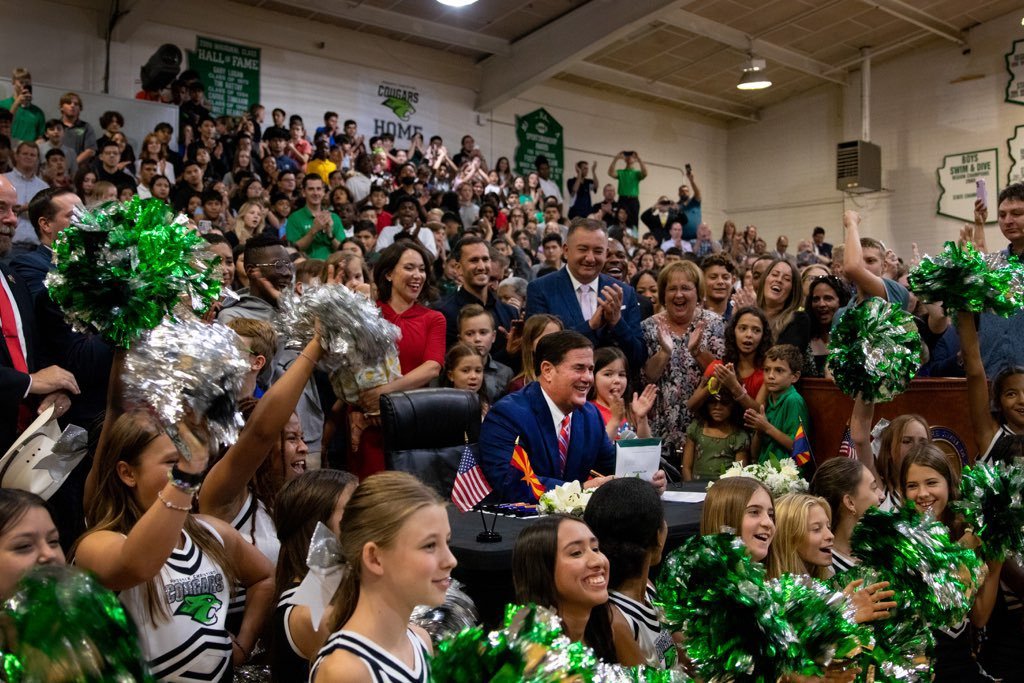
Arizona Gov. Doug Ducey joins students and families to celebrate historic legislation establishing education savings accounts for all students in the state. Photo courtesy of the Governor's Office
Editor's note: The following is a news release from the Arizona Governor's Office
Arizona Gov. Doug Ducey on Tuesday joined families, educators and community leaders to celebrate Arizona’s successful effort to ensure every Arizona student can attend any school of their choosing.
“Arizona is now the gold standard for educational freedom in America,” Ducey said in a news release. “Our kids will no longer be stuck in under-performing schools. We’re unlocking their educational potential and advancing a bold new era of learning opportunities. Parents and teachers know there is no one-size-fits-all model to education. Kids and families should be able to access the school or learning program that best fits their unique needs — regardless of income or where they live. In Arizona, we’re making sure they have that choice.”
The governor spoke today at Phoenix Christian Preparatory School alongside parents and their kids who have benefitted from Arizona’s Empowerment Scholarship Accounts (ESA), as he signed a bill that opens the scholarship program to every K-12 student in Arizona.
The legislation, sponsored by Rep. Ben Toma, has been lauded as the most expansive school choice initiative in the nation.
“I was proud to continue the Arizona tradition of leading on school choice and bring educational freedom to more than 1.1 million students,” said Toma, the House majority leader. “By opening Empowerment Scholarship Accounts to every K-12 student, we will improve outcomes and make choice a reality for all students. This session, we stood together to get this done for Arizona students and parents. Governor Ducey has been an invaluable partner in transforming school choice in our state, leading the way in unlocking the schoolhouse door.”
With ESAs open to all students, Arizona solidified its position as the gold standard for educational freedom. In a story published today, Chris Rufo, senior fellow at the Manhattan Institute, said “universal school choice has long been the Holy Grail for conservative education reformers. Governor Ducey has achieved it.”
The ceremony at Phoenix Christian was highlighted by elementary schoolers singing a welcome song and stories from Arizona families of how school choice has unlocked their children’s full potential.
One of those parents is Jenny Clark, who, after her own children’s positive experience with ESAs, has helped other parents take the opportunity the program presents.
“Arizona’s Empowerment Scholarship Account program is truly life-changing for so many of our state’s children,” Clark said. “My five children have benefitted from ESAs and I can’t help but think how many kids don’t get the help they need. Now, they will. Every child in Arizona will have the same opportunities and ability to get the education tailored to their needs. Governor Ducey has led on this issue, expanding school choice to every family.”
Parent Annie Meade has seen firsthand how Arizona’s education options can impact a child’s education. Her four children have had a combination of homeschool, microschool and public education. Universal ESAs stand to bring new opportunities to her kids, who are now all eligible. Meade spoke about her enthusiasm for the education savings accounts at the ceremony today.
“Kids deserve to be in the education environment in which they can thrive, but so many families have been limited by their income, or zip code,” said Meade. “The Empowerment Scholarship Account program was something that I learned about from other friends who had qualified, but unfortunately, our family never had access to the scholarship, until now. The passage and signing of H.B. 2853 means that now every Arizona family will have the freedom, the choice, and the opportunity to choose an ESA for their child’s education…Thank you again, Rep. Ben Toma, and Governor Doug Ducey, for making this scholarship a reality for families like mine.”
The students at Phoenix Christian are no strangers to the benefits of education savings accounts. Jeff Blake, the school’s superintendent, spoke about the resources and one-on-one learning students receive at his school.
“At Phoenix Christian Preparatory, we are proud to have 31 students on Empowerment Scholarship Accounts,” Blake said. “This funding has helped our school serve many students in need and bring them an education that best suits them. With universal school choice, we’ll be able to serve more students with an exceptional education. We’re grateful for the foresight and leadership of Governor Ducey and the Arizona Legislature for prioritizing every K-12 student.”
Drew Anderson, senior pastor of First Watch Ministries and Legacy Christian Center in South Phoenix has worked with kids in his South Phoenix community to achieve academic success.
“Education is the great equalizer in America,” he said. “If we are able to give our lower-income families and minorities with better education, we’re unlocking the doors to success for so many who are often left behind. As a pastor I’ve seen too many of our black and brown children struggling, just looking for some guidance on homework. I’m grateful to Governor Ducey and the Legislature for saving our kids.”
Arizona families who participate in ESAs would receive more than $6,500 per year per child for private school, homeschooling, microschools, tutoring, or any other kinds of educational service that helps meet the needs of their students outside the traditional public school system.
Janelle Wood, founder of the Black Mothers Forum, spoke about the partnership she formed with Governor Ducey starting in 2020 to “fight to make sure our black children have an opportunity to live and breathe in a safe and supportive community whether that be a learning community, in their living community or in their homes.”
Wood continued, “As a concerned black mother, I want to make sure that we are heard loud and clear from this day forth. We matter, our children matter and we’re not going anywhere. We’re going to keep speaking to each system that holds our families back and our children back.”
Arizona’s universal education savings accounts now serve as the model for the rest of the nation to follow. Education choice advocate Corey DeAngelis, a senior fellow at the American Federation for Children, called the monumental legislation “the biggest school choice victory, not just in Arizona, but in U.S. history.”
Of the unprecedented school choice initiative, DeAngelis said, “This is how you truly empower parents and truly secure parental rights in education. I want to thank Governor Ducey for empowering every single family in the state of Arizona. This is a national model.”
He then led the crowd of students, parents and community members in a chant: “Arizona will now fund students not systems.”
Two important legislators in funding students were Senate President Karen Fann and House Speaker Rusty Bowers.
“Every parent wants nothing more than to see their child succeed,” Fann said. “This session, we committed to expanding educational opportunity. Working with Governor Ducey and the Arizona House, we delivered. Each and every Arizona student has access to an education environment that will suit their needs. The Empowerment Scholarship Account will transform education in our state and bring unlocked potential to our kids.”
“In Arizona, we fund students, not systems,” Bowers said. “One size does not fit all when it comes to education. Universal Empowerment Scholarship Accounts will ensure the money follows the children as they are enabled to attend the school environment that works best for them. The Arizona House of Representatives has worked collaboratively with Governor Ducey for years to expand school choice for every student. Today, we celebrate the empowerment of 1.1 million students and their parents to choose the learning environment they need.”
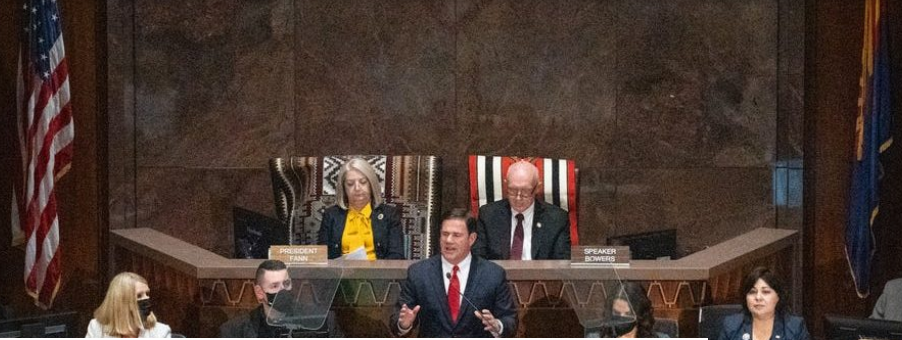
Education choice advocates nationwide are lauding Arizona’s recent expansion of school choice under the leadership of Gov. Doug Ducey via education savings accounts as the gold standard for the education choice movement and a model for other states to follow.
Editor’s note: This commentary on why Florida should follow Arizona’s lead on education savings accounts for all students appeared Tuesday on Tallahassee.com.
After elections and with our next legislative session, we should reclaim our opportunity to expand educational freedom to all young students in the state of Florida.
Florida’s well-deserved A+ position began over 20 years ago, when then-Gov. Jeb Bush lead educational reforms that established a strong foundation for success. Now, to continue building on that achievement, we must become more competitive in guaranteeing educational freedom. That means adopting universal Education Savings Accounts (ESAs).
ESAs are savings accounts managed by parents and used exclusively for the educational benefit of their child. The accounts give families the autonomy to direct their child’s funding to the schools, courses, programs, and services they choose.
This personalized approach to education maximizes each child’s natural learning abilities. Every child in Florida should have the flexibility to pursue the kind of education most tailored to their individual needs, and one that sets them up for lifelong learning and success.
Florida could learn a lesson from some other states. For example, West Virginia adopted a nearly universal ESA program that is open to all public-school aged kids or kids who are about to enter kindergarten, ensuring that more parents can access the kind of education that works best for their children.
Even better, Arizona is the first state in the nation to adopt an ESA program that provides true universal eligibility, allowing all families to decide what learning environment works best for their children. Gov. Doug Ducey signed the legislation last week and has voiced his excitement that Arizona is leading the way in expanding school choice, and this new law makes them the most educationally free state in the nation.
To continue reading, click here.
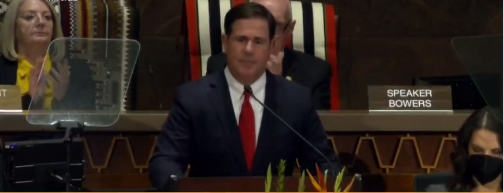
Arizona Gov. Doug Ducey told Arizona lawmakers earlier this year: "Send me the [school choice] bills, and I’ll sign them.” On Friday, they heeded his call.
The state’s lawmakers expanded eligibility for the Empowerment Scholarship Account program to all students in the state at the conclusion of the 2022 legislative session. Previously, approximately one-quarter of Arizona students were eligible to participate.
Also during the 2022 session, the Arizona Legislature substantially increased K-12 funding for public schools, and by a two-thirds vote, suspended an aggregate expenditure limit that would have prevented districts from spending money already in their possession.
The usual suspects will decry this session as “destroying Arizona public education” but actually what it represents is the next logical step in an experiment in education freedom.
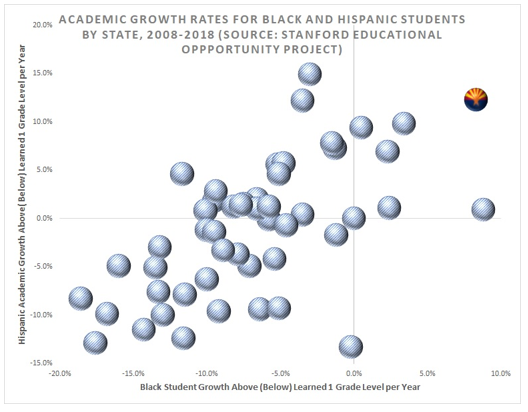
It is well worth noting that a great many indicators demonstrate that Arizona’s experiment with giving educators the opportunity to open new schools and in offering families the opportunity to choose among them was going quite well before the pandemic. I don’t think Arizona would be willing to trade places with any other state on the academic growth of Black and Hispanic students shown between 2008 and 2018:
 Arizona already has three universal education programs: school districts (which receive the highest amount of spending per pupil on average), charter schools (which educate a higher percentage of students than in any other state); and the original scholarship tax credit program. Arizona’s other choice programs are either means-tested or like the ESA program have served special student populations.
The original scholarship tax credit program has universal eligibility but only raised approximately one-sixth of the amount of funds raised by the largest of Arizona’s 207 school districts last year. In total, Arizona’s K-12 tax credits raised about $250 million last year, which is more than half the money received by the largest school district.
The Empowerment Scholarship Account program is funded on a formulaic basis like districts and charter schools, and thus could become larger than the tax credit programs over time.
Much wrangling is sure to follow. Assuming the expansion survives the attacks of opponents, I can safely predict the following:
Arizona public schools are not going anywhere. Their funding is guaranteed in the Arizona Constitution, their level of funding is already at a historic high, and will go higher still.
No “mass exodus” of students will occur out of Arizona’s other three other education models with universal eligibility. There are about 1.2 million public school students in Arizona, and the last survey of private schools that I am aware of found 26,000 available private school seats. That’s about 2.1% of students for those scoring at home.
Parental demand for private education, or possible lack thereof, will continue to shape the K-12 space in Arizona.
The Empowerment Scholarship Account program, of course, has many uses other than private school tuition, so we’ll have to see how things develop. As for learning pods, thousands of adventurous parents and educators already have found a way to “pod up” with students accessing public funding.
What is most important about any private choice program is not the number of actual participants, although it is quite important to them. The most important aspect of private choice programs is who can participate.
In other words, what is the funded eligibility of the program? This law will provide every student in Arizona a new education option and will be there if their families conclude they need it.
That is as it should be. All Arizona families pay their taxes, all deserve access to every K-12 program.
An education tool with the flexibility of the ESA creates new opportunities for teachers, families, and students. Arizona educators took their previous set of tools, and in a slow but steady process of co-creation, shaped a K-12 system with the amazing potential for expansion and replication. Parents demanded more of some schools, and either depopulated or closed others.
The best is yet to come.
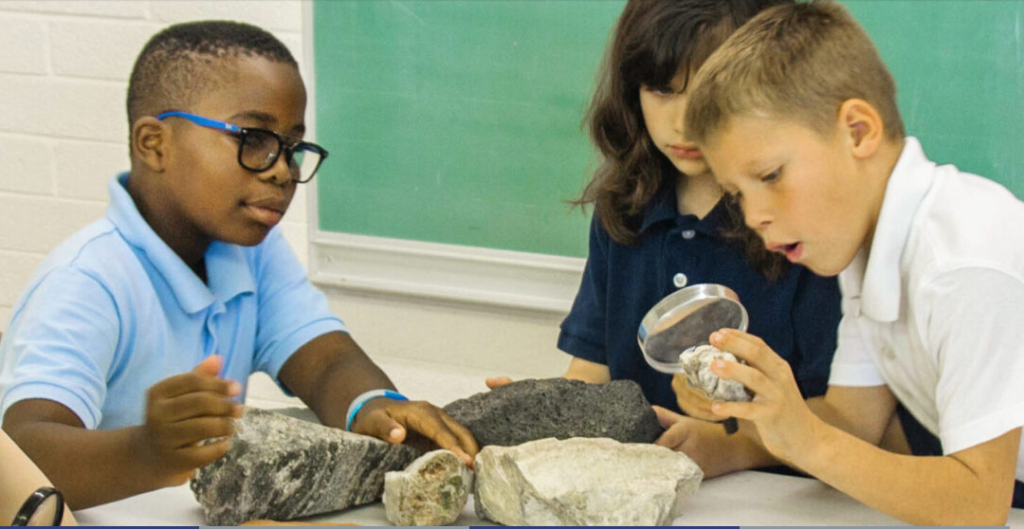
Redeemer Christian School in Mesa, Arizona, one of 451 private schools serving more than 66,000 Arizona students, bases its educational approach upon the classical teaching model known as the Trivium, dividing the academic life of a student into three stages reflecting the student’s natural capacity for certain types of learning.
Editor’s note: This Q&A about Arizona’s House Bill 2853 appeared last week on the Goldwater Institute’s website.
The Arizona Legislature has unveiled an ambitious plan to put K-12 students and parents first. Sponsored by House Majority Leader Ben Toma and co-sponsored by over two dozen of his peers, HB 2853 would open the doors to educational opportunity for kids throughout the Grand Canyon State.
While the bill has already cleared its first hurdle—passing the House Ways and Means Committee — it’s worth digging into what exactly the legislation does, and doesn’t do, for Arizona families.
What is the purpose of the legislation?
HB 2853 expands eligibility for the Arizona Empowerment Scholarship Account program to every family in the state. Families who participate would receive over $6,500 per year per child for private school, homeschooling, “learning pods,” tutoring, or any other kinds of educational service that would best fit their students’ needs outside the traditional public school system.
Any child who wishes to opt out of their local public school (or who already has) would be allowed to join the ESA program under the bill.
Many families simply lack the financial resources to pursue private or homeschooling options, while others have made financial sacrifices and shoulder the expense of private school tuition or paying for homeschool supplies. These families are all currently entitled to send their child to a public school (at a cost of over $10,000 per year to taxpayers), regardless of their income.
This bill would ensure that all families have the freedom to choose whatever form of education best fits their child’s needs.
Does this harm existing ESA families or will it crowd out families who are already eligible for the program?
No, this bill places zero new restrictions on any family who is already eligible for the ESA program, including special needs students.
To continue reading, click here.

