
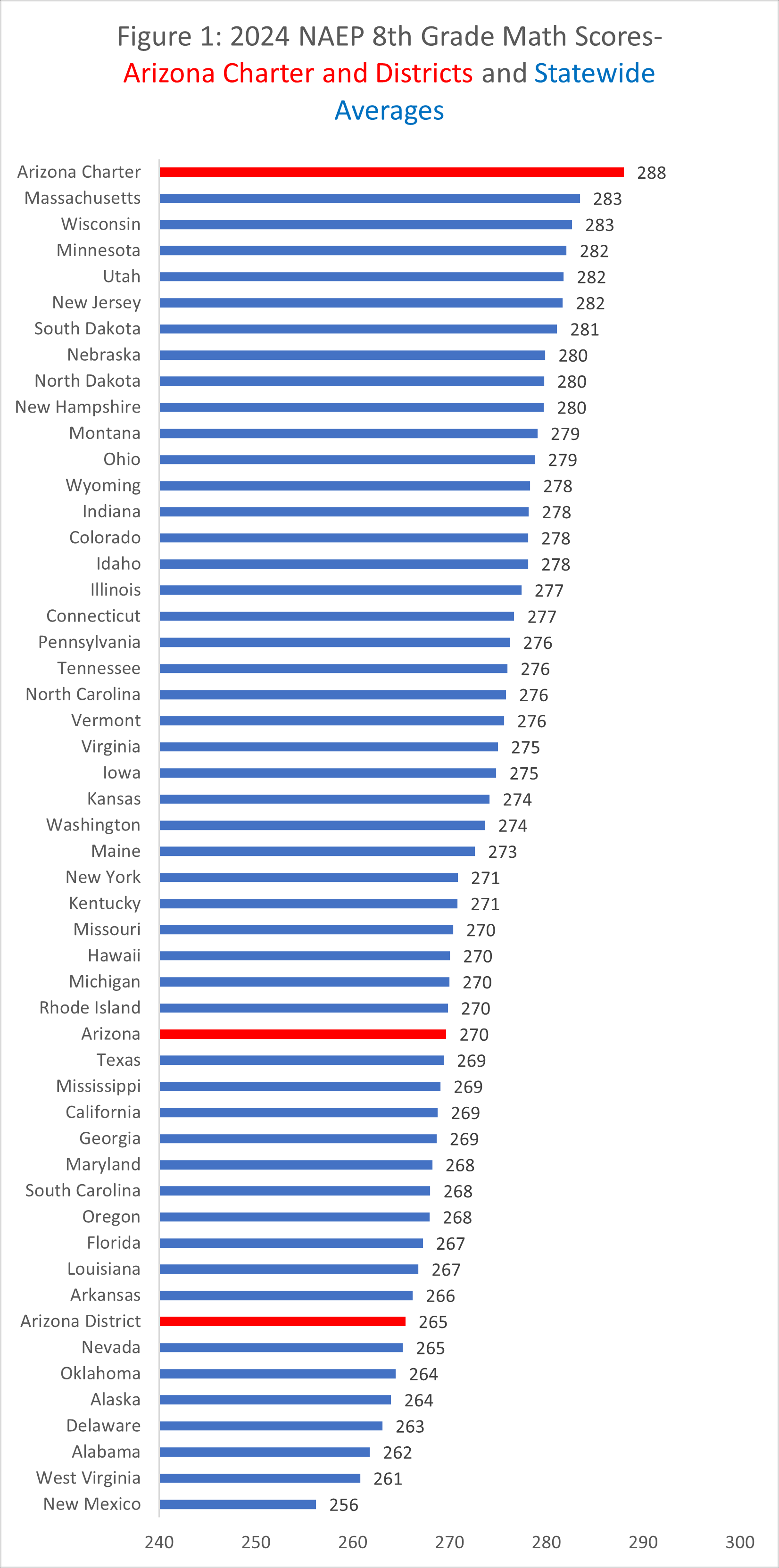
In examining the 2024 NAEP results for Arizona, a rather stark picture emerged that Arizona charter and Arizona districts had strongly diverged- Arizona charter schools show academic recovery, whereas Arizona district scores sank, in some cases, to all time lows. This came despite district spending standing not only higher than charters on a per pupil basis and standing at or near record high levels. Arizona charter schools still have an incentive to attract students, whereas during the federal money printing extravaganza districts of the COVID-19 debacle often spent a lot more money even as their enrollments shrank. The NAEP shows the scale of the academic gulf between Arizona charter school students and Arizona district students placed into context with statewide average scores on the 2024 eighth grade math exam:
Drowning districts in cash even as their enrollments shrink may have turned off the positive competitive impact of choice programs, and data published by the Common Sense Institute Arizona shows just how stark this has been. Kamryn Brunner and Glenn Farley of the Common Sense Institute Arizona have been tracking the enrollment and expenditure trends of school districts that have announced school closings since January 2025. I used their data to make Figure 1:

So, the word cloud that pops in my head when looking at this data prominently features “RECKLESS” and “IRRESPONSIBLE” and “UNSUSTAINABLE.” A few months ago the Arizona State Board of Education put the Isaac School District into financial receivership. This enrollment loss was not driven by Arizona’s ESA program, as the state’s open enrollment report shows 2,319 students who reside within the borders of Isaac attend public schools outside of the district (through open enrollment and charter schools) and the ESA quarterly report shows only 82 ESA students reside within the Isaac school district. The number of students who transferred from an Isaac district school to the ESA program will be smaller still, as these students may have previously been attending other districts, charter schools or private schools.
The districts in Figure 2 have announced a total of 13 school closings. Another chart from the Common Sense Institute Arizona shows far more is needed. The Arizona district system has physical capacity to serve almost 1.3 million students, but only 850,000 enrolled.

So how did Arizona districts wind up with a spare 450,000 spaces? There is not a single culprit. A baby bust started in 2008, but this seems not to have informed the decisions of districts. Part of the story is that Arizona families have less demand for district schools. The main culprit however is the usual suspect: politics. The Arizona Center for Investigative Reporting (AZCIR) and KJZZ reported in 2017 on financial relationships between a small group of architects, construction companies and subcontractors and the school districts in Maricopa County. They found that architects, construction firms and subcontractors accounted for nearly all the financial contributions made to Maricopa County districts’ bond and override campaigns from 2013-2016. This is dubious enough in a fast-growing district with clear facility needs, but it has also been happening in districts with shrinking enrollments.
Arizona should collect K-12 capital funding statewide, rather than on a local basis and provide it on an equitable per pupil basis to students. District and charter schools should be free to spend these funds in whatever fashion they feel furthers their educational mission, whether that is building a new school, patching a leaky roof, or paying their teachers. Districts with large amounts of underused space should, however, not receive these funds until such time that they return or offload such space to some sort of productive use.
Arizona is likely not the only state where the positive impact of competitive effects drowned in a sea of COVID cash. With the 2024 election having hinged largely upon an inflationary spiral coinciding with federal money printing, and 10,000 Baby Boomers reaching the age of 65 per day until 2030, the reckless level of spending on K-12 seems all but certain to reverse.
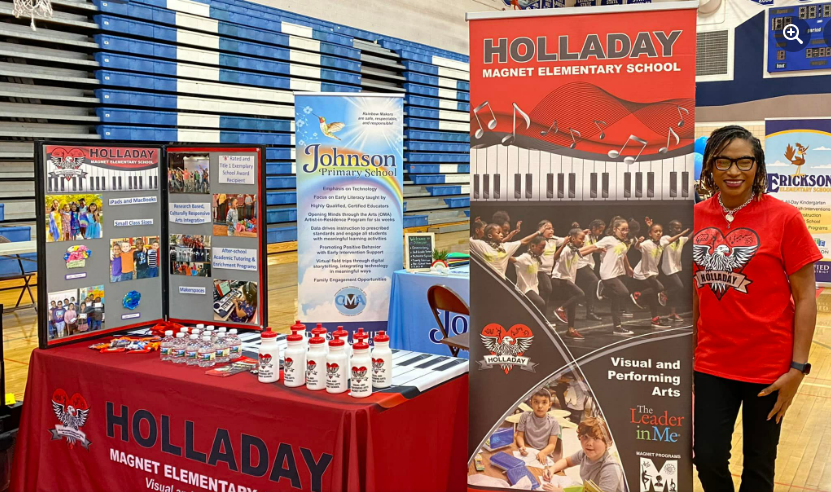
The mission of Holladay Fine Arts Magnet, part of the Tucson Unified School District, is to integrate visual and performing arts to foster creativity, equity, cultural responsiveness and innovation.
Editor’s note: This commentary was co-authored by these Arizona educators: Stephanie Miller, superintendent, Congress Elementary School District; Tonya Stroizer, principal, Holladay Fine Arts Magnet; Jessica Maskowske, school director, Western School of Science & Technology; Luis Perales, school leader, Mexicayotl Academy of Excellence; Angelina Canto, assistant superintendent of curriculum & instruction, Nogales Unified School District.
New data from the Center on Reinventing Public Education finds 93 of 100 large and urban districts have mentioned staffing shortages in the 2021-22 school year and close to half of these districts – 48 – are experiencing shortages across multiple departments and positions. Nearly two-thirds of districts are struggling to fill teaching or instructional aide positions. This trend is seen here in the Grand Canyon State as well.
The good news is that there is a tremendous opportunity with Senate Bill 1159 moving through the Arizona Legislature to reduce barriers to entering the profession and expand grow-your-own pipelines that can help leaders like us attract a broader, more diverse pool of talent.
We lead as principals and superintendents of vastly diverse models focused on project-based learning, college prep, STEM, and the arts. We have created diverse working environments that have created more teaching options for educators and diverse learning options for students and families in our rural and urban communities.
We need access to high quality teachers who are experts in their craft and will go above and beyond for our students. These additional pathways provide us with meaningful access to a diversity of educators who might not otherwise be able to access the certification process. We know what top talent looks like and we should be entrusted to make hiring decisions that best serve the needs of our students.
Opponents have suggested that this bill will lower the quality of teaching. This is absolutely false.
All candidates in any of these pathways must demonstrate the skills necessary to be successful with their students. In fact, this bill allows us to provide high-quality professional development experiences for these teachers based on cutting edge research.
The state cannot move as fast as the current need demands and more options are needed.
As leaders in the education profession, state policymakers should entrust us to make the right hiring and firing decisions for our students and families – having the best teachers in our classrooms is our priority. We aim to support the development of quality teachers.
For three school years, we have been challenged to rethink teaching and working in schools, redesign outdated models, and to reimagine learning for our students in a pandemic and soon post-pandemic world.
Last year, the Legislature passed House Bill 2862, which provided the option for schools and systems to have tremendous regulatory relief with seat time flexibility providing a runway to innovate. As more innovative models are developed, schools will need both teachers and school leaders with unique skills and talents to effectively lead their students to success.
This bill empowers interested local leaders like us with the tools to find, hire, and retain great talent we want. It’s not a mandate – but it’s an essential tool for the state’s most entrepreneurial, forward-thinking leaders to meet their classroom needs.
We have a growing school leadership talent pipeline crisis in our state too. Just as there is not one way to train to become an excellent teacher, there should not be one certification pathway to become an excellent school leader. State Bill 1159 empowers local school leaders like us with permission to develop the tools and programs to train and certify the next generation of high-quality school leaders. These pathways are meant to be locally driven and allow for high-impact work experiences so our school principal and assistant principal candidates can hit the ground running on day one.
The world of schooling and learning is changing. These new learning models are proving to be successful for our children, and more parents want access to them. We need new and additional preparation models to cultivate the next generation of teachers and school leaders. A diverse pool of talent that is locally trained is a benefit for the current teacher shortage and will help alleviate crowded classrooms and immediate staffing demands. This is an urgent need.
We know what excellent talent looks like and what our students deserve.

