
Hello again Florida. I’m glad to be “back” although still from a distance – a distance I hope that will continue to have a utility. I’ll get to that in a bit.
I’ve taken on a role as Editor of redefinED and I have been asked to introduce myself, which is not something I’m accustomed to or comfortable in doing. Bear with me.

Matthew Ladner, new Editor of redefinED.
Like a former Florida governor, I was raised by a proper Episcopalian family in southeast Texas in the late 20th Century. Also like this governor, I graduated from the University of Texas at Austin – he in 1978, me in 1990. The similarities trail off after that, however. Gov. Bush went off to a grandly successful career in politics, while I went on to study political science and became an obscure policy nerd, err wonk, no I mean analyst. Our family eventually moved from Texas to Arizona, where I happily remain today.
Random chance led me to an interest in K-12 reform in Florida. As an analyst at the Goldwater Institute, I was engaged in a debate about whether reformers should push choice-based reform or standards/testing-based reforms. At the time there seemed to be an easy answer to me – yes please. I remember thinking to myself, “If choice and transparency really are two great tastes that taste great together, I should be able to demonstrate that somewhere – but where?”
Florida.
Gov. Bush had relentlessly pursued both a standardized testing system and school grades and K-12 opportunity policies like charter schools, virtual learning and school vouchers. I decided to take a close look at Florida’s scores on the Nation’s Report Card (aka NAEP) to see if there was evidence of forward momentum. I was familiar with Arizona’s scores, and blinked and double checked as I found Florida’s minority students outscoring the statewide averages for all students in Arizona at the time. Looking around a bit more led to the realization that Arizona was far from alone.
Arizona of that time did not score well on NAEP, and worse still had developed what I regarded as complacency – something along the lines of if you control for demographics we are kind of average! Subsequently I’ve discovered that most states have a story like this – about how their state is the one with the tough to educate kids. The story in Arizona involved kids coming across the border unable to read Spanish, much less English, yadda yadda etc. In Minnesota, the story involves Hmong students from what I can gather. Close your eyes and I’ll bet you can recall a version of this story from whatever state you’ve lived in.
This is a myth of the self-defeating sort; this story deserves our respectful critique and ultimate rejection. If State X has the tough to educate kids and you know honestly can’t do anything with them then why do we have a public education system at all? In real life you don’t get to “control for demographics.” You either educate the kids that show up in your schools, or you don’t.
The fact Hispanic Floridians were reading about a grade level above the average Arizona student at the time became a useful data point in a personal campaign against Arizona complacency. A victory in that (still ongoing) war came a few years later when Gov. Bush visited Arizona and testified to a joint meeting of the House and Senate education committees. Arizona adopted several of Florida’s reforms – including school grades and funding incentives. One cannot draw any firm conclusions between policy and outcomes but I will note for the record that the Nation’s Report Card has given six state level exams since 2009 (4th and 8th grade math, reading and science) and Arizona is one of only two states to show statistically significant gains in all six. Not bad considering that the Great Recession drop kicked our state’s economy with a steel toed boot. We drew a lot of inspiration from Florida.
I had the opportunity to become a bit of a minor K-12 de Tocqueville to Florida during this period. As it turned out, Florida had not peered deeply into its own academic gains, and was not aware of things like this from the 2009 4th grade reading NAEP:
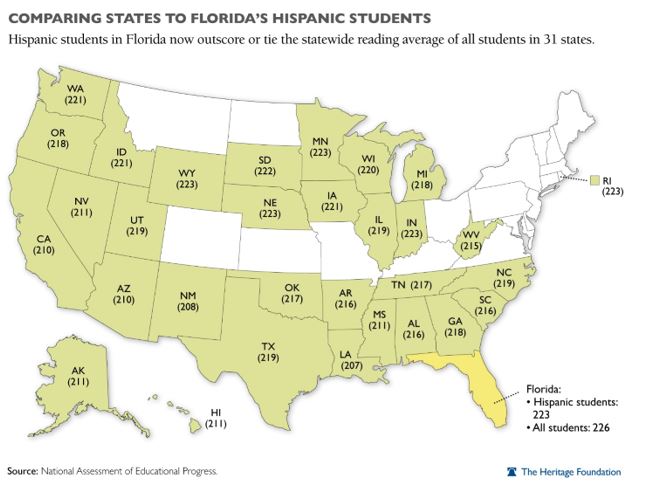
Which isn’t kind of cool but rather genuinely awesome – an accomplishment in which Florida students, educators and policymakers should take abundant pride. Florida Hispanic students tied Wyoming in a reading exam written in English – take that edu-fatalism! My role in this great feat was exactly zero – other than to note the scale of Florida’s success from a useful distance.
Later I went on to be a part of the original Arizona team that developed Education Savings Accounts (I’ll provide a Marvel-comics-like origin story post at some point); served for five years with Gov. Bush’s team at Excel in Ed; and then most recently worked at the Charles Koch Institute, helping to develop an organizational point of view on K-12. Most recently, I’ve joined the team at the Arizona Chamber of Commerce and Industry, champions of educational improvement in my state, and become editor here at redefinED.
Just over a decade has passed since I first squinted at my screen wondering if there was some sort of mistake in Florida’s NAEP scores. I’m certainly older and grayer, hopefully wiser and still retaining an outsider’s eye. Orwell said that to understand London, one needs to live in Paris. Likewise it took a Frenchman to recognize the true greatness of American democracy. Every Floridian reading this post knows a great deal more about Florida than I do; my only advantage is one of a perspective enhanced by distance.
Florida is a grandly innovative state with a record in policy implementation that is far greater than average. It’s very hard to appreciate this when you are close to your own inevitable policy and political messiness, but trust me, it is very clear from over here. I’m proud, for instance, that Arizona originated both scholarship tax credits and education savings accounts. Both innovations have been successfully taken to greater scale, however, in Florida – in no small part due to the relentless attention paid to the details of implementation.
You’ve taken crucial first steps towards equalizing opportunity in schooling. The sky not only did not open with a rain of frogs or locusts, you’ve seen real tangible progress. Florida public education, despite much protestation from traditionalists, is not only still there, it is substantially improved.
Funding for public education is guaranteed in the Florida Constitution and is as close to a permanent institution as you get in American society. It’s here to stay. Florida, however, has the chance not just to practice the form of public education, but to fulfill its actual promise. Much divides our society, but Americans still unite on crucial issues, including education. We desperately want an education system that gives students the knowledge, skills and habits needed for success and to responsibly exercise democratic citizenship. We – left, right and center – commonly and fiercely desire a system of schooling which serves as an engine of class mobility. Florida has moved the needle in this direction by setting families free to pursue opportunities that would otherwise be denied to them. More of this is needed and the next step will be to develop a consensus around setting educators free as well.
More on that later.
Grim challenges lay ahead for Florida. I’ll lay out the latest on some of them in coming posts. We should never, however, make the mistake of underestimating human ingenuity – and especially of betting against a wildly inventive state in the world’s most creative nation. Your challenges will be great, but you have been more than equal to them thus far.
Go and amaze us. Where Florida leads, others will follow.
Kansas: Lawmakers are pushing for two new bills, which include recommendations from the National Alliance of Public Charter Schools, to bring the school choice movement to a state with only 15 charter schools (The Topeka Capital-Journal).
Georgia: Proposed legislation looks to cap the state's private-school tax credit program and limit it to students with a financial need (Atlanta Journal Constitution). A parent-trigger bill that paves the way for traditional public schools to convert to charters also gets a nod from legislators (Atlanta Journal Constitution).
 New Hampshire: The House is set to vote on a measure that could end a Board of Education moratorium on charter schools (New Hampshire Union Leader). More from The Telegraph of Nashua.
Tennessee: A $4 million Mathematica study finds KIPP students show significant learning gains in reading, math, science and social studies in the first four years (The Commercial Appeal).
Alabama: State school board members offer mixed reactions following the surprise passage of the Alabama Accountability Act, which gives tax credit scholarships to parents who want to remove their children from failing public schools and enroll them in private schools or a non-failing public school (AL.com). Also, a circuit judge blocked the signing of a controversial bill that created tax credit scholarships (The Anniston Star). (more…)
Eleven states currently offer tax credits to specified taxpayers who make contributions to tax-exempt non-profit organizations that in turn use those contributions to fund scholarships for qualifying, financially-needy, elementary and/or secondary school students attending private schools. This fairly recent development is currently empowering perhaps 150,000 lower-income families, who generally are unable to afford private schools, to make this sort of school choice for their children. To be clear, these plans provide benefits for taxpayers who make contributions that help other people’s children attend private schools.
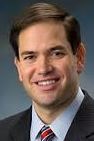
Sen. Rubio
Sen. Marco Rubio, R-Fla., has just introduced a bill that would expand this tax credit scholarship initiative nationwide. To understand the good (and dubious) features of Senator Rubio’s proposal, it is important to appreciate the state law background against which it is set.
Florida has the financially largest of these 11 state tax credit programs, with about 50,000 children currently participating. It restricts the scholarships to children from truly low-income households; the child must be eligible for a free- or reduced-price school lunch – currently just over $40,000 a year for a family of four. Other states are more generous, with Oklahoma reaching well into the middle class since there a family of four can still qualify with $120,000 in annual income. Senator Rubio’s plan, while not as tightly restricted as Florida’s, focuses the scholarships on families with income no more than 250 percent of the poverty level, which is a bit over $50,000 today. The main thing to emphasize here is the senator clearly seeks by his bill to empower the least well-off Americans who are currently least able to exercise school choice – a choice that more well-to-do families make by either moving to a better public school district or paying for private schools on their own.
Several state plans give tax credits to both individual and corporate donors (and for corporate donors the plans sometimes allow credits against a variety of state taxes). Senator Rubio’s bill does the same – allowing married couples and single taxpayers both to obtain a federal income tax credit for an annual contribution of up to $4,500, and allowing corporations an annual corporate income tax credit of up to $100,000. Florida by contrast only allows corporate tax credits and Arizona (which was the first state to adopt this program) initially granted only individual tax credits. Senator Rubio’s proposed tax credit limit for couples and individuals is about twice that now allowed in Arizona. Some states have no cap on donations, and indeed in Florida a few very large corporate donors contribute millions each year to the plan.
Senator Rubio’s proposed tax credit is a 100 percent credit, as is true in both Florida and Arizona, for example. This means that for every qualifying dollar contributed, federal income taxes would be reduced by a dollar. This essentially makes contributions costless to the donors. They, in effect, are able to re-direct their tax dollars to this specific cause – helping needy families send their children to private schools. It is worth nothing, however, that some states grant only a partial tax credit, such as the 65 percent credit allowed in Iowa and the 50 percent credit allowed in Indiana. In those latter states, donors must put up some of their own money.
Most states that adopted these plans imposed a maximum overall limit on the amount of tax credits that may be claimed each year in support of the program. These maxima vary enormously and even so are often not reached. Senator Rubio’s plan has no such limit. It probably would be complicated and costly, but clearly not impossible, for the IRS to administer an overall ceiling in a way that allowed would-be donors to know whether their contribution was within the national maximum and hence truly eligible for the credit.
One important difference between many state plans and Senator Rubio’s proposal is there is no limit on the amount of the scholarship that may be awarded. Florida, for example, caps scholarships at $4,335 at present; in Georgia the limit is just over $9,000. Hence, as appears to be the case in states like Iowa and Indiana, it would be legally possible under the senator’s plan for a child to win a full scholarship to a very high cost, elite private school and hence indirectly obtain government financial aid well beyond what is now being spent on public schools. This is perhaps unwise. Note, however, that nothing in Senator Rubio’s bill would require scholarship granting organizations to award full scholarships or high-value scholarships. In many states at present, the average scholarship is less than $2,000 a year. Since it would be rare to find a school with tuition that low, either the families must find some way to come up with the difference, or the schools must use their own financial aid plans to make up some or all of the gap.
The most striking difference between most state plans and Senator Rubio’s is children already enrolled in private schools would be eligible for scholarships. (more…)
Montana: House Republicans endorse three school choice bills - one to authorize charter schools, another to create a modest tax credit scholarship program and a third to create an education savings account program for students with disabilities (Independent Record). A day later, several defect on the charter school bill and it goes down - though maybe not permanently - on a 50-49 vote (Billings Gazette). The tax credit scholarship bill clears the Senate (The Missoulian).
Florida. U.S. Sen. Marco Rubio, R-Fla., introduces legislation to create a national tax credit scholarship program (redefinED). A parent trigger bill that was defeated last year in a dramatic tie vote is back this year (redefinED).
 Colorado: Two bills to expand private school choice through tax credits go down to defeat (Ed News Colorado). A student is in limbo after his mother withdraws him from a charter school to send him back to his zoned district school but the district says it's too late (9News.com).
Arizona: Charter schools would have to follow state purchasing laws and those that use management companies would have to post salary information under a bill filed in the wake of a newspaper investigation (Arizona Republic). Lawmakers nix a bill that would have required mailers be sent to parents informing them of school choice programs (Arizona Daily Sun).
New Mexico: Public schools, including charter schools, would be barred from contracting with private entities under a bill supported by critics who fear "a Trojan horse-type assault on the state to divert public education funds" (Santa Fe New Mexican).
Idaho: Lawmakers consider equitable funding for charter schools (Idaho Reporter).
Washington: The state public schools superintendent asks legislators to put charters under his watch, a move that conflicts with the new law voters recently approved that calls for a separate supervisory panel (King5).
California: The San Francisco school district triples the rent for charter schools, after charging less than other districts for years, prompting an outcry from some charters (San Francisco Chronicle). (more…)
 Editor's note: This op-ed appeared in today's Tampa Bay Times.
Few public issues are as absorbing as the balance between religion and government, so a ballot initiative that aims to change the boundary is worthy of rigorous debate. Instead, Florida's Amendment 8 is being treated to a proxy campaign on school vouchers.
A new radio ad by the Florida Education Association: "Amendment 8 allows the government to give our tax dollars to any group claiming to be a religious organization, so any religious group or sect can use our money to fund their own religious schools."
FEA president Andy Ford: "This is designed to open the state treasury to voucher schools."
Alachua School Board member Eileen Roy: "It's the very death of public schools. That's not overstating it, in my opinion."
These are provocative arguments, to be sure, but they are basically irrelevant. The amendment was placed on the ballot by two legislators — Sen. Thad Altman, R-Viera, and Rep. Scott Plakon, R-Longwood — who have said repeatedly they want to protect religiously based social services. Their interest was piqued by a lawsuit, Council for Secular Humanism vs. McNeil, that challenges a prison ministries program, and by the fact that the New York-based council has called it "a springboard to mounting other challenges."
In turn, the pro-Amendment 8 campaign is being led by a coalition of community-service providers and religious leaders who have raised less than $100,000 to date. They believe that if the secular humanists will sue over prison ministries, they might one day challenge the Catholic Charities or Catholic hospitals or the YMCA. After all, the current constitutional language is explicit: "No revenue of the state or any political subdivision or agency thereof shall ever be taken from the public treasury directly or indirectly in aid of any church, sect, or religious denomination or in aid of any sectarian institution."
Now it is certainly true that voucher advocates have previously pushed to alter the no-aid clause. But it is just as clear that they played no role in getting this amendment on the ballot and, most telling, have raised not a penny for the campaign. Their reasons are pragmatic, not philosophical: Federal and state court decisions in recent years have rendered the no-aid clause all but moot as it relates to school choice. Read full editorial here.
Editor's note: This is the second of two posts we're running this week to commemorate the landmark U.S. Supreme Court decision in Zelman v. Simmons-Harris.
 As we commemorate the 10th anniversary of the landmark Zelman Supreme Court case, its implications are widely visible in the expansion of voucher programs, such as those in Indiana and Louisiana, as well as the growth of tax credit scholarship programs from Florida to Arizona. But the primary Zelman principle - that parents can utilize scholarship funding to enroll in any qualified school that they believe will best educate their children - is also at the heart of an important court battle in Douglas County, Colorado.
Conceivably, Zelman could not only lead to the reinstatement of an innovative voucher approach that local school districts could adopt more broadly, but also provide a pillar for arguments to overturn Colorado’s discriminatory and prejudiced Blaine Amendments.
Beginning in June 2010, the Douglas County School District’s School Choice Task Force began a series of community discussions to align its programs with its overarching policy of “universal choice.” The purpose: to create “multiple pathways for educational success” and then to assist families in choosing the best educational program for their child. This led in March 2011 to the adoption of a pilot Choice Scholarship Program (CSP) whereby in the 2011-12 school year up to 500 families could receive either the lesser of a private school’s tuition or 75 percent of the per-pupil revenue the district received. This amounted to a scholarship of $4,575 for 2011-12.
Just before its implementation in fall 2011, the Denver District Court issued a permanent injunction against the program because it caused state funds to flow to religious schools, violating the Blaine Amendments in the Colorado constitution and the Public School Finance Act. The appeal to overturn this decision attracted high-powered support from the Colorado Attorney General, the Beckett Fund for Religious Liberty, the Institute for Justice on behalf of families that had received scholarships, and the school district itself. Zelman is at the heart of their legal briefs.
The Institute for Justice notes that neither the school district nor the state has any role in selecting the school in which the family enrolls, i.e., this is a private choice program that Zelman specifically endorsed as constitutional. Citing the Zelman decision, when a scholarship program “permits government aid to reach religious institutions only by way of the deliberate choices of numerous individual recipients, the circuit between government and religion is broken,” and any “incidental advancement of a religious mission…is reasonably attributable to the individual recipient, not to the government.” This principle of parental choice, which state supreme court decisions upholding voucher programs in Wisconsin and Ohio recognized even prior to Zelman, led an Indiana court this year to reject a challenge to the Indiana Choice Scholarship Program. Yet, for some reason, the Colorado trial court chose to ignore this precedent. (more…)
 A chain of Catholic, college-prep high schools that has demonstrated success with low-income students is eyeing two Florida cities for a possible expansion. Tampa and Miami are near the top of the list for the Chicago-based Cristo Rey Network, group president Rob Birdsell told redefinED. The reasons: A good job pool. The availability of tax credit scholarships. A need for more high-quality options for low-income kids. And maybe even some nudging from former Florida Gov. Jeb Bush.
“We very much want to get to Florida,” Birdsell said in a phone interview. “Gov. Bush is a friend of Cristo Rey (and) he is persistent.”
Lauded by education reformers and others for innovative work with Hispanic and African American students (see if you can get through this “60 Minutes” piece without crying), Cristo Rey now operates 24 Catholic high schools in 17 states and the District of Columbia. Its students typically come in two grade levels behind. But 84 percent of those who graduate enroll in college.
The students pay more than half of the $12,000 average tuition through a corporate work study program that gives them real-world experience at banks, hospitals, law firms and other partners. Accessing Florida’s tax credit scholarship program – worth $4,335 per student this fall – would fill out most of the remaining gap. That would take pressure off both the families and the network’s fundraisers. (more…)
Stephanie Saul offered an indictment in the New York Times today of tax credit scholarship programs that have, in my opinion, serious design flaws. These flaws were almost guaranteed to provide examples like Saul found for her article. How lawmakers and, just as importantly, parental choice advocates respond is an important test of their credibility.
Not much of what Saul reported is new, though that makes it no less troubling. Georgia’s law sets no boundaries on the income of scholarship recipients and no limit on the amount of the scholarship itself. It requires no financial audits, no attempt at any meaningful data collection. Many of the contributions are steered through schools and parents with a self-interest to underwrite the tuition of their own students. In Georgia and two other states she covered, Pennsylvania and Arizona, the public has little idea whether students are learning because no tests are required and no academic data collected.
The story was loaded with powerful anecdotes of abuse, but employed surprisingly pedestrian journalistic standards in its attempt to portray those practices as national in scope. The punchline in what newspaper writers call the nut graph – that “the programs are a charade” – was qualified as a question raised by “some” private school administrators. The characterization of programs becoming “enmeshed in politics” was leavened again with the word “some.” How many of the eight states with tax credit scholarship laws “collect little information”? You guessed right. The answer was “some.”
To her credit, Saul did acknowledge that at least one state has different statutory and regulatory standards: “In Florida, where the scholarships are strictly controlled to make sure they go to poor families, only corporations are eligible for the tax credits, eliminating the chance of parents donating for their own benefit. Also, all scholarships are handled by one nonprofit organization, and its fees are limited to 3 percent of donations. Florida also permits the scholarships to move with the students if they elect to change schools.”
The Florida scholarship program, as readers of this blog should be aware, is where the creators of this blog work. So we certainly have a self-interest in seconding such an assessment but also an intimate appreciation of the tension that appropriately exists with education options that have one foot in the private market and the other in the public treasury. We want to give the parents of poor and struggling school children something they could not otherwise afford – a private school learning option – and we recognize that with tax-credited funding comes public responsibility.
Finding the right balance between regulation and market is no simple feat. But our prescriptions for a well-designed law are as follows: (more…)

