
Jason Bedrick and I published a piece at the Daily Signal about the Roosevelt Elementary School District in South Phoenix. The Roosevelt district has experienced enrollment loss for decades, and the school board of the district has announced plans to close five schools.
I first learned of Roosevelt Elementary School district some 20 years ago when a Roosevelt student brutally assaulted a co-worker’s child. The staff’s response was far less than satisfactory, but at the time, it was difficult to locate mid-year transfer spots for my co-worker’s children, even after we enlisted the aid of a person who specialized in such situations.
I’m happy to report that in 2025, it is less difficult for desperate parents to execute a mid-year transfer.

Multiple factors explain the decline of Roosevelt’s enrollment, including a nationwide baby bust that began around 2007. Students living in the boundaries of Roosevelt but attending other public schools, both districts and charters, outnumber ESA students approximately 10 to 1. So, Arizona’s open enrollment and charter statutes deserve more credit than the ESA program. An examination of the reviews of Roosevelt Elementary schools left by students, parents and staff on private school navigation websites made my co-worker’s experience from 20 years ago seem to be far from an isolated, unfortunate incident. Here are some examples:
“Please do not take your children here. Almost every child is bullied, and the staff won't do anything. If you truly care about your kid's school experience, don't sign them up.”
“This school makes kids act out by tolerating relentless bullying and cruel treatment by teachers for special needs kids.”
“The kids get bullied, my son got a Black eye the 1st day of school and they told me that because he didn't know who the kid was there was nothing they could do.”
“This school should be shut down.”
“…They don’t take care of bullies; they just ignore the problem and leave the kids (to) fend for themselves; it seems that this is a safe place for bullies not for other kids. I would recommend that you should never enroll your kid here, and if you do, be prepared to endure what seems to be a never ending bully problem, and its not only the teachers that don't do anything about bullies.”
“I would rate it ZERO stars. This school is not SAFE NOR ORGANIZED. Roosevelt school district needs to step up their game or close this school down.”
“Students are constantly fighting or involved in some type of confrontational altercation with each other. Teachers behave more as peers than educators. My grandchild has attended this school for the past five years. I have seen very little improvement. If it were my choice, they would not attend.”
People who work for school districts have organized, and they use the fact that Americans dislike school closures. I would submit, for your consideration, that it is not wicked legislators or dastardly choice supporters who have forced the looming closures of Roosevelt schools. Rather, it has been due to the action of thousands of families who live in the boundaries of the district, who desire safe schools that will equip their children with the knowledge, habits and skills necessary for success. They have chosen to prioritize the long-term interests of their children over the short-term preferences of Roosevelt staff in increasing numbers for decades.
This is a thumbs up for Roosevelt students, whose interests the community has collectively put first, more than a thumbs down for the district schools. Roosevelt district schools will remain the best funded option on a per-pupil basis and might just stage a comeback if they can secure the confidence of families regarding safety and academics. Some of my friends in Arizona’s K-12 reactionary community would prefer that Roosevelt schools receive unconditional immortality. It is difficult to view these folks as engaged in anything other than macabre traffic in other people’s children. Perhaps I judge too harshly; the Phoenix area K-12 industrial lobbying complex is probably large enough to delay the need for difficult decisions in Roosevelt. If they are willing to enroll their own children in Roosevelt schools through open enrollment or otherwise, they might be able to stave off the need for safety and academic improvements.
Opponents of choice in Phoenix have been avid users of choice. One of your humble author’s children graduated from a South Phoenix charter school just a few miles away from Roosevelt. He attended with the children of two gubernatorial nominees who campaigned against choice (including Gov. Katie Hobbs), a child of the president of the Arizona Education Association and a co-founder of Save Our Schools Arizona, among others. Rather than choosing safe and academically performing charter and district schools, this community could instead put their families where their mouths are and lead the renaissance of Roosevelt district schools by enrolling their own children and grandchildren.
While this noble project gets off the ground, we in the Arizona choice community will continue to prioritize the interest of families above those institutions.

Tim DeRoche featured the tale of an Arizona boy named Brayden in a Time Magazine piece on the shortcomings of open enrollment practice and law for students with disabilities:
"In May 2022, an Arizona mom named Karrie got a heartbreaking message from the local public school: Her son Brayden wouldn’t be allowed to return as a second-grader in the fall. The reason? Brayden had been diagnosed on the autism spectrum, and the school claimed that it didn’t have any more room for kids with disabilities."
Brayden’s family had moved outside the Tanque Verde district attendance boundary but had remained enrolled through the open enrollment statute. After Tanque Verde Unified officials went through the process of drawing up an Individual Education Plan with Brayden’s family, however, other Tanque Verde officials kicked him to the curb. They were able to do so because of a canard promoted by Arizona districts known as “program capacity.” The claim essentially is that while the district may have empty seats, it lacks “program capacity” to serve students with disabilities. Arizona districts thus prevent students with disabilities from participating in the state’s largest form of K-12 choice.
Time out! Important nerdy context: Arizona funds the education for students with disabilities by a weighted formula that is imperfect but goes up to ~x6 basic state aid. Charter schools are required to admit students by lottery; districts have a more recent lottery requirement that has a de facto “program capacity” loophole not allowed by the Arizona State Board for Charter Schools (equal protection challenge anyone?) Students with disabilities are overrepresented in Arizona’s ESA program, and there is, in addition, a scholarship tax credit program exclusively for students with disabilities. While districts claim to have “programs,” their SWD populations vary from year to year, as does their staffing.
Okay, time back in! Recently, Ben Scafadi performed an analysis of open enrollment in Kansas. In Kansas, as is generally the case, districts decide their capacity to accept open enrollment students. Scafadi decided to compare the number of seats made available through open enrollment to the overall enrollment trend in those same districts since 2019. Scafadi called this the “Change-in-Enrollment Method” to identify open enrollment capacity. Obviously, districts occasionally close schools, etc., but for the most part, the logic is unavoidable: if you were educating X number of students in 2019, there is every reason to view that as a floor for enrollment in 2024, absent unusual circumstances. Scafadi found discrepancies: 
Naturally, when I saw the Scafadi study, I thought, “Why not apply the ‘Change-in-Enrollment Method’ to Arizona School Districts for students with disabilities?” I filled a hat with the names of Arizona school districts, and purely by chance drew Tanque Verde Unified out of the hat. In 2019, the National Center on Education Statistics put the enrollment for students with disabilities for the Tanque Verde Unified School District at 286. The Arizona Department of Education put the 2025 enrollment for students with disabilities at 206. Thus, the special education “program” at Tanque Verde Unified shrank by 28% between 2019 and 2024, in small part because they purged Brayden.
The basic logic of the Scafadi change in enrollment method applies: if Tanque Verde’s special education “program” was 29% larger in 2019 than in 2025, why was there a need to disenroll Brayden? Moreover, an examination of school district enrollment trends for students with disabilities in Arizona districts generally show more districts losing enrollment for students with disabilities than those gaining.
Tanque Verde Unified is not alone. Collectively, the 10 Arizona school districts with the largest enrollment of students with disabilities in 2019 lost 1,786 students with disabilities since 2019, but there is approximately a 0% chance of a student with a disability accessing any of these districts through open enrollment. Two paths can be pursued to end the discrimination against students with disabilities in open enrollment. First, an enterprising attorney could explore whether the Arizona court system is willing to uphold the “Equal Privileges and Immunities” clause in the Arizona Constitution. Second, lawmakers could pass legislation defining district “program capacity” for students with disabilities as having an enrollment floor not less than their enrollment with students with disabilities at a past date (2010 is a nice even number) and require the districts to make spots available until reaching that enrollment figure.
“Brayden’s Law” has a nice ring to it.
 If you look at enrollment trends in the Arizona districts with the largest total enrollment losses, look at the Arizona Open Enrollment report and the Quarterly ESA report, you get Figure 1. In Figure 1, both the gains from open enrollment (blue columns) and the losses to other districts and to charter schools (red columns) are presented. The purple columns represent the ESA enrollment of students who live in each of these districts.

Note that the ESA students reside in these districts; many of them were never enrolled in the district where they reside when they enrolled in the ESA program. Some students were already attending private schools, in which case they effectively transferred from the private scholarship tax credit program to the ESA program. Others were in those red columns, attending charter schools and other district schools through open enrollment. Others enrolled in kindergarten straight into the ESA program; others moved in from other states. Others, of course, transferred into ESA directly from their resident district. The purple columns, however, undoubtedly overstate the impact of the ESA program on district enrollments.
Even if they did not, I invite you to compare the red and the purple columns. The financial impact to a district school is identical whether they transfer to another district school, to a charter school, to the ESA program, or move out of the state.
Facing a multimillion-dollar deficit, the board of the Roosevelt Elementary School District in Phoenix Arizona recently began a debate over a proposal to close as many as five schools, a third of the district total. This is the result of the decisions of Roosevelt families to pursue other public school options, and their decisions should be respected rather than vilified.
Americans tend to react to school closure proposals with an irrational romanticism, which is to say, we hate them, and we are not overly concerned about practical considerations. It won’t be long until opponents of private school choice attempt to blame these closures on the ESA program, but as I will demonstrate below families residing within Roosevelt Elementary but choosing other public school options have played the primary role.
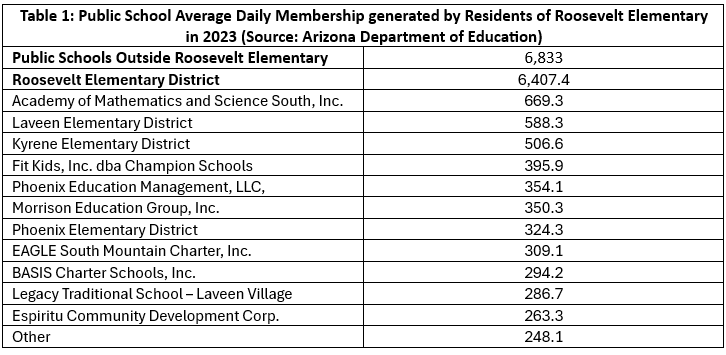
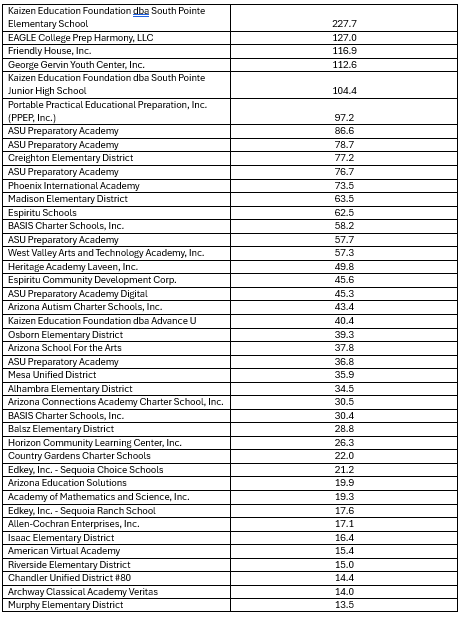

The single largest source of enrollment for Roosevelt students, the Academy of Math and Science South, demonstrated a rate of academic growth 14% above the national average. The second largest, Laveen Elementary School District also sports an academic growth rate 14% above the national average and has bus stops within the boundaries of Roosevelt Elementary (wisely allowed by Arizona law.) We should always bear in mind that parents have a great many factors to consider outside of academics when selecting a school, including student safety and bullying.
Arizona lawmakers passed a statewide open-enrollment statute and charter schools in 1994. Twenty-eight years later, we find most Roosevelt students attending public schools from outside their zoned district school. This represents the decisions of Roosevelt families, not choice advocates.
The most recent ESA quarterly report by the Arizona Department of Education shows 900 residents of the Roosevelt Elementary School District used ESAs. Public school choice students thus outnumber ESA students by more than 7.5 to 1. Whether that ratio remains or changes will depend entirely upon the decisions of Roosevelt area families.
Lawrence Garfield famously noted in the shareholder speech in Other People’s Money, “I didn’t kill it! Don’t blame me. It was dead when I got here.” Even if Arizona anti-school choice leader Beth Lewis stole Thanos’ Infinity Gauntlet and snapped away the ESA program, it would only be a matter of time until Roosevelt lost those 900 students and more to other public schools unless the district made their schools more desirable to families.
Hopefully the Roosevelt authorities will succeed in streamlining the district and create a set of schools that successfully compete for enrollment in the highly competitive south Phoenix area. We are almost three decades into a plebiscite conducted by shoe leather. Arizona families are free to pursue happiness in education, rather than be funding-unit peons herded by their ZIP codes.

Imagine the major metro area near you if students were free to attend the fanciest school district in the leafiest local suburb. Can Dallas kids enroll in Highland Park? Can Columbus students transfer through open enrollment into Grandview Heights? Will Smith portrayed a kid from a tough background who got to go to school in Bel Air, but how often does this happen in real life? If you mentally put the over/under on the number of students getting the chance to do this at 1, take the under. Thousands of Phoenix students however attend school in Scottsdale. Sadly, a recent report from the Brookings Institution exemplifies the sort of short-sighted thinking that prevents these kinds of opportunities from materializing in other states.
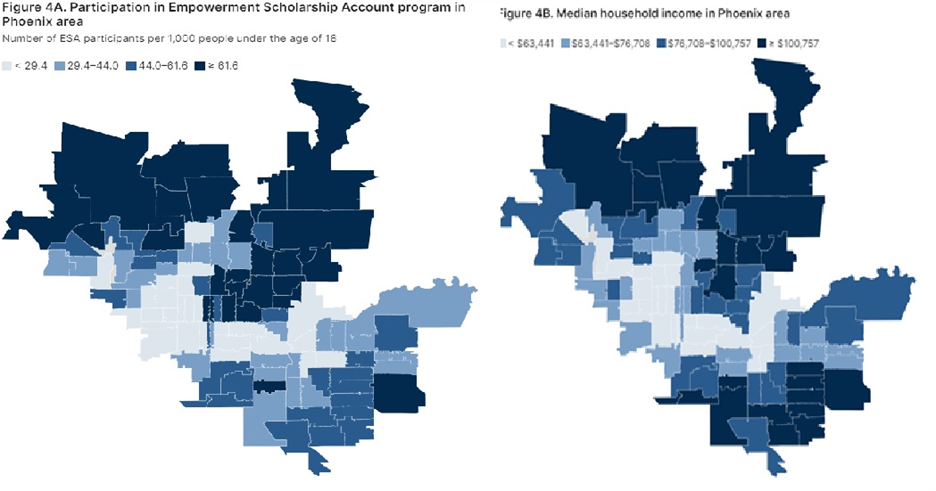
The Brookings Institution recently published a report on the Arizona Empowerment Scholarship Account Program that was long on unsupported claims and short on context. Brookings decided not to engage in nuance in titling its study Arizona’s ‘Universal’ Education Savings Account Has Become a Handout for the Wealthy.
The study can be briefly summarized with two maps from the report: on the left is a ZIP code map of the Phoenix area by the rate of ESA participation (darker=more), and on the right the same zip code map by family income (darker=higher average). The maps look kind of similar. Is Arizona’s ESA program an instrument of plutocracy?
In a word, no. Quite the opposite.
Arizona has four other private choice programs besides the ESA program- all scholarship tax credits. Two of these programs are means-tested for the exclusive use of middle and low-income families. One of the other credits requires scholarship granting organizations to consider income in making awards, and the final credit is for children with disabilities- a fair number of whom will also be from families of modest incomes. These tax-credit programs raised over $264 million for scholarships in 2023, (see below) and higher income families do not qualify for many of these dollars.
Lower-income families desiring to attend private schools often prefer the tuition tax credit program over the ESA program. Meanwhile, higher income families are not eligible for much of the scholarship tax credit funding. Under Arizona law, you cannot participate in both programs.
All the ZIP codes in the Brookings analysis, including those with higher-than-average incomes, have public schools operating in them. The statewide average total district spending per pupil on school is almost twice as high as the ESA program. Higher income Arizonans pay their taxes and are entitled to attend school districts like everyone else, but they are also entitled to participate in the Empowerment Scholarship Account if they desire. If the ESA program is a “give away to the rich” then what pray tell is the Scottsdale Unified School District?
Speaking of Scottsdale Unified, it stands as a shining example of why choice programs should be universal. Scottsdale Unified publishes an ongoing demographic report and publishes the number of out of district open enrollment students served. This graphic is from that report:

The average home price in Scottsdale Arizona stands at $893,000, but 21% of Scottsdale Unified’s enrollment came from out of district through open enrollment. The reason 4,667 students can attend Scottsdale Unified without having a family purchase a $893,000 home is because 9,000 students living in Scottsdale Unified go to school elsewhere- charter schools, other districts through open enrollment, private schools.
Universal choice programs- including the Arizona ESA program but also including charter schools and district open enrollment-help create open enrollment opportunities. A virtuous cycle worked through Arizona schooling as educators supplied high demand school models, nearly all school districts began accepting open enrollment transfers. When a large majority of Phoenix students could attend Scottsdale Unified schools, it had the effect of closing low-demand charter schools.
During the last period in which all six state-level NAEP exams were available, fourth and eighth grade math, reading and science, (2009 to 2015) Arizona students alone made statistically significant gains on all six exams. The Stanford Educational Opportunity Project linked state tests in grades 3-8 across the country for the 2008-2019 period. Arizona’s low-income students have the fastest rate of academic achievement growth in the nation. Counterintuitively, universal choice has worked wonders for low-income students.

The Brookings study is neither the first nor will likely be the last example of folks back east lacking context about Arizona choice. Arizona created two universal choice programs in 1994 (charters and open enrollment) then a mix of universal and means-tested scholarship tax credits and finally the ESA program. Critics predicted doom every step of the way and continue to this day.

A portion of the early adopters of the ESA program, excluded from fully participating in other programs, chose to participate in ESA. Understood in context, you have no reason to feel alarmed and every reason to follow suit in your state- especially if you are concerned about poor students.
 A budget adopted last week by lawmakers in Arizona includes two key provisions geared toward expanding access to schools of choice for the state’s K-12 students.
A $10 million allocation will establish transportation innovation grants that school districts, charter schools, and other community groups can use to help students attend a school that formerly may have been unavailable to them due to a lack of transportation options. In addition to the grants, funding can be used to modernize existing transportation systems.
The budget also makes the school district open enrollment system more transparent.
Both provisions were goals established by education advocates and Arizona Gov. Doug Ducy at the start of the legislative session. As part of his administration’s “Arizona Resilient” policy statements, Ducey urged legislators to remove one of the greatest barriers to accessing school choice, pointing out that “a choice is only a choice if you can get there, and unfortunately, those with the greatest hurdles to getting there are in our low-income neighborhoods.”
The transportation plan earned bipartisan support before it became part of the overall budget package and garnered the attention of parent advocates who testified to the House Ways and Means Committee about challenges they face under the current school transportation system.
In a column that appeared in the Arizona Capitol Times, Querida Walker, a parent of five, noted that her appearance before the committee, rather than serving as an opportunity for her to lead the way to new programs and solutions to help families, resulted in criticism “by individuals and policymakers who are content with maintaining the status quo and keeping kids trapped in failing schools.”
Arizona’s current open enrollment policy, which has existed in Arizona for decades, allows students to attend public schools other than the campus for which they are zoned based on their address. But education choice advocates have charged that some districts discourage the use of open enrollment school choice by shielding information about enrollment windows or by creating opaque paperwork requirements.
Ducey pledged to end what he called exclusionary policies such as unreasonably short enrollment windows that he said cause hardships for parents.
“The way we do open enrollment at school districts across the state is overdue for reform,” Ducey said. “It’s time to make it truly open for all.”
Emily Anne Gullickson, president of Great Leaders, Strong Schools, a group that advocates for increasing students’ access to high-quality schools, praised the measures as a means of ensuring all families will have equitable access to education choice.
“With the passage of this budget, Arizona is making it clear that families choose public schools they wish to attend,” Gullickson said. “Public schools no longer get to pick the students they serve.”

Ronald Reagan speaking at the Brandenburg Gate on June 12, 1987: Mr. Gorbachev, tear down this wall!
In your author’s humble opinion, this chart from the Thomas B. Fordham Institute is the most revealing K-12 graphic of the last decade.
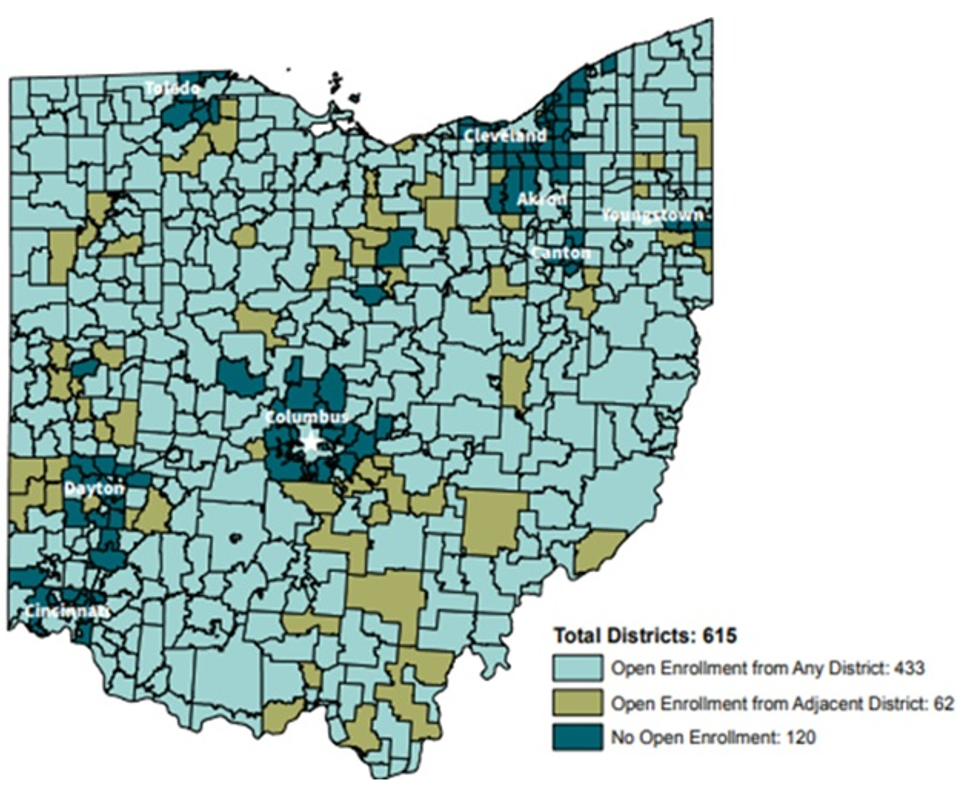
Ohio’s urban areas find themselves surrounded by districts that choose not to participate in open enrollment, featured in dark green. The children of Columbus, for instance, represented by the white star, appear to be surrounded by districts that do not offer open enrollment.
Later this week, this blog will offer a podcast interview with Chad Aldis, vice president for Ohio Policy and Advocacy at Fordham, whose research produced this map. Before criticizing the Ohio suburbs that deny open enrollment, let’s just put it on the table that a map of your state, if one existed, might look eerily similar to this one.
Unless, that is, you live in Arizona.
In Arizona, nearly all districts participate in open enrollment. Open enrollment students outnumber charter students nearly two to one in the Phoenix area despite its distinction as the nation’s largest charter sector.
Arizona has the largest state charter sector in the country, with nearly 20% of students attending charter schools. Ohio not only has fewer charter schools than Arizona; the schools are more geographically concentrated in urban areas. Ohio has a larger student population – 1.7 million students compared to 1.2 million in Arizona – but has far fewer charter schools overall and especially fewer suburban charter schools.
Data from the National Alliance for Public Charter Schools shows approximately 50 suburban charters in Ohio compared to 136 in Arizona.
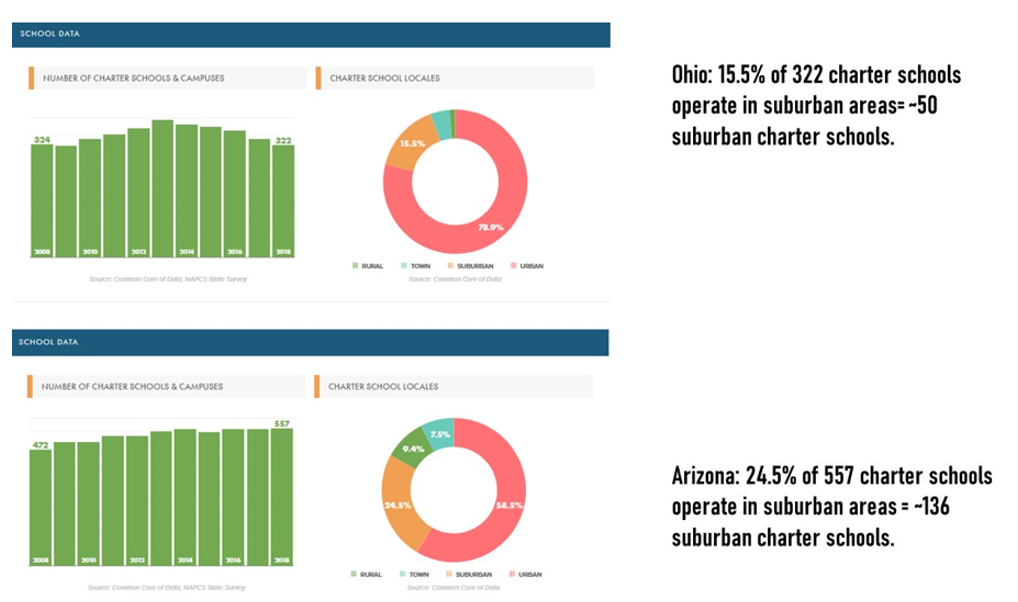 The Brookings Institution measured the availability by the percentage of students with access to one or more charter schools in their ZIP code. Arizona led the nation with 84% of students having one or more charter schools in their ZIP code, whereas Ohio stood at 31.9%.
Your author is going to go way out on a limb at this point.
While it could be that the people running suburban districts in Arizona are unusually interested in stamping out economic and racial segregation because of the dry climate or … something … the level of non-district options held by suburban families has a lot to do with it. Scottsdale Unified, for instance, may accept 4,000 open enrollment transfers because 9,000 students who live within the boundaries of the district go to school elsewhere.
How is this working out for the kids?
Stanford University’s Opportunity Project linked state academic exams across all 50 states to allow comparisons between schools, districts and their associated charters, and counties. The chart shows the comparison for academic gains for poor children in the largest counties in each state: Maricopa County (Phoenix area) in Arizona and Franklin County (Columbus area) in Ohio.
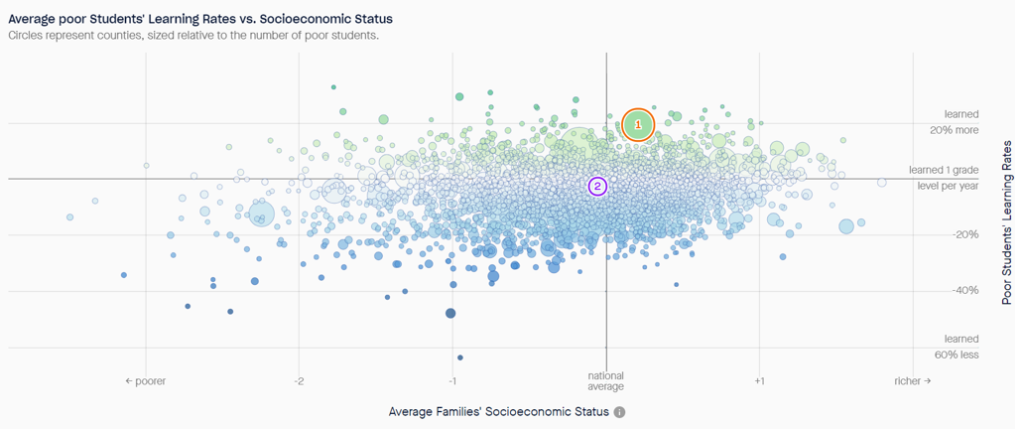
The rate of academic growth for poor students in Maricopa County is 19.3% above the national average for all students. The rate of academic growth for Franklin County students is 2.6% below the national average. Maricopa County outperforms Franklin County across all eight subgroups available in the Stanford data.
What we see in the Fordham map at the start of this post isn’t working, but don’t look for shame alone to open the gates of opportunity for Ohio’s urban students. Only broad choice programs can create the incentives needed to tear down these walls.
 The Florida Legislature is considering expanding open enrollment for public schools and giving students more freedom to cross district boundaries.
What could change if parents are more able to move their children to schools outside their assigned zones? We can draw some insight from Arizona, which has had a statewide open enrollment policy for nearly two decades.
In a nutshell, public schools in the Grand Canyon State have taken more steps to attract students and please parents, by expanding special programs and marketing their schools.
"Open enrollment has really transformed public education in Arizona,” said Kristine Harrington, a spokeswoman for Scottsdale Unified School District in Arizona. The district, she said, has responded to parent demands by creating more International Baccalaureate and magnet school programs, including schools that focus on science and robotics.
Schools near the borders of other districts almost always have long waiting lists, Harrington said. Some of the district's high schools enroll as many as one third of the students from out-of-district addresses.
Florida's school districts have embraced IB and magnet programs. In recent years, they've expanded them, and considered broader open enrollment policies, sometimes while speaking in explicit terms about competing with a growing charter school sector.
In Arizona, the greater freedom of movement among schools may have helped accelerate a similar trend.
“Open enrollment has been very, very popular,” David Garcia told the Arizona Republic. Garcia, an education professor at Arizona State University, said more students use open enrollment to transfer to other public schools than enroll in charter schools. In a state with one of the highest percentages of charter schools in the country, that says something. (more…)

