
The Stanford Educational Opportunity Project has developed a new data tool called the “Segregation Explorer.” Let’s start with the definition of what is being measured in this data, which stretches from 1991 to 2022:
Segregation estimates in the interactive map represent the two-group normalized exposure index, which measures the difference between two groups’ exposure to one of the groups. For example, the White-Hispanic normalized exposure index compares the proportions of White (or Hispanic, equivalently) students in the average White and Hispanic students’ schools. A White-Hispanic normalized exposure value of 0.5 indicates that the proportion of White students in the average White student’s school is 50 percentage points higher than in the average Hispanic student’s school (ignoring the presence of other groups aside from the racial dyad of interest). For more information on this measure, see our brief.
Okay so bottom line: darker is more segregated, lighter is less segregated. If we take the map back in time as far as it will go (1991) the White-Non-White student exposure index looks like this:
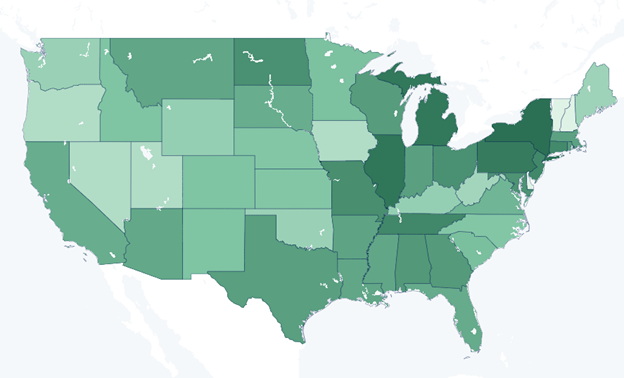
If you are squinting at your phone, New York was the school segregation capital of the United States with a white-non-white exposure index of .62. Fast forward to 2022 and the white-non-white exposure index map looks like:
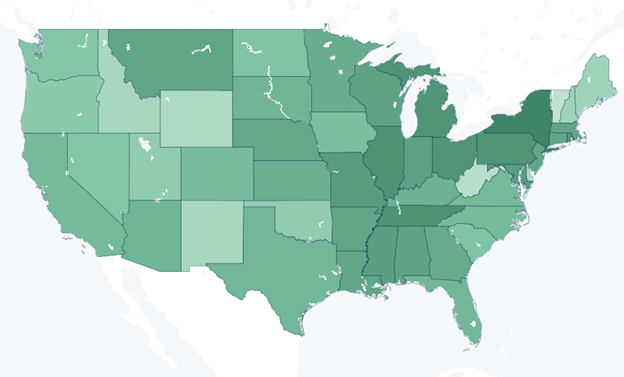
Thirty-one years later, New York remains the school segregation capital, but at least it went down from .62 to .51.
Choice opponents often claim that choice programs are increasing school segregation. A sadly typical example came in a guest column claiming that school choice had made Arizona school segregation worse than the 1950s and 1960s (!)
Well, school level data from the 1950s is a bit hard to come by, but let’s check the trend in the Stanford Educational Opportunity Index-White-Non-White exposure index trend:
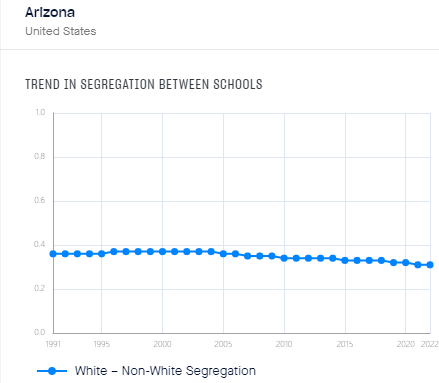
So again if you are squinting at your phone, in 1994 (the year Arizona’s charter and open enrollment laws passed- kicking off the K-12 choice era) the white-non-white index stood at .36 and in 2022 the same measure had dropped to .31- which just happens to be one half of the level of New York in 1991.
The Stanford Educational Opportunity Project also has updated figures for the academic growth of poor students. Let’s see how that worked out for Arizona (1) and New York (2):
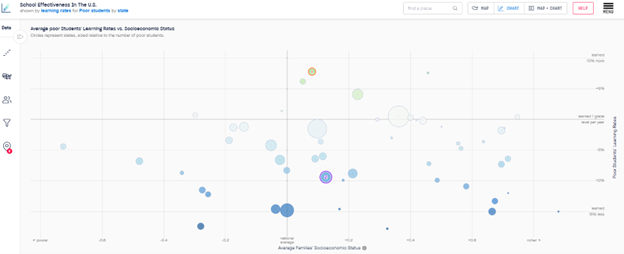
Somebody must be benefiting from the $38,000 per student spent in New York’s public school system, it’s a shame that the list does not include the students.
Mexicayotl Academy of Excellence, a charter school in Nogales Arizona, demonstrated the highest level of average academic growth among Arizona schools in the latest version of the Stanford Educational Opportunity Project data (see national data below). Clocking in at an impressive 95.6% faster than the national average, Mexicayotl is famous for academics, native dance performances and fun. It is not just the fortunate students in Nogales who can learn from Mexicayotl- the school has much to teach the rest of us as well.
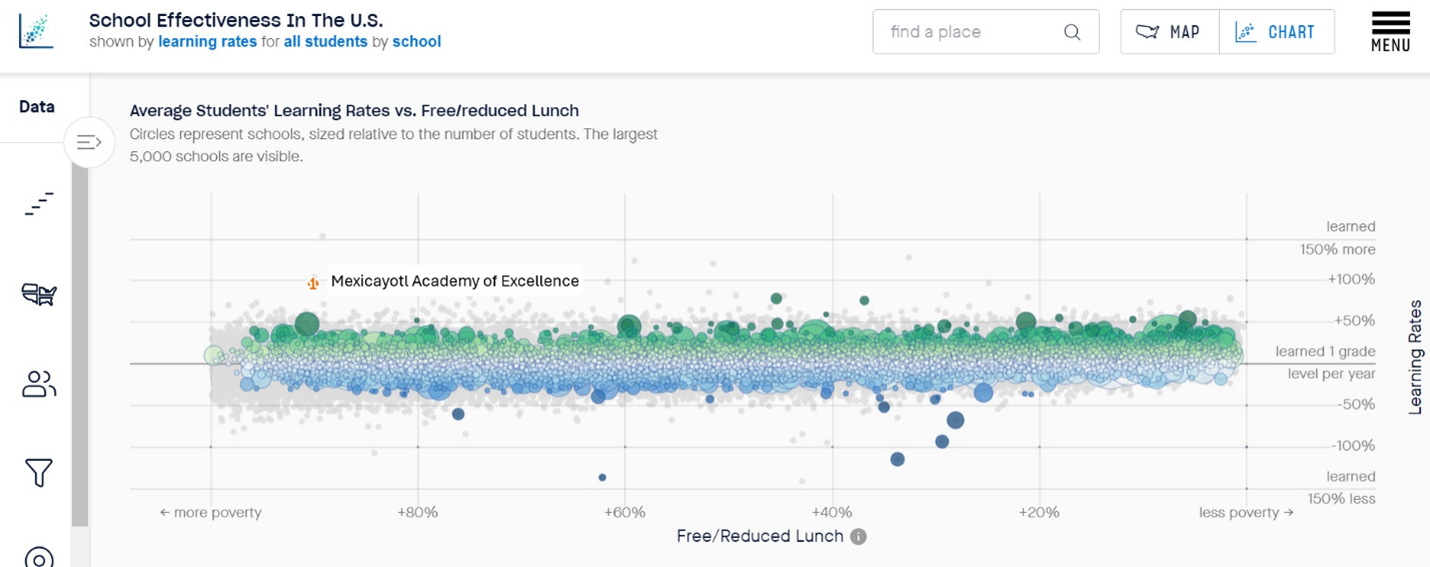
Source: Stanford Educational Opportunity Project
Former Arizona Superintendent of Public Instruction Lisa Graham Keegan wrote about Mexicayotl and other schools like it for the Fordham Institute. LGK cautioned against technocratic overconfidence- especially in the form of five-year default closure provisions-because it turned out in Arizona that some fantastic authentically community schools might have been closed by such folly:
Moreover, Arizona’s “wild” charter journey led to many low-income, highly performing charter management organizations that can only be found in the Grand Canyon State. Many are community-focused and community-developed, which we all say that we want, but their first priority was on stabilizing the communities they grew from. In other words, they weren't very good academically to start—but they did transform their neighborhoods, and parents trusted these new schools with their precious children over many other options that went out of business due to lack of enrollment.
Years later, many of them, like Academies of Math and Science, Mexicayotl Academy, and Espiritu Schools, are now among the top performing schools in not just the state, but in the country, and were highlighted in last week’s Education Equality Index. The thing is, it took a decade to do that. And we Arizonans let it happen.
A few things for overconfident technocrats to consider: how many Mexicayotl Academies have been closed around the country by five-year default closure provisions in charter laws? What if authentic, community-based schools need a bit more runway than parachuting in a group of TFA kids to whip up math scores with a cat-o-nine tails? What if our methods for judging school quality are still primitive?
Mexicayotl’s parents in the early years, surveying their other options, decided to place their confidence in the school’s staff. Luckily, Arizona’s charter law did not have a default closure provision and also granted 15-year charters. Arizona’s method of accountability (lots of options) is brutally efficient compared to the top-down method, but Mexicayotl survived it.
Indiana recently followed suit in lengthening their charters to 15 years. This will take a considerable administrative burden off the schools rather than having them continually working on renewal. Fortunately, Indiana is also equipped with other options for families with the broadly available voucher law.
Who will be next?
 The Florida Legislature is considering expanding open enrollment for public schools and giving students more freedom to cross district boundaries.
What could change if parents are more able to move their children to schools outside their assigned zones? We can draw some insight from Arizona, which has had a statewide open enrollment policy for nearly two decades.
In a nutshell, public schools in the Grand Canyon State have taken more steps to attract students and please parents, by expanding special programs and marketing their schools.
"Open enrollment has really transformed public education in Arizona,” said Kristine Harrington, a spokeswoman for Scottsdale Unified School District in Arizona. The district, she said, has responded to parent demands by creating more International Baccalaureate and magnet school programs, including schools that focus on science and robotics.
Schools near the borders of other districts almost always have long waiting lists, Harrington said. Some of the district's high schools enroll as many as one third of the students from out-of-district addresses.
Florida's school districts have embraced IB and magnet programs. In recent years, they've expanded them, and considered broader open enrollment policies, sometimes while speaking in explicit terms about competing with a growing charter school sector.
In Arizona, the greater freedom of movement among schools may have helped accelerate a similar trend.
“Open enrollment has been very, very popular,” David Garcia told the Arizona Republic. Garcia, an education professor at Arizona State University, said more students use open enrollment to transfer to other public schools than enroll in charter schools. In a state with one of the highest percentages of charter schools in the country, that says something. (more…)
 The Shadow Faction
Dianne Douglas was elected as Arizona’s Superintendent of Public Instruction largely on an anti-Common Core platform. Last week Douglas, a Republican, decided to start her war against Common Core by firing two State Board of Education employees. Arizona Gov. Doug Ducey (a fellow Republican who previously endorsed Douglas) stepped in to stop the firing, arguing that the State Superintendent didn’t have the power to terminate Board of Education employees.

Diane Douglas
Douglas retaliated in a bizarre press release, accusing the governor of supporting “two liberal staff” members of the board and creating "a shadow faction of charter school operators and former state superintendents who support Common Core and moving funds from traditional public schools to charter schools."
Demonstrating the best way to deal with criticism, Lisa Graham Keegan (the alleged ringleader of the shadow faction) decided to respond with humor. According to the Arizona Republic, Keegan “sat up late ordering coffee mugs emblazoned with #shadowfaction.” For supporters, she’s ordered mugs with the words #shadowfactionfan.
The issue gets more bizarre with Douglas, but that is another story.

Dr. Evil, rumored to be a working for the Shadow Faction as a consultant.
Speaking of using humor to address criticism, Matthew Ladner (who was snubbed in Diane Douglas' Shadow Faction press release despite being the senior advisor for policy and research at Gov. Jeb Bush's Foundation for Education Excellence, co-chair of Gov. Ducey's education transition team, and the mastermind behind the concept of Education Savings Accounts that is now sweeping the nation) pens a humorous letter to the Arizona Republic, the state's largest newspaper, which has frequently editorialized against school choice programs.
Ladner points out the obvious: despite the newspapers annual prediction that public schools will be decimated by the school choice movement, public schools in Arizona continue to grow in enrollment. He concludes: (more…)
 Alabama: Judge Gene Reese issues a stay on his own injunction against the Alabama Accountability Act school choice program (AL.com, Montgomery Advertiser, redefinED, American Federation for Children). The decision to lift the injunction takes uncertainty away from low-income families (AL.com). Jeff Reed, public relations director for the Friedman Foundation, says school choice thrives in the state even with the lawsuit (One News Now).
Arizona: Eileen Sigmund, president of the Arizona Charter Schools Association, and Glenn Hamer, the association's vice chairman, say charter schools provide some of the best education in the state and are still looking to improve (Arizona Republic).
Connecticut: Education leaders in Bridgeport drop the idea of suing the state over approving six charter schools in the area after the city attorney says the district has no basis for a lawsuit (Stamford Advocate).
Delaware: Lawmakers debate education savings accounts (JayPGreene.com, Choice Media, Education Week). The News Journal editorial board supports school choice if parents pick charter schools but not if parents want vouchers or education savings accounts to choose private schools.
Florida: The Florida PTA, state teachers union and Florida NAACP urge the governor to veto a school choice bill that includes expansion of tax credit scholarships (the scholarship program is administered by Step Up For Students, which co-hosts this blog). (Tampa Bay Times, Orlando Sentinel).
Idaho: Terry Ryan, president of the Idaho Charter School Association, says over 19,000 children attend charter schools in the state, making support for it a winning proposition for elected Republicans (Idaho Education News). (more…)
Alabama: Cameron Smith, vice president of the Alabama Policy Institute, shows readers the students who benefit from the Alabama Accountability Act (AL.com).
Arizona: Gil Shapiro, a spokesman for FreeThought Arizona, says parents can't be trusted to home-school or choose a good school for their child (Arizona Daily Star). Linda Thomas, a member of the Oracle School Board, says parents can be trusted to pick a good school (Arizona Daily Star).
California: Larry Aubry at the Los Angeles Sentinel says charter schools are civil rights failures because they are more segregated than traditional public schools. Avery Bissett, a student at Chapman University, says vouchers would provide the state an inexpensive experiment on how to improve public education (Orange County Register).
D.C.: Scott Pearson, director of the D.C. Public Charter Schools Board, says charter schools have helped to improve public school performance (Washington Post).
Georgia: During a debate among Democratic candidates for the open state school chief position, state Rep. Alisha Thomas Morgan said she will "buck the Democratic party for the best interest of children" and supports charter schools and tuition tax-credit scholarships (Atlanta Journal-Constitution).
Florida: Denisha Merriweather, a former tax-credit scholarship student, tells her story (redefinED). Ron Matus, the editor of redefinED, dispels the myths surrounding the tax-credit scholarship program (Pensacola News Journal). Scott Maxwell, a columnist for the Orlando Sentinel, says public schools lose when students are allowed to transfer to private schools. Chris Guerrieri, a middle school teacher in Jacksonville, opposes private school vouchers because students aren't forced to attend private schools (St. Augustine Record). Jac Wilder VerSteeg, a journalist based in Palm Beach County, says parents don't know best when it comes to their own child's education (Sun-Sentinel). The Orlando Sentinel reaches out to readers and finds 51 percent support expanding school vouchers. Two private schools have been barred from receiving McKay vouchers for reporting students that never enrolled (Miami Herald). Virtual learning labs become more popular in Lee County (NBC 2). Education leaders in Miami-Dade approve what may become the state's largest charter school (Miami Herald). (more…)
Arizona: Amy Silverman, a journalist at the Phoenix New Times, says charter schools lead to segregation for special needs students (note: the state has two private school scholarship programs for special needs students).
California: All candidates seeking to fill a vacant school board seat in Los Angeles agree on the value of public charter schools (LA School Report).
Florida: Sherman Dorn, a professor at Arizona State, ponders why there has been no constitutional challenges to the Florida Tax Credit Scholarship Program or the state's other voucher programs. The American Civil Liberties Union is filing a complaint to stop single gender schools (redefinED). State Impact looks at some of the research on single gender schools. U.S. Rep. Dan Webster, R-Orlando, explains why he supports charter schools (Sunshine State News). The Duval County School District may lose up 3 percent of its total enrollment to charter schools over the next decade (Florida Times-Union).
The Legislature sends the tax-credit scholarship expansion bill to Gov. Rick Scot (Heartlander). The teachers union asks the governor to veto it (Orlando Sentinel, Tampa Bay Times). A record-setting 100,000 students have started applications for tax-credit scholarships (redefinED). Chris Guerrieri, a public school teacher and education choice opponent living in Jacksonville, makes many negative claims about parental choice and Step Up for Students (which co-hosts this blog) (Gainesville Sun, Pensacola News-Journal).
Georgia: The Atlantic Public School District is negotiating a compact with local charter schools to encourage collaboration (WABE Public Radio). The number of charter schools that must hold admission lotteries grows as waiting lists increase (The Telegraph).
Louisiana: A bill to allow students in low-performing public schools to transfer to higher-performing schools advances (Associated Press). Traditional public and charter schools in New Orleans look to expand the use of technology in the classroom (Hechinger Report). U.S. Sen. Mary Landrieu, a Democrat, supports charter schools and believes every child should have the right to attend one if they wish (CNN). Two bills that would negatively impact charter schools fail to pass out of committee (The Advertiser). Kenyatta Collins, a high school student attending a charter school in New Orleans, says her school focuses too much on discipline and not enough on academics (Time). (more…)
Arizona: The Tucson Diocese School Board says parents can be trusted to decide on the education for their own children (Arizona Daily Star). Gov. Jan Brewer signs a bill to expedite the approval process for parents seeking Empowerment Scholarship Accounts (Associated Press). The state superintendent of public instruction will increase scholarship amounts to 90 percent of the funding for charter schools after the state legislature declines to clarify the voucher funding limits (Capitol Media Service). The Jewish Tuition Organization raises $2.9 million to fund scholarships for seven Jewish day schools in the state (Jewish News).
Colorado: The Coloradan chronicles the six charter schools of Fort Collins.
Connecticut: Charter schools in the state receive about $3,000 less per pupil (New Haven Register). Education leaders in Bridgeport and Stamford consider taking legal action to stop more charter schools from opening in the cities (Connecticut Post, Associated Press). Education reform groups representing many different interests, including charter schools and school choice, work to shape education policy in the state (Middletown Press News).
Florida: A bill to expand the tax-credit scholarship program and create an education savings accounts program stalls on Thursday (Associated Press, Politifix) but passes out of the Senate and House the next day (Associated Press, redefinED, Tampa Bay Times, WFSU, Florida Current, News Service of Florida, South Florida CBS 6, Miami Herald, Jaypgreene.com). State Sen. Dwight Bullard, D-Miami, an opponent of the scholarship expansion, accuses Step Up For Students of bribery but refuses to offer proof and apologizes for his comments (Palm Beach Post, Orlando Sentinel). (Step Up administers the program and co-hosts this blog.) Opponents rallied to try and defeat the bill (Orlando Sentinel).
A lot of back-and-forth on whether tax credit scholarships are good for English language learners (Voxxi, Tampa Bay Times). Kate Wallace with the Foundation for Florida's Future says school choice helps students and is only a threat to adults worried about keeping their jobs (Context Florida). Educators in both public and private schools say school choice is beneficial to students (redefinED). Valerie Strauss argues "accountability" means everyone should follow the exact same rules, regulations, curriculum and take the same exact tests (Washington Post). John Romano, a columnist for the Tampa Bay Times, calls lawmakers hypocrites for not requiring private schools to follow the same accountability rules as public schools.
The state legislature cuts charter school capital funding support from $91 million to $75 million (Tampa Bay Tribune, redefinED). Charter schools receive less money than traditional district schools (State Impact). The Florida League of Women Voters discuss its study on charter schools on WJCT radio. A school district explores allowing students access to other public schools through open enrollment (Ocala Star Banner). (more…)
Arizona: A bill to allow children of military service members killed in action to become eligible for Empowerment Scholarship Accounts passes into law (Watchdog). Gov. Jan Brewer vetoes a bill to allow owners of S-Corps to receive individual tax credits for donations to scholarship funding organizations, but signs two bills related to Empowerment Scholarship Accounts (Arizona Republic, Associated Press).
California: Two Democrats battle for leadership of California's K-12 system: one backed by the establishment and the other backed by education reformers (Reuters).
Colorado: The school choice oriented school board in Jefferson County looks to provide more equity for charter school funding (Denver Post). Fewer students get their first choice in Denver's public school choice program (Chalkbeat).
D.C.: The D.C.Public Charter School Board hears proposals for eight new charter schools (Washington Post).
Delaware: A charter school principal says charter schools were meant to help improve the quality of public education but not intended to simply duplicate public schools (The News Journal).
Florida: The senate revives a plan to expand the tax-credit scholarship program, but the senate's version is less ambitious than the House version (Education Week, Tampa Bay Times, Florida Current, The Ledger, WFSU, Palm Beach Post, Naples News, Highlands Today, GTN News, St. Augustine Record, redefinED). William Mattox, an education researcher at the James Madison Institute, argues that private schools already face greater accountability because parents, and donors, can leave at any time (Daytona Beach News-Journal). A local public school PTA president favors school choice and says the legislature should expand options, not deny them (Tampa Tribune). The Palm Beach Post editorial board opposes expanding tax-credit scholarship eligibility from 230 percent of poverty to 260 percent because that now represents the middle class. The Orlando Sentinel editorial board opposes expanding the tax-credit scholarships without more accountability, which the editorial board defines as taking the exact same test as public school students. The Tampa Bay Times editorial board believes it is hypocritical to require the FCAT of public schools and students but not of private school students on scholarship. A private school principal says she supports school choice in all its forms because schools that work for one child may not work well for another (Context Florida). A tax-credit scholarship mom says she is thankful for a program that helps build a future for her children and others (Daytona Beach News-Journal). (more…)
Alabama: The Alabama Education Association, which opposes a new tax-credit scholarship program, says former Gov. Bob Riley has personally banked up to $1 million from it (he has made $0) (AL.com). The AEA is spending hundreds of thousands of dollars to back Republican and Democrat candidates to run against lawmakers that support school choice. (AL.com).
Arizona: A bill to expand the education savings accounts program advances in the Senate (Arizona Capitol Times, Associated Press) but is defeated after nine Republicans vote no (Arizona Republic, Arizona Daily Star, Associated Press). Laurie Roberts, a columnist for the Arizona Republic, describes the Empowerment Scholarship Accounts expansion as a bill designed to weaken public schools. The accounts allow families access to special needs funds in order to customize the learning options for their children (Wall Street Journal, Jay P. Greene Blog). The editorial board for the Daily Courier says school choice should remain limited to public schools, including public charters. The accounts allow parents to save money for use in future education, including higher education, and David Saifer, a columnist for Tucson Weekly, seems to think saving money is a terrible idea. So do public education officials (Arizona Capitol Times). A Democrat campaign manager says the accounts will destroy public education (Maricopa.com).
Delaware: State officials approve four new charter schools (The News Journal).
Florida: Steve Knellinger, an administrator at St. Petersburg Christian School, says tax-credit scholarships create more options and help improve student achievement (Tampa Bay Times). A mother of two tax-credit scholarship students is mad the PTA is fighting thel scholarships (Florida Times-Union). James Herzog, director of education for the Florida Conference of Catholic Bishops, says there is good evidence to prove school choice expansion is needed (Palm Beach Post). Gov. Rick Scott is noncommittal on whether private schools accepting scholarship students should take the same state assessment as public schools (State Impact). The Florida Citizens for Science want private schools that accept tax-credit scholarships and vouchers to teach evolution by state standards (Tallahassee Democrat). A former Republican lawmaker says public schools should be fully funded before allowing voucher programs to expand (The Ledger). Frank Cerabino, a columnist with the Palm Beach Post, says school choice has been around for a long time for those who can afford it. The Florida Times-Union editorial board says education achievement is getting better and solving poverty is a better solution to improving schools than attempting school choice. Eileen Roy, a school board member in Alachua County, thinks vouchers will destroy public schools (Gainesville Sun). Former state Senator Al Lawson says tax-credit scholarships serve some of the most disadvantaged students in the state and the program deserves to be expanded (Florida Today).
Democratic lawmakers blame charter schools for a decrease in state appropriated capital funding for public schools (Creative Loafing). Charter school critics claim charters get the lion's share of capital funds but the critics disregard local revenue sources (redefinED). Six single-gender charter schools will open over the next few years in the Jacksonville area (Florida Times-Union). (more…)

