Arizonans have a pet peeve involving people from “back East” who judge us before they understand us. The Washington Post jumped into this with both feet by publishing a story with the headline Public schools are closing as Arizona’s school voucher program soars.
The story, which prominently features the long-troubled Roosevelt Elementary School District’s decision to close five schools, has multiple problems. The paragraphs below will document one of the main problems. Before moving to that, the reader should note that multiple people made efforts by both email and phone to alert the Post reporter to these data during the research process, including the sharing of many of the links to the same state data sources that will be used below.
Arizona K-12 choice is complex with multiple types of choice operating simultaneously and interacting with each other: the nation’s largest state charter school sector, multiple private choice programs, and (the granddaddy of them all) district open enrollment. No one should fault anyone for failing to appreciate the complexity of a situation from afar, but ignoring data to formulate a fundamentally misleading narrative is another matter.
Just to set the stage, under the Arizona education formula, spending follows the child. From the perspective of a school district, it makes little financial difference as to whether a child transfers to another district, enrolls in a charter, takes an ESA, or moves to California -- you either have enrollment to get funded, or you do not. Because districts also generate local funding with enrollment, they are (by a wide margin) the best-funded K-12 system in the state on a per-pupil basis on average.
The Arizona Department of Education tracks public school students by district of residence and by public district or charter school of attendance. The 2025 report includes a tab called “District by Attendance,” and it reveals that of the total public-school students residing with the boundary of Roosevelt Elementary and attending a Roosevelt Elementary district school amounts to 6,551 students. The same report reveals that 5,764 students live within the boundaries of Roosevelt but attend charter schools. Finally, the open enrollment report documents that 2,741 students live within the boundaries of Roosevelt but attend other district schools through open enrollment.
Separate reports from the Arizona Department of Education document ESA use by school district. The most recent quarterly report currently available finds that 803 students reside within the borders of Roosevelt Elementary and are enrolled in the ESA program (see page 22). If we stopped the story there, the conclusion that the fiscal impact on Roosevelt Elementary from other school districts was more than three times larger than that of the ESA program would appear unavoidable. “Public schools are closing as a majority of families choose other public schools” does not seem quite as exciting but would be far more accurate.
But we should not stop the story there. Another report from the Arizona Department of Education tracks not only which districts ESA students reside in, but also what school they previously attended. Page 17 of this report reveals that the number of students residing in Roosevelt Elementary district and which previously attended a Roosevelt Elementary school stood at 129. Put it all together, and the picture looks like this:

School boards don’t close five schools in a 6,551-student district because of the loss of 129 students. Enrollment in Roosevelt Elementary began to decline years before the ESA program existed. “Public schools are closing as Arizona voucher enrollment soars” is akin to “Sun rises as rooster crows” as it pertains to Roosevelt Elementary. If the ESA program did not exist, we have every reason to believe that a large majority of ESA students would employ other choice programs.
The fault lies not in Roosevelt’s stars, but in itself -- a large majority of the community it serves prefers schools other than the ones they are operating. Statewide Arizona school districts spend an estimated billion dollars annually on underutilized and vacant school buildings -- funds they could be spending on teacher salaries and academic recovery, and which also happens to approximately equal the budget of the ESA program, which 90,000 Arizona students use for K-12 education.
The Roosevelt school board has decided to focus their efforts, and good luck to them. The unstated thesis of the Washington Post’s narrative, however, is that readers should sympathize with the interests of Roosevelt employees rather than with those of the Roosevelt families exercising agency in the education of their children. This is the greatest misdirection of all. We fund schools first for the benefit of children, not the adults working in the schools.
This is all an all-too-common sort of thing in K-12 journalism these days, and it is hardly unique to Arizona. Florida, for example, has no shortage of hugely exaggerated claims regarding the impact of choice on school districts. Author Amanda Ripley, interviewed for a book she wrote on deep problems of journalism, noted the “strange and insular world of journalism prizes,” which encourage simplistic “us versus them” stories. “This adversarial model that we’ve got going in education, journalism, and politics no longer serves us. There’s a good guy and a bad guy, and everything’s super clear; it just breaks down. And we keep awarding prizes in that model. But 99 percent of stories are not that clear-cut,” Ripley noted.
What is clear-cut: Roosevelt Elementary may have 99 problems, but losing 129 kids to the ESA program ranks far from being one.
In 2005, the Alaskan Congressional delegation created a national controversy when they attempted to secure $398,000,000 to build a bridge to an island with 50 inhabitants. Known as “the Bridge to Nowhere” this effort lingered on until Congress finally halted it in 2011. The islanders continued to make do with a ferry. Arizona school districts, however, already full of vacant space, are determined to make Alaskan Congressional pork look reasonable by comparison in building schools to nowhere.
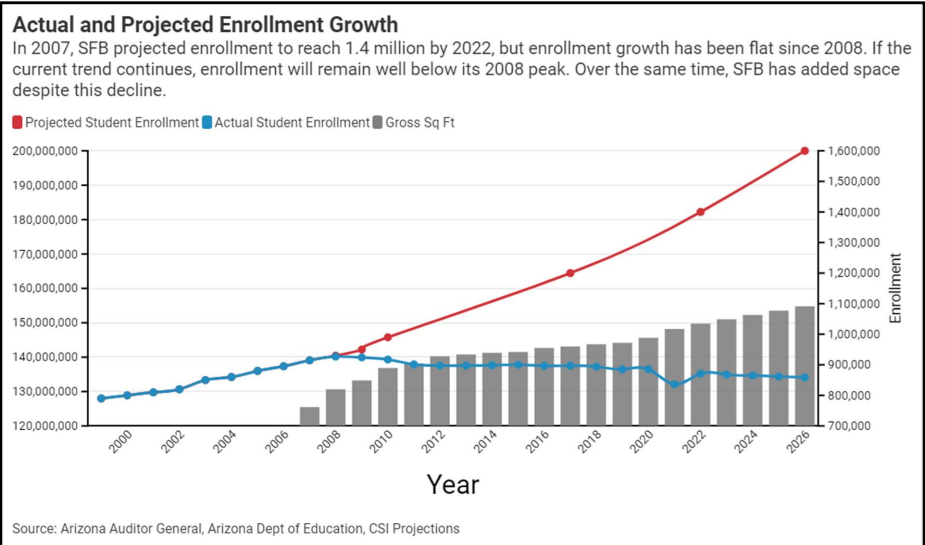
This chart from a revealing study by the Common Sense Institute shows a central planning/crony capitalism dynamic in Arizona district school construction. The red line (projected statewide enrollment) departed from reality beginning with the Great Recession, whereupon it departs dramatically from the blue line (actual statewide enrollment). A giant nationwide real-estate bust that prevents people from selling their houses and moving to Arizona was not great for enrollment growth. The Baby Bust 2008 kicked off depressing enrollment growth once the real-estate crisis faded.
Despite the statewide district enrollment decline that started that year, Arizona school districts added approximately 20 million square feet of new district school space. Note that the blue line in the Common Sense Institute chart above represents total K-12 enrollment, rather than district enrollment. What has been happening with district enrollment? Glad you asked:
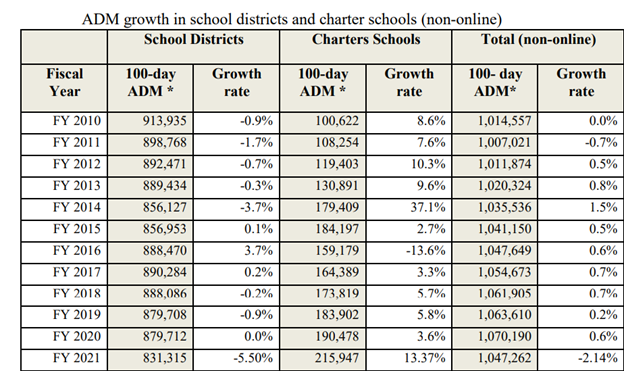
Between a Baby Bust that shows no sign of relenting, continued charter school enrollment growth and new kid on the block Universal ESA, you might think that Arizona school districts would buckle down and focus on putting more resources into the classroom. You would however be entirely mistaken. Instead, districts are asking voters for billions of dollars in (you guessed it!) new school construction! More than $4.3 billion, to be precise.
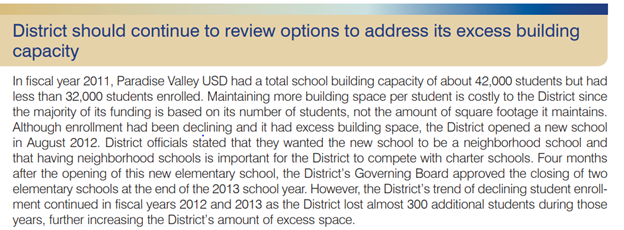
The district I live in, Paradise Valley Unified School District, is going out for a half billion dollars in total bond debt. In 2013, the Arizona auditor general noted that the district had a physical plant space for 42,000 students, but only 32,000 students enrolled. Therefore, the auditor general recommended leasing vacant space:
Paradise Valley Unified was down to 28,707 students in 2022. In the summer of 2023, the district announced the possibility of closing schools in response to enrollment decline. In the fall it will hold a bond election to take on an extra $558,716,667 in debt for the following purposes:
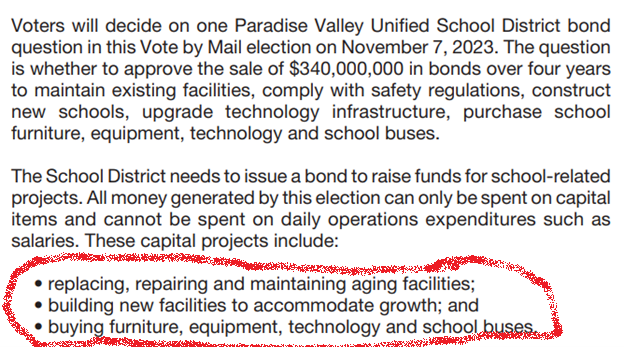
The solution to a district with space for 42,000 students but fewer than 29,000 students would be to retire aging facilities rather than replace or repair them. The district’s enrollment has declined by 18% since the year 2000, making the notion that the district needs to “accommodate growth” odd.
Right about now you might be wondering, “what’s going on here?” The Arizona Center for Investigative Reporting provided an important clue in 2017 when it found that district bond campaigns are often 100% financed by school construction firms. Like the construction of ghost cities in China, politics and cronyism rather than necessity drive these bonds.
When the Baby Boomers moved on to college and careers and were replaced by Baby Busters, many schools closed. Today, we see schools remaining either under-used or vacant. Arizona policymakers should require all future bond elections to be held on the uniform election date in even-numbered years and should consider creating a base-closing commission to get zombie schools out of district backlogs and into some sort of productive use.

