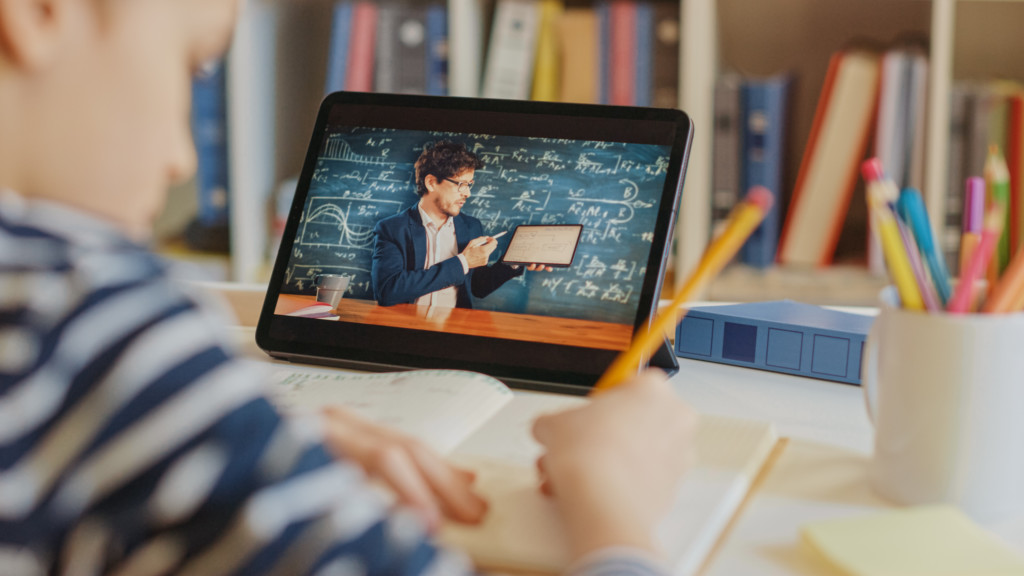
 Editor’s note: With this commentary, redefinED welcomes Julie Young as our newest guest blogger. Founding CEO and former president of Florida Virtual School, Young serves as vice president of education outreach and student services at Arizona State University and is managing director of Arizona State University’s Prep Academy and ASU Prep Digital.
As the world continues to work through the pandemic, teachers and students are back in school wading through the new realities of whatever “school” means these days. Among other things, the pandemic has certainly challenged any notions of a “typical” school model. Indeed, if there is any commonality among schools right now, it is that “typical” may no longer exist.
Where will things go from here?
As we wondered aloud about this, we landed on a few predictions, based on our view of the industry in this moment, and our look back at how trends in tech adoption have played out over the years. Here are a few thoughts:
The switch to tech-supported learning is permanent.
While our natural tendency to look at the past with nostalgia is strong, especially during such turbulent times, educators seem to agree that after this mass exodus to remote learning, things will never go back to exactly what they were. This is both good and bad.
On the negative side, no digital learning professional would have wished 2020 on any teacher. Instantly rolling into remote learning was truly a worst-case scenario. What ensued was more about patching holes and saving the ship than proactively building the ship in the harbor and preparing for launch. Teachers have heroically moved forward, but few will disagree with the idea that today’s version of remote learning is not a permanent landing spot.
Because of the rough transition, it’s not surprising that we have lost teachers in the process, especially those on the cusp of retirement or early in their careers. After weighing the frustrations versus the option to leave, some are opting for the exit, especially in light of the reality that once school is “normalized,” digital learning is highly likely to play a bigger role.
On the upside, some teachers who are willing to take on the task of learning both the tools and the strategies for working effectively within online environments have found the online or blended environment to be invigorating. One seasoned teacher told us recently that teaching online for the first time opened up a whole new world of learning to him, helping him to address his own stagnancy.
At our site-based locations, where classes are still largely remote, students and teachers alike are becoming accustomed to some of the new Web 2.0 tools they have adopted. As teachers use various online tools, they often find new ways to incorporate them into their instructional planning. Since many of the tools teachers are using are free or low cost, we expect the uptick in use of digitally supported learning tools is here to stay, even in brick and mortar schools.
Many students will stay online.
Right now, full-time online learning programs are seeing huge enrollments spikes. In fact, as the 2020 school year approached, here in the network of ASU Preparatory Schools, where ASU Prep Digital lives, we saw many parents hedging their bets – enrolling students in both site-based and the fully online school.
We expect that there will be some “leveling out” when parents have more options for a traditional face-to-face environment and want to go back to what is familiar. At the same time, we know there will be parents and students who may have formerly been averse to an online learning environment but are now seeing benefits that they don’t want to lose, particularly the greater sense of student agency.
Innovation and model experimentation will increase.
Now that teachers and administrators in traditional schools have had to build new models in the worst possible conditions, they will soon be able to take stock of their new knowledge and apply it in a much more proactive and strategic manner.
We expect to see more innovation arising from the pandemic once educators can catch their breath. Over the years, we have always found that when teachers have space to try something new, they become the best source of information on how to improve the innovation on behalf of students.
Alternative school ideas – ‘unschool,’ micro-schools, learning pods, homeschooling, ‘outschool’ – will continue to increase.
Years ago, homeschooling was considered a radical notion, a fringe idea for hippies or religious groups. Today, homeschool is mainstream, and similar ideas are taking form.
“Micro-schools,” which harken back to the one-room schoolhouse notion, were already seeing growth before the pandemic. Micro-schools could be seen as an alternative for those who like the creativity homeschools affords, but they either don’t want to teach their own kids or don’t have the option to do so.
Homeschooling and even “unschooling” models, where curriculum is determined by the student’s interests versus a pre-set curriculum, now have access to online material to enhance and support student learning.
The flexibility inherent in alternative programs like these may be something parents increasingly want to see. While having the kids at home is an untenable situation for some families, others have found themselves surprised by the joy of simply being able to watch their kids in the moment of discovery.
Which leads us to the last point.
Notions about how and when students progress will continue to change.
For some time now, we’ve seen signs that old ideas about how a student progresses through material and grade levels are changing.
At the college level, the trend toward incremental learning with shorter-term certifications and stackable credentials has taken hold. This “incremental learning” trend has moved into the high school and even lower grade levels, with students now able to receive badges and other forms of recognition for learning mastery.
We have always known that students don’t all progress at the same rate, and progression across disciplines and skill areas also varies from one student to the next. For years, though, the idea of building a K-20 learning environment where competency and mastery determine advancement versus age or grade levels was hard to imagine.
Today, digital content and data tools are making it easier to envision a time when students will work toward achieving more and more mastery along a competency pathway, versus a course or grade level. At ASU Prep Digital, we already offer glimpses of this model by pulling down college on/off pathways into the high school program.
Students can opt for in-course college paths to get college credit while still in high school. Our full-time students can potentially earn up to 48 college credits at no cost throughout their high school career at no cost to the families. ASU Prep Digital continually works with innovation centers throughout the university to identify university materials and assets that can be repurposed for learning and for college and career readiness for high school students.
The wholesale dive into remote learning was a worst-case scenario. With every crisis, though, innovations arise, and we expect the pandemic to yield a new cadre of newly equipped educators who are ready to implement new possibilities they wouldn’t have explored otherwise.
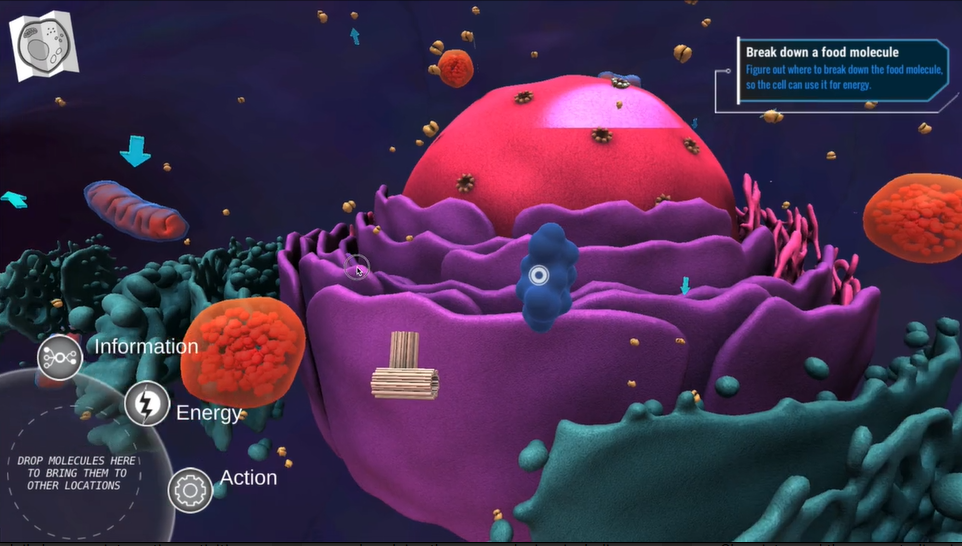
BioBeyond offers students a 3-dimensional, immersive experience where learning happens by doing and every action provides feedback.
Apparently, Bill and Ted were onto something.
The two teenage slackers facing academic failure in the 1989 sci-fi film “Bill & Ted’s Excellent Adventure” turned from apathetic to excited about their world history project when given the chance to meet the likes of Socrates, Napoleon and Abraham Lincoln by traveling back through time in a phone booth.
Fast forward three decades, and the concept of experiencing lessons firsthand not only is possible, but eventually will play a key role in the next generation of education.
While students connected with their teachers via videoconferencing and online collaboration tools from home during the coronavirus pandemic, they didn’t get the direct, continual instruction they were familiar with in a traditional classroom. Integrating immersive technology and virtual learning experiences offers teachers the potential of providing the best of both worlds, sparking student curiosity and creativity even if teacher and student aren’t in the same physical space.
One example: BioBeyond, a course that allows high school students to have 3-dimensional, immersive experiences and master concepts while on an adventure that prompts them to answer the age old question, “Are we alone in the universe?”
“We know from research that we learn best by doing, by exploring, by engaging the material,” said Ariel Anbar, a professor at the School of Earth & Space Exploration at Arizona State University.
Anbar’s team developed the course, which originally was designed for college students. A geologist and chemist, Anbar narrates the course introduction.
The high school version of BioBeyond, which debuted at the start of the 2019-20 school year, is the flagship course at Arizona State University’s Prep Digital, an accredited online high school that allows students to take a single course or enroll in a full-time, diploma-granting program. Students also get the opportunity to earn concurrent college credit at ASU.
The $1 million course was funded through a grant from the Gates Foundation and NASA and is available for licensing by schools around the world.
“The university designed BioBeyond to capitalize on the natural curiosity that human beings have,” said Julie Young, vice president of education outreach at the university and managing director of ASU Prep Digital and ASU Prep Academy, a charter school network. “It’s beautifully done in terms of the look and feel of the course. We’re getting very good feedback. Students are excited about the content, and teachers are excited about teaching the content, and parents like how much they are learning from the content.”
(For more on Young and the future of education, listen to her podcast with Doug Tuthill, president of Step Up For Students, the nonprofit K-12 scholarship administration organization that hosts this blog.)
Instead of lectures and tests, BioBeyond brings lessons to life by taking students on a journey that feels like a video game. The adventure begins with virtual visits to five diverse locations around the world, including the ocean floor, to examine and classify species. Then students go on a virtual field trip to the Galapagos Islands to find out how species change over time. The course teaches cellular biology through a simulation that includes the inside of volleyball player’s nerve cell and asks students to make the cell fire so the player can hit the ball.
The reason behind all the earthbound travel? In order to effectively contemplate the possibility of extraterrestrial life, the course creators reason, we must first gain a firm grasp of life on our own planet.
In addition to being interactive, BioBeyond is also adaptive, meaning it interacts with students to offer lessons based on particular interests and progress. If a student is struggling in an area, extra time is offered for problem solving or material mastery. If a student is making rapid progress in an area, he or she will have additional opportunities to dig deeper.
“The course acts like Google Maps,” said Amy McGrath, chief operations officer for ASU Digital Prep and an associate vice president for educational outreach and student services at the university.
For example, drivers, like students, are heading toward the same destination, but they may be starting their trip from different locations. Those who make a wrong turn or need to take a detour are simply rerouted to the same end point. The course also generates analytics that teachers can use to see each student’s strengths and interests and where extra help is needed.
“It’s high tech, but it’s also high touch,” McGrath said. “It allows for meaningful conversations.”
Grades are formative, meaning they reflect the student’s mastery at their own pace. Classroom teachers, however, are free to add summative assessments, evaluating student learning at the end of an instructional unit by comparing it against some standard or benchmark.
ASU offers other courses that employ scenario-based learning, though none are as sophisticated as BioBeyond. In an online course, for example, students help treat a patient named Hero who has been diagnosed with cancer.
“As Hero goes through the journey and works through the treatments, the students are learning chemistry through that relevance,” Young said, adding: “This is who we want to be and how we want to design learning.”
Besides making lessons more engaging, the experiential content also creates equity. Students who can’t afford to travel can now “see” the world and get exposed to concepts and careers they might never have been able to consider.
“They can be under water with the sea lions, see coral and understand what a marine scientist does for a living,” said Young, a former Florida third-grade teacher who noted that many of her students had never visited the beach, despite living minutes away.
Though BioBeyond is currently the only course of its kind at ASU, Young reports that a U.S. history course is on the horizon and will be a reality in the next six to 12 months.
“We would like to see the kids have the opportunity to interact with Abraham Lincoln or George Washington or be on the battlefield in the Civil War,” she said. “It takes the student into the moment by utilizing the technology we have available.”
Bill and Ted undoubtedly would rate such a course “excellent.”
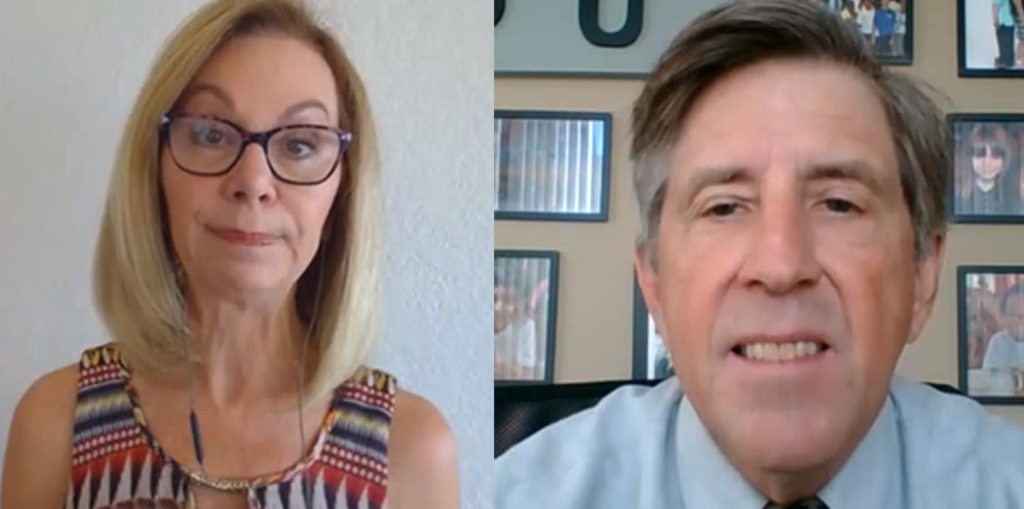 In this episode, Step Up For Students President Doug Tuthill talks with Julie Young, vice president of education outreach and student services at Arizona State University and managing director of Arizona State University’s Prep Academy and ASU Prep Digital. Young, who has been celebrated as an education disruptor for nearly three decades, was founding CEO and president of Florida Virtual School, the world’s first statewide virtual school and one of the nation’s largest K-12 online educator providers.
The longtime friends share a fascinating discussion about the future of public education in the wake of a global pandemic. Both believe the shifts that have occurred have accelerated change, making competency-based education the “new normal” by default. They also discuss the crucial role of virtual reality technology as it relates to the competency-based model. Both Young and Tuthill remember teaching in classrooms 15 minutes from the beach populated by students who had never been there and discuss how virtual reality can end such inequities.
Young: “We’re not going back to the old normal, and we’re creating our new normal. And our new normal will be to offer families choices.”
EPISODE DETAILS:
· What we can learn from the sudden shift to digital learning and how parents took control in structuring their learning and working days
· The empowerment that occurs when parents plan curriculum and how COVID-19 has allowed them to watch how their kids learn
· How virtual reality can level the equity playing field, giving more children greater and personalized access to understanding what the world is like
· How assessments will change and combine, creating an experience based on the needs of each learner
· How the role of teachers will shift in this new environment
LINKS MENTIONED:

