
States that lead in providing varied choices to families with autism aren’t just doing the righteous thing. They also are making themselves a more desirable place in which to live and invest.
Anyone associated with the pursuit of “economic development” will tell you that the quality of local schools is a key factor in a community’s ability to attract high-paying jobs. Businesses are better able to recruit and retain employees if their children have access to a good education.
Academics are just one element in assessing schools. The availability of student services increasingly is a key consideration for families – especially with regard to autism.
According to the Centers for Disease Control and Prevention, autism is the fastest-growing development disability in the nation. The prevalence of autism in U.S. children jumped from 1 in 150 in 2000 to 1 in 59 in 2014. The reasons for that surge are the subject of much debate. It may be due to better diagnosis, increased awareness, and broader definitions of autism; the spectrum of disorders has expanded to include a wider range of language abilities and social behaviors.
Regardless of the causes, schools and communities are struggling to keep up with the increasing demand for autism services – and not just because they have a moral duty to do so. They also have a legal obligation. The federal Individuals with Disabilities Education Act (IDEA), first enacted in 1975, mandates that public school students with intellectual disabilities, including autism, are entitled to early intervention services and special education.
Alas, compliance with IDEA -- by districts and by entire states – has been uneven, to say the least. The Houston Chronicle in its 2016 investigative series “Denied” reported how Texas officials arbitrarily decided what percentage of students should get special education services, leaving thousands of children searching for assistance.
Parents need alternatives outside a system that not only may not be working for them, it may be working against them.
There is another incentive that cannot be ignored: Being an autism-friendly community can have economic benefits.
Research has found a correlation between autism and affluence -- upper-income parents are more likely to have children with autism. Again, the causes are uncertain. Perhaps it’s because parents with higher educations and higher-paying jobs have more resources than their less-educated and less-affluent counterparts to seek diagnoses and services for their autistic children. Nevertheless, many childhood developmental disabilities have an inverse relationship with socio-economic status – the poorer the family, the more likely a child is to have a developmental issue. Autism, however, appears to be the opposite effect.
A 2010 University of Wisconsin-Madison study found that affluent children were almost twice as likely as the poorest children to have autism. Poor neighborhoods did have lower rates of diagnosis. But even among children with no autism diagnosis, the richest children displayed signs of autism 39 percent more often than those in the poorest neighborhoods. This was true within all ethnic groups: Wealthier African-American or Hispanic parents were more likely to have autistic children compared to poorer people of the same ethnicity.
Is it because of lifestyle or other environmental factors? Or are certain traits of successful people – especially those involved in such fields as engineering and the sciences – passed on to their offspring? The search for answers continues.
Whatever the reasons, the statistical reality is that educated, affluent parents are more likely to have children with autism, and thus will seek to live and work where they have access to quality services. Communities have an obligation to provide such services to all regardless of socio-economic background, but the demographics of autism indicate there is a positive externality to adopting such policies: an influx of the kinds of educated residents and high-wage employers that areas compete with each other to attract.
A 2011 online survey by Autism Speaks found that nearly 75 percent of respondents were not satisfied with their community's resources and services for people with autism. Among those who said they are generally pleased with the availability of services and resources where they live, many cited satisfaction with the educational services their child receives.
It costs more than $8,600 extra per year to educate a student with autism. Federal grants can help defray costs, but they don’t cover everything.
Education choice can play an important role in bridging that gap and providing families more options.
Florida has two education programs that assist parents of children with special needs, including autism. The McKay Scholarship was the nation’s first such voucher program, providing eligible students the opportunity to attend a private school or transfer to another public school. It currently serves 31,000 students. The Gardiner Scholarship is an education savings account (ESA) that goes further by allowing parents to spend funds on a combination of programs – not just schools (including home schools), but also tutoring, specialists, curriculum and technology. It serves more than 11,000, making it the nation's largest ESA.
Several states, including Arizona, Mississippi and Tennessee, have adopted either vouchers or ESAs for special-needs students. In 2004, Ohio launched the nation’s first and only private school voucher program exclusively for students with autism. Unfortunately, Virginia Gov. Terry McAuliffe in 2016 vetoed a bill that would have created an ESA for students with disabilities.
ESAs offer families the most freedom. Parents can choose where to spend the money, specifically tailoring schooling and services to meet their children’s individual needs. That empowerment can also incentivize providers to offer a wider array of services, and at lower cost.
As the autism spectrum expands to include more diverse behaviors, it’s vital that students have as many education preferences as possible to find the best fit. That could be a traditional classroom setting, a charter or private school that specializes in autism, a homeschool network of parents of children with autism, or even a combination of those. Indeed, it’s unrealistic to expect all the possibilities to fit under one roof, within one paradigm.
States that lead in providing varied choices to families with autism aren’t just doing the righteous thing. They also are making themselves a more desirable place in which to live and invest. Ultimately, that will boost the quality of life for all.
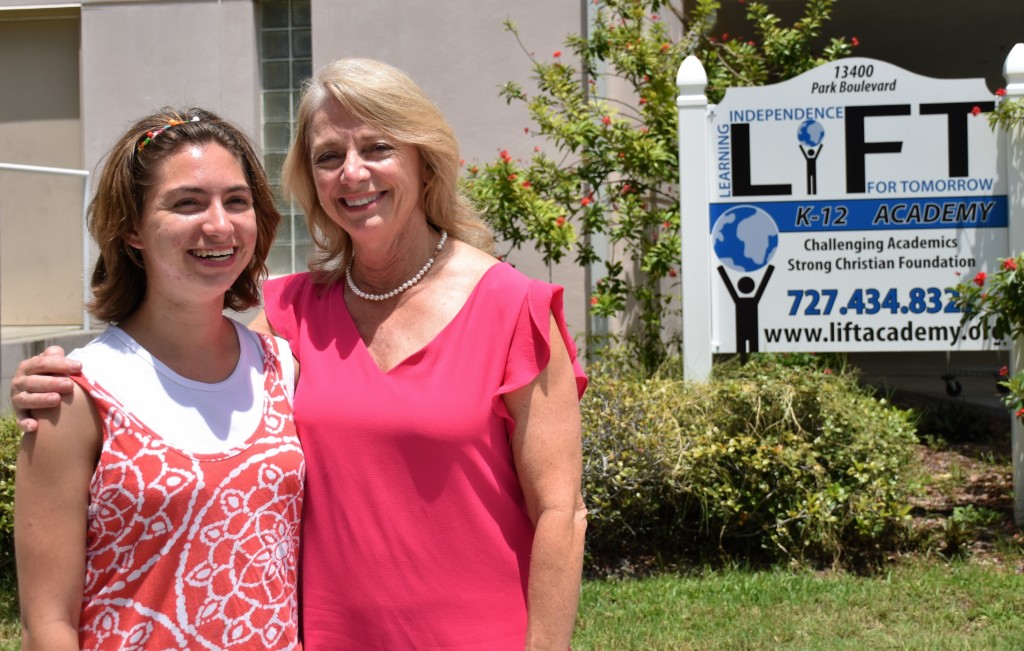
Kim Kuruzovich, an educator with more than 20 years experience in public, private and home schools, is executive director of LiFT Academy, a private school for students with special needs. Of 130 students, 124 attend with help from state-supported school choice scholarships.
SEMINOLE, Fla. – Kim Kuruzovich’s daughter Gina has moderate autism, speech apraxia and dyslexic tendencies. She began a suite of therapies at age 2, then, at age 4, saw a psychologist for an educational evaluation.
The expert wasn’t encouraging.
“He told us, ‘You can look forward to Gina putting pencils in a box,’ ” recalled Kuruzovich, who has more than 20 years of experience teaching students with disabilities.
She and husband Mike drove home in stunned silence. It took a couple of months, but they snapped out of the haze and chose to ignore that doctor. It was the start of Kuruzovich learning to trust her instincts as a parent as much as she trusted her instincts as an educator.
Now, 19 years later, Kuruzovich is executive director of a private school built on those instincts.
LiFT, which stands for Learning Independence for Tomorrow, opened in 2013 with 17 students and five unpaid teachers who wore every hat imaginable. Today, it operates on two spacious, tree-lined church campuses. They serve more than 130 students with special needs, 124 of whom attend thanks to state-supported school choice scholarships.
“I never, ever wanted to go into administration. Ever,” Kuruzovich said. “I only ever wanted to be a teacher. I love teaching. I love seeing the kid get it and feel good about themselves.”
“What I found is I still get it as an administrator, but I get it in a bigger way. Now it’s not just my classroom, it’s every kid in this school.”
Before LiFT, Kuruzovich had taught in public, private and home schools. Her passion and talents helped make LiFT possible.
So did school choice.
Three state-supported scholarships - the McKay Scholarship, a voucher for students with disabilities; the Gardiner Scholarship, an education savings account for students with special needs such as autism; and the Florida Tax Credit Scholarship for low-income and working-class students - allow many LiFT parents to access a school they wouldn’t have been able to afford otherwise. (The Gardiner and FTC scholarships are administered by nonprofits such as Step Up For Students, which hosts this blog.) But those scholarships also opened doors for Kuruzovich and her colleagues. It gave them power to create a school that could best serve those parents – and sync with their own visions of what a school should be.
In Florida, where school choice is becoming mainstream, more and more educators like Kuruzovich are walking through those doors.
***
It’s the first week of the school year, and Kuruzovich is in peak form – gliding through hallways and classrooms, a fast-talking, wise-cracking, blond blur of smiles and warmth.
The sheer number of inside jokes she shares with her students highlights how deep her connection runs with each of them. (more…)
TAMPA – To challenge students in his first-period social studies class, professional animator-turned-educator Nick Gallo-Lopez asked them to imagine being trapped in a maze of mirrors inhabited by a people-eating chandelier.
It wasn’t your typical social studies lesson. But then, Focus Academy isn’t your typical school, and these weren’t your typical students.
One student in particular stood out.
Daniel Miguenes, lean and long-limbed with dark, watchful eyes, stepped back as his classmates huddled. He remained silent as they chose partners and plotted their escape from the maze, as if separated from them by an invisible curtain.
Gallo-Lopez continued the lesson, occasionally attempting to lure Daniel in. But he didn’t push. Experience has taught him that forcing a student like Daniel to engage is like trying to convince a vegetarian to eat prime rib.
The last thing he wanted to do was unravel the bond he and his colleagues have forged with Daniel in the three years he’s been with them.
“It’s taken time to get on Daniel’s wavelength, to gain his trust,” Gallo-Lopez said. “Maintaining that connection is the key to his continued success, not just academically, but socially as well. That’s our goal here.”
* * * (more…)
When Charleen Decort was looking for the right school for her daughter, she traveled around South Florida, looking at factors some parents rarely consider, like the color of the walls and the shade of the lights.
When she found her current school, a predecessor of what is now Connections Education Center of the Palm Beaches, another factor carried the day: Trust.
"She has to feel comfortable around you," Decort said of her daughter, who has autism, "and they take the time to do that here. That's big."
She got on the waiting list for the school's early learning program. If a spot hadn't opened in time for kindergarten, Decort said she would have considered teaching her daughter at home, or even moving somewhere else.
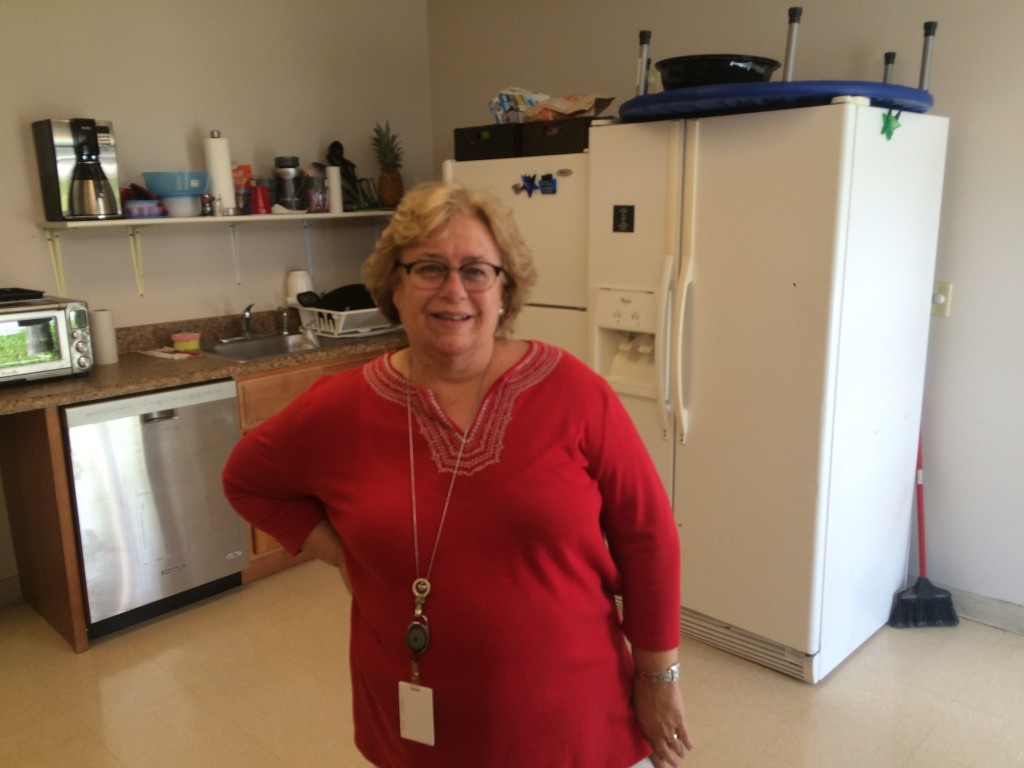
Principal Debra Johnson shows a visitor around Connections Education Center of the Palm Beaches.
Fortunately, she found a place for her daughter, now in third grade, in a growing array of small schools, some public, some private, that are purpose-built to serve children who might be distracted by the flickering of a fluorescent bulb, or rely on an iPad to communicate, or have other special needs that can be hard to accommodate in traditional schools.
Connections — currently a private school, with a charter application set to be approved later today by the Palm Beach County School Board — is a newcomer to this sector-agnostic niche, which caters to children with autism.
Debra Johnson helped start Connections this year, after the Renaissance Learning Center, where she had been principal, moved north to Jupiter. It's now housed in a world-class facility at the Els Center for Autism, as first reported by the Palm Beach Post. Johnson and several other employees launched the new school in West Palm Beach to accommodate parents who couldn't make the drive to the north end of the county.
Other schools have sprung up in surrounding communities, with different emphases but similar goals. There's the Palm Beach School for Autism, a charter school in Lantana. Mountaineers School of Autism is a K-12 private school in West Palm Beach. Oakstone Academy promotes inclusion for special needs students. (more…)
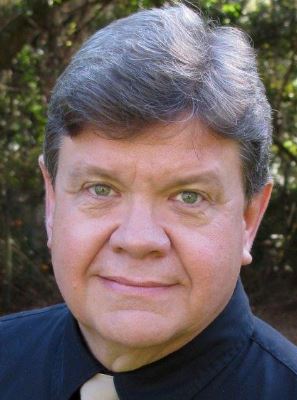
John Kurnik
Wonks and politicos weren’t the only attendees at the Jeb Bush education summit in Tallahassee this week. Parents who support educational choice were also there, including John Kurnik of Tampa, Fla., who has a 12-year-old son with autism.
A college professor, Kurnik introduced Florida Senate President Andy Gardiner, and for good reason. Gardiner led the legislative charge last year for creation of Personal Learning Scholarship Accounts, a new ed choice program for students with significant special needs. Kurnik and his wife Mary secured a PLSA for their son, and have become vocal and visible supporters.
We thought Kurnik’s prepared remarks were worth posting in full. They’ve been edited slightly for length and clarity.
Good afternoon! My name is John Kurnik, and I am honored and humbled to be speaking to you today about high-quality education for the children in our state.
First, on behalf of my son John who has autism, my wife and family, the Florida PLSA recipients and the thousands of family members, friends, neighbors, and all those who will be touched in a positive and hope-filled way … thank you ... from the bottom of our hearts.
Thank you for knowing that the educational paradigm for special needs education requires early and effective intervention if we are to help these young people maximize their special gifts in a timely manner. And until now, many families including my own, have had to triage psychologist- and physician- recommended therapies and treatments according to those available services and the family budget. Or more times than not, completely go without.
Many thanks for helping these young people and their families with the hope of overcoming hurdles to success, and giving them the possibility of a productive, full, and happy life with the blessing of the PLSA. They will benefit from the PLSA. And when they benefit, all of us – our neighborhoods, our communities and our state – will benefit too.
I congratulate you for recognizing that special needs includes hope for the parents, siblings, friends, and relatives of a special-needs child who needs 24-7 care and attention by a wonder woman or superman parent or caregiver.
Thank you for trusting us as those caregivers for our special kids to make the best decisions possible on their behalf as good stewards of these funds which allow great things to happen. Believe that the vast majority of us play by the rules, and we agonize over the best use of this precious gift. (more…)
Grade appeal: Two West Palm Beach County schools are among 12 in the state appealing their overall grades to the Florida Department of Education. Sun Sentinel.
 Charter schools: Pinellas County's newest charter school, University Preparatory Academy, draws complaints concerning students with behavioral problems. Tampa Bay Times.
Common Core: Will new Common Core standards mean less teaching to the test? StateImpact Florida.
Special needs: A Palm Beach high school culinary club partners with Autism Speaks to develop a cooking program that helps kids with autism make friends. Sun Sentinel.
Enrollment: Palm Beach County schools lose more than 1,000 students in official district count while charter school enrollment booms. Palm Beach Post.
Drop in: Orange County educators will visit former students who have dropped out of school to persuade them to return. Orlando Sentinel.
Mentors: What the Polk County School District needs now is more mentors, says the district's Superintendent Kathryn LeRoy. The Ledger.
The arts: "Orange County has reached a milestone,'' writes columnist Scott Maxwell. "We have at least one art or music teacher in every school. That is both impressive … and sad.'' Orlando Sentinel.
Name change: A social media campaign gains steam toward changing the name of a Jacksonville high school named after the first grand wizard of the Klu Klux Klan. Florida Times-Union.
Editor’s note: The McKay Scholarship Program for students with disabilities has on occasion been criticized because it does not require that student progress be measured with a standardized test. Robyn Rennick with the Coalition of McKay Scholarship Schools argues that such a policy would be ineffective and counterproductive.
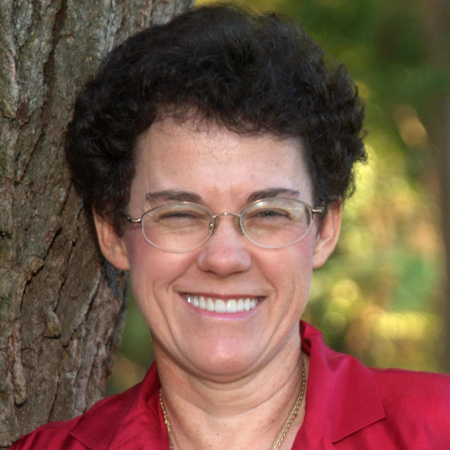
Rennick
The McKay Scholarship is quite different from tax credit scholarships in Florida or other programs that are working with the general student population. All recipients of McKay Scholarships have diagnosed disabilities and had either an Individual Education Plan or 504 Plan in the public school. Therefore, by definition, they are a unique group of students with all types of disabilities from low cognitive functioning, to autism, to learning disabilities.
The issue of requiring standardized testing was thoroughly investigated and discussed prior to crafting the initial legislation to create the McKay Scholarship. Legislators determined it was an inappropriate measure of accountability. The testing issue was brought up again between 2004 and 2006 when the accountability bill for scholarship programs was being crafted. Legislators again saw the inappropriateness of this type of testing and did not place it the legislation. They recognized that the “one size fits all” approach to testing is wrong for this population of students.
How do you test such a diverse population? What standardized test measures the growth of a severely non-verbal autistic child whose progress may be measured in gaining 40 words in a year and in being able to sit appropriately for five minutes? What standardized test measures the progress of a developmentally disabled child who is learning proper hygiene? Placing these children in a standardized test format would never show the immense progress they may have made that year, compared to where they were. It would also be a cruel exercise to make the children follow.
What of the learning disabled students? Shouldn’t standardized testing be used to show their progress? When the Coalition of McKay Scholarship Schools surveyed its members, we found more than 50 percent of the schools did use a standardized test, especially those serving the learning disabled population. However, what is also typical is these students often enter the private schools three or four years behind their peers on standardized test scores. If a student only “gains” a year on the standardized test, they are still behind. Has the school failed?
We have seen the controversy in our public system as to whether “experts” agree that standardized tests really show whether a school is working. From a research basis, for scores to be compared, the population has to be similar. As we have already noted, the McKay population is extremely diverse. Also, the population has to be large enough to develop an aggregate score. Forty-five percent of schools with McKay students have 10 or fewer students. No researcher would validate aggregate scores from such a small group of subjects. Even in a school with 100 students, the diversity of the groups would not allow for a true picture. So to require standardized testing which is reported to DOE, and then to craft a “research report” from that, would be the most flawed research and a tremendous waste of everyone’s effort, time and money.
This is a parent choice program. Parents are the consumers. They can leave if their children’s needs are not being met. (more…)

