 Nobody invoked Ronald Reagan this week and demanded that somebody (Randi Weingarten? President Obama? The local school board?) “tear down this wall,” but two school choice champions got close. Step Up for Students President Doug Tuthill used the Berlin Wall analogy yesterday in a redefinED post about the big-picture trends in ed reform. And in a beautiful coincidence, Robert Enlow, president and CEO of the Friedman Foundation for Educational Choice, did so today in an op-ed for CNN.
Wrote Enlow: “Just like the millions of East Germans who demanded freedom, we know that there are millions of parents that want to be removed from a system that uses a zip code to determine where their children must attend school.” He concluded, “Vouchers should be made available to children no matter if they are poor, disabled, from the middle class or from a family of 10, or from a rural, suburban or urban area. There should be no restrictions on who gets to choose, just like there were no restrictions on who could escape tyranny once the Berlin Wall fell.”
Also by coincidence, one of the nation’s biggest pollinators for school choice, Jeb Bush, delivered an ed reform speech in Colorado this week. He didn’t explicitly urge anyone to tear down any walls, either, but according to Education News Colorado he did implore the audience of 1,700 to “join reformers to make school choice both public and private the norm in our country."
Hmmm. Anyone else see speech potential here? Tampa. August. Fired-up delegates shouting "Tear down this wall!" as millions watch ...
Getting lost in the complexities of education reform is easy, so I use the following analogy to help me understand the daily ebb and flow of school reform issues.
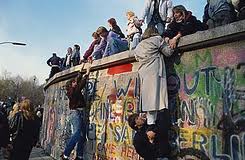 School districts are East Germany.
School choice programs are refugee camps comprised of people who have left East Germany.
The promised land (i.e., a better public education system) is West Germany.
The promised land becomes attainable when the number of families in refugee camps becomes large enough to make a well-regulated, market-driven public education system viable.
I equate school districts with East Germany because they are command-and-control, politically run monopolies where teachers and parents have little decision-making power. School districts employ legal barriers (i.e., the Berlin Wall) to prevent families from leaving, although affluent families have always been able to buy their way out. Increasingly, lower-income families are accessing resources (i.e., tax credit scholarships and vouchers) which allow them to get out also.
While this analogy is not precise, it does help me understand the motivations, tensions and contradictions that permeate the current education reform movement. Today we have two parallel reform movements. One is attempting to improve productivity within East Germany, while the second is trying to knock down the Berlin Wall and turn all of public education into West Germany. (more…)

