 Blaine Amendment: The Constitution Revision Commission's Declaration of Rights Committee approves a proposal to put repeal of the Blaine Amendment before voters in 2018. The amendment prohibits the use of tax money “directly or indirectly in aid of any church, sect or religious denomination." In 2006, the Florida Supreme Court cited the amendment when it ruled that a state violated the law with its scholarship program for students to attend private schools. House Speaker Richard Corcoran, R-Land O'Lakes, has long called for a repeal of the amendment. The proposal now goes to the full commission, where 22 of the 37 members would have to approve it to put it on the November 2018 ballot. Sixty percent of voters would then have to approve the repeal to put it into effect. Tallahassee Democrat. News Service of Florida.
Education spending: Gov. Rick Scott continues a state tour to promote his education budget, which he says will boost spending on K-12 education to a record $21.4 billion. “We’re going to have historic funding for the sixth year in a row,” says Scott about his proposal to increase per-student spending from $7,297 to $7,497. But an analysis in Folio Weekly magazine questions that statement. Using the Consumer Price Index calculator, the magazine says it would take $8,377.89 per student today to match the $7,126 per student from then-Gov. Charlie Crist's 2007, pre-recession budget. Florida Politics. WJCT. Florida and 28 other states are spending less on education now than they were before the 2008 recession after an adjustment for inflation, according to a study by the Center on Budget and Policy Priorities. And Florida and six other states each spent at least 15 percent less per-student in 2015 than in 2008. The 74.
Superintendent honored: Pinellas County School Superintendent Mike Grego is named Florida superintendent of the year for his work to close the achievement gap between black and nonblack students. Grego, 60, has been superintendent in Pinellas for just over five years. He now represents Florida at the national competition in Nashville in February. Gradebook. WUSF.
By Lloyd Dunkelberger
News Service of Florida
A ban on state support for religious groups would be removed from the Florida Constitution under a proposal approved Wednesday by a Constitution Revision Commission panel.
In a 5-1 vote, the commission's Declaration of Rights Committee endorsed a measure (Proposal 4) that would eliminate the Constitution's so-called “no-aid” provision, which prohibits public funding “directly or indirectly” for any church, religious group or “sectarian institution.”
The no-aid provision, which dates to Florida's 1885 Constitution, has been invoked in recent years in legal fights over using publicly funded vouchers to send students to private schools. A state appellate court in 2004 cited the provision in striking down a voucher program, though the Florida Supreme Court later found the program unconstitutional on other grounds.
Religious schools and vouchers: Two U.S. Supreme Court decisions this week could have implications for the constitutionality of vouchers for religious institutions. Monday, the court ruled that Missouri could not exclude private religious schools from a playground grant program. Tuesday, the court ordered the Colorado Supreme Court to reconsider a decision that the state's Blaine Amendment prohibits public funding of religious institutions. redefinED. Education Week. Associated Press.
Voucher studies: Long-term studies in Louisiana and Indiana show that former public school students who keep private school vouchers for several years eventually catch up and sometimes pass their peers in reading and math tests. Earlier, shorter-term studies have shown that those students tend to lag behind their public school peers. redefinED.
Immunizations upheld: Parochial schools can require students to get immunizations to be admitted, the First District Court of Appeal rules. A parent filed the appeal after the Holy Spirit School in Jacksonville refused to admit his child without immunizations. News Service of Florida.
Teaching bonuses: The Manatee School for the Arts is offering bonuses of up to $3,000 fill two 6th-grade math teaching positions, plus higher than expected salaries. The district has sent recruitment letters to the most highly rated math teachers in school districts around the state. Bradenton Herald. (more…)
Once again, prohibitions on funding religion don't stand in the way of school choice.
In the latest case, a Montana court ruled religious schools could participate in a tax credit scholarship program.
A group of moms backed by the Institute for Justice had challenged regulations that kept religious schools out of the program.
The Associated Press reported the ruling late last month:
[District Judge Heidi Ulbricht] found that the program is funded through tax credits, not appropriations, and the constitution does not address the use of tax credits. “Non-refundable tax credits simply do not involve the expenditure of money that the state has in its treasury,” Ulbright wrote.
Amendments and education: State law requires a review and update of the constitution every 20 years. Republican lawmakers intend to use the opportunity to overturn the Supreme Court's decision that the school voucher program was unconstitutional and repeal the Blaine Amendment, which forbids state funds from going to religious institutions. The review will be conducted by the 37-member Constitutional Review Commission, which can put amendments on the 2018 ballot. Thirty-three of the members will be appointed by state Republican leaders. Miami Herald.
Extended days study: A Palm Beach County School District study indicates there has been little benefit to students from the state law requiring longer days at public elementary schools with the lowest reading scores. The district looked at the 58 times schools have been forced to extend the school day by an hour. In 22 cases, there was improvement in students' reading scores. In 26 cases there was none, and in 10 cases schools' performances worsened. Last year, the district estimates, the extra hour at 25 district schools cost $9 million. Palm Beach Post.
Early education benefits: Quality early childhood education is expensive but has lasting, positive effects in all areas of society, according to a new study by Nobel Laureate James J. Heckman, a University of Chicago economics professor. Every dollar invested in childhood education produced a return of $6.30, according to the study. For more than 30 years, Heckman tracked disadvantaged black children, 8 weeks to 5 years old, who were in an intensive child-care program in North Carolina. Florida Times-Union.
District cuts testing: The Volusia County School District is cutting the number of hours students are being tested. Fifth-graders, for example, will have 26 fewer hours of district assessment testing. Elementary students once were spending three times the hours taking district tests as students in neighboring Flagler and Seminole counties. Daytona Beach News-Journal. (more…)
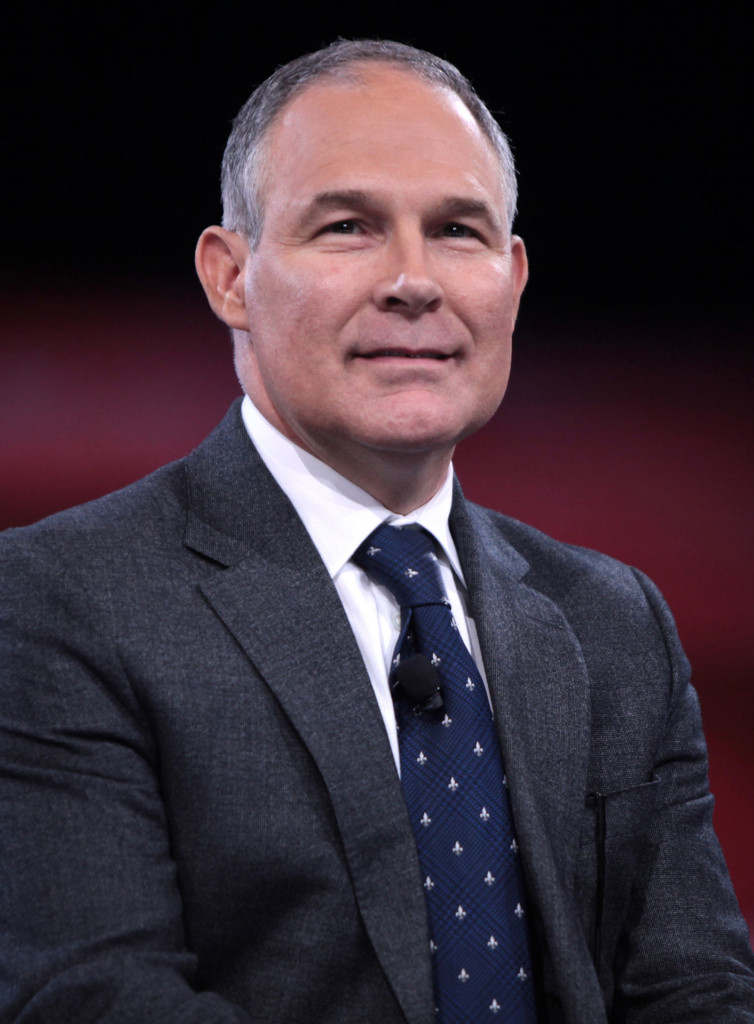
Oklahoma Attorney General Scott Pruitt
Scott Pruit recently helped defend a special needs voucher his home state, which was challenged under a so-called Blaine Amendment that bars public spending for "sectarian" purposes. The state Supreme Court upheld the program in a unanimous decision after finding it served a public purpose, rather than a religious one.
But Pruitt, addressing the American Federation for Children's national policy summit in Washington, said similar provisions in other states could create a legal "impediment" to parental choice.
"I think there needs to be [ballot] initiatives in those states, and/or legislative action, to take the Blaine Amendments off the books," he said. Religious institutions, he added, should be on a "level playing field" with secular ones.
A 2012 effort to take Florida's prohibition off the books received little financial backing, but it faced organized opposition and unfounded allegations that its primary aim was to clear a constitutional path for school vouchers. Voters ultimately rejected it. (more…)
 Black suspensions: An investigation of more than 600,000 punishments in Pinellas County schools from 2010-2015 shows that black children are suspended at a much higher rate than in the other six large Florida districts, and four times the rate of other children based on their share of the school population. And more than half of those suspensions are for loosely defined offenses such as "not cooperating" and "class disruption." Tampa Bay Times.
Homeless students: More than 71,000 students in Florida public schools were homeless in the 2013-2014 school year, or 3.74 percent of the total. Orange County has about 7,000 homeless students, and Brevard, Seminole and Volusia each have about 2,000. Florida Today.
K-12 funding: State Sen. Don Gaetz, R-Niceville, wants fellow legislators to consider other options to boost spending for K-12. Gaetz has been critical of Gov. Rick Scott's education budget, which puts most of the burden of raising additional dollars on Florida residents through property taxes. Miami Herald.
Vouchers in courts: Several school voucher advocate groups are lobbying the U.S. Supreme Court to take up a Colorado case to determine the constitutionality of spending public dollars for tuition at private, religious schools. Many states, including Florida, have so-called Blaine Amendment prohibitions in their constitutions against spending state tax revenue on religious institutions. Education Week. (more…)

The U.S. Supreme Court (Wikimedia Commons)
Four school choice advocacy groups are asking the U.S. Supreme Court to hear a case that found the the Douglas County, Colo., school voucher program unconstitutional.
The school district is looking to use the case to strike a blow against constitutional restrictions on school choice.
In an amicus brief filed this week, the Goldwater Institute, the Foundation for Excellence in Education, the Hispanic Council for Reform and Educational Options and the American Federation for Children are calling on justices to consider the district's arguments, which may help bring states' Blaine Amendments under scrutiny by the nation's highest court.
“The educational opportunities of millions of American schoolchildren are jeopardized by the Blaine amendments,” Clint Bolick, the vice president of litigation at the Goldwater Institute, said in a press release.
Blaine Amendments, which restrict the use of public funding for religious or "sectarian" institutions, are present in at least 37 state constitutions, and are currently being cited in cases seeking to terminate programs in Florida, Georgia, Oklahoma and Nevada. (more…)
Indiana: The state supreme court rules vouchers constitutional (Indianapolis Star). The decision could set a precedent for other states with Blaine amendments (ABC News). More coverage from StateImpact Indiana, Fort Wayne Journal Gazette, Associated Press, Christian Science Monitor, Huffington Post. In the ruling's aftermath, the Senate Education Committee approves a proposal to expand the program in one way (RTV6), but not as far as originally proposed (Indianapolis Star). Republicans are split over how to grow the program (Evansville Courier & Press).
 Tennessee: Anti-Muslim sentiment surfaces in the Tennessee voucher debate (Murfreesboro Post).
Georgia: Lawmakers increase the cap on the state's tax credit scholarship program (Atlanta Journal Constitution).
Texas: Education Commissioner Michael Williams says more school choice won't mean a mass exodus from Texas public schools (Associated Press). Lawmakers consider speeding up the parent trigger (Texas Tribune). Once an outcast education sector, home-schooling is on the rise (Amarillo Globe-News).
Louisiana: Voucher applications are up 20 percent despite legal uncertainty (Baton Rouge Advocate). More from the New Orleans Times Picayune. (more…)
 Editor's note: This op-ed appeared in today's Tampa Bay Times.
Few public issues are as absorbing as the balance between religion and government, so a ballot initiative that aims to change the boundary is worthy of rigorous debate. Instead, Florida's Amendment 8 is being treated to a proxy campaign on school vouchers.
A new radio ad by the Florida Education Association: "Amendment 8 allows the government to give our tax dollars to any group claiming to be a religious organization, so any religious group or sect can use our money to fund their own religious schools."
FEA president Andy Ford: "This is designed to open the state treasury to voucher schools."
Alachua School Board member Eileen Roy: "It's the very death of public schools. That's not overstating it, in my opinion."
These are provocative arguments, to be sure, but they are basically irrelevant. The amendment was placed on the ballot by two legislators — Sen. Thad Altman, R-Viera, and Rep. Scott Plakon, R-Longwood — who have said repeatedly they want to protect religiously based social services. Their interest was piqued by a lawsuit, Council for Secular Humanism vs. McNeil, that challenges a prison ministries program, and by the fact that the New York-based council has called it "a springboard to mounting other challenges."
In turn, the pro-Amendment 8 campaign is being led by a coalition of community-service providers and religious leaders who have raised less than $100,000 to date. They believe that if the secular humanists will sue over prison ministries, they might one day challenge the Catholic Charities or Catholic hospitals or the YMCA. After all, the current constitutional language is explicit: "No revenue of the state or any political subdivision or agency thereof shall ever be taken from the public treasury directly or indirectly in aid of any church, sect, or religious denomination or in aid of any sectarian institution."
Now it is certainly true that voucher advocates have previously pushed to alter the no-aid clause. But it is just as clear that they played no role in getting this amendment on the ballot and, most telling, have raised not a penny for the campaign. Their reasons are pragmatic, not philosophical: Federal and state court decisions in recent years have rendered the no-aid clause all but moot as it relates to school choice. Read full editorial here.

