 Tennessee: A task force appointed by Gov. Bill Haslam leaves no doubt that a private school voucher program is under serious consideration (Memphis Commercial Appeal). More here and here.
Florida: Teachers unions, school boards and media outlets are distorting the aim of a proposed constitutional amendment, claiming it's about private school vouchers (redefinED). A charter school task force appointed by the state Legislature considers a proposal to allow local school districts to levy additional property taxes for charter school capital costs (Orlando Sentinel). The Palm Beach County school district - one of Florida's biggest - is beginning its public school choice application process for next year's seats this week (Palm Beach Post.)
Georgia: The NAACP, Southern Christian Leadership Conference and other civil rights groups are part of a coalition opposed to a charter school amendment on the November ballot. (Associated Press)
Louisiana: Private schools say their experience with the new voucher program has so far been good. (dailycomet.com)
Pennsylvania: Gov. Tom Corbett and Republican lawmakers want to address funding inequities for charter schools. (Harrisburg Patriot-News)
New York: A study finds charter schools are undermining enrollment at Catholic schools (Albany Times Union). Charter school applicants come under fire at a public hearing. (Utica Observer Dispatch) (more…)
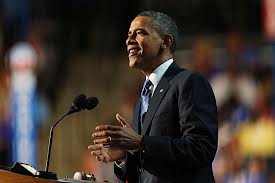 DNC: President Obama suggests Mitt Romney would gut education spending, but avoids mention of Race to the Top (redefinEd). (Image from Minnesota.publicradio.org) Panel discussions sponsored by Democrats for Education Reform highlight the battle within the party over education policy (redefinED). Teachers union leaders promise to campaign hard for Obama, despite difference over teacher evaluations, charter schools and other policies. (Education Week)
Florida: The new chair of the state Board of Education helped bring the KIPP charter school network to Florida (redefinED).
North Carolina: The state board of education authorizes the opening of 25 more charter schools next year. (Associated Press)
California: The Los Angeles school district, which has more charter schools than any district in the country, is scheduled to discuss a moratorium on new ones. (Los Angeles Times)
Indiana: Republican gubernatorial candidate Mike Pence unveils an education agenda that includes expanding vouchers, but it's light on details. (Associated Press)
Pennsylvania: Cyber charter school are growing rapidly in the state, creating tensions with traditional school districts. (Pittsburgh Post-Gazette)
Tennessee: The state education commissioner blasts a privately-owned online school for its test results, calling them "demonstrably poor." (TheLeafChronicle.com)
New Mexico: The state's first virtual charter school begins classes. (Santa Fe New Mexican)
 Texas: State lawmakers talk vouchers and hear about expanded learning options in Louisiana and Florida (KVUE.com). A judge rules that a charter school support group's concerns can stay in a lawsuit over state education funding. (Austin American Statesman)
California: A local school board won't allow a school to be converted into a charter school, even though that's what parents using the state's parent trigger law wanted. (Education Week)
Florida: The superintendent of the state's biggest school district says the educational environment is now driven by choice. (redefinED)
Indiana: The state's public school districts are marketing themselves with billboards and door-to-door campaigns in an effort to persuade parents to steer clear of vouchers and private schools. (Associated Press)
New Hampshire: The state's "Blaine Amendment" becomes an issue in the race for governor. (Concord Monitor)
Michigan: A community debates as a charter school operator begins to run all of its schools. (Detroit News)
Missouri: An appeals court rules that a judge was wrong in ordering charter schools to pay millions to the Kansas City School District. (Associated Press)
Pennsylvania: A private foundation will manage 20 financially struggling Catholic schools in the Archdiocese of Philadelphia. (Education Week)
Washington D.C.: Despite growing enrollment, charter schools are overshadowed by traditional public schools in funding and other matters. (Washington Post)
Editor’s note: For years, there have been concerns about discordant trend lines for students in many states – rising, according to the state’s own standardized tests, but anemic according to the National Assessment of Educational Progress. In Florida (where we’re based), the lines tend to be in sync. But this post scrutinizes a state where that isn’t the case.
by Alan Bonsteel
The California Department of Education (CDE) just announced it must delay the release of its annual STAR testing results because at least some of the test questions were posted on Internet sites such as Twitter and Facebook. Way back in April, CDE found about 1600 images on the Internet, though many were only of test booklets and student answer sheets rather than actual questions. After investigating, CDE traced the images to 12 schools around the state. It’s now trying to analyze how much damage the leaked questions, at least 36 to date, have caused so it can accurately report scores.
Almost all states do their own testing of their public school students, an obvious conflict of interest that almost always results in unrealistically rosy test results. Tests tied to inherently weak standards that states have been allowed to adopt produce test results that do not correlate with what students actually need to know. Here in California, the STAR has made up nearly all of the misnamed “Academic Performance Index" since 1999. Although the high school exit exam has been added, the addition of graduation and dropout data, called for in the legislation more than a decade ago, has yet again been delayed until next year.
From the outset the STAR results soared, at least in part due to lax security, a failure to change or even rotate questions from year to year, and consequently, some teaching to the actual questions on the test. By contrast, the two other standardized tests given throughout the United States, the NAEP, or National Assessment of Educational Progress, and the SAT, have remained generally flat, showing only very modest improvements over more than a decade in each case. Both of these latter two tests are given by independent testing authorities, and security has been maintained with them.
California is not the worst when NAEP scores are analyzed; Iowa, Maine, and Oklahoma have grabbed that honor. Thanks to Education Next, you can find a map with results from 41 states here. California edged itself just above the median.
For years our group, California Parents for Educational Choice, has commented in the news media about the disconnect between the self-administered STAR and the two objective exams, with telling results. (more…)
 Louisiana: School choice groups join the state in defending the new voucher program against a lawsuit filed by the state teachers unions and school boards association. (The Advertiser) A judge denies an injunction sought by voucher opponents to suspend the program while the case plays out in court. (New Orleans Times Picayune)
Florida: In one South Florida city, 14,000 students are on a waiting list to enroll in one of the city's charter schools even though the city's traditional public schools have a good reputation. (South Florida Sun Sentinel)
New Jersey: The state teachers union and school boards association want education officials to hold off on approval of virtual charter schools. (NJ Spotlight) Celebrity Rabbi Shmuley Boteach, running for Congress, supports a federal school voucher program. (NJ.com)
Georgia: A state senator forcefully reiterates his support for vouchers during a debate with his election challenger. (Cherokee Tribune)
Tennessee: A pro-charter school political action committee donates the maximum to school board candidates it backs in Nashville. (The Tennessean)
Pennsylvania: State education officials authorize four new virtual charter schools after closing a different one last week. (Education Week's Charters & Choice blog) (more…)
 Arkansas: A federal judge's ruling on the state's school choice law opens the door for legislative action on choice. (Arkansas News)
Maine: Gov. Paul LePage and the newly formed Maine Charter School Commission are at odds over the pace of the commission's work. (Bangor Daily News)
Louisiana: More financial concerns surface about a private school that has drawn an unflattering spotlight to the state's new voucher program. (Monroe News Star) Meanwhile, state education officials are still considering how best to assess private schools that accept voucher students. (New Orleans Times Picayune.) And lawsuits over the voucher program begin to pile up. (Shreveport Times)
Pennsylvania: Lawmakers get set to consider school choice expansion in the form of more tax credit scholarships. (Harrisburg Patriot News) The Pittsburgh schools system is considering its own virtual school to win back students lost to cyber charter schools. (Pittsburgh Post Gazette)
Michigan: Black students in charter schools outperform their peers in traditional public schools, a study by a charter school support group finds. (MLive.com) (more…)
Editor’s note: Progress in the parental school choice movement is measured not only by big gains in states like Indiana and Louisiana, but by the flurry of incremental developments in more states every year. Peter Hanley, executive director of the California-based American Center for School Choice, offers a look at encouraging developments in his home state.
 California has the nation’s largest charter school program, with 982 charter schools serving 412,000 students. But with nearly a two-thirds Democratic legislature heavily influenced by the California Teachers Association, tax credit scholarships or vouchers have been entirely off the table. In fact, charter schools’ flexibility is under near constant attack. Now, though, two legislators have introduced innovative approaches that address a unique feature in California’s constitution and attempt to bring educational tax credits to the state.
Unlike any other state, California has a voter-initiated constitutional amendment (Prop. 98) that sets a floor on the percent of general fund monies that must be spent on education. Anything that removes money from the general fund will instantly trigger the public education coalition to oppose it. So these legislators, one Democrat and one Republican, have proposed models that benefit both public and private schools.
Senate Bill 1542, introduced by Democratic Sen. Gloria Negrete McCloud, provides individual and corporate tax credits to Local Educational Advancement Program (LEAP) organizations. They will assist K-12 students from families with demonstrated financial needs to receive critical services before or after school, on weekends, or during the summer. SB 1542 precisely aims to ensure academic services - such as diagnostic evaluations, tutoring, summer school, and college and career planning and counseling - that have been heavily damaged by the extraordinary recession California has experienced since 2008. Although many more fortunate families in the state continue to be able to provide such services for their children, those with low and moderate incomes cannot and are disproportionately suffering. Children from public and private schools would be eligible for these services.
The Senate Governance and Finance Committee is expected to hold a hearing on this bill within the next few weeks. The future likely depends on whether it can be fit into the state’s budget, with questions now revolving around whether both individuals and corporations will be eligible for the credit, how large the credit will be, and whether it will be a straight credit or a percentage of a donation. Notably, the committee has not raised any objections about private school participation.
Assembly Bill 2582, sponsored by Republican Assemblyman Brian Nestande, takes a more traditional approach. (more…)

