
States with recent education choice lawsuits involving EdChoice Legal Advocates and the Institute for Justice.
As education choice options expand for families across the nation, opponents are stepping up their fight to preserve the status quo.
Observers say these conflicts are examples of growing pains that come when a society undergoes transformational change.
 “It’s just part of the cost of doing business,” said Michael Q. McShane, director of national research at EdChoice, a national nonprofit think tank. “Educators are not alone in challenging policies they don’t like. New laws get passed; people who can’t do things democratically try to do things through the courts.”
Michael B. Horn used a famous quote (often misattributed to Mohandas Gandhi) to describe the spate of lawsuits: “First they ignore you, then they laugh at you, then they fight you, then you win.”
“I think we’ve entered the fight stage,” said Horn, the co-founder, distinguished fellow, and chairman of the Clayton Christensen Institute and an author of several books on disruptive innovation. “Education choice has gotten big enough that the entrenched interests dedicated to preserving the status quo are starting to see it as a threat.”
Legal fights over education choice began in the 1800s when Catholic families opposed the Protestantism taught in public schools. In 1925, the U.S. Supreme Court ruled in Pierce v. Society of Sisters that parents had the right to put their children in private schools. In 2002, the high court issued another landmark decision, Zelman v. Simmons-Harris, which upheld an Ohio scholarship that allowed parents to spend the money on religious schools. The high court found that when the parent controls the expenditure, the state has no role in determining whether the parent will choose to use funding at a religious or secular school.
With the Zelman ruling settling that question, choice opponents began trying to insert race-based arguments using the language of state constitutions. Michael Bindas, a senior attorney at the Institute for Justice who argued the landmark case Carson v. Makin before the U.S. Supreme Court, outlined that shift in a paper published in the Syracuse Law Review. According to Bindas, common arguments center on education clauses requiring states to maintain uniform or common public school systems. Education choice opponents, he said, take that a step further and claim that private scholarship programs could upset racial balances that state constitutions require state governments to maintain. They also argue that the requirements that states maintain public school systems bar them from establishing concurrent private education choice programs. Lower court judges in Ohio and Utah recently cited this argument in striking down choice programs. Ohio plaintiffs also raised the issue of racial balance argument, which the judge rejected.
McShane and Horn say the spate of lawsuits won’t stop education choice programs from becoming the norm in public education. However, they will delay the transition.
“Yes, these cases are a headache and can delay implementation, but school choice has a good track record,” McShane said. “It will take numbers and time, and it’s going to tip over into a different mindset.”
Where things stand
Montana: Families are waiting on a judge to rule on a lawsuit brought by opponents of a 2024 education savings account program for students with special needs. Plaintiffs argue that the law allowing reimbursements for $6,800 per child violates several provisions of the state constitution and redirects tax dollars to private institutions at the expense of students with special needs who remain in public schools. The judge denied the plaintiff’s motion for a temporary halt to the program, allowing families to continue using their ESAs while the case is pending.
Ohio: The state has appealed a lower court’s ruling that declared the state’s $700 million Educational Choice Scholarship Program (EdChoice) unconstitutional. In siding with the coalition of school districts and other choice opponents, the judge said that the program was not a subsidy program, as the state argued, but a separate system of schools in violation of the state constitution. However, the judge rejected the plaintiffs’ argument that the program violated the state constitution’s education clause by creating racial imbalances in the district schools. The 10th District Court of Appeal is expected to hear the case in 2026.
Utah: Families are continuing to receive funds from the Utah Fits All scholarship program while a district court ruling in favor of a teachers union-backed lawsuit is under appeal to the state Supreme Court. A district judge ruled that the state constitution prevents lawmakers from using tax revenue to fund education programs other than public education, higher education, and services for people with disabilities. The judge rejected the state’s argument that it had met its funding obligations to public education and that nothing in the law prohibited it from funding a separate program to support families choosing private or home education.
Wyoming: Families seeking to use Steamboat Legacy Scholarship ESAs had to find other options for the 2025-26 school year after a trial judge blocked the state from distributing funds in July at the request of the Wyoming Education Association and other plaintiffs until the judge rules on their lawsuit against the program. The judge recently denied a motion by state officials and attorneys for two families to dismiss the lawsuit based on their argument that the plaintiffs lacked legal standing.
Missouri: Education choice advocates scored a win last month when a judge denied the teachers union’s request to freeze payments to the MOScholars K-12 scholarship program as their lawsuit continues. MOScholars began in 2021 as a tax credit program supported by private donors. Earlier this year, the state allocated $51 million to the program, prompting the Missouri Education Association to file the complaint, which contends that the allocation unconstitutionally diverts taxpayer funds to private schools.
Arkansas: The state’s Education Freedom Account program is being fought on two fronts. In June 2024, opponents sued in state court, arguing that the program illegally diverted tax dollars from the public school system to benefit private schools. The judge denied the state’s motion to dismiss the complaint, so state attorneys are appealing to the state Supreme Court.
The same plaintiffs filed another lawsuit a year later in U.S. District Court. It argues that the program violates the Establishment Clause of the First Amendment because “it aids in the establishment of religion” by providing state funding to private schools operated by religious organizations. The state refutes that by arguing that the money can go to schools representing a wide variety of faiths, as well as secular schools.
They also argue that the program violates the Equal Protection clause of the 14th Amendment because it discriminates against low-income families, families in rural areas where there are fewer private schools and students with disabilities, because private schools are exempt from the federal Individuals with Disabilities Education Act. The program is also discriminatory, according to the complaint, because private schools are not held to the same standards as public schools. The state attorney general has filed a motion to dismiss the case, arguing that the plaintiffs lack standing.
Kentucky: The Kentucky Supreme Court heard arguments on Sept. 11 about whether the state’s charter school funding law violates the state’s constitution. Charter schools have been legal in the Bluegrass State since 2017, but there was no state funding mechanism. Lawmakers passed House Bill 9, which allocated money to charter schools, which are publicly funded but independently managed. A trial court judge ruled in 2023 that the law violated the state constitutional ban on the use of tax dollars to support non-public education and the constitutional requirement for “an efficient system of common schools.”
The story: A federal judge’s ruling means that Maine can continue to bar religious schools from a state school choice program, despite a 2022 U.S. Supreme Court ruling that struck down an outright ban.
Setting the stage: As the U.S. Supreme Court weighed the landmark Carson v. Makin, Maine extended its anti-discrimination law to private schools participating in its town tuition program.
The other Makin case: A Catholic school and a rural family sued, arguing the law forces religious schools to set aside their beliefs if they want to access public tuition subsidies. That, they contend, conflicts with the 2022 Carson ruling, which cleared the way for public funding of religious private schools.
U.S. District Judge U.S. John Woodcock Jr. denied the plaintiffs’ request for a preliminary injunction, saying the case was unlikely to succeed. However, his ruling said he expects a higher court to have the final say.
“The plaintiffs are free to practice their religion, including the teaching of their religion as they see fit, but cannot require the state to subsidize their religious teachings if they conflict with state anti-discrimination law,” Woodcock wrote in a 75-page ruling.
Why it matters: The case, St. Dominic v. Makin, along with a similar lawsuit filed by other Maine families, raises a key question that echoes other education choice cases: Can states require religious schools to adopt policies that conflict with their beliefs to accept public money?
Yes, but: A 2020 U.S. Supreme Court ruling said teachers at religious schools are not covered by federal employment discrimination laws if their roles are “ministerial.” Whether that line of reasoning could play a role in Maine and Oklahoma has yet to be determined.
Catch up quick: Maine is one of a handful of northeastern states that allows students in areas without public high schools to receive “town tuition” funds to attend nearby private schools. Maine banned religious schools from participating in 1982 after including them for nearly a century. Three families sued the state in 2018 on the grounds of religious discrimination, resulting in the 6-3 Carson decision.
Adèle Keim, senior counsel at Becket Law, representing St. Dominic Academy and a Catholic family, accused the state of making an end run around Carson. She also said the state allows out-of-state schools to participate and admits it does not police their policies. “St. Dominic is just asking for the same treatment Maine already gives to other private schools."
The state’s response: The state attorney general did not comment on the federal judge’s ruling. However, in a statement shortly after the Carson ruling, he said he was “terribly disappointed and disheartened” by the decision and called the education offered by certain religious schools “inimical to public education.”
To be continued: The plaintiffs have already appealed to the First Circuit Court of Appeals in Boston.
Last year, the landmark U.S. Supreme Court decision Carson v. Makin said excluding schools from choice programs solely because they teach religion violates the First Amendment’s free exercise clause.
The ruling delivered a definitive resolution to decades of legal battles. It dismantled one of the major barriers private school choice programs have faced in state constitutions: Prohibitions on public funding flowing to religious or “sectarian” schools.
The result is a major shift in the national legal landscape surrounding modern school choice programs. The primary terrain of battle is no longer the federal judiciary, but state and local courts across the country. And school choice supporters are spending less time playing defense, ensuring publicly funded programs that allow students to attend programs of their choice pass constitutional muster. They’re going on offense, targeting the remaining barriers not just to school choice programs, but to education entrepreneurs looking to create new options for students.
Leaders at the forefront of this next generation of legal battles say constant vigilance will remain essential.
“The opposition to parental choice programs will be looking for other avenues to block and interfere with choice programs,” said Shawn Peterson, president of Catholic Education Partners, a national nonprofit organization that advocates for expanded school choice. “In some states, that will certainly mean through the state court route as these courts might be more favorable. I do think, however, that those state courts will have to consider the U.S. Supreme Court’s ruling and what that might mean for eventual appeals.”
That’s one of the arguments attorneys are using against a teachers union-backed lawsuit filed in state court to Alaska’s Correspondence School Allotment Program. The program, which evolved from a 1930s program for rural students, now operates like an education savings account program after the legislature changed the law. ESAs are programs that grant families restricted use accounts to spend on state-approved educational expenses. At issue is the state constitution, which says, “No money shall be paid from public funds for the direct benefit of any religious or other private educational institution.”
Defenders of the program argue that the money goes to families who can choose from a wide variety of options, including programs offered by district schools. Eliminating religious schools from that menu of choices would place the state on a collision course with recent federal precedents.
“If you read the Alaska Constitution in a very broad way to say the Legislature can never give any benefit to families that choose private schools, you are making it so that a group of people who are exercising a fundamental liberty interest that is protected by the U.S. Constitution explicitly in case law can never get benefits from the state in the same way that other groups can, and that’s unconstitutional under the U.S. Constitution,” said Kirby Thomas West, an attorney with Institute for Justice, which is intervening in the case for a group of families who are using the program.
Her employer, which represented families in Carson and an earlier landmark school choice case, Espinoza v. Montana Department of Revenue, recently announced plans to phase out its role in defending the existence of the school choice programs as the challenges of unique state laws shift to those states’ courts.
The nonprofit public interest law firm has joined forces with the advocacy group EdChoice. Institute for Justice leaders say the handoff will free it up to focus on another evolving arena as new state laws allow entrepreneurs to start microschools and other non-traditional forms of education.
“We are seeing the fruits of our labor,” said Michael Bindas, a senior attorney at Institute for Justice who argued Carson v. Makin before the U.S. Supreme Court. He said the firm’s goal when it began in 1991 was to settle the First Amendment issues that opponents were using to quash school choice programs in their states. Meeting those goals helped clear the way for a wave of school choice programs across the country.
Those programs are aiding the growth of new programs that challenge prevailing norms in schooling, and risk inviting wrath of hostile regulators.
“Government does what government does when it’s faced with this type of innovation,” Bindas said. “It either tries to apply old regulations to these new kinds of models, regulations that don’t necessarily fit or adopts new regulations that stifle the innovations that parents and entrepreneurs are engaged in.”
Bindas said the new legal frontier of education regulations fits well with Institute for Justice, which has a long history of defending property rights and economic liberty. He said the issues are varied, which makes the new focus exciting.
“These issues come in all shapes and sizes,” he said. “These are issues that IJ has long litigated. We bring our expertise and deep experience to bear on barriers and new burdens that entrepreneurs are facing.”
That’s welcome news to Don Soifer, CEO of the National Microschooling Center. The nonprofit was founded as a resource to support the model, which took off during the pandemic and now serves between 1 and 2 million students.
Soifer hears stories constantly from the founders of small learning communities about their struggles with local officials trying to enforce regulations that were created years ago to apply to other uses. Some governments classify them as day care centers subject to the state’s child welfare agency.
Others require them to apply for special land use exceptions. One founder attending a Harvard University school choice conference mentioned that one regulation required three restrooms for a program serving only 10 kids.
“Today's American microschooling movement is very different than the schools of choice that precede it,” Soifer said. “Small learning environments can be designed and operated around the specific needs of individual learners and families. Regulatory frameworks need to continue to adapt to these exciting new opportunities.”
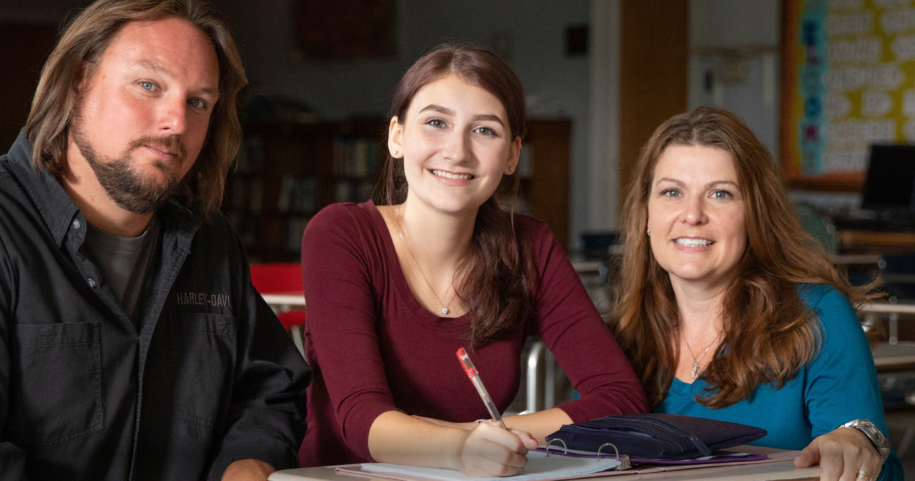
David and Amy Carson of Maine, pictured here with their daughter, Olivia, challenged a decades-long policy limiting to secular schools a state program offering financial assistance to families seeking education choice for their children.
Editor’s note: This commentary from Leslie Hiner, vice president of legal affairs and director of the Legal Defense and Education Center at EdChoice, first appeared on washingtonexaminer.com.
History repeats itself, and there is no better reminder than constitutional litigation, in which one issue can be revisited many times over many decades.
The U.S. Supreme Court’s recent decision in Carson v. Makin, upholding the constitutionality of school choice for the third time in 20 years, revealed that naysayers have argued against the right of parents to direct a child’s upbringing and education for over 100 years.
They are still wrong. The Constitution does not require public funding for a child’s education. States control K-12 education but do not have an unfettered right to disregard individual liberties protected by the Constitution.
Discrimination against religion and ancestry has a long history. In 1854, the Rev. John Bapst, a Swiss Jesuit in Maine, was beaten, burned, tarred, feathered, and left for dead for opening a classroom at his church to educate Catholic children expelled from public school. The school board, which vowed to Protestantize the Catholic children, expelled them for refusing to recite Protestant prayers and Bible readings required in public school.
Fearing Catholics would request public funds to educate these students, Bapst’s church was firebombed. Nativist groups and the Know Nothing party (formed in the 1850s to diminish the perceived influence of Catholics and immigrants) fueled anti-Catholic sentiment. Resisting nativist pressure to discriminate against Catholics, Vermont adopted the first town tuition voucher program in 1869; towns provided tuition for students to attend any school.
Maine created a similar voucher in 1873, 19 years after Bapst was forced to leave. At the turn of the 20th century, the national compulsory education movement advocated mandatory education. The Ku Klux Klan, whose influence was at its zenith from Maine to Oregon, believed students should also be compelled to attend only public schools, which taught Protestant ideals.
In 1922, Oregon adopted a compulsory public school attendance law, giving rise to the landmark Supreme Court ruling in Pierce v. Society of Sisters. Walter M. Pierce was Oregon’s governor, and the Society of Sisters operated two Catholic schools effectively outlawed by the new law. Oregon’s attorneys argued the Catholic Church was undermining democracy by instructing Catholic children differently and claimed federal courts have no authority to question Oregon’s education laws.
They were wrong on both points. Attorneys for private schools argued that forcing children to attend public schools only was a deliberate attempt to deny the religious liberty of parents to send their children to schools of their choice.
In 1925, the Supreme Court held that the state has no general power to force children to be instructed by public teachers only, declaring, "The child is not the mere creature of the State." Fast forward to 2002: In Zelman v. Simmons-Harris, challengers against Cleveland’s voucher program claimed parents using vouchers for religious school tuition gave the appearance of state support for religion, violating the Establishment Clause. The Supreme Court said vouchers give parents a true private choice of religious or secular options.
In 2020, challengers claimed parents using school choice violated Montana’s constitution prohibition against aid to religious entities in Espinoza v. Montana Department of Revenue. Again, the Supreme Court said parents using public education funds to pay tuition at religious schools was the parents' choice.
The court added that a state constitution’s strict Establishment Clause that violates a parent’s federal religious liberty rights must be disregarded as "odious to our Constitution."
This year, the Supreme Court, in Carson v. Makin, admonished lower courts for failing to apply its rulings in Espinoza and prior cases. Parents seeking the right to use vouchers to pay for their children’s tuition at religious schools in Maine (as the 1873 law entitled them to until a 1980 change barred religious schools from participating) were victorious over challengers who once again claimed that using public funds at religious schools violated Maine’s constitution.
The Supreme Court affirmed, again, that vouchers give parents a truly private choice of religious or secular options and that parents’ religious liberty is protected under the First Amendment.
Those who would limit, rather than cherish, individual rights under our Constitution should give attention to legal history and the clear meaning of our Constitution.
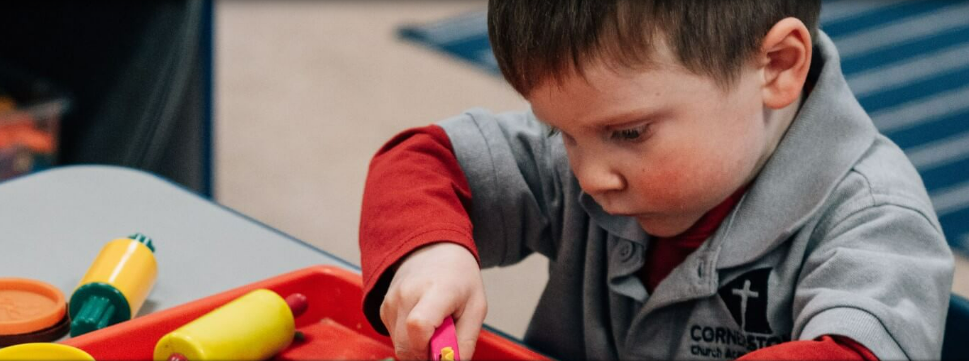
Cornerstone Christian Academy in Las Vegas is one of 171 private schools in the state serving nearly 30,000 students. Cornerstone’s vision is to encourage development of the whole child, engaging the student’s spiritual, academic and physical growth to prepare him or her to become productive kingdom citizens ready to be used for God.
Editor’s note: This commentary from Valeria Gurr, director of external relations for the American Federation for Children, and Shaka Mitchell, director of State Strategy and Advocacy for the American Federation for Children, appeared Friday on thenevadaindependent.com.
This spring, the U.S. Supreme Court has done its level best to stay in the headlines, but one pivotal case has yet to receive its due.
In the case of Carson v. Makin, the court found in favor of parents who wanted to use public funds to send their children to private, religious schools. While this case involved parties in the state of Maine, it could have major, positive effects for families in Nevada, too.
Parents who live in rural Maine and lack a local public high school could already use education funds apportioned by the government to put their kids in a private school. Unfortunately, for some families, they could not choose schools that provide religious instruction (though they could select a school that has a religious mission — the implication being that some schools are too religious).
The high court determined that if a state decides to allow education funds to be used for private school tuition, it may not discriminate against schools simply because they are religious. Parents in Maine may now choose schools according to their conscience, not the whim of a bureaucrat at the state Department of Education.
So, what does this mean for children in Nevada?
Some may erroneously believe the ruling will create programs that are de facto religious, causing some parents to reject the programs altogether. This is an argument that misses the point.
The high court’s ruling should be viewed as a possible pathway to help Nevada lawmakers fulfill their constitutional obligation. Article IX, Section 1 of the Nevada Constitution expresses the intent for the government's involvement in the educational system. It reads:
“A general diffusion of knowledge and intelligence being essential to the preservation of the rights and liberties of the people, the Legislature shall encourage by all suitable means the promotion of intellectual, scientific, moral, and agricultural improvement.”
To continue reading, click here.
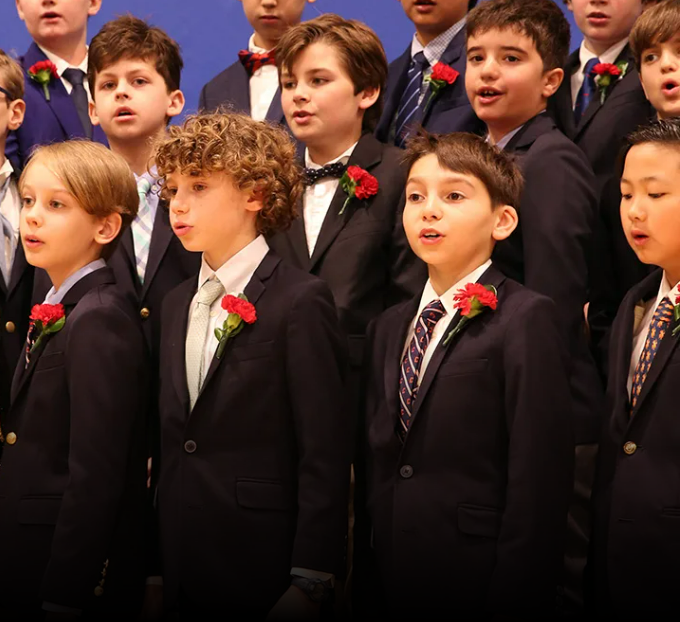
Collegiate School, founded in 1628, an independent school for boys in New York City, claims to be the oldest school in the United States. It is located on the Upper West Side of Manhattan and is a member of the New York Interschool and the Ivy Preparatory School League.
Editor’s note: This commentary from Chester E. Finn, distinguished senior fellow and president emeritus of the Thomas B. Fordham Institute, appeared Thursday on the institute’s website.
The Supreme Court’s 6-3 decision in Carson v. Makin, telling Maine it must not deny tuition assistance to families solely because the private schools they choose are religious, may not make a huge difference on the ground in the Pine Tree State, since liberal legislators had already inserted a “poison bill” into the law authorizing such aid.
They now deny “town tuitioning” payments to any private school, secular or sectarian, that discriminates on the basis of gender identity and sexual orientation. That constraint hasn’t fazed the several dozen secular private schools—mostly small and in small towns—that already participate.
It likely won’t cause indigestion for some of Maine’s religious schools. But it’s apt to prove unacceptable to the two conservative Christian schools whose religiousness is what kicked off the lawsuit. They’ve signaled that they won’t take the money if it means changing their curricula or admission standards.
Welcome to the complicated universe of private elementary-secondary schooling in America circa 2022 and the innumerable twists and turns of efforts to use public funds to help families access schools that suit them.
It’s a big universe, too: more than 30,000 schools (in 2019)—roughly one-fourth the total—enrolling some 4.7 million pupils (9 percent) and employing half a million teachers. Charter schools and homeschooling are coming on strong, but private schools still offer the most options.
This sector is far older than public education and infinitely more varied, such that bean counters have difficulty even sorting its schools into coherent categories. The latest big federal survey (2015) reported that “Sixty-seven percent of private schools, enrolling 78 percent of private school students...had a religious orientation or purpose.”
The one-third that are secular contains most of America’s big-name prep schools and upscale “independent” schools. But it also contains thousands of “special education” schools for youngsters with disabilities, with attendance often paid by their school districts, as well as thousands of “special emphasis” schools that range from Montessori to science, from agriculture to giftedness.
On the far larger sectarian side, subcategories proliferate, as do vast differences in scale. The 2015 survey reported twenty-eight different groupings plus 304 schools described as religious but fitting into none of the groups.
To continue reading, click here.
 Around the state: School board races heat up, teacher shortages statewide, a boost in spending on school safety in St. Johns, resignations at a high school in Pinellas and new presidents at Saint Leo University and University of North Florida. Here are details about those stories and others from the state’s districts, private schools, and colleges and universities:
Broward: Citing almost a dozen mass shootings that occurred over the Fourth of July holiday, Broward County school teacher and gun violence prevention activist Tracy Merlin said she will use her new role with the Florida Commission on the Status of Women to amplify demands for common sense gun laws. Florida Phoenix.
Palm Beach: Three candidates are vying for the lone school board seat here that's not guarded by an incumbent. Debra Robinson, a school board member for more than 20 years, decided not to run for re-election, opening the door for Edwin Ferguson, Christopher Persaud and Corey Michael Smith. Candidates will face off on Aug. 23 in a primary election. If no one receives 50% of the vote, the top two vote-getters will face off in the general election on Nov. 8. Palm Beach Post.
Pinellas: Four assistant principals resigned from Tarpon Springs High School over the past year, with the latest being a week ago. Three of them began the 2021-22 academic year at the campus. One joined in January as a replacement. In addition, about two dozen teachers departed, including the current Teacher of the Year. Tampa Bay Times.
Duval: The number of teachers entering classrooms in Florida this school year continues to dwindle, including in Duval. A new survey released by the Florida Education Association shows over 9,500 teaching and staffing vacancies statewide. This time last year, the FEA reported about 5,000 shortages. As of this week, Duval County Public Schools reported 529 vacancies for certified teachers, which is up 23% compared to the start of last school year. The vacancies are are almost double the number Duval saw at the beginning of the 2020-21 school year. The Florida Times-Union.
Volusia: There are hundreds of openings here, and the teachers union presidents say with the level of shortage they're facing this close to the start of the school year, there won't be enough teachers for the number of enrolled students. That also means there could be more students this year per classroom. There are currently 365 openings for teachers. The county raised the base pay for new hires to $47,500, but there hasn't been an increase in the state budget for those who are already working. WKMG.
Pasco: The Pasco County School Board has three of its five seats up or consideration. Steve Meisman (District 1), Matt Geiger (District 3) and Charles Touseull (District 5) share talking points on issues that include their opposition to the district's property tax referendum and what they call "woke" curriculum. Two incumbents, Cynthia Armstrong (District 3) and Megan Harding (District 5), are defending their records on the school board. Allen Altman retired after four terms in District 1. Meanwhile, newcomers Al Hernandez and James Washington are vying for Altman's spot. Tampa Bay Times.
Collier: A new high school will be opening in North Naples in 2023. Parents, meanwhile, have been pushing for more information — specifically on zoning. The school district plans to hold meetings for naming the school in September. Naples Daily News.
St. Johns: Officials here are boosting spending on school safety. A plan presented on Tuesday morning to the school board calls for more than $1 million more than last year to be allocated toward protecting schools, which includes increasing pay for armed guards. The increases will cost the school district a total of around $4.7 million. With state assistance, the district only has to pay $1.9 million, officials said. That's a district budget increase of more than $668,000, compared to last year. All 43 schools in St. Johns will have an armed guard on campus when the new school year starts in the fall. Some high schools, when available, will have two guards available. News4Jax.
University and college news: A professor at the University of South Florida is studying whether college students diagnosed with attention-deficit/hyperactivity disorder, or ADHD, can use a technology called "brain painting" to improve attention spans and reduce the need for prescription drugs. Tampa Bay Times. Saint Leo University announced a new president on its website this week. Edward Dadez, formerly the school's provost, was selected by the board of trustees to succeed Jeffrey Senese. Tampa Bay Times. Meanwhile, the University of North Florida has also lined up its next president. The Board of Governors approved Moez Limayem, a former USF business college dean, as University of North Florida's seventh president. Florida Times-Union. For the third year in a row, the University of West Florida led the state in finding success after school. UWF had more combined success at finding additional academic opportunities or employment during their first year out of college than did graduates from any other university within the Florida State University System. More than 72% of the UWF students who graduated at the conclusion of the 2020-21 school year are now furthering their education or are employed. Pensacola News Journal.
Attacks increase: About one in three school leaders noticed an uptick in student fights or physical attacks this past school year that are believed to be brought on by the pandemic and its lingering effects, new federal data shows. Also, more than half of school leaders reported an increase in classroom disruptions from student misconduct for the same reason. Chalkbeat.
Opinions on schools: Defenders of discrimination in education received a well-deserved comeuppance last month. The first was a lesson in constitutional law, while the second was the creation of expansive opportunities for parents to choose how and where their children learn. This combination will define K-12 education for the next century. reimaginED. The Catholic school movement has been advocating for the position that the court finally endorsed in Carson v Makin, which is that you can't exclude a religious school from public benefit programs like school voucher programs because they're religious. There is a long history of Catholic schools seeking public resources and being rebuked both politically and legally. reimaginED.
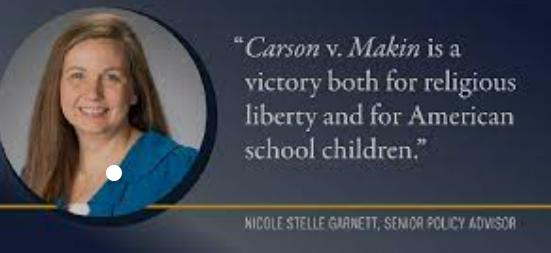 Nicole Garnett, senior policy adviser to the Alliance for Catholic Education and a Notre Dame University law professor, recently joined Tim Uhl, secretary of education/superintendent for the Catholic Diocese of Buffalo, on the Catholic School Matters podcast to discuss the recent Carson v. Makin Supreme Court case and implications for school choice moving forward. Here are some excerpts of the podcast:
The Catholic school movement has been advocating for the position that the court finally endorsed in Carson v Makin, which is that you cannot exclude a religious school from public benefit programs like school voucher programs because they’re religious. That is a position the Catholic Church has taken for over 175 years … So, there is a long history here of Catholic schools seeking public resources and being rebuked both politically and legally.
Neutrality toward religion isn’t math, it’s law. So, it’s not we don’t count up how many kids are in what kind of school and decide what neutrality is. It’s not a neutrality question, it’s a legal question ... The First Amendment requires neutrality toward religion.
It is true that Catholic schools have been flirting with being charter schools for a long time. It’s always important to keep in mind … it’s not necessarily a good idea that even if you could be a charter school that you want to be a charter school … there’s lots of political reasons you might not want to do it … it’s arguable that you should be permitted to if you want to.
You can listen to the full podcast here.
 Those defending discrimination in education received a well-deserved comeuppance last month—from two quarters. The first, a lesson in constitutional law, matches nicely with the second, the creation of expansive opportunities for parents to choose how and where their children learn.
This combination will define K-12 education for the next century.
The U.S. Supreme Court ruling in Carson v. Makin was the first blow to prejudice, this time against religious discrimination. The Court ruled in favor of Maine parents who have no assigned public school in their local areas and so chose religious schools for their children—presenting a challenge for special interest groups who oppose school choice.
Chief Justice Roberts wrote, “Maine’s decision to continue excluding religious schools from its tuition-assistance program … promotes stricter separation of church and state than the Federal Constitution requires.” Again, these Maine students did not have assigned traditional schools to attend nearby. So if parents freely choose a certain private religious school, this does not violate the Constitution.
A teacher union’s response to the decision falls flat: “The power and purpose of public schooling is to educate every child, regardless of geography or demography,” wrote the American Federation of Teachers’ president Randi Weingarten.
But this “power and purpose” clearly did not extend to some rural areas of Maine—the very restrictions Weingarten says public schools are designed to overcome. In Carson, it is private schools that overcame the challenges posed by geography and demography.
Weingarten says the decision “discriminates” against “our most vulnerable students,” hoping we will forget that the children in this case had no assigned public school, making them vulnerable to not receiving an education at all—thus being discriminated against for their geography—had religious schools not been an option.
The second strike against education discrimination came in Arizona.
At the very end of the legislative session, state officials expanded the nation’s oldest education savings accounts to include all students in the state. Arizona’s accounts opened in 2011 and served 75 children with special needs. Over the last decade, lawmakers expanded the accounts to include children from different walks of life, including students on tribal lands, adopted children, children in military families, and children assigned to failing public schools, among other student categories.
In this way, the accounts allowed private education providers, including religious schools, to help those Arizona students that traditional schools could not reach due to geography, demography, or another area of discrimination that the “power and purpose” of assigned schools failed to reach: The soft bigotry of low expectations from persistently low-performing public schools.
The accounts inspired lawmakers in nine other states to adopt similar account options serving thousands of children, including more than 17,000 children in Florida.
In recent years, state lawmakers have been creating learning options that break down barriers between children and families from different backgrounds, income levels, and religions. Florida officials combined the state’s accounts and a scholarship program, securing it in the state funding formula.
West Virginia lawmakers will allow nearly every child in the state to apply to access education savings accounts in the fall. Policymakers in Missouri and Kentucky combined tax credit scholarships with education savings accounts, a unique combination of charitable contributions to scholarship organizations that will allow students to customize an education according to his or her needs.
These learning options have appropriately set high expectations for the future. Small steps may not be noticed, nor impactful. Policymakers in Georgia, Oklahoma, South Carolina, and Texas have come close in recent years and supportive lawmakers should receive applause for their intent. But “coming close” only merited mention when nearly all other states could only reach that far.
Now state lawmakers have gone beyond close, beyond pilot programs with temporary funding. Mindful of parent and taxpayers’ new expectations for state lawmakers, Texas Gov. Greg Abbot said recently, “We can fully fund public schools while also giving parents a choice about which school is right for their child.”
He added, “Empowering parents means giving them the choice to send their children to any public school, charter school or private school with state funding following the student.”
Education savings accounts are the norm. Unions are left defending assigned schools’ limited—discriminatory, even—reach. The future will not be defined by “coming close” to creating quality learning options for all children any more.
Michael Bindas, senior attorney for the Institute for Justice, said a former Maine attorney general did not pay close attention to the Supreme Court’s commitment to religious liberty in recent years, which “embroiled the state in five lawsuits spanning three decades and that culminated in the Supreme Court’s ruling against the state,” and that the state’s current attorney general “seems to not have learned any lessons from that experience.”
Editor’s note: This article appeared last week on washingtontimes.com.
Religious schools got what they wanted when the Supreme Court allowed them to participate in a state tuition program. But the state attorney general said the ruling will be for naught unless the schools are willing to abide by the same antidiscrimination law as other private schools that participate in the program.
An attorney for the families criticized the “knee-jerk” comments, and the leader of a religious group predicted further litigation.
The Supreme Court ruled that Maine can’t exclude religious schools from a program that offers tuition for private education in towns that don’t have public schools. But religious schools didn’t have long to savor their victory before learning of a new hurdle.
Attorney General Aaron Frey said both Christian schools involved in the lawsuit have policies that discriminate against students and staff on a basis of sexual orientation or gender identity, preventing their participation in the tuition program despite the hard-fought litigation.
“The education provided by the schools at issue here is inimical to a public education. They promote a single religion to the exclusion of all others, refuse to admit gay and transgender children, and openly discriminate in hiring teachers and staff,” he said in a statement.
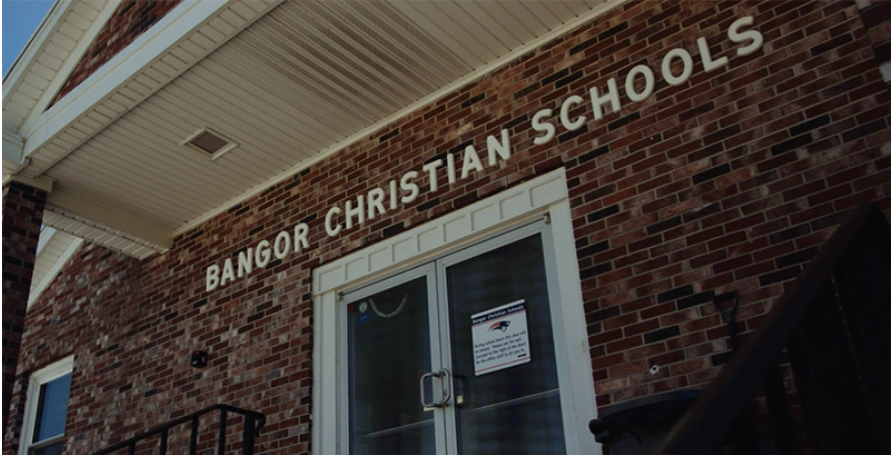
There was no immediate comment from two schools, Temple Academy in Waterville or Bangor Christian Schools.
To continue reading, click here.

