Sonia Sotomayor, Supreme Court justice, might never have blossomed in the Bronx without the help of a faith-based school, a Catholic oasis called Blessed Sacrament. Sotomayor herself says so. Asked by Anderson Cooper if she would have become who she is without the school, Sotomayor said, “Doubtful.”
Sadly, Blessed Sacrament is closing this year, felled by the same social and economic forces – and education policies - that contributed to the shuttering of 1,300 Catholic schools in the past 20 years. There is tragedy and irony in its passing. You don’t have to be religious to feel it.
For most of this country’s history, faith-based schools have been a fundamental part of the American experience. But now, as the nation continues to wrestle with how best to get academic traction with poor and minority kids, its 21,000 religious schools continue to shrink, and continue to be mostly overlooked as a potential piece of the solution.
Here’s the tragic part. Eleven of 12 gold standard research studies find positive academic outcomes for students using vouchers to attend private schools, the vast majority of them religious schools. More recently, William Jeynes, a researcher at California State University, Long Beach, found via a meta-analysis of 90 studies that students in religious schools were on average seven months ahead of their peers in traditional public and charter schools. This was after controlling for race, gender, poverty and parental involvement.
Faith-based schools are a financial bargain, too – for all of us. Average tuition is thousands of dollars less than per-pupil funding for public schools, so collectively, taxpayers are saving tens of billions of dollars a year.
All this isn’t to say faith-based schools are the end-all, be-all. They range in quality just as charter and virtual and traditional public schools do. But in this era of customization, they offer more options, and in this time of desperation, more hands on deck. There is no good reason to bar them from the mix of educational alternatives that is helping parents and educators find the best fit for each and every child. (more…)
Across America, Catholic schools are closing. But in San Antonio, Fla., where cows meet cul-de-sacs on the fringe of greater Tampa, St. Anthony Catholic School is getting new classrooms.
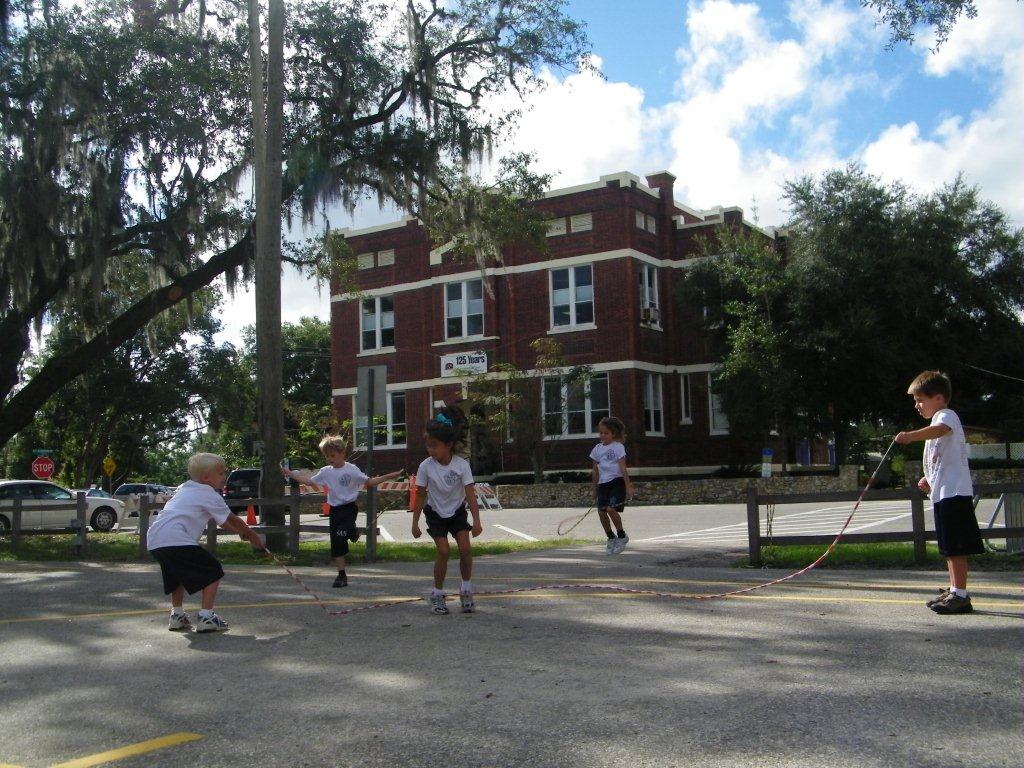
Just a few years ago, there was serious talk of closing St. Anthony Catholic School in San Antonio, Fla. But after recent enrollment gains, the school is planning to replace aging portables with a new building. (Photo courtesy of St. Anthony)
The 129-year-old, K-8 school has rebounded since it hit a Great Recession low of 153 students in 2010. It’s up to 196 students this year and aiming for 270 within a few. The comeback has quashed talk of closing, said the principal, Sister Alice Ottapurackal, and instead prompted the diocese to schedule a new building to replace aging portables.
“All this is going to be gone,” said Sister Alice, gesturing to a clutch of boxy buildings behind the stately red brick of the main school house. “It’s an amazing feeling,” she said of the rising numbers. “It’s good to see people are still interested in Catholic education.”
St. Anthony represents a fresh, Florida twist to the oft-told story of Catholic school decline. Choice and competition are part of the Sunshine State’s potentially more optimistic plot line.
Catholic school enrollment nationwide fell another 1.5 percent this year to 2,001,740, according to a report released March 22 by the National Catholic Educational Association. But in Florida, enrollment ticked up for the first time in five years – by 1 percent in K-12 and 2.7 percent counting pre-school, according to the Florida Catholic Conference.
Florida’s 217 elementary and secondary Catholic schools now enroll 82,489 students, up from 81,632 last year. The jump is even more impressive given competition from Florida’s booming charter schools, which added 48,000 students in the past two years alone.
The most visible reason for growth: Florida’s tax credit scholarship program for low-income students. The number of scholarship students in Catholic schools rose this year from 6,538 to 8,575, a 31 percent increase, according to data from Step Up For Students, which administers the program and co-hosts this blog. In some urban counties, the trend lines are even steeper. Over the last three years, the numbers in Hillsborough, which includes Tampa, leapfrogged from 167 to 431, with annual increases of 41 percent, 25 percent and 47 percent, respectively. (more…)

