By Lauren May, Mary Camp, and Ron Matus
First, Florida. Now, Indiana. Which state will be next for a Catholic school comeback?
Our new, 2026 “Catholic school update brief” highlights not only continued Catholic school growth in Florida – which saw enrollment rise for a fifth straight year – but signs of resurgence beyond Florida, nudged by the historic expansion of school choice across America.
As we noted when the latest National Catholic Educational Association statistics were released in March, Indiana is now, like Florida, showing net enrollment growth over the past decade. Among the Top 10 states for Catholic school enrollment, the Sunshine State and Hoosier State are, for now, the outliers.
But don’t sleep on Ohio, which saw its Catholic schools grow by more than 3,000 students this year; or Texas, where a jaw-dropping 274,000 students applied for that state’s brand-new choice program. Don’t overlook smaller states with big choice programs and momentum, including Iowa and New Hampshire. And don’t forget about the potential of the new federal scholarship tax credit to enhance what’s been happening in the states.
Our brief includes a 50-state chart where you can track Catholic school enrollment year-by-year over the past decade. (Big thanks to the NCEA for collecting the data.)
It also includes more insight into the pace-setting growth in Florida, including a rapid rise in the number of students using special-needs scholarships.
If you have any questions, don’t hesitate to reach out. Our emails are in the bios at the end of the brief.

Bishop William Wack from the Diocese of Pensacola-Tallahassee joins in on the fun running around with the students at Trinity Catholic School in Tallahassee.
Florida Catholic schools are thriving, and the latest enrollment numbers prove it. Across the state, enrollment rose from 90,870 in the 2023-24 school year to 93,455 – a 2.8% year-over-year increase.
Driving much of this growth is the use of private school scholarships, which rose by 27% this year. Programs like the Family Empowerment Scholarship for Educational Options and the Florida Tax Credit Scholarship provide families with about $8,000 per student to pay for private school, making Catholic education more accessible than ever.  The news comes just as Catholic schools across the United States are celebrating Catholic Schools Week simultaneously with National School Choice Week, which runs from Jan. 26 through Feb. 1.
“(Scholarship) programs are giving more working-class and middle-class Florida families the ability to choose Catholic schools — and more of them are doing just that,” said Bishop Gerald Barbarito of the Diocese of Palm Beach, which has 20 schools in five counties.
National state-by-state figures are not expected to be released until March, but last year’s report offered encouraging news, with Catholic school enrollment in PreK-12 holding steady. In 2023-24, 1,693,327 students were enrolled in Catholic schools across the United States, virtually the same number as the prior year. (Officially, the 2022-23 number was 1,693,493.) In Florida, enrollment climbed to 90,785, up 5.2% from the prior year.
The 2023 passage of House Bill 1, which made every family in Florida eligible for a scholarship, has been a game changer for Catholic schools. Last year, 56,192 students used scholarships to attend Catholic schools. This year, that number has jumped to 72,851. In the Archdiocese of Miami, the number of families using scholarships increased by 45%.
However, Florida was an outlier when it came to Catholic school enrollment growth a decade before Gov. Ron DeSantis signed HB 1 into law.
Between 2013 and 2023, Florida was the only state in America in the Top 10 for Catholic school enrollment that did not see declines in enrollment. While other states saw declines during that span, Florida experienced 4.4% growth, which was credited to the Sunshine State’s already robust school choice scholarship program. The positive trend lines in Florida were the subject of a special report: “Why Catholic schools in Florida are growing: 5 things to know.”
“Over the past few years, we have made an intentional effort to educate families about these programs and encourage them to apply,” said Jim Rigg, archdiocese secretary of education and superintendent. “At this point, over half of our schools are full with a waiting list, so we decided to work closely with families enrolled or interested in schools that were not full.” He feels that their measured and strategic approach helped families understand and apply for the scholarship.
This remarkable growth is not limited to a single region. Schools within the Diocese of Venice in southwest Florida saw the most growth, with a 4.9% increase. Superintendent Father John Belmonte attributes this success to strategic goals set for each school.
“The most important thing that we do is communicate with families and invite them to attend our schools. We do this by sending out 1 million emails and text messages to families across the diocese every year,” he said. Schools are also innovatively addressing capacity challenges in high-demand areas by maximizing classroom space and adopting creative scheduling.
Catholic schools in Florida are also making strides in serving students with unique abilities, as enrollment for these programs increased by 36%. Schools like Holy Family Catholic school in Jacksonville are pioneering innovative ways to serve their students, such as individualized, small-group-focused learning. Similarly, schools like Bishop Larkin Catholic School in the Tampa Bay area have implemented initiatives like Morning Star programs, which provide a low student-to-teacher ratio, tailored curriculum, and dedicated classrooms to help students with learning and developmental challenges succeed academically, socially, and spiritually. Thanks to the Family Empowerment Scholarship for Unique Abilities, families in this program receive scholarship dollars to make specialized education more accessible.
The continued growth has paved the way for exciting school expansions and new facilities. In December, The Basilica School of Saint Mary Star of the Sea in the Florida Keys celebrated the ribbon-cutting of its new high school building. Meanwhile, Donahue Catholic Academy in rural southwest Florida is set to expand with modular classrooms to accommodate 200 students on a wait list. Rigg expressed optimism about the future.
"We are continuing conversations about how to expand the growth of Catholic education in Florida,” he said.
Catholic school enrollment in Florida grew more in the past year than in the previous 10 years combined, while Catholic school enrollment nationally held steady, according to the latest figures from the National Catholic Educational Association.
The longer-term trend lines now show Florida Catholic school enrollment up 9% over the past decade, while it’s down 14% nationally.
In light of the new data, we thought it appropriate to issue this brief update to our paper from August.
“Why Catholic Schools In Florida Are Growing: 5 Things To Know” took a closer look at Florida's upward trends and the leading factors behind them.
Our new brief is meant to supplement that paper. We updated a handful of key charts and graphs using new data from the NCEA and the Florida Catholic Conference, including a year-by-year breakdown of Catholic school enrollment for all 50 states.
We also added a couple of new charts. One highlights the number of students using special needs scholarships in Florida Catholic schools. The other does the same for non-Catholic students. Both are on the rise.
As with the paper, we hope our brief can inspire and inform, and perhaps point to lessons from Florida that might be especially useful to Catholic education supporters in states with new choice programs. Challenges remain, but now the wind is at your back.
Editor's note: Some of the figures in Appendix A in the original update brief were incorrect. The correct version here was put in its place on May 9, 2024.
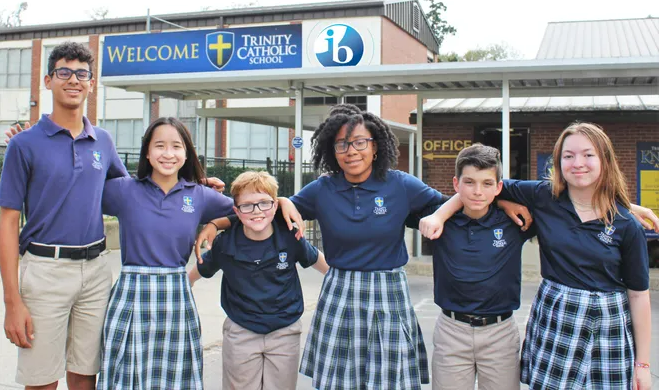
As Catholic school enrollment grows, many schools, such as Trinity Catholic School in Tallahassee, Florida, are adding new programs. Trinity announced in March 2022 that it had received authorization as an International Baccalaureate School following an intense, two-year candidacy phase.
Editor’s note: This question-and-answer interview with Lincoln Snyder, president and CEO of the National Catholic Educational Association, appeared Sunday on catholicworldreport.com.
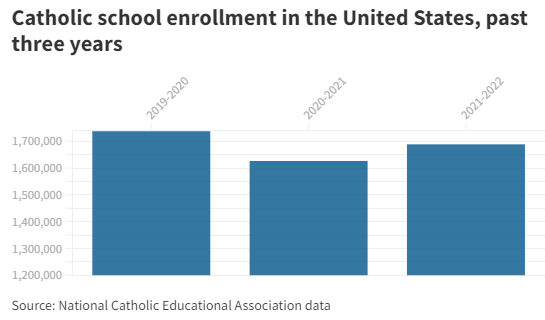
Catholic schools in the United States have grown in enrollment for two straight years, reaching record levels in some dioceses. Nationwide, Catholic enrollment jumped from 1.63 million to 1.69 million students, an increase of more than 3.5%, according to data released in February by the National Catholic Educational Association.
Though the statistics show that enrollment has not yet reached pre-pandemic levels — 1.74 million students enrolled in 2019 — the reversal is notable, as before the pandemic enrollment was trending down by 2% to 3% annually.
Lincoln Snyder, president and CEO of the NCEA, which works with Catholic educators to support ongoing faith formation and the teaching mission of the Catholic Church, spoke with CNA about the new numbers and the state of U.S. Catholic education today.
Can you break down for me how the enrollment numbers at Catholic schools (in the U.S. overall) have changed since the start of the pandemic?
We did see an initial drop in those first months of the pandemic. There was a lot of disruption for a lot of families in a lot of places. And so, the following May of 2020, we did see a drop in enrollment. We saw a number of schools close. A lot of difficult decisions were made at that point, but since then, Catholic schools have been on a consistent two-year upswing, so it’s very encouraging news for us.
We saw a 3.8% gain overall in the 2021-22 school year [an increase of 62,126 students]. And now in the 2022-23 school year, we’ve seen it go up another three-tenths of a percent [an increase of 5,076]. So just by way of numbers, our biggest single archdiocese in terms of enrollment is Los Angeles, and we’ve added more than another L.A. to our overall Catholic school enrollment. So for Catholic schools, this has been a really significant gain just in terms of the number of kids in our schools.
Do you know how many of the Catholic and public school families who moved to home schooling at the start of the pandemic have remained in that arrangement?
It’s very hard for us to track exactly what happened to individual families. And part of the reason I say that is we’ve also seen a lot of movement of people within the United States, and within regions. So the gains have been stronger in the South, Southeast, and Southwest. Obviously, in the Northeast, we’ve seen some places lose overall numbers of kids in big numbers. Home school is definitely one of those places where a lot of families ended up — we know that as a national trend.
I really couldn’t say with any confidence how many kids that had been at Catholic schools pre-pandemic would have ended up in home schools today. We just don’t have data. But I will say that we have more new families in our schools now than we did. So people have either changed schools within their area, or they’ve moved to a new area in really big numbers. And we know that in both those cases, it appears that families were much more likely to consider a Catholic education than they have been before.
To continue reading, click here.
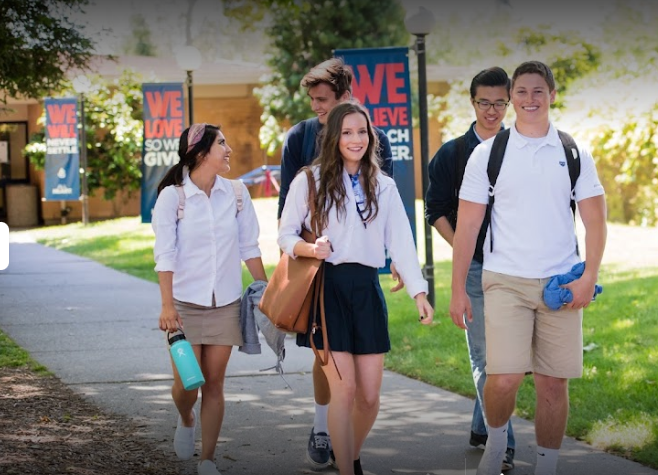
Born of a collaboration between the Dominican Sisters of San Rafael and the De La Salle Christian Brothers, Justin-Siena High School in Napa, California, has served families in that region since 1966. Although firmly rooted in the Napa Valley, the school is part of a ministry that spans continents, centuries, and generations.
Editor’s note: This article appeared Sunday on ktla.com.
For the first time in decades, Catholic school enrollment is up, both in Southern California and across the country.
After reaching heights of more than 5 million students in the 1960s, enrollment dropped to 1.6 million before the pandemic, resulting in empty desks and school closures.
“There was real concern for the sustainability of Catholic schools, not only here but nationwide,” said Erin Barisano, superintendent of schools for the Diocese of Orange. “Then the pandemic hit and who would have thought this would be the shot in the arm that we needed to show how wonderful our schools are.”
When schools transitioned to remote learning during the pandemic, Catholic schools in Orange County were some of the first and only to be back in the classroom.
“That was a game changer for us, when public school counterparts couldn’t open for in-person, the Catholic schools in Diocese of Orange, we opened Sept. 8, 2020, fully in person,” Barisano said.
To continue reading, click here.
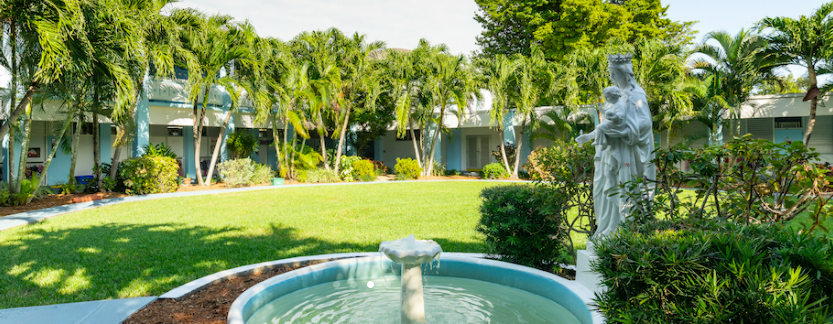
The Basilica School of St. Mary Star of the Sea, serving 154 students in prekindergarten through Grade 8, will expand to serve high school students for the 2022-23 school year.
Jim Rigg likes to call the latest Catholic school enrollment trends “the Great Registration.”
Modifying the catchphrase “the Great Resignation” about the large numbers of workers leaving their employers, Rigg, who serves as superintendent of schools for the Archdiocese of Miami, was describing the increases in the number of students enrolling in Catholic schools, reversing years of declines nationwide.
The Miami archdiocese saw one of the largest percentage increases in Catholic school students among the nation’s largest dioceses. With 34,892 students this year, that represents 5.4% increase over last year.
Now, the trend can continue, much to the delight of parents in the Lower Keys who say they don’t want their children’s access to a Catholic education to end after middle school. The Basilica School of Saint Mary Star of the Sea, the only Catholic school in Key West, has announced plans to add a high school to its pre-K through grade 8 program.
It’s a return of sorts. Mary Immaculate High School, which opened in 1886 and merged with several other Catholic high schools in the 1960s, closed in 1986 due to declining enrollment, leaving the Basilica School, which stopped offering instruction after middle school, the area’s only Catholic school for the past 40 years.
Principal Robert Wright said the expansion was driven by enrollment that had increased 100% between 2013 and 2019.
“We have been at capacity with a waiting list since then,” he said.
During the most recent accreditation process, Basilica School parents were asked what improvements or enhancements they needed for the well-being of their child. The overwhelming response was for the addition of grades 9 through 12.
Archbishop Thomas Wenski responded by giving administrators permission to begin a feasibility study. After determining the school’s enrollment model, facilities, and financial position, Wenski authorized the expansion on March 3.
The school is expected to open for grades 9 and 10 for the 2023-24 academic year in the school’s 17,500-square-foot auditorium, which will be renovated with funds from a capital campaign that will soon be launched.
Wright said the fully accredited high school will offer students dual enrolment and advanced placement courses, the latest technology, and popular extracurricular activities, clubs, and sports programs.
“With an anticipated/expected enrollment of approximately 180 students by year three, the vision is to keep classes small, and to do small well,” Wright told the Keys Weekly.
“As valued in Catholic tradition, our new Basilica High School will continue to provide academic excellence to our community’s adolescents, while encouraging intellectual curiosity and the pursuit of truth, goodness and beauty,” Wright said.
The Basilica School currently serves 154 students who attend on the state’s income-based tax credit scholarship or the Family Empowerment Scholarship. Twenty students attend using the Family Empowerment Scholarship for Students with Unique Abilities.
(Step Up For Students, which hosts this blog, manages these scholarship programs.)se
Rigg said he is thrilled that the Basilica School is expanding to include high school.
This will be the only Catholic high school in Monroe County, and I know it will provide a rigorous, faith-based education to the people of the Florida Keys,” Rigg said. “Much of this growth is fueled by the expansion of state scholarship programs, such as those supported by Step Up for Students. The future is bright for education throughout Florida.”
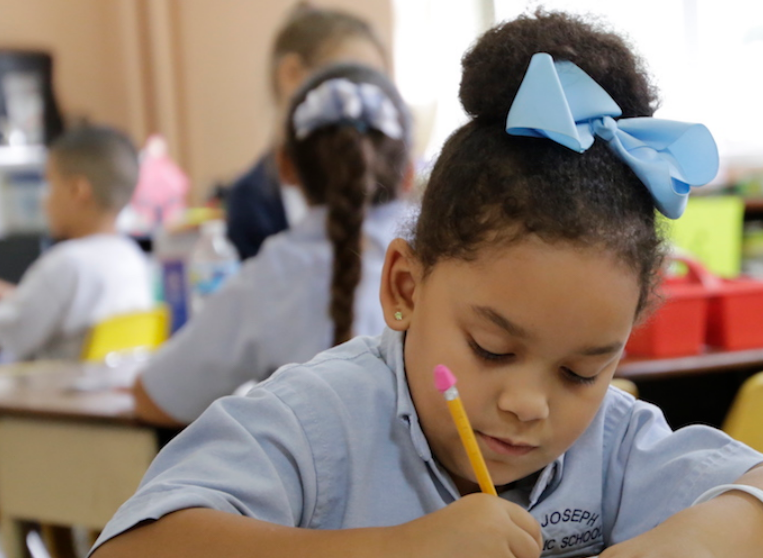
St. Joseph Catholic School in Tampa provides a quality Catholic education for all students, developing their potential as active Christians and contributing citizens who use their gifts for the service of others. State school choice scholarships have been largely responsible for the school’s success in accomplishing this mission while increasing enrollment.
One state stands out behind this year’s encouraging Catholic school rebound, and it’s the same one that’s been defying Catholic school trend lines for a decade.
Catholic school enrollment in Florida rose 6.3 percent in 2021-22, the biggest jump of any of the 10 states with the biggest Catholic enrollments and outpacing the 3.8 percent hike nationally, according to new state-by-state figures provided to reimaginED by the National Catholic Educational Association.
School choice deserves part of the credit.
Nationally, 6.8 percent of Catholic school students use state school choice scholarships, says the NCEA, which collected that data for the first time this year. In Florida, according to the NCEA, it’s 35.9 percent.
“The scholarships have been a tremendous blessing for us,” said Brenda Budd, principal of Tampa’s St. Joseph Catholic School, which is nearing capacity after being in danger of closing a decade ago. “They have allowed us to serve our mission.”
This year’s bounce back nationally doesn’t quite erase the prior year’s 6.4 percent drop. But it offers hope to a sector that continues to struggle with long-term enrollment loss despite a sustained reputation for quality and equity.
Among the 10 biggest Catholic school states, California saw a 5.2 percent increase; New Jersey, a 3.9 percent increase. Other states with large Catholic school sectors that saw big gains include Minnesota (up 8.0 percent), Massachusetts (up 6.9 percent), Michigan (up 6.2 percent) and Indiana (up 4.7 percent).
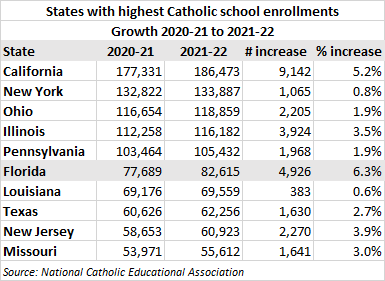
Since 2011-12, Catholic school enrollment has fallen 17 percent nationally -- it now stands at 1,688, 417 -- and dropped by double digit percentages in nine of the 10 biggest Catholic school states.
In Florida, Catholic school enrollment has risen 0.7 percent over that span. This, even though in Florida’s choice-rich education environment, more options are sprouting all the time.
Ten years ago, enrollment at the 125-year-old, PreK-8 St. Joseph Catholic School had dipped to 160 students. This year, it’s up to 296 students, with nearly 90 percent using choice scholarships. (Several of those scholarship programs are administered by Step Up For Students, the nonprofit that hosts this blog.)
About 85 percent of the families served by St. Joseph are Hispanic. To ensure families are comfortable and communication is top notch, the school has assembled a largely bilingual staff.
“We have to earn our right as educators every day,” said Chris Pastura, superintendent of the Diocese of St. Petersburg, which includes St. Joseph. “If we’re not able to give parents an education that’s the best for their children, they can go elsewhere.”
Expect more good news about Catholic schools in Florida going forward.
Last year, Florida lawmakers expanded income eligibility thresholds for the two biggest scholarship programs, which will make Catholic schools (and other private schools) accessible to even more low- and middle-income families who deem them the best fit for their children.
 Editor’s note: Good news for Catholic schools comes on the heels of National Catholic Schools Week, with dioceses including the Archdiocese of Miami posting enrollment gains. This article first appeared on catholicnewsagency.com and uses information included in a recent reimaginED post, which you can read here.
After a difficult 2020-21 year for many Catholic schools, enrollment numbers are rebounding nationwide, according to data from the National Catholic Educational Association.
Overall, enrollment in Catholic schools in the U.S. is up from 1.63 million last year to 1.69 million this year, an increase of more than 3.5%, according to the NCEA. Despite the increase, enrollment numbers do not appear to have yet reached 2019 levels, which saw 1.74 million students enrolled.
Catholic News Agency contacted the 10 largest dioceses in the country by Catholic school enrollment to ask how their enrollment numbers this year compare with last year.
Cincinnati
Cincinnati has a disproportionately large number of Catholic school students for its size. Spokeswoman Jennifer Schack told CNA that the archdiocese has 39,839 students enrolled this year, an increase of 1.5% over the previous year.
However, when looking at the past five years, the number of students is trending down by 2.5%, she said.
To continue reading, click here.
 On this episode, Tuthill speaks with the Conference’s associate for education about the history of Catholic education and the tension between Catholic schools maintaining an open, welcoming environment for all students while adhering to the practices and beliefs of their religious identity.
With nearly 30,000 of Florida’s roughly 80,000 Catholic students receiving some type of state scholarship, education choice plays a significant role in Florida’s Catholic schools. Tuthill and Barrett discuss Senate Bill 48, the landmark choice bill proposed by the Florida Senate that will be discussed during this year’s legislative session, and opportunities the Catholic community has to better serve families should the bill become law.
"We are not trying to discriminate against anybody. We're trying to maintain (schools) where we can build and teach and provide an environment that is based on the fundamental aspects of the Catholic faith.”
EPISODE DETAILS:
· The history of Catholic education in America stemming from Protestant discrimination in the first modern public schools
· How education choice provides vibrancy to Catholic schools in Florida even as enrollment declines in other states
· Issues of religious freedom and non-discrimination language that governments are codifying into law
· How Catholic schools handle identity issues on a school-by-school, per-family basis rather than adhering to blanket policies
· Senate Bill 48 and how its potential to help Catholic schools serve more students in better ways
Editor’s note: The National Catholic Educational Association is sponsoring Catholic Schools Week from Jan. 27-Feb. 2. Students, families, parishioners and community members are focusing on the value that Catholic education provides to young people as well as its contribution to local communities. This year’s theme is Catholic Schools: Learn. Serve. Lead. Succeed.
Catholic schools have a rich tradition of providing high-quality education to disadvantaged children in America’s cities. A recent study of private school enrollment in Education Next found that middle-income families in particular have been losing access to private schools, in part due to a declining number of Catholic schools.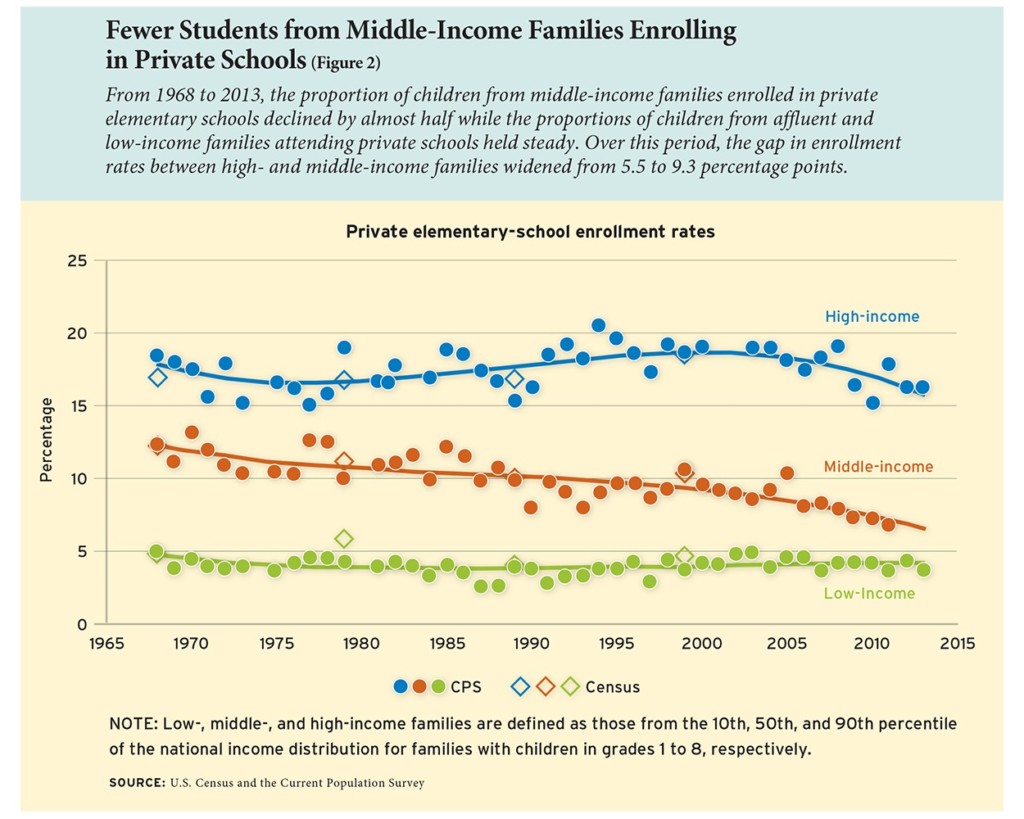
It’s worth noting that in the absence of private choice programs, the ability of middle and (especially) low-income families to access private schools would have declined further. In 1965, 13,000 Catholic schools served 5.2 million students. As a result of closures, 6,600 Catholic schools now serve 1.9 million students.
Reducing funding discrimination against private schools is not the only path to expanding access; reducing costs with innovative models also can expand access. This type of innovation is bubbling up in the Catholic school sector.
Cristo Rey is a network of 35 Catholic schools focused on low-income students that combine college-prep academics with a four-year corporate work study program in which Cristo Rey students share office job in partnerships with participating firms. Generated revenue keeps tuition costs low. Cristo Rey graduates are earning four-year college degrees at three times the rate of low-income students nationally, and have pursued blended learning strategies in pursuit of further improvements in outcomes and possible cost containment.
Founded in 2010 by the University of Notre Dame Alliance for Catholic Education (ACE), Notre Dame ACE Academies responded to a call from U.S. bishops for greater collaboration between Catholic higher education and K-12 schools. Notre Dame has partnered with Catholic schools in states with private choice programs and has launched an effort to explore blended learning strategies. ACE has partner schools in Palm Beach and Tampa, in addition to partnerships in Arizona and Indiana.
Then there is this very interesting speech by Gareth Genner to the Georgia Public Policy Foundation:
Genner’s organization Parish.Academy is helping to create 40-160 student Catholic micro-schools with a goal of an annual cost of $3,885 per student. From the organization’s website:
Parish.Academy offers a unique opportunity to keep a Catholic school open even if enrollment has fallen substantially and with unsubsidized total costs of $3,850 or less the tuition will be within the means of a greater number of parishioners. Please consult with us before announcing a school closing and let us offer you with a no-cost solution.
Color me intrigued. This Anglican will be praying for the success of these and other Catholic innovators.

