Editor's note: This story is part of our series marking National School Choice Week. We also recognize Catholic Schools Week, which runs concurrently. The scholarship application season opens on Feb. 1. Visit Step Up For Students to learn more and apply.
In 1999, the former school choice scholarship student was 10 years old and living in the Deep South Navy town of Pensacola, Florida. He was being raised by a single mom who worked as a cashier; growing up in a tough neighborhood; and going downhill in a tough public school.

Then, all of a sudden, he was a student at Little Flower Catholic School.
Experiencing the school for the first time, he told me 20 years later, “felt like going to Disney.”
The cathedral was towering. The statue of St. Therese, exotic. Even the classrooms smelled different. “Like Glade,” he said.
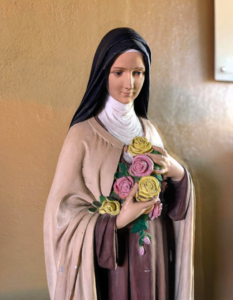
The former student didn’t know anything about the scholarship that allowed him to attend. He didn’t know why his mom enrolled him. He just knew that one day he was in third grade at a “bottom of the bottom” school, and then he and his too-big backpack were in fourth grade across town.
Just like that, he said, he went from playing dice and fearing he’d be called a “doofus” for studying, to collecting Pokémon cards and competing academically with the children of doctors and lawyers. For the next two years, the entire community at his new school — the teachers, the other kids, the other families — embraced him.
Two years, it turns out, was long enough for him to affix himself to a path no one else in his family had taken. To high school graduation. To a four-year college. To a good-paying job.
Without this little Catholic school, he said, none of it would have happened.
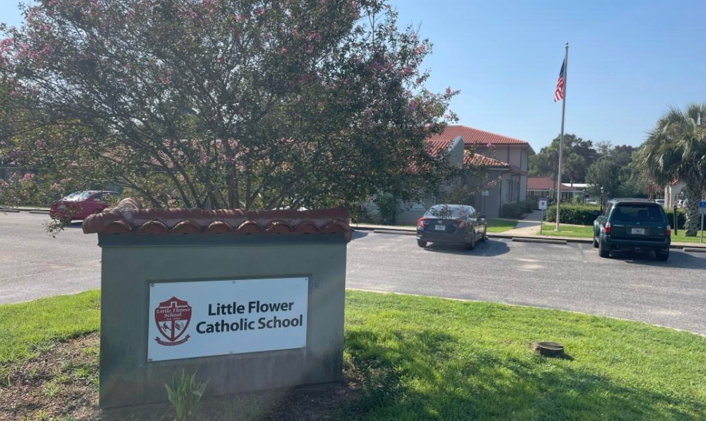
I met the former student in 2019. That was the 20th anniversary of Florida’s Opportunity Scholarship, the first, modern, statewide voucher program in America. I had set out to find some of the first “voucher kids” and see what happened to them.
Ultimately, I wrote about one of them, but not the kid from Little Flower. His story, though, seared into my brain.
It was uncanny how he so clearly described how this one, brief education intervention so radically changed the arc of his life. He said Little Flower showed him what school was supposed to be like, and, more importantly, what a family was supposed to be like.
A few years later, I would think of the student when choice opponents tried to demagogue scholarship programs because some low-income students use the scholarships only for a short time. They insinuated short-term use proved the poor quality of available private schools, rather than reflect student transience tied to income.
I continue to think about the former student today, as I continue trying to understand why some schools are so much more effective for low-income students. For half a century, we’ve known Catholic schools are among them. It’s another reason I’m grateful Catholic schools in Florida are growing again, and excited about the potential of school choice to reverse the trend lines in other states, too.
The “Catholic school advantage” has made the American Dream a reality for millions of working-class kids, usually at far less cost than public schools. But why?
“Catholic Schools and the Common Good” sought to answer that question. A classic in education research, it was published in 1993, just a few years before Florida launched its first scholarship program. It’s jarring how many school characteristics identified as central to Catholic school effectiveness are so basic.
An orderly environment. High expectations for every student. A focus on academics and character. And above all, pervasive warmth and hope, grounded in a faith that extended a “genuine sense of human caring” to every kid.
Why is it so hard to get more of that?
…
The kid was assigned to his neighborhood school. He and the school struggled. The man he grew up to be described the school and its outcomes this way:
The kids who went there, many of them are either dead or in jail or not successful. It was the bottom of the bottom in a sense. Kids who’ve been generation after generation in a certain mindset. The same cycle. Generational curse. Broken homes. A lost generation of kids with no fathers.
In first grade, he was held back.
“I don’t know if it was because he was slow at that time, or if the teacher didn’t take the time out to teach right,” his mom told me. “I went to school a couple times and asked, ‘What’s going on?’ They said, ‘He’s a good kid. He behaves. He’s trying.’”
But as time went on, the kid began hanging with tougher students. In hindsight, he said, he was “starting to go to a dark place.”
Just in the nick of time, the stars lined up.
Students were eligible for the Opportunity Scholarship if they attended a public school that earned two F grades in four years. The student in Pensacola attended one of those schools.
…
The kid’s mom couldn’t drive him to Little Flower every day. It was a long haul. Her car was unreliable. Her elderly friends volunteered to give her son rides.
They didn’t have much money, but sometimes they’d hand him a dollar for lunch. They told him he had an opportunity other kids didn’t have.
Study hard, they told him. … Stay away from the street … Make your mama proud.
The kid started at a second-grade level academically, even though he was in fourth grade. He said many of his classmates were already doing middle school work. But no one at Little Flower ever made him feel inadequate, he said. His teachers simply gave him more 1-on-1 attention so he could catch up.
Gratitude fueled him. He didn’t want to let down his mom. Or the “old heads” who gave him rides. Or a former teacher from his prior school, who sometimes took him to church and told him, “There’s something special in you.”
Competition fueled him, too. He knew he was behind many of his classmates but was determined not to stay there. Everything about the school, he said, told him he was just as capable.
The former student said he loved the diversity at Little Flower. Working class, middle class, upper class. Mostly white, but with a growing number of Asian students and, thanks to the choice scholarships, more Black students. Increasingly diverse, yet united as a community.
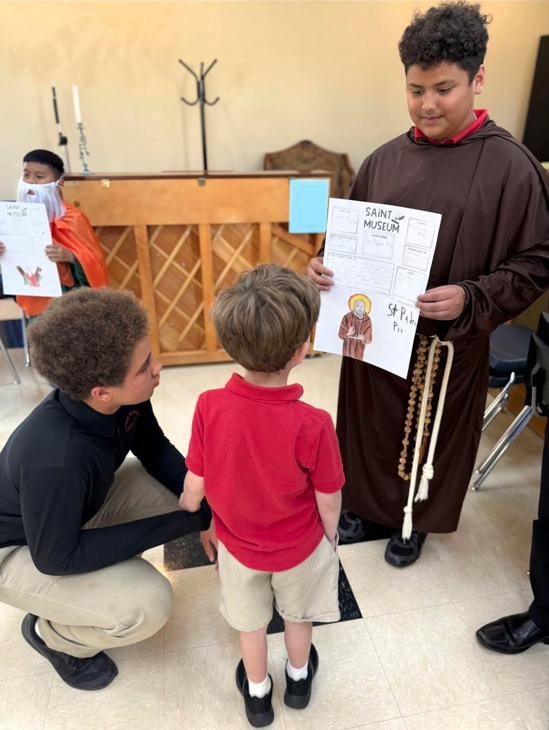
The kid said his new friends invited him into their lives, where he glimpsed a world he’d never seen. Comfortable homes. Nice things. Moms and dads.
“It opened up my mind to think different,” he said, “to understand that just because you come from a certain area, you don’t have to follow that line.”
…
The kid returned to his zoned school for middle school. He didn’t know why. His mom couldn’t remember.
But the lessons from Little Flower stuck with him.
He graduated from high school, attended a four-year college, and earned a bachelor’s degree. He said he loved college, and not just for academics. He was surrounded, he said, by students with “concrete families.”
Just like he was at Little Flower.
“I got to see what a family was,” he said. “A functional family. A healthy family. This is what a family feels like. It gives you spirit … inspiration … warmth … “
Today, the former scholarship kid has a good-paying job. He’s married with kids. He told me his “biggest mission in life is to raise a healthy family.”
Little Flower taught him that, he said, without ever having to say it.

Bishop William Wack from the Diocese of Pensacola-Tallahassee joins in on the fun running around with the students at Trinity Catholic School in Tallahassee.
Florida Catholic schools are thriving, and the latest enrollment numbers prove it. Across the state, enrollment rose from 90,870 in the 2023-24 school year to 93,455 – a 2.8% year-over-year increase.
Driving much of this growth is the use of private school scholarships, which rose by 27% this year. Programs like the Family Empowerment Scholarship for Educational Options and the Florida Tax Credit Scholarship provide families with about $8,000 per student to pay for private school, making Catholic education more accessible than ever.  The news comes just as Catholic schools across the United States are celebrating Catholic Schools Week simultaneously with National School Choice Week, which runs from Jan. 26 through Feb. 1.
“(Scholarship) programs are giving more working-class and middle-class Florida families the ability to choose Catholic schools — and more of them are doing just that,” said Bishop Gerald Barbarito of the Diocese of Palm Beach, which has 20 schools in five counties.
National state-by-state figures are not expected to be released until March, but last year’s report offered encouraging news, with Catholic school enrollment in PreK-12 holding steady. In 2023-24, 1,693,327 students were enrolled in Catholic schools across the United States, virtually the same number as the prior year. (Officially, the 2022-23 number was 1,693,493.) In Florida, enrollment climbed to 90,785, up 5.2% from the prior year.
The 2023 passage of House Bill 1, which made every family in Florida eligible for a scholarship, has been a game changer for Catholic schools. Last year, 56,192 students used scholarships to attend Catholic schools. This year, that number has jumped to 72,851. In the Archdiocese of Miami, the number of families using scholarships increased by 45%.
However, Florida was an outlier when it came to Catholic school enrollment growth a decade before Gov. Ron DeSantis signed HB 1 into law.
Between 2013 and 2023, Florida was the only state in America in the Top 10 for Catholic school enrollment that did not see declines in enrollment. While other states saw declines during that span, Florida experienced 4.4% growth, which was credited to the Sunshine State’s already robust school choice scholarship program. The positive trend lines in Florida were the subject of a special report: “Why Catholic schools in Florida are growing: 5 things to know.”
“Over the past few years, we have made an intentional effort to educate families about these programs and encourage them to apply,” said Jim Rigg, archdiocese secretary of education and superintendent. “At this point, over half of our schools are full with a waiting list, so we decided to work closely with families enrolled or interested in schools that were not full.” He feels that their measured and strategic approach helped families understand and apply for the scholarship.
This remarkable growth is not limited to a single region. Schools within the Diocese of Venice in southwest Florida saw the most growth, with a 4.9% increase. Superintendent Father John Belmonte attributes this success to strategic goals set for each school.
“The most important thing that we do is communicate with families and invite them to attend our schools. We do this by sending out 1 million emails and text messages to families across the diocese every year,” he said. Schools are also innovatively addressing capacity challenges in high-demand areas by maximizing classroom space and adopting creative scheduling.
Catholic schools in Florida are also making strides in serving students with unique abilities, as enrollment for these programs increased by 36%. Schools like Holy Family Catholic school in Jacksonville are pioneering innovative ways to serve their students, such as individualized, small-group-focused learning. Similarly, schools like Bishop Larkin Catholic School in the Tampa Bay area have implemented initiatives like Morning Star programs, which provide a low student-to-teacher ratio, tailored curriculum, and dedicated classrooms to help students with learning and developmental challenges succeed academically, socially, and spiritually. Thanks to the Family Empowerment Scholarship for Unique Abilities, families in this program receive scholarship dollars to make specialized education more accessible.
The continued growth has paved the way for exciting school expansions and new facilities. In December, The Basilica School of Saint Mary Star of the Sea in the Florida Keys celebrated the ribbon-cutting of its new high school building. Meanwhile, Donahue Catholic Academy in rural southwest Florida is set to expand with modular classrooms to accommodate 200 students on a wait list. Rigg expressed optimism about the future.
"We are continuing conversations about how to expand the growth of Catholic education in Florida,” he said.
Editor's note: This story is published in celebration of National Catholic Schools Week, which runs from Jan. 28-Feb. 3.
Visit Guardian Angels Catholic School in Clearwater, and you’ll feel a deep sense of community as soon as you pull up to the entrance. School leaders stand at the curb, waving at parents and greeting each student as they leave their cars. The day starts with a student-run television news show, including announcements about frequent evening social events. Principal Mary Stalzer strolls through each room to ensure everything is running smoothly.
 By mid-morning, the youngest students are running around on the playground. Middle schoolers work in science labs. In another room, students read stories they have written or edit a classmate’s work. Outside, students tend vegetable gardens that are part of the school’s fully certified STREAM program. (STREAM stands for Science, Religion, Technology, Engineering, Arts and Math and is the Catholic school version of a STEAM program.) Teachers link the gardening projects to Jesus’ parable about what can be achieved by having faith the size of a tiny mustard seed.
Where Catholic schools are often tied to a single church, with which they often share a location, Guardian Angels is an inter-parish school, which means it has no specific church. Instead, support is spread across four local parishes. This may help explain why the school's leaders have made building community a priority.
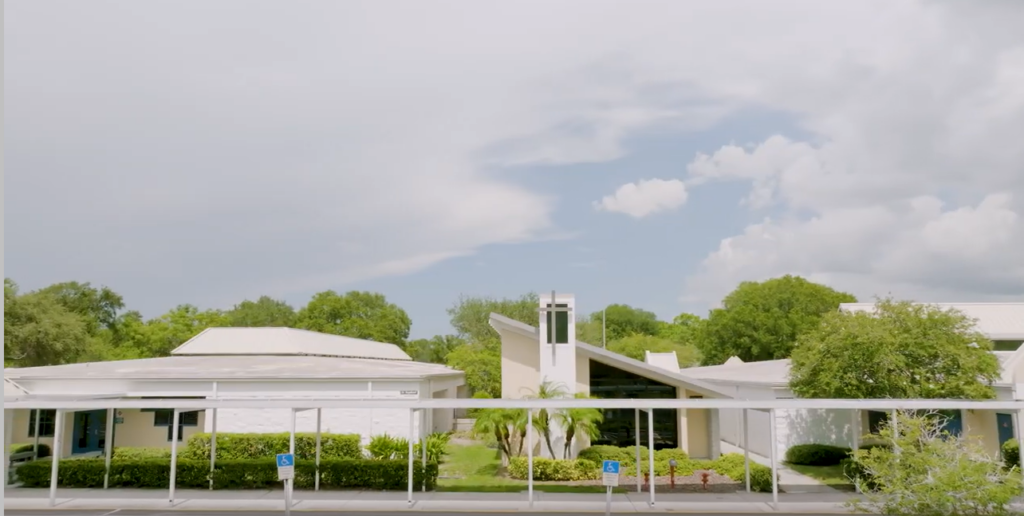
The tree-shrouded campus sits tucked away in a neighborhood of modest homes and apartment complexes, not visible from major highways.
“We are the hidden gem of northern Pinellas County,” said Stalzer, whose career with Catholic schools has spanned a quarter century.
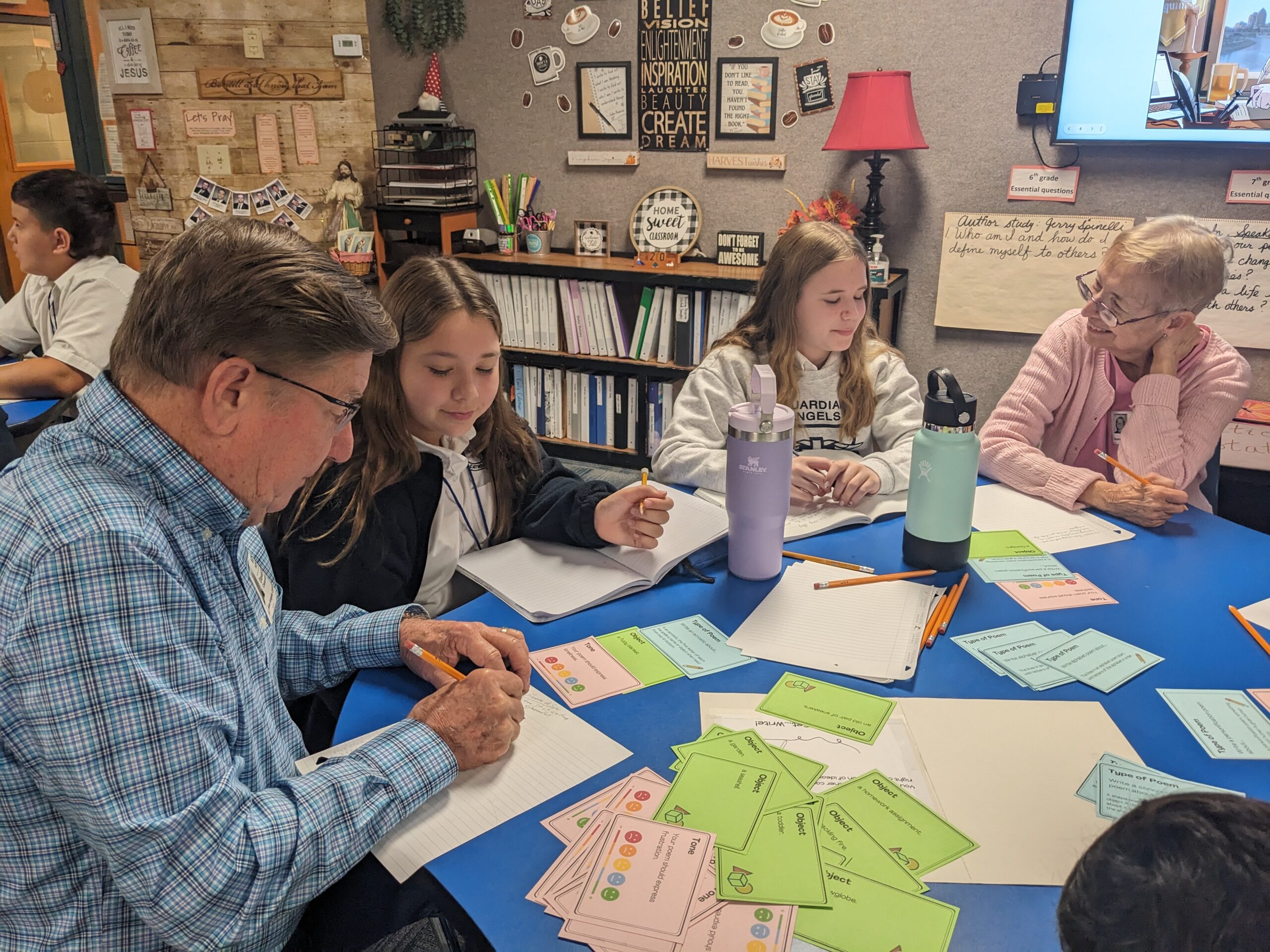
Guardian Angels Catholic School in Clearwater, Florida is known for its deep sense of community, which is fostered by the encouragement of parents and grandparents to be involved in school activities. Photo courtesy of Guardian Angels Catholic School
Guardian Angels Catholic School
 Over the years, she has taught elementary school, worked in the library, and served as assistant principal before becoming head of the school. “We are warm and welcoming. We know our students; we know their parents and their grandparents.”
This year, more people have discovered the sparkle of Guardian Angels, where enrollment spiked this school year by 19% after several years of decline due to the pandemic and other nearby schools.
Stalzer attributed the substantial increase to several factors, including a grassroots marketing campaign that included in-person and online meetings, letters, social media posts, and word-of-mouth. However, the primary reason she cited and other school leaders gave for their growth was the Florida Legislature’s passage of House Bill 1, the largest expansion of school choice in United States history.
While this year’s growth at Guardian Angels is sure to turn heads, it’s part of a much broader statewide trend. Recent data from the Florida Conference of Catholic Bishops show Catholic school enrollment grew by 4% across the Sunshine State in the 2023-24 school year. That increase is on top of the 4% growth seen over the past decade highlighted in a special report by Step Up For Students.
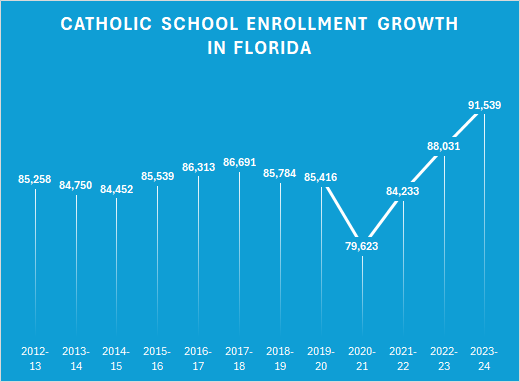
Chart courtesy of Ron Matus
Stalzer and the other Catholic school leaders across the state made every effort to make existing and new families aware of the new law, which extended scholarship eligibility to all Florida students regardless of their family’s income.
“People found it hard to believe that they didn’t have to qualify for it financially,” Stalzer said. “I have heard some families say it’s an answer to their prayers.”
Chris Pastura, superintendent of schools for the Diocese of St. Petersburg, where Guardian Angels is located, said the law helped many families who otherwise would not have been able to afford Catholic schools. The 34 elementary and secondary schools in the diocese, which cover five counties in the greater Tampa Bay area, reported a year-over-year growth rate of 3.8%
“What I found was an immense sense of gratitude from a lot of middle-class families,” Pastura said. Those families might be getting by, he said, but make financial sacrifices to provide their kids with a Catholic education.
“This is a great example of a program helping them at the bottom line,” he said.
With its current enrollment at 191, Guardian Angels still has plenty of room before it reaches what Stalzer called a “comfortable” count of 350 students. Other schools across the state are hitting their maximum capacity, which they attribute to Florida’s rising population and the availability of state school choice scholarships. This year, 78% percent of Florida Catholic school students received them.
“Catholic school enrollment continues to soar in the state of Florida,”’ said Deacon Scott Conway, superintendent of schools for the Diocese of St. Augustine, which reported 4% year over year growth across its 29 schools in 17 northeast Florida counties.
“One of our biggest struggles is not having enough seats for students, which causes us to have to turn many students and families away,” he said. “We are so blessed here in Florida that our legislature has recognized the importance of empowering school choice for families. For most people, there is no choice without the scholarship program.”
One of those schools is Holy Family Catholic in Jacksonville, which serves students in kindergarten through eighth grade. The school recently ramped up its Wildcat D.E.N.S. program to provide personalized tutoring for students struggling in key academic areas and enrichment for students identified as gifted.
This year, for the first time, the school had to start a waitlist for students in kindergarten through fourth grade, assistant principal Amanda Robison said.
Florida’s largest Catholic school region also reported growth of about 4% this year, continuing a trend that began four years ago.
“Enrollment is the largest it has been in over 10 years,” said Jim Rigg, who oversees 64 schools as superintendent of schools for the Archdiocese of Miami, which includes Miami-Dade, Broward and Monroe counties. “Over 50 percent of our schools are filled with waiting lists, and nearly all of the remaining schools are growing.”
Rigg cited the August re-opening of St. Malachy Elementary School in Tamarac, which had closed 14 years earlier due to declining enrollment, along with the addition of a high school to an elementary school in Key West as evidence of rising demand. Cristo Rey Miami High School also opened in 2022, the second Florida location for a national network of high schools that specialize in college preparatory academics and on-the-job work experience for students from financially constrained households.
“Unfortunately, there are now areas of the Archdiocese where we simply do not have open seats in our schools,” he said.
Rigg added that Archdiocese leaders are in “active conversations” about future openings and reopenings to accommodate the demand, which he attributed to Florida’s robust scholarship programs as well as an influx of families from the northern U.S., Latin America and the Caribbean.
“It is important that we do our best to meet the strong and growing demand for Catholic education in South Florida,” he said.
Editor’s note: The National Catholic Educational Association is sponsoring Catholic Schools Week from Jan. 27-Feb. 2. Students, families, parishioners and community members are focusing on the value that Catholic education provides to young people as well as its contribution to local communities. This year’s theme is Catholic Schools: Learn. Serve. Lead. Succeed.
Catholic schools have a rich tradition of providing high-quality education to disadvantaged children in America’s cities. A recent study of private school enrollment in Education Next found that middle-income families in particular have been losing access to private schools, in part due to a declining number of Catholic schools.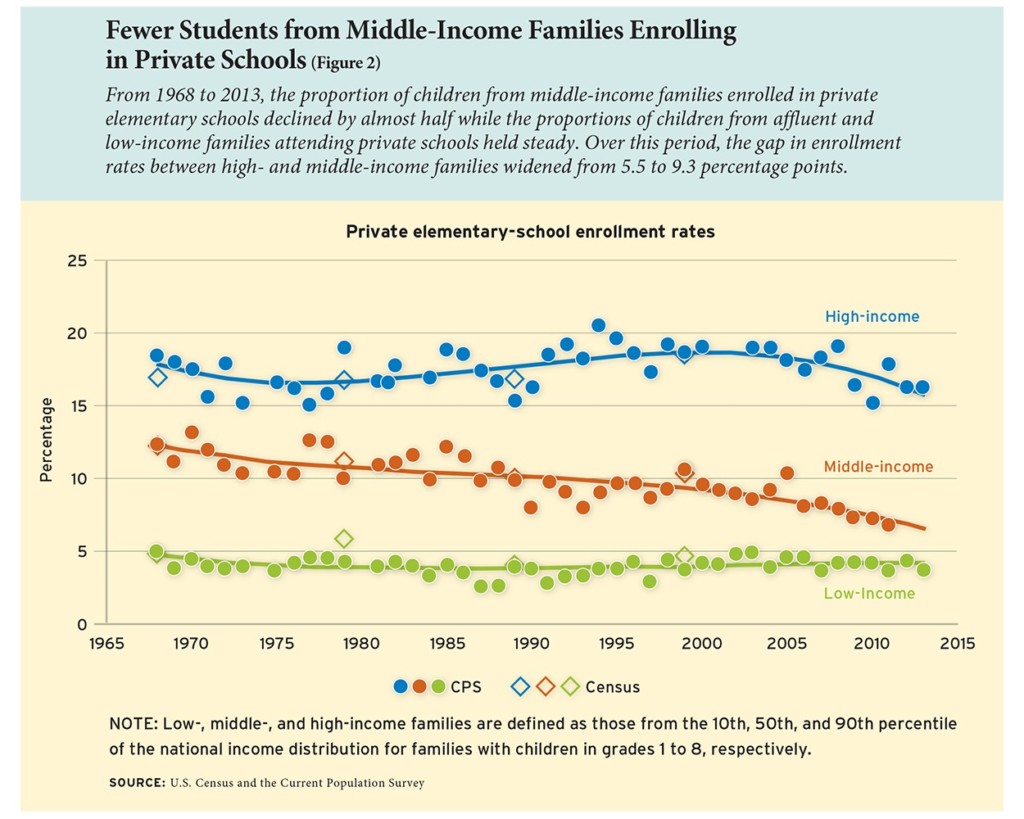
It’s worth noting that in the absence of private choice programs, the ability of middle and (especially) low-income families to access private schools would have declined further. In 1965, 13,000 Catholic schools served 5.2 million students. As a result of closures, 6,600 Catholic schools now serve 1.9 million students.
Reducing funding discrimination against private schools is not the only path to expanding access; reducing costs with innovative models also can expand access. This type of innovation is bubbling up in the Catholic school sector.
Cristo Rey is a network of 35 Catholic schools focused on low-income students that combine college-prep academics with a four-year corporate work study program in which Cristo Rey students share office job in partnerships with participating firms. Generated revenue keeps tuition costs low. Cristo Rey graduates are earning four-year college degrees at three times the rate of low-income students nationally, and have pursued blended learning strategies in pursuit of further improvements in outcomes and possible cost containment.
Founded in 2010 by the University of Notre Dame Alliance for Catholic Education (ACE), Notre Dame ACE Academies responded to a call from U.S. bishops for greater collaboration between Catholic higher education and K-12 schools. Notre Dame has partnered with Catholic schools in states with private choice programs and has launched an effort to explore blended learning strategies. ACE has partner schools in Palm Beach and Tampa, in addition to partnerships in Arizona and Indiana.
Then there is this very interesting speech by Gareth Genner to the Georgia Public Policy Foundation:
Genner’s organization Parish.Academy is helping to create 40-160 student Catholic micro-schools with a goal of an annual cost of $3,885 per student. From the organization’s website:
Parish.Academy offers a unique opportunity to keep a Catholic school open even if enrollment has fallen substantially and with unsubsidized total costs of $3,850 or less the tuition will be within the means of a greater number of parishioners. Please consult with us before announcing a school closing and let us offer you with a no-cost solution.
Color me intrigued. This Anglican will be praying for the success of these and other Catholic innovators.
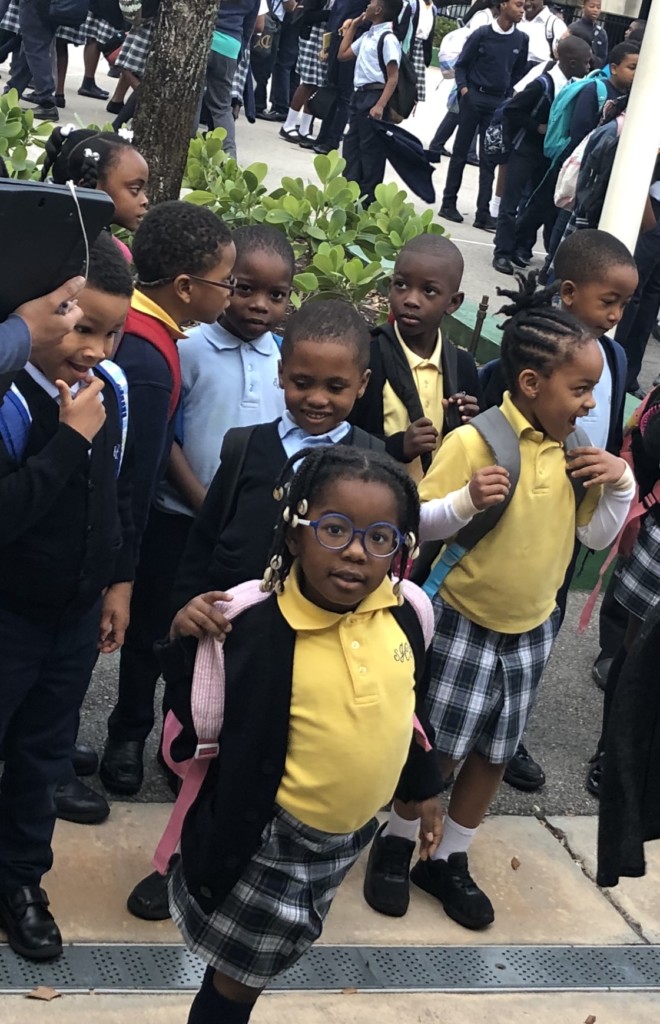
Students at St. James Catholic School in North Miami, along with thousands of students at Catholic schools across the country, will celebrate National Catholic Schools Week this year from Jan. 27-Feb. 2.
Editor’s note: Catholic Schools Week, sponsored by the National Catholic Educational Association, is celebrated this year from Jan. 27-Feb. 2. Through events such as open houses and other activities for students, families, parishioners and community members, schools focus on the value that Catholic education provides to young people as well as its contribution to local communities. This year’s theme is Catholic Schools: Learn. Serve. Lead. Succeed.
NORTH MIAMI, Fla. – In the car line at St. James Catholic School, nursing assistants, housekeepers and taxi drivers stop-and-go their compacts, sending a steady pulse of students in monogrammed navy sweaters and iconic plaid skirts toward the school’s courtyard. At 7:40 a.m. sharp, 400 strong stop to recite the Pledge of Allegiance over the roar on nearby I-95 and listen to their principal pray for peace.
If Catholic schools in America are supposed to be disappearing, somebody forgot to tell St. James.
The school has 468 students in PreK-8.
That’s a third more than five years ago. That’s triple what it had 20 years ago. This school year, St. James added four modular classrooms to accommodate growth.
What makes the rise even more noteworthy is St. James is awash in an ever-expanding sea of educational choice. In the choice-iest school district in arguably the choice-iest state, parents have the power to pick from a dizzying menu of district schools, charter schools and private schools, many of them high-quality and tuition free. Yet they flock to this throwback Catholic school with its name hand-painted on the administration building and a Black Madonna in the lobby.
“I love it, I love it, I love it!” said Fabiola Boutin, an admissions counselor at a small college who chose St. James for sons Kemar, 9, and Kris-Noah, 6. “When you see St. James students versus the other students, you can tell they’re different. It’s the way they talk. The way they act. The vocabulary. If I couldn’t put them (my sons) in St. James, I would go back to Haiti.”
In Florida, a bustling Catholic school like St. James isn’t unusual. For a decade, enrollment in Florida Catholic schools has held steady around 85,000, and, in seven of the last eight years, has actually risen slightly. The exception – a modest drop this year – is due mostly to an enrollment decline in the Florida Tax Credit Scholarship for lower-income students. That program (administered by nonprofits like Step Up For Students, which hosts this blog) serves nearly 100,000 students and has, for the first time, hit a wall in fundraising.
St. James has 410 students on scholarship, up from 302 five years ago. About 90 percent are of Haitian descent. The vast majority of their parents would not have been able to afford tuition without the scholarship. Most are paying $500 to $600 a year with it.
They had other options.
Miami-Dade is a poster child for the new normal in public education. Nearly 70,000 students attend charter schools. About 30,000 attend private schools using state-backed choice scholarships. At least 100,000 attend district magnet schools. By some estimates, nearly 70 percent of all PreK-12 students in Miami-Dade now attend something other than their zoned neighborhood school.
Within 4 miles of St. James there are at least seven magnet schools, specializing in everything from robotics and law studies to museums and expressive dance; at least six charter schools, including two that earned A grades from the state; and at least seven private schools that accept the tax credit scholarship, including a Montessori school, a Lutheran school with 300 scholarship students, and another Catholic school. Expand the radius a few more miles, and plenty of other choices surface on the grid. A new KIPP charter school, for example, is 15 minutes away.
The 66-year-old St. James is off-white with butterscotch trim, flanked by swaying palms. The neighborhood it helps anchor is Haitian and Dominican, Filipino and Nicaraguan, black and Puerto Rican. It’s hard to miss the occasional sagging fence amid banyan and bougainvillea. At the same time, it’s impossible to miss families in their Sunday best, emerging from homes of weathered stucco.
St. James doesn’t come with a lot of frills. Some Catholic schools in Florida are responding to the competition by adding on. Some do IB. Some bolstered their STEM programs. Some have partnered with the Alliance for Catholic Education at the University of Notre Dame. But even with its 1-to-1 iPad ratio in grades 5-8, St. James is old school.
So why do so many parents choose it?
Because it’s old school. Many parents still want a classic Catholic education for their kids, like millions have for generations. They like that faith, character and academics are aligned. They like that structure, discipline and high expectations are a given. (Were more scholarships available to middle-income families, demand would be even more obvious. But that’s a story for another day.)
“Good manners … good foundation,” said Lucdina Doriscar, the mother of two St. James students who does cleaning work at the airport.
She and other St. James parents repeatedly say the school is like family.
“People can feel that,” said Sister Stephanie Flynn, an educator for 40 years, the principal of St. James for 10. “When you’re part of a big county thing, it’s really hard for parents to know their school. In a Catholic school, you know you’re part of that community.”
According to Flynn, about 75 percent of St. James students will matriculate to Catholic high schools, most to Monsignor Edward Pace in Miami Gardens. The rest will go to public high schools, mostly magnets and charters. To those who still think choice pits public versus private, the reality on the ground in a choice-rich place like Miami-Dade suggests something more organic and complementary.
Parents can’t help but spread the word.
Last week, one St. James parent spoke about the school at an MLK Day event with Florida Gov. Ron DeSantis. Ghismide Saint Jean, whose 6-year-old Josiah is one of 13,000 students on a waiting list for the tax credit scholarship, said she’s working 10 to 14 hours a day as a waitress to keep him at St. James. She said she chose it over the neighborhood school because it’s smaller and more nurturing, which is important because Josiah’s lung problems require frequent hospitalizations. “I can’t imagine him being in another school,” she told the crowd. “And neither can he.”
Fabiola Boutin said she selected St. James because, “I’m picky.”
She researched several charter schools but deemed them too stressful. She considered another Catholic school but liked that St. James puts more emphasis on teaching English. She considered district schools but found St. James more welcoming.
“When you drop off your kids, they say, ‘Good morning.’ It’s not that way everywhere,” Boutin said. “I just feel more connected here. They (my kids) are home when they’re here.”
by Darla Romfo
 For those of us who follow school choice discussions, the past two weeks have given ample material for conversation, given National School Choice Week, followed by Catholic Schools Week, and the news of the imminent closing of nine Jubilee Catholic Schools with their unique history and mission in Memphis, Tennessee.
During School Choice Week, CSF’s New Hampshire program was part of a happy gathering with 350 people showing up in the middle of an ice storm to celebrate what can happen when parents are empowered with real educational choices for their children. The New Hampshire tax credit program is growing and there is a possibility of education savings accounts (ESAs) in the future. This has uncovered parental demand for more options, and in response, the Catholic Superintendent announced they will actually be opening four new schools. The size of the tax credit program to date does not support four new schools, but the change in culture and expectations does. It has become an environment of hope and excitement about what’s possible. (more…)
Common Core. To conservatives: "I suggest you give up the bashing of a critically important reform simply because your political enemy endorsed it." EdFly Blog.
 Charter schools. The highly successful Pembroke Pines charter school system says it deserves a share of the Broward school district's capital improvement dollars, reports the Miami Herald. The Pinellas school district will vote yet again Tuesday on whether to shutter the long-troubled Imagine charter school in St. Petersburg, reports the Tampa Bay Times. A Palm Coast charter hopes to bounce back from an F, reports the Daytona Beach News Journal.
Teacher evaluations. Senate President Don Gaetz says the new evals may be too complicated and, combined with other big changes in education, could put the system at risk of imploding, reports the Florida Current. Washington Post ed blogger Valerie Strauss uses Gaetz's comments to tee off on Florida ed reform.
More on teacher pay. Gov. Rick Scott's proposal runs up against competing demands, reports the Tampa Bay Times. It "would provide welcome relief" but doesn't make up for "all of the damage this governor has done to public education," writes the Times editorial board. Cash shows respect, writes Times columnist Dan DeWitt. It'll help show teachers are valued, writes the Pensacola News Journal. Give Scott credit for supporting merit pay and across-the-board raises, writes the Daytona Beach News Journal. His commitment needs to be more than a one-time gimmick, writes the Palm Beach Post. A good thing no matter the motivation, writes the Gainesville Sun. Transparent pandering, writes the Panama City News Herald. "Met with skepticism," reports the Tampa Tribune. Lawmakers should be careful about both teacher raises and a proposal to transform the state retirement system, writes the Ocala Star Banner.
Satanists. They like the school prayer bill Scott signed last year. Really. Coverage from Tallahassee Democrat and Associated Press. (more…)

