CLEARWATER, Fla. – The orphans in a tiny town in Tanzania left the biggest impression on Sarah Williams.
They were so cute and kind and happy.
And curious.
The children were fascinated with Sarah’s long hair. It’s something rarely seen in that part of the world, where water is so scarce the locals shave their heads so as not to waste the precious resource on something as ordinary as washing their hair.
Sarah let the kids run their fingers through her locks. She showed them how to make a ponytail and how to braid it.
“They were so happy,” Sarah said. “They don’t have much, but they have each other. All they wanted was to hold our hands and play with us.”
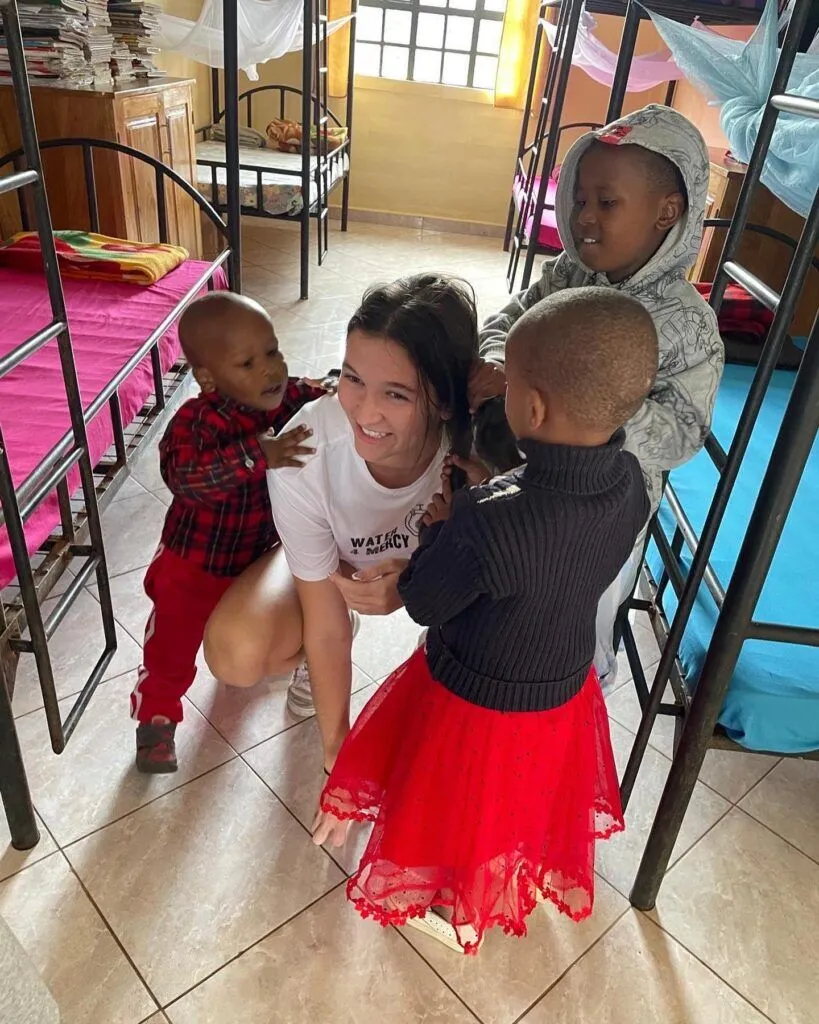
The orphans that Sarah Williams met in Tanzania were curious about her long hair.
Sarah, five of her classmates from Clearwater Central Catholic High School (CCC) and two chaperones from the school spent 10 days last June in Tanzania as representatives of Water 4 Mercy, a nonprofit that provides water and food and hope to remote villages in Africa.
Water 4 Mercy was started in 2018 by Nermine Khouzam Rubin, whose daughter, Samantha, is a graduate of CCC.
Sarah is a junior who attends the private Catholic school on a Family Empowerment Scholarship for Educational Options (FES-EO). The scholarship is managed by Step Up For Students.
She is a member of CCC’s Water 4 Mercy service chapter, the largest service chapter in the school. It began in 2021 and has raised $36,000 through fundraisers. This was the first time CCC students traveled to Africa.
“It’s life-changing,” said Beth Lani, CCC’s director of advancement and moderator of the school’s Water 4 Mercy chapter.
The 16-page itinerary that Sarah and her classmates received said it would be a “fun and meaningful journey” and a “life changing adventure.”

It was for Sarah and for Corey Vohra, a senior who also made the trip.
They visited schools, an orphanage and convent, and several rural villages. They also attended Mass in Swahili and went on a safari.
“I went there with an open mind,” Corey said. “I wanted to see where the journey would take us.”
They met villagers barely scraping by without one of life’s biggest necessities – clean water – yet were also some of the happiest people they’ve ever met.
They saw smiling faces everywhere they went. Children lined up and waved when the traveling party drove by.
“It showed me a different perspective on my life,” Corey said. “I feel like coming out of that trip, I'm very grateful for everything I have and all the privileges I have in life.”
When Sarah returned home, she researched the type of social work needed in countries like Tanzania.
“It impacted me so much I want to do something about it,” she said. “I’m looking at majors for college, and I’d like to major in social work so I can go back and work with the orphanage.”
Sarah plans to attend the University of Tampa, where she can continue to play volleyball and major in social work.
“Before this trip I wanted to major in interior design,” she said, “so this is something totally different. I love being around children. I babysit for a ton of different families. I always had a connection with children, so I think this is something that I want to stick with.”
Corey, who also attends CCC on an FES-EO scholarship, plans to attend college in south Florida and major in international affairs.
“This trip helped me figure out what I want to do,” he said. “Maybe I can be part of the United Nations and do something to help make a difference there.”
The trip included visits to places like Mabalangu Village, a community of 2,200 that recently gained access to clean water for the first time thanks in part to the efforts of CCC’s Water 4 Mercy service chapter.
And to villages that are in the process of gaining access to clean water. It was those visits that left a lasting impact. The students watched villagers gather water from muddy water holes also used by animals. You can imagine what is mixed in with the mud.
“It was crazy,” Corey said. “And then you come home, and you can take like 10 steps and get water from your fridge.”


The villages consist mostly of women and children, because the men travel to other parts of the country for work. Those women and children carry the water back to their homes in containers they balance on their heads.
“I saw a big difference between the village with no water and the village with water,” Sarah said. “Everybody was happier. They looked cleaner.”
Lani was one of the chaperones. This was her second trip to Tanzania with Water 4 Mercy. Seeing the impact the school is making in Tanzania was “very inspiring,” she said.
She graduated from Cleveland State University with a degree in anthropology and said she would have jumped at the chance to go on a trip like this at that time had one been available.
“I know these kids, they're bright kids, and I figured maybe it wouldn’t pivot their career choice, but maybe give them a different perspective, and it might color what they do in the future,” she said. “But to hear them say it actually is guiding their career choice, at least at this point in their lives, is wonderful. I’m thankful that I could share that opportunity with them.”

Jackson Pelletier’s enrollment at St. Paul’s Catholic School Riverside on an education choice scholarship began with a trip to the pediatrician.
That’s when his parents, Natasha and Greg, noticed the private school in Jacksonville across the street from the doctor’s office.
The family had just moved to the area from San Diego after Greg, a gunnery sergeant in the Marines, had been assigned to the Blount Island Command, a Marine Corps support facility in Jacksonville, Florida.
Jackson attended his district school, and that was fine, Greg said. However, Greg attended a Catholic elementary school and always wanted that faith-based education for Jackson and his younger brother, Cameron.
“I feel like it definitely helped me in my formative years, and I wanted that foundation for my kids, as well,” he said.
But he and Natasha felt Greg’s military salary could not support the cost of private school.
Still, Greg took a tour of St. Paul’s, and was surprised when Stasia Holzbaur, St. Paul’s office manager, admissions director and military liaison, told him about the scholarships managed by Step Up For Students.
“I think that’s great,” Greg said. “It definitely lifts a burden and allows us to put our kids in a good school that we probably wouldn't be able to afford otherwise.”
In 2021, Florida lawmakers made the Florida Tax Credit Scholarship, Family Empowerment Scholarship for Educational Options and Family Empowerment Scholarship for Students with Unique Abilities accessible to military families.
Jackson, now in the fifth grade, receives the Florida Tax Credit Scholarship. Cameron is in pre-K and not yet eligible for a scholarship.
“The scholarships have been a game-changer for military families,” Holzbaur said. “Especially for those families with multiple children who want to put them in a Catholic school.”
The Pelletiers have been married since 2012. During that time, Greg has been stationed in New York, Massachusetts, North Carolina, California and now Jacksonville.
“We absolutely love it,” Natasha said. “Greg has a great career, and he’s supported our family throughout the years. We love going to new places. When it was just me and Greg, it was fine. But now our kids are involved, and it's a little tougher for them. We’re able to adjust fast, but it is an adjustment for our kids.”
The family arrived from San Diego in the summer of 2023. Jackson was enrolled in a new school, making the adjustments all children make when they switch schools. He would make another once his parents learned of the state education choice scholarships.
“Jackson loves St. Paul’s,” said Natasha, who works at the school as a pre-K4 assistant. “He has a ton of friends. He likes the small class sizes. He can focus more and get a little more help from his teachers.”
Jackson and Cameron are going to have to make that adjustment again when Greg’s assignment in Jacksonville ends this summer. The next move could be back to San Diego or to Okinawa, Japan.
“We don't have a choice, but we make wherever we go home,” Natasha said.
With children from 23 military families enrolled at St. Paul’s, Jackson has classmates who live the same itinerant life as he and Cameron. Some of those military families have a parent who is deployed. In one family, both parents are deployed.
Greg, who has been a Marine for 15 years, spent two months in Virginia earlier this year. He recently spent a week in Okinawa.
“No one knows how hard it is on a military kid,” Natasha said. “They go to school; they make friends; they have a group of friends, and then in three years, they leave and do it all over again. It’s nice that at St. Paul’s, he has a little community that knows exactly what he’s going through.”
As a state-designated Purple Star school that supports the unique needs of military families, St. Paul’s is required to:
“They understand the sacrifices military families make, and they are understanding,” Greg said.
Holzbaur has gathered photos of the school’s military parents. They will be displayed on a wall of heroes on Veterans Day. The families are invited to attend a reception after the mass that day.
It’s part of her job to lead the tour when a miliary family visits the school. She said she’s surprised at how many parents don’t believe her when she tells them about the scholarships. Because most are from out of state, they are not familiar with Florida’s parent-directed education policies.
“It’s so nice to see the look on their faces the first time they hear about it, and they realize they can afford to send their kids here,” Holzbaur said.
You can count Greg and Natasha among that group.
“It was a relief knowing our boys were going to go to a good school and get a good education,” she said. “With the scholarship, it’s amazing.”
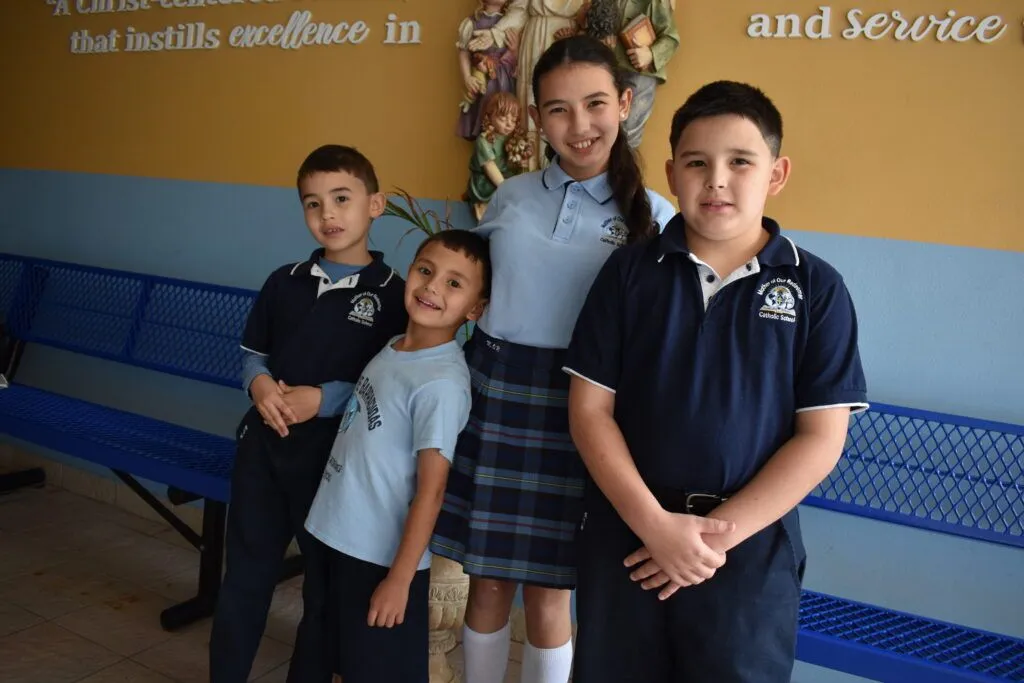
The Ivins children, (from left) Lucas, Nicholas, Rebekah and Joseph, are flourishing academically.
MIRAMAR, Fla. – William Ivins moved his family to South Florida ahead of his retirement from the United States Marine Corps and enrolled his children at Mother of Our Redeemer Catholic School, hoping they would reap the same rewards as he did from a faith-based education.
But, as William and his wife, Claudia, would soon learn, that was easier said than done.
A lawyer for much of his 20-year career in the Marines, William needed to pass the Florida Bar Exam before he could enter the private sector. It was a long process that left him unemployed for 19 months.
“It was a struggle,” he said. “My retirement income was not enough to pay for the cost of living and tuition for my children.”
William and his wife Claudia faced a few choices: continue with the financial struggle, homeschool their children, send them to their district school, or move out of state. None were appealing to the Ivins, and fortunately, they didn’t have to act on any.
The Florida Tax Credit Scholarship made possible by corporate donations to Step Up For Students allows his four children to attend Mother of Our Redeemer, a private K-8 Catholic school near the family’s Miramar home.
“It was a perfect storm of having to retire from the Marines and not really having a job lined up,” William said. “The transition was more difficult than I thought it would be. The income just was not available for us to continue our kids’ education in the way we wanted. Had the scholarship not been there, we would have been forced to move out of state or homeschool them or move them to (their district) school.”
In July 2020, the Ivins moved to South Florida from Jacksonville, N.C., where William had been stationed at Camp Lejeune. William contacted Denise Torres, the registrar and ESE coordinator at Mother of Redeemer, before making the move. She told William the school would hold spaces for his children. She later told him about the education choice scholarships managed by Step Up For Students.
“That was a big relief for him,” Torres said.
At his mother’s urging, William began attending Catholic school in high school.
“That was a life-changer for me,” he said.
He converted to Catholicism and vowed if he ever had children, he would send them to Catholic school for the religious and academic benefits.
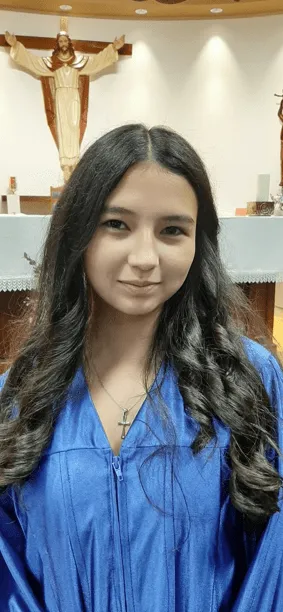 Rebekah graduated in May from Mother of Our Redeemer. She had been an honor roll student since she stepped on campus three years ago.
“Rebekah likes to be challenged in school, and she was challenged here,” Claudia said.
Rebekah, who received the High Achieving Student Award in April 2022 at Step Up’s annual Rising Stars Awards event, is in the excelsior honors program as a freshman at Archbishop McCarthy High School.
“She's an amazing, amazing student,” Torres said. “It’s incredible the way she takes care of her brothers. She's very nurturing. Every single teacher has something positive to say about her.”
Rebekah’s brothers, Joseph (sixth grade) and Lucas (third grade), do well academically and are active in Mother of Redeemer’s sports scene, running cross-country and track. Nicholas, the youngest of the Ivins children, is in first grade. He was allowed to run with the cross-country team while in kindergarten, which helped build his confidence.
William had been in the Marines for 20 years, eight months. He served as a judge advocate and was deployed to Kuwait in 2003 for Operation Iraqi Freedom, to Japan in 2004, and then to Afghanistan in 2012 for Operation Enduring Freedom.
He retired in May 2021 but didn’t find employment until December 2022. The Florida Bar Exam is considered one of the more challenging bar exams in the United States. He took the exam in July 2021 and didn’t learn he passed until September. It took William more than a year before he landed a position with a small law firm in Pembrook Pines.
Claudia, who has a background in finance, works in that department at Mother of Our Redeemer Catholic Church, located next to the school.
“They have really become part of our community,” principal Ana Casariego said. “The parents are very involved and are big supporters of our school and church.”
In Mother of Our Redeemer Catholic School and Church, Willian and Claudia found the educational and faith setting they wanted for their children.
“It is a small community environment where you know all the teachers and staff by first name,” William said. “My kids have received a wonderful education in an environment where they don’t have to worry about bullying, and they can really strive to grow and do their best academically.
“The scholarship kept us in the state and kept our kids in the school system that we wanted them to be in. It’s been a great blessing to us.”
Education choice critics often assert that allowing families to choose the best learning environments for their children undermines our civic culture. They say our democracy is strengthened when children are required to attend public common schools.
The idea of public common schools originated in the early-to-mid 1800s in response to increased emigration from Europe. A surge of Irish immigration into Massachusetts led that state’s Protestant-dominated government to create the nation’s first mandatory school attendance law in 1852. Horace Mann, Massachusetts’ first secretary of education, led the campaign to teach Irish Catholic children how to be good Protestants in government-run common schools.
The Catholic community in Massachusetts and elsewhere rebelled against the Protestants’ public common schools and began creating Catholic schools. This ongoing conflict came to a head in Oregon in 1922 when the state amended its constitution to require all children to attend public (i.e., Protestant) common schools. The Ku Klux Klan (KKK) helped lead the effort to pass this amendment.
 An order of Catholic nuns sued to prevent their Catholic school from being closed and prevailed in a 1925 U.S. Supreme Court decision, Pierce v. Society of Sisters. This decision ended the public common schools movement as envisioned by Mann, the KKK, and others, but the common school myth endures.
Education choice opponents regularly assert that returning to the days of most children attending public common schools is the best way to improve our polarized civic culture. But those days never existed. Most U.S. children have never attended public common schools. For most of our history, Black and white children attended racially segregated schools. My high school was racially segregated until my junior year (1971-72), which is about 140 years after Mann helped launch the common schools movement. Neighborhood attendance zones cause public schools to be segregated by family income. Public magnet schools separate students by interests and aptitude, and academic tracking within schools segregates students by academic achievement levels.
The non-existence of mythical public common schools does not refute the criticism that education choice programs undermine our civic culture. Fortunately, a growing body of research does refute this criticism and suggests education choice programs help improve our civic culture.
Patrick Wolf is a distinguished professor at the University of Arkansas’ College of Education and Health Professions. Wolf and his research team recently reviewed 57 studies that examined the relationship between private school choice and the quality of civic engagement. These studies consistently showed that participating in private school choice is associated with higher levels of political tolerance, political knowledge, and community engagement. Wolf concluded that, “Private schooling is a boost, not a bane, to the vibrancy of our democratic republic. The benefits of private schooling in boosting political tolerance are especially vital, as we need to be able to disagree with others without being disagreeable.”
Charles Glenn is professor emeritus of educational leadership and policy studies at Boston University’s Wheelock College of Education & Human Development. Glenn conducted research that helps explain Wolf’s findings.
Glenn examined the role Islamic schools play in helping Muslim immigrant children assimilate into the U.S. culture. He found these children assimilated much better when they attended Islamic schools that help them maintain their religious and cultural identity while successfully adapting to American values and norms. Glenn concluded that these schools helped students develop a sense of belonging in both their cultural community and the wider U.S. community by focusing on cultural preservation and adaptation. This dual focus was apparently crucial to helping these Muslim children successfully integrate into U.S. society.
Glenn’s findings are similar to what we see students experiencing in the education choice programs Step Up For Students manages. Most of the students we have served over the past 23 years have come from lower-income and minority families. When we poll these families as to why they are participating in our programs, the top answer is always safety.
All people, but especially children, have a basic need to be physically and psychologically safe. Children who do not feel safe in school go into fight or flight mode, which shows up as them refusing to go to school or going to school and constantly getting into trouble.
Parents regularly report amazing transformations in their child’s behavior when they use education choice scholarships to enroll their troubled child in a school where this child feels safe. While parents often see these changes as miraculous, these improvements reflect normal human psychology. Most people’s behavior is better when they feel safe and secure.
This need for safety and security while participating in public education is why education choice programs help improve our civic culture. As Glenn’s research shows, education choice programs help families find environments in which their children learn to feel secure about who they are and learn to use this security as the basis to interact appropriately with those who are different from them.
Much of the polarization and hostility we see in our civic culture stems from people feeling unsafe and insecure. The immigrant Muslim children Glenn studied learned to feel secure about themselves and their native culture in private Islamic schools and used this security as the basis to interact successfully with our diverse society. They became secure and confident and saw cultural differences as opportunities to learn and grow, not as threats.
The evidence suggests that the choice critics are wrong. Education freedom does not contribute to unhealthy social discourse. When done well, it is part of the solution.
RIVERVIEW – Rosa Salom Garcia’s car was reinforced to withstand bullets because the threat of being kidnapped was a part of everyday life in Venezuela.
She was a leading eye surgeon in her native Caracas with a practice spread over multiple locations in the city. Her daughter, Maria Castillo Salom, attended private school.
Life was great until it wasn’t.
Until the political climate became volatile in the mid-2010s, with the government confiscating some of Rosa’s offices. Until kidnappings of citizens who could pay huge ransoms were commonplace. Rosa feared for her safety as well as Maria’s.
“All I wanted to do in life I did,” Rosa said. “My life became Maria’s life.”

So, in the summer of 2017, mother and daughter moved to Riverview, east of Tampa. Rosa gave up her medical practice and left her family for a safer, better future for Maria.
“She never said, ‘I did this all for you,’ but I knew,” Maria said. “I knew all the sacrifices she had made. She left her whole life behind, and my main goal was to make her proud.”
Maria, who arrived in time for the seventh grade, continued her private school education with the help of a Florida Tax Credit Scholarship, which is funded by corporate donations to Step Up For Students.
Maria finished elementary school at nearby St. Stephens Catholic School, then attended Tampa Catholic High School, where she graduated in 2023 third in her class with a 4.0 GPA and an appointment to the U.S. Naval Academy in Annapolis, Maryland.
“We’re forever grateful for Step Up,” said Gabriel Casas Diaz, Rosa’s husband and Maria’s stepfather. “Without Step Up’s help, Maria won’t be where she is right now.”
That first year at St. Stephens was not easy for Maria, now 20. An honor roll student in Caracas, Maria had little trouble in science and math, because two plus two equals four in any language. But her English was limited, and she struggled with American History. The smaller classes at her new school provided the right educational setting, because teachers could take the time to work with Maria. They knew she was a bright student, and they were determined to help her succeed.
They explained assignments during class and tutored her afterwards.
“I had teachers who were truly devoted to me,” Maria said. “Honestly, I took up a lot of their time.”
Attending a Catholic school in her new home offered some much-needed familiarity with her faith as she adjusted to the move to a new country.
“It was really good to be connected to my faith,” she said. “It was a difficult move. My father is still in Venezuela. So is my extended family.”
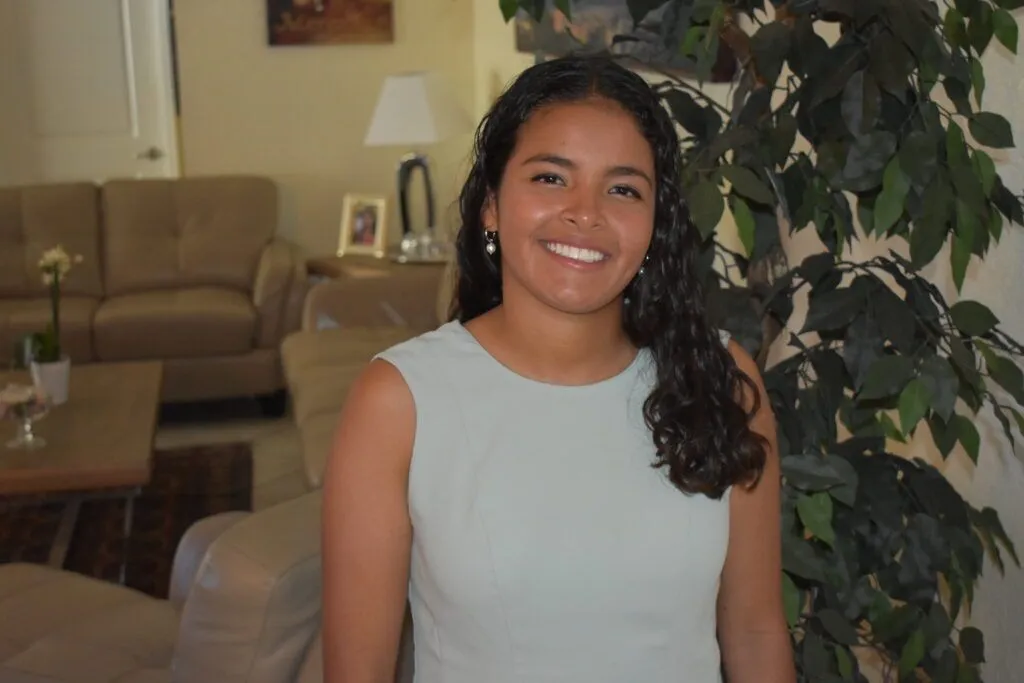
n the eighth grade, Maria wrote an essay about the life she left behind. She didn’t leave anything out. She wrote about the violence, the poverty, the never-ending fear for her family’s safety. The essay was for a contest where the winner received a $10,000 scholarship toward high school. Maria finished second.
But her essay was forwarded to the administration at Tampa Catholic. Maria was asked to apply and was accepted. The essay earned her a Mary Neary Scholarship from her new school. That coupled with a scholarship from the Diocese of St. Petersburg for her grades and the FTC scholarship enabled Rosa to afford Tampa Catholic.
“I am eternally grateful for the (Florida Tax Credit) scholarship, for allowing me to make it through,” Maria said.
Maria found the teachers at Tampa Catholic as helpful and encouraging as those at St. Stephens. It wasn’t long before she was taking AP classes. She studied French and became president of the French National Honor Society. She took six math classes and continued her education during the summer though Florida Virtual School.
She recorded more than 200 community service hours from volunteering at Feeding Tampa Bay and the Humane Society of Tampa Bay. She played three years of soccer, stopping as a senior only because her courseload was too demanding.
When asked during her junior year by Tampa Catholic’s college counselor about her college plans, Maria answered with the three words: The Naval Academy.
Somewhat stunned, the counselor suggested the University of Notre Dame as a safe school, where she could join its Navy ROTC. But Maria had her eyes set on the Naval Academy, which could lead to a career in the Marines or the FBI.
Gabriel retired after nearly 29 years as a Marine, and Maria likes the camaraderie he has with fellow Marines, those he’s known for a long time and those he just met. It’s “Oorah” and an instant bond.

Maria, who became a U.S. citizen in 2020 along with Rosa, received the acceptance email from the Academy on March 31 of her senior year. She already had been accepted to Notre Dame and the University of Florida.
She had just finished taking an AP biology exam when she noticed the email alert on her Apple Watch. She was excused from class and called her mom with the news. They both cried.
“My mother, she’s my role model,” Maria said. “I had to make her sacrifice worth it.”
Rosa has changed careers since moving to the United States. She earned a liberal arts degree at Hillsborough Community College and is a certified mental health counselor, working with immigrants.
“I really appreciate all that this country made for Maria, for us in general,” Rosa said. “She has a great opportunity. Maria’s future would be different if she remained in Venezuela. Totally different worlds.”
Maria loves her new world.
“I feel like the United States opened its heart and to us and I've just been so grateful,” she said. “It certainly is amazing. I don't think it could be a better place in the world, and that's kind of the reason I'm serving the country, to show I’m so grateful to it.”

The story: A federal judge’s ruling means that Maine can continue to bar religious schools from a state school choice program, despite a 2022 U.S. Supreme Court ruling that struck down an outright ban.
Setting the stage: As the U.S. Supreme Court weighed the landmark Carson v. Makin, Maine extended its anti-discrimination law to private schools participating in its town tuition program.
The other Makin case: A Catholic school and a rural family sued, arguing the law forces religious schools to set aside their beliefs if they want to access public tuition subsidies. That, they contend, conflicts with the 2022 Carson ruling, which cleared the way for public funding of religious private schools.
U.S. District Judge U.S. John Woodcock Jr. denied the plaintiffs’ request for a preliminary injunction, saying the case was unlikely to succeed. However, his ruling said he expects a higher court to have the final say.
“The plaintiffs are free to practice their religion, including the teaching of their religion as they see fit, but cannot require the state to subsidize their religious teachings if they conflict with state anti-discrimination law,” Woodcock wrote in a 75-page ruling.
Why it matters: The case, St. Dominic v. Makin, along with a similar lawsuit filed by other Maine families, raises a key question that echoes other education choice cases: Can states require religious schools to adopt policies that conflict with their beliefs to accept public money?
Yes, but: A 2020 U.S. Supreme Court ruling said teachers at religious schools are not covered by federal employment discrimination laws if their roles are “ministerial.” Whether that line of reasoning could play a role in Maine and Oklahoma has yet to be determined.
Catch up quick: Maine is one of a handful of northeastern states that allows students in areas without public high schools to receive “town tuition” funds to attend nearby private schools. Maine banned religious schools from participating in 1982 after including them for nearly a century. Three families sued the state in 2018 on the grounds of religious discrimination, resulting in the 6-3 Carson decision.
Adèle Keim, senior counsel at Becket Law, representing St. Dominic Academy and a Catholic family, accused the state of making an end run around Carson. She also said the state allows out-of-state schools to participate and admits it does not police their policies. “St. Dominic is just asking for the same treatment Maine already gives to other private schools."
The state’s response: The state attorney general did not comment on the federal judge’s ruling. However, in a statement shortly after the Carson ruling, he said he was “terribly disappointed and disheartened” by the decision and called the education offered by certain religious schools “inimical to public education.”
To be continued: The plaintiffs have already appealed to the First Circuit Court of Appeals in Boston.

Carlos Lamoutte organized a concert that raised $18,000 for the Victor Pena '16 Annual Financial Aid Scholarship to Tampa Jesuit Catholic High School.
TAMPA – The night ended with a set of Latin music, one of Victor Peña’s favorites, and everyone inside the theater on the campus of Jesuit High School was standing and moving something – arms, legs, hips.
It was the final set of a two-hour concert to raise money for a scholarship to honor Victor, Jesuit Class of 2016, who died along with a close friend, Sean Shearman, in a car accident in Tallahassee in October 2020.
Carlos Lamoutte was the bandleader and ringleader. He’s Jesuit Class of ’25. He attends the private, all-male, Catholic high school in Tampa with the help of Florida’s Family Empowerment Scholarship for Educational Options (FES-EO), managed by Step Up For Students.
His family and the Peña family are close. They attend the same Catholic church near their homes – the Peñas in Brandon and the Lamouttes in Plant City. The children attended the same Catholic elementary school. They’ve vacationed together. Spent days together at the beach.
The scholarship to honor Victor’s memory was Carlos’ idea.
“I can’t imagine who I would be without Jesuit,” Carlos said. “They truly are shaping me into becoming the man I am, and the same exact experience I’m having, I want for others to have, and I know how expensive it is for some families to send their sons here.”
The Victor Pena ’16 Benefit Concert raised $18,000, which will go toward the Victor Pena '16 Annual Financial Aid Scholarship to Jesuit.
“As Victor’s parents, we are super pleased at this beautiful gesture of the school and Carlito, because if it wasn't for his spark, and his idea and his organizing, pushing and making the case to school administration officials, it never would have happened,” Victor Peña Sr., said. “He was the linchpin.”
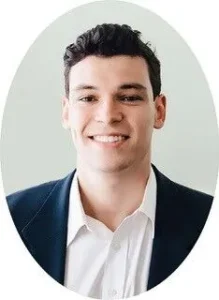
Victor Peña, Jesuit Class of '16
Carlos, 17, is a talented musician who plays the guitar and piano. He’s also the lead singer of his rock band, The Jesuit Boys, which he formed two years ago with some classmates. They play at Catholic events around Tampa.
Victor was a close friend of Caroline Lamoutte, Carlos’ older sister who is now in medical school at the University of Florida. Carlos saw Victor as an older brother.
“He had a huge, positive impact on my life,” Carlos said. “There is this heaviness in my heart.”
Since Victor’s passing, Carlos had wanted to honor him in some way. It was this past December while having dinner with his parents – Ana and Carlos – that Ana mentioned his music.
“My Mom said, ‘You have this talent, and the Lord has asked you to use this gift for something great because this gift wasn't given to you just to have fun. It is to make an impact on the world,’ ” Carlos said. “So, I thought, ‘Well, shoot. I've always wanted to do something for Victor. This could be it. I can raise money in his name.’ ”
“The light bulb went on,” Ana said, “and from that point on, he was nonstop.”
The Rev. Richard C. Hermes, S.J., president of Jesuit High, didn’t hesitate to say yes when Carlos approached him with the idea of a benefit concert. With guidance from Nick Suszynski, Jesuit’s director of development, and help from other members of the Jesuit staff and a few alumni, Carlos put together a silent auction, food, and musicians for the event.
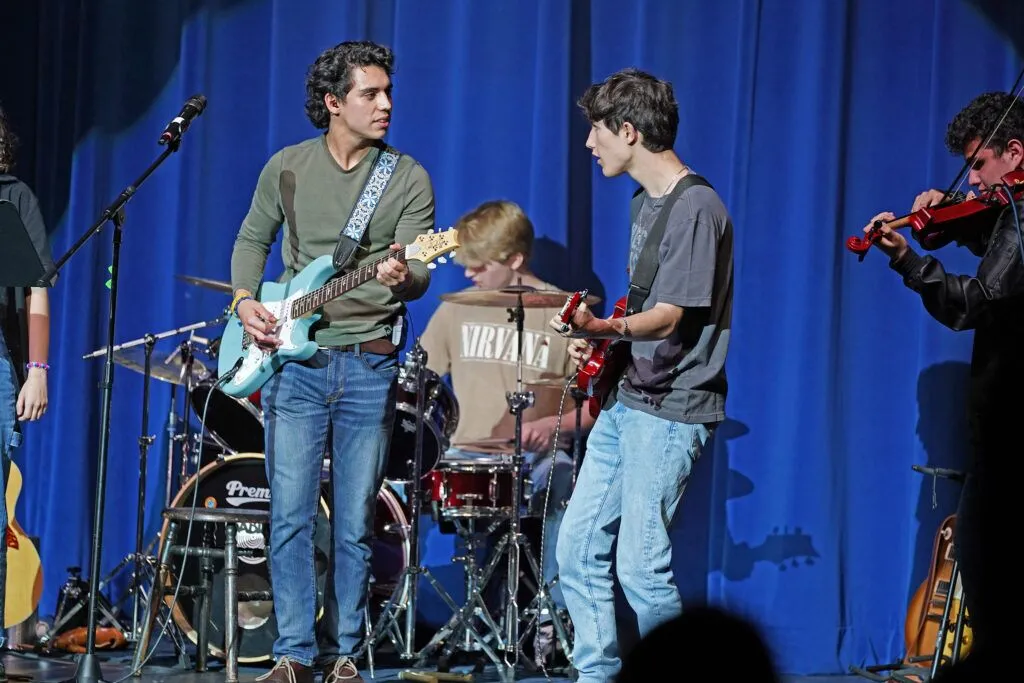
Carlos and his rock band play their set during the The Victor Pena ’16 Benefit Concert. (Photo courtesy of Jesuit High.)
The crowd of 200 that gathered at the Antinori Center for the Arts included members of the Peña family from Georgia and Miami and former classmates of Victor’s from as far back as grade school. Victor’s brother, Gabriel (Jesuit class of ’17), was the emcee. His sister, Angie, read a poem.
At one point, Lidia Peña, Victor’s mom, joined the band on stage and played a duet of several Cuban dances on the piano with her sister, Lisette Garcia.
“It was right,” Ana said. “It was music. It was dancing. It was food. It was Victor.”
“Victor was definitely there,” said his father. “Victor was a fun-loving guy. He just loved to have fun. We believe in an afterlife, so we really feel that he was a happy camper that night.”
Victor’s family and friends remember him for his larger-than-life personality, his levelheadedness, his strong Catholic faith, his smarts, his ability to bring friends and family together, and his high energy, which everyone agrees was contagious.
Family and friends say the same thing about Carlos.
“I see Victor every time I interact with Carlito,” Victor Sr. said.
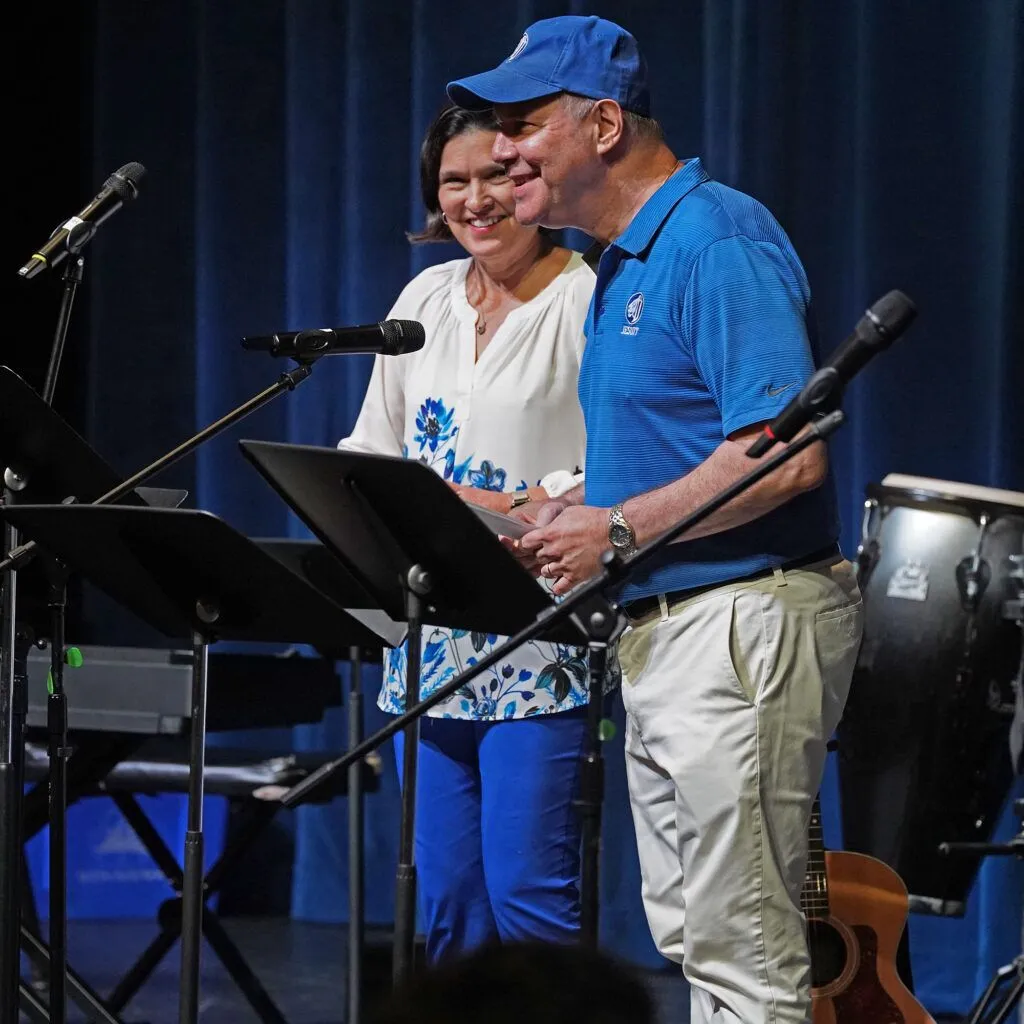
Lidia and Victor Peña thank those who attended the benefit concert in memory of their son, Victor. (Photo courtesy of Jesuit High.)
Carlos is an honor roll student who is interested in a music career. He’d like to attend Vanderbilt University in Nashville and major in finance or economics with a double major in music business.
Though he is a natural at leading a band on stage and interacting with the audience, organizing the benefit concert has led him to think his future might be on that side of the business -- marketing and promotion. Also, working with Suszynski on the concert provided an introduction to the world of fundraising.
“Maybe creating a nonprofit would be something that I'd like to do,” Carlos said. “This has been a super cool experience in that perspective, as well.”
And there is always the medical profession. His other sister, Lauren, is in dental school at the University of Florida.
“Having the (FES-EO) scholarship is a huge blessing,” Carlos said. “With a sister in medical school, a sister in dental school, and me at a private school, my parents didn’t know how they were going to make ends meet. The scholarship came along and it has helped. It’s been such a blessing in my own life.”
Carlos plans to visit Vanderbilt this summer during a trip to Nashville. He knows his senior year will pass quickly, and it will include the big decision of where to go to college and what to study.
He also knows his senior year will include another Victor Pena ’16 Benefit Concert to raise more money for the scholarship fund. In fact, it’s Carlos’ plan that the concert became a yearly staple on the Jesuit social scene, whether he’s involved or not.
“It felt amazing to know that we were all in it together,” Carlos said. “The school wanted to help. The people in the audience wanted to help. And we were making a huge impact to honor Victor and for all these future kids who are going to come to Jesuit in need of financial aid.”

Sebastian (left) and Alejandro have combined to win more than 60 awards for directing and graphics while working for the Christopher Columbus (High) News Network.
Originally, all Raymond Rodriguez-Torres was expecting was a public service announcement honoring his late daughter.
He – and his daughter’s memory – received more. Much more.
Rodriguez-Torres hoped the multi-media club at Christopher Columbus High School in Miami, his alma mater, could produce a PSA about Live Like Bella, the nonprofit that battles childhood cancer in honor of his daughter Bella, who died in 2013 when she was 10.
Omar Delgado, the teacher who oversees the club at Christopher Columbus, thought Bella’s story warranted more.
“I said, ‘This is a documentary, and I have the perfect guy to do it,’” Delgado said.
That would be Sebastian Broche, who recently graduated from the private Catholic high school after attending on Florida’s Family Empowerment Scholarship for Equal Opportunities (FES-EO) managed by Step Up For Students.
Sebastian led a team of 18 Columbus students that included his brother Alejandro and produced a moving 30-minute documentary. The project earned Sebastian a Suncoast Student Production Award (SSPA) from the National Academy of Television Arts & Sciences for best director and an SSPA for Alejandro for best graphics.
It was also named the best documentary in the nation by Student Television Network.
It is expected to be released on Amazon Prime Video.
“What they put together is beyond what we could have ever been able to conceive, which was telling Bella’s story in the appropriate way. I think it was extremely touching,” Rodriguez-Torres said. “I’m so proud of these kids. It’s difficult for me to put it into words.”
“Live Like Bella” tells Bella’s story from when she was first diagnosed with Stage Four Alveolar Rhabdomyosarcoma, through her six-year fight and ends with her legacy, which is a nonprofit that has raised more than $37 million and provided more than $6.5 million in financial support for families in 49 states and 37 countries since its inception in 2013.
There are interviews with Bella’s family and doctors, videos and pictures of Bella, a clip of LeBron James and Dwayne Wade of the Miami Heat, who wrote #LiveLikeBella on their sneakers during the 2013 NBA Eastern Conference Finals, and pictures of Bella that turned into sketches through the magic of editing. The documentary received a standing ovation from the overflow crowd at the Miracle Theater in Coral Cables after its premiere in March.
“It’s pretty powerful,” Sebastian said. “And that was the goal.”
***
Sebastian and Alejandro, who has attention deficit disorder (ADD) and attends Columbus on a Family Empowerment Scholarship for Students with Unique Abilities (FES-UA), are Miami natives but lived most of their lives in Costa Rica. The boys returned to Florida during their middle school years. By then, their parents had divorced and their dad, Alejandro Sr., had moved to Miami. He wanted Sebastian to attend Columbus. Their mom, Aimée Uriarte, agreed and moved with the boys to Miami.
The FES-EO made attending the private Catholic high school affordable.

Aimée flanked by her talented sons during the "Live Like Bella" premier.
Two years later, Aimée Uriarte wanted the same high-level academic opportunity for the youngest of her two sons, knowing that’s what Alejandro needed to develop his talents and self-confidence. As a single mother, Aimée was able to achieve that with the FES-UA scholarship.
“I think every family deserves the scholarships, regardless of income or their child’s conditions,” said Aimée Uriarte, the boys’ mother. “I think the whole country should emulate Florida.”
Sebastian admitted that the all-male student body, the strict dress code, and the challenging classes at Columbus took some getting used to.
“God works in mysterious ways,” he said. “The fact that I ended up here is probably one of my biggest blessings. It was definitely the school for me. I feel it has given me so many opportunities. It was something that I didn't know I needed at the time, but now looking back, I can’t see myself going anywhere else.
“They make you a man and a man of principles, especially.”
Sebastian will attend Santa Fe College in Gainesville in the fall with the goal of transferring across town to the University of Florida, where he plans on majoring in journalism. His goal is to own a digital media company.
That’s a different career than what he expected when he entered Columbus as a freshman. Back then, Sebastian was interested in art and architecture. But a friend suggested he join Christopher Columbus News Network (CCNN), the student-run broadcast news program. Sebastian did and soon realized his talents included directing and producing programs and videos.
“I found out I was better at broadcasting than drawing,” he said.
Alejandro, 16, followed his brother to Columbus and joined CCNN, as well.
“I think they were both just trying to find their way and they were able to tap into a side of themselves they didn’t know they had,” Delgado said. “As a teacher that's what you want to see. You want to see kids reach their full potential, and I really think that Sebastian and Ale are doing that.”
Alejandro’s plan is to attend Florida State University and pursue a career in film.
“Getting to see the level of national recognitions and not only academic, but also the human quality of teachers and mentors that Sebas and Ale have had access to at Columbus, is something I never imagined in my wildest dreams. Never” Aimée said. “I’m simply in awe and beyond proud of the men my sons are becoming.”
The brothers have combined to win more than 60 awards for directing and graphics. Sebastian earned a $4,500 per semester scholarship from the National Academy of Television Arts & Sciences, received a $7,500 grant from Media for Minorities, and received the Mike Wallace Memorial Scholarship, worth $10,000, funded by CBS News.
***
Raymond Rodriguez-Torres and his wife, Shannah, were approached by several groups, including Netflix, about a documentary on Bella after the clips aired of NBA superstars paying tribute to their daughter. But the couple was uncomfortable with strangers coming to the house and taking videos of Bella’s bedroom.
Rodriguez-Torres is a 1994 graduate of Columbus and was a part of CCNN during its early years. The network of Columbus alumni in South Florida is very tight. It threw its support behind Bella’s fight against cancer and later behind the nonprofit. Word spread through the alumni circle and Rodriguez-Torres found himself meeting with school officials interested in working on his original plan of a PSA. Eventually, he met with Delgado, and Delgado sold him on his vision of a documentary produced by CCNN.
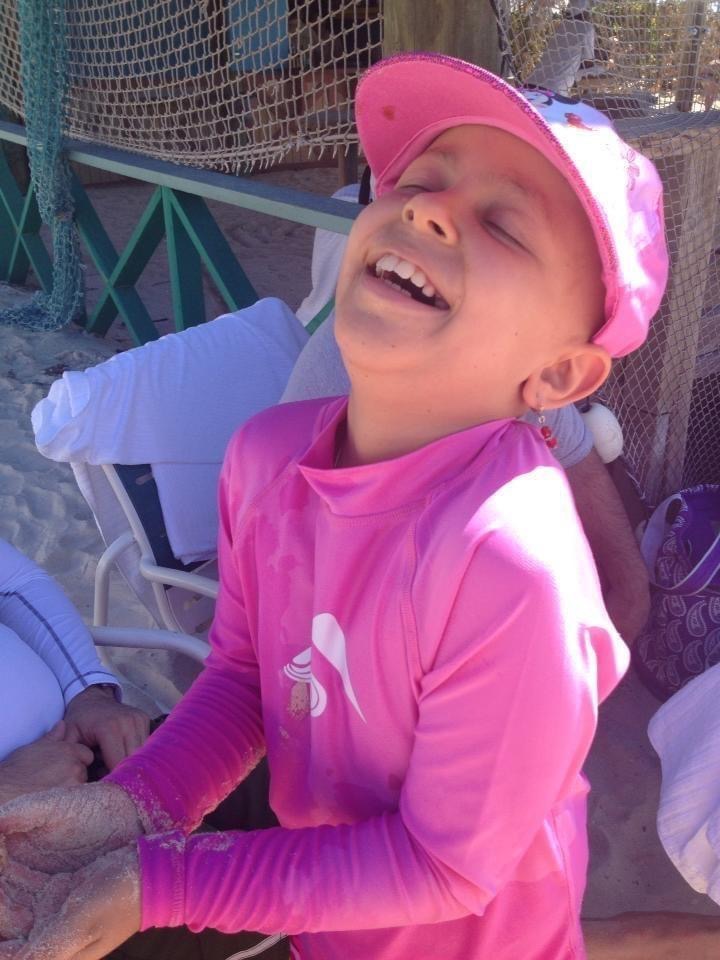
The Live Like Bella foundation has raised more than more than $37 million to fight childhood cancer.
“I knew we had one shot at this,” Rodriguez-Torres said. “Ultimately, I said, ‘This is the way God and Bella wanted it. They want a bunch of high school kids doing something nobody expects.’ Little did I know what was coming.”
Delgado did. Sebastian was the producer and editor. He made the storyboards and came up with the questions to be asked during the interviews. Alejandro worked on graphics and animation.
“He’s a really creative kid,” Sebastian said of his brother. “He’s a lot more creative than I am. Give him a camera and give him an idea, and that kid will blow your mind.”
Sebastian learned of Bella’s powerful story during a meeting with Shannah and Raymond Rodriguez-Torres. Sebastian, who already produced two documentaries for CCNN, knew it would be his biggest challenge. But he said he wasn’t intimidated.
“I knew how strong of a story it was,” Sebastian said, “and during the whole meeting I was thinking, ‘OK, here’s how I want to tell it.’ ”
Nearly six months later, the documentary was ready. Nearly everyone who saw the finished product was amazed that it was produced by a high school senior directing a team of fellow classmates.
Nearly everyone, because Delgado was not amazed.
“Sebastian impresses me every single day,” Delgado said. “To see who he has become in the last four years is something that I am eternally proud and grateful for.
“But to tell you I was surprised, I wish I could because I missed that feeling of being surprised by Sebastian. I don't have it anymore because it’s something I expect from him, because he's such an amazing human being and he just keeps on producing.”
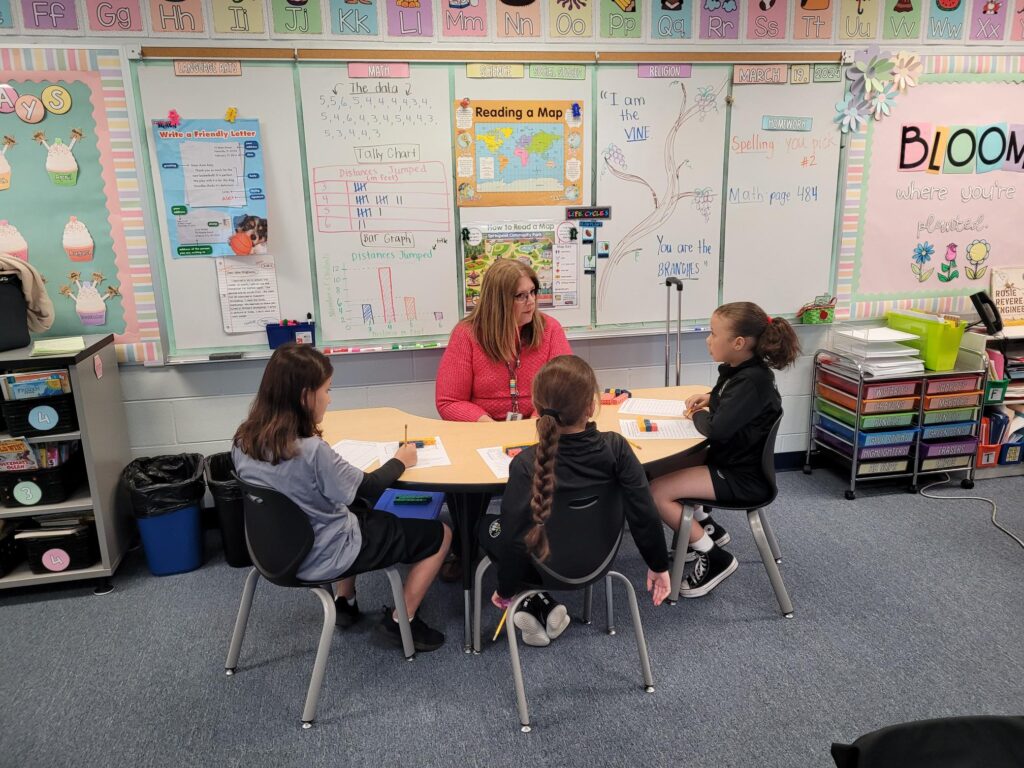
Amy Galloway provides targeted math support to three students as part of Holy Family Catholic School's D.E.N.S. program. D.E.N.S. stands for Differentiation, Enrichment and Needed Support.
JACKSONVILLE, Florida - Math class at Holy Family Catholic School begins with two polls, one in which students share their snack preferences and the other in which they name their favorite animals.
Second-grade teacher Alicia Revels divides the room into two groups of students and assigns each a survey to give the class. The two groups count the votes.
Revels writes the results on the whiteboard. In the snack poll, cookies edged out popcorn six to five, while only one student chose chips. In the animal group, tigers received the most love with six votes. Monkeys got four, while two students preferred elephants.
Revels’ goal when she designed the lesson: teach students how to display and interpret data. “I love it when students can have input when it comes to data, so it makes it more relevant to them,” she said.
After the fun, Revels asks the students to design a bar graph for their poll results and create related equations.
As the students begin work, three girls who were in the animals group break away and head to a small table at the right side of the classroom. Amy Galloway hands each student two worksheets and connecting blocks in red, blue and yellow.
“What do you put first in a bar graph?” Galloway asks. After creating the graph with the blocks, they draw and color it with markers on a graph sheet. They then fill in the numbers 0 through 10 in the left column and the names of each animal in the columns along the bottom row.
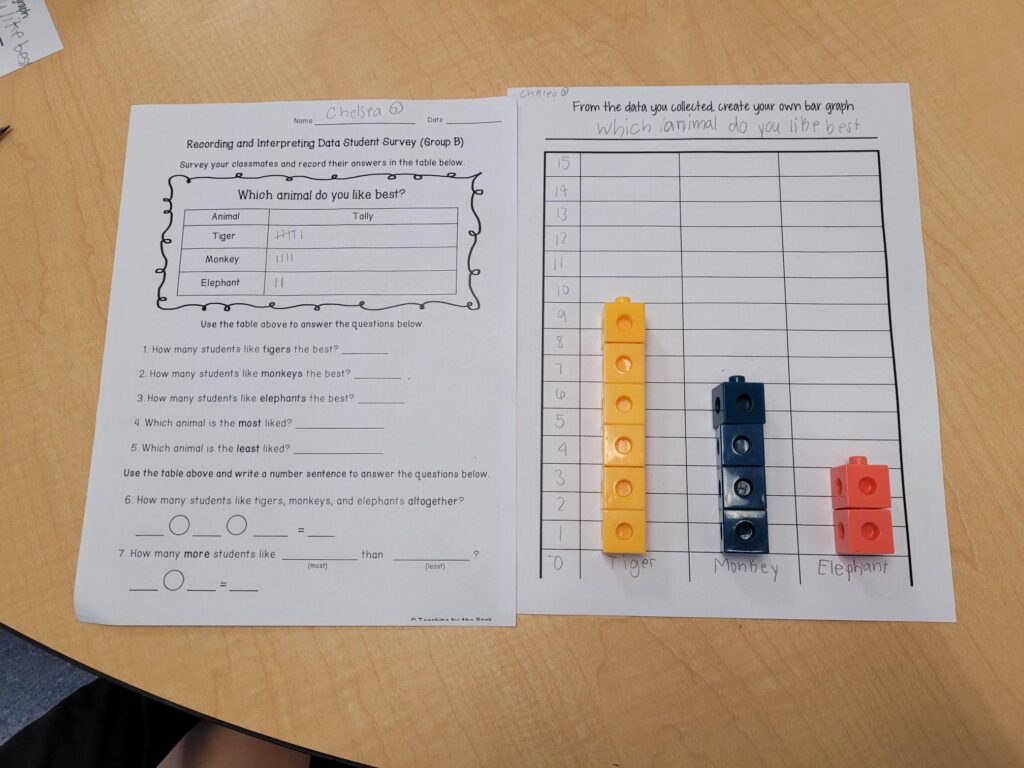
After a math lesson, D.E.N.S. students use these colored blocks to create bar graphs to help them interpret data.
Though the casual observer might not notice, the three students are receiving stealth tutoring. It’s one example of Holy Family’s Differentiation, Enrichment and Needed Support or D.E.N.S. program in action.
It's also another example of how Florida Catholic schools are increasingly trying new approaches to better meet the needs of more diverse students and fuel their growth in the Sunshine State.
“D.E.N.S started as a way to give teachers additional support and create smaller groups in the class to meet student needs,” explained assistant principal Amanda Robison.
The program also includes enrichment for students identified as high achievers to dig deep into non-academic subjects, including religious education. Down the hall from Revels’ class, a small group of third graders in the enrichment program makes small tombs with paper plates and pebbles to expand the lessons taught during the Christian holy week. About 30 to 40 students participate in the enrichment component. A third part of the program, led by the school guidance counselor, offers help dealing with life events and is open to all the K-8 school’s 408 students.
Robison, who joined the staff in August as part of a new administrative team, worked to revitalize the program, which had been scaled back during the pandemic.
Her background in special education and educational leadership helped her transform the program to zero in on specific learning needs and support students who needed targeted help.
The staff started analyzing test scores to see which students were below grade level in certain areas, for example, phonics or math.
The students take the Renaissance Star reading and math assessment for progress monitoring quarterly throughout the school year. This is used for determining which students may need intervention or enrichment. Educators use the results to determine which students have mastered a specific skill on the Florida math standards, such as "Add or subtract multi-digit numbers including using a standard algorithm with procedural fluency."
Those who have fallen behind are assigned to D.E.N.S. for extra help to get them back on track in those specific areas. Students who are in D.E.N.S. take the assessments every six to eight weeks to measure progress and determine whether intervention is still necessary.
The school also uses iXL, a website that delivers personalized learning and diagnostic tests, to verify Star scores and help ensure students get the intervention that best meets their needs. Teachers also use iXL lessons as practice exercises following an in-class lesson.
One advantage of D.E.N.S. is that it infuses differentiated support and enrichment into the school day, so families’ before or after-school schedules are not disrupted. The learning support teachers “push in” to the regular classroom and work with the smaller group at the same time their classmates are learning the same lesson. It also makes receiving extra support seem routine and discourages labeling.
Sessions last for six to eight weeks, and students leave D.E.N.S. when the data show they have mastered the targeted skills. For those who require additional help, temporary pullout programs and one-on-one instruction are also provided.
“It’s really beautiful because the students aren’t having to live in this intervention world,” Robison said. “They are visiting it.”
School data shows the program is working. Of those receiving help in reading, 93% have made progress, and 85% percent getting help have progressed in math. Robison said the program had delivered 100 services in the prior week, though not necessarily to 100 students as some receive multiple services.
The program also benefits more than just those students receiving help by allowing teachers to instruct a diverse group of students while allowing those who don’t need extra support to move forward.
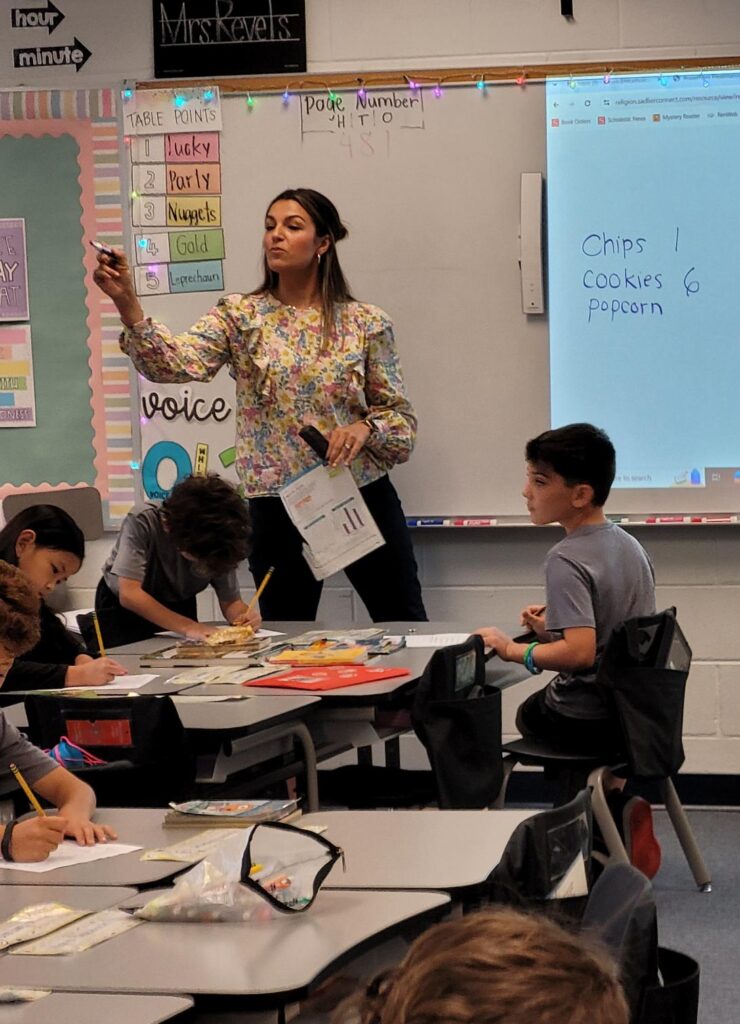
D.E.N.S. allows classroom teachers like Alicia Revels to educate a diverse group of students by offering support to those who need it so she can continue to focus on the rest of the class.
“When my team goes in and works with this targeted group, it gives the teachers in the class the ability to really focus on what the other students need,” Robison said. “It’s really meant to keep the pace of the class instruction continuous and high-achieving and make sure education is getting scaffolded along the way to ensure nobody is left behind.”
After the three D.E.N.S. students finish their math graphs, they grab their electronic tablets and seamlessly rejoin the rest of the class, where all the students are taking their diagnostic tests to measure their skills. An algorithm targets areas are each student needs more practice. It also acts as a D.E.N.S. screener. If some areas stand out as off track, teachers can offer extra practice and do further testing to see if they could benefit from D.E.N.S.
“We can swoop in,” Robison said. “It’s designed in a way to take the stress off the teachers and not have them have to differentiate among several grade levels in their instruction.”

An attorney defending the Oklahoma’s charter school board wasted no time identifying the primary issue before the Oklahoma Supreme Court.
“This is whether the operation of a charter school violates the establishment clause,” said Philip Sechler, representing the Oklahoma Statewide Virtual Charter School Board.
The board’s approval of St. Isidore of Seville Catholic Virtual Charter School last year catalyzed a controversy in the Sooner State that could pave the way for the nation’s first religiously affiliated charter school. That means the case has national ramifications and could reach the U.S. Supreme Court.
The high court sidestepped the issue when it declined last year to review a 2022 appellate court decision that said charter schools were state actors. Other federal circuits have issued conflicting decisions.
Experts have said Oklahoma Attorney General Gentner Drummond’s lawsuit to stop St. Isidore could bring the issue of public schools operated by religious groups back to the nation’s high court to settle.
On Tuesday, the Oklahoma Supreme Court took center stage for a case that has split the state’s top Republicans and frayed relationships within the diverse national charter school movement.
Drummond argued that St. Isidore is a public school and is subject to the same rules as the state’s other charter schools, which include being non-sectarian and tuition-free for families.
Yet in its application to open a new school, it “promises to be “Catholic in every way, Catholic in teaching and Catholic in employment.” Drummond added that the school requires the principal to be a practicing Catholic, while the state’s public schools cannot limit hires to members of one faith.
The Oklahoma Catholic Church and the state, he said, “have formed an actual union” that “eviscerates the separation of church and state” and violates Oklahoma’s constitution and charter school laws. While the U.S. Supreme Court may very well decide someday that public schools can be religious, the state court is limited in this case to a decision based on state law.
Attorneys for the statewide charter authorizer and for St. Isidore, which is intervening in the case, argued that the state does not control charter schools, as Drummond argued. Charter schools are public schools designed to be run by private organizations given autonomy to foster innovation.
“It has its own facilities, its own bank account, its own ability to raise funds and enter contracts in its own name,” Sechler said. “Being a public school does not make St. Isidore a state actor.”
Sechler also pointed out that charter schools hire their own staff, design their own mission statements and academic programs, and determine their own teaching methods. He added that no student is required to attend charter schools.
He said that operating under a state contract said, “does not make it a part of the government.”
Justices peppered the attorneys with questions throughout the arguments, including why using government funds to pay religious hospitals and allowing state scholarships to be used for religious colleges were constitutional.
When justices asked about the recent trilogy of U.S. Supreme Court decisions that struck down bans on religious schools’ participation in state school choice programs, Drummond said those organizations were private, with funding going to families who could choose where to spend it. Justice Dana Kuehn asked if public religious schools should be allowed as counterweights to secular public schools that “expound [ideologies] outside ABC and 123.”
“Does that open the door for a charter school to have a religious component if the public school has an anti-religious component?” she asked.
Justice Yvonne Kauger expressed concern that a U.S. Supreme Court decision in favor of religious charter schools would open the door to many religious organizations seeking to open publicly funded schools.
“When this all comes down – Katie bar the door – everybody would be affected,” she said. “Are we being used as a test case? It sure looks like it.”
St. Isidore attorney Michael McGinley assured the court that St. Isidore was not intended to be a test case but instead was an effort to meet the needs of families. He said many students in rural areas live too far away from in-person Catholic schools.
The state’s existing school choice scholarships, he added, won’t cover the entire cost of education, leaving low-income families to make up the difference. A charter school would solve that problem.
“Voucher programs are wonderful,” he said, “but they’re not perfect.”

