When Florida lawmakers established the first statewide Charter School Review Commission in 2022.
 The National Association of Charter School Authorizers also weighed in, saying that forcing school districts into sponsorship of schools they didn’t authorize would cause district officials to disengage, weakening charter oversight.
That was before Susie Miller Carello showed up. Before becoming executive director at the newly established Florida Charter Institute, she spent 12 years leading the Charter Schools Institute at SUNY, the largest higher-education authorizer in the country, and earned the moniker “America’s Authorizer.”
Under her leadership, New York choices, quadrupled enrollment, and significantly improved student achievement. By the end of her term, she helped authorize 221 schools that enrolled 120,000 students.
A 2023 study by the Center for Research on Educational Outcomes (CREDO) showed that New York, known for highly acclaimed charter networks such as Success Academy and Uncommon Schools, led the nation in outperforming their district school peers by the largest margins.

Susie Miller Carello, executive director of the Florida Charter Institute
Carello’s job as chief of the Florida Charter Institute is to recommend to the seven-member statewide charter review commission whether to approve a proposed charter’s application or send the founders back to work on a plan that passes muster.
Since this institute began its work in 2023, would-be charter schools have submitted 22 applications. Just two made it to the commission for a vote. One of those was approved by the commission, the other rejected. Those who filed the other 20 withdrew their proposals after hearing Carello’s feedback.
“We’ve been very choosy,” Carello said. “We are committed to being very thorough and investigating the people who want to affect the lives of Florida children and gain access to millions in public funds to make sure they have not only a good design, but also that they have the capacity to put that good design in place.”
Statewide process more than a decade in the making
Efforts to establish a statewide review process that bypasses sometimes hostile local school boards stretch back nearly two decades. In 2008, a state appeals court struck down efforts to create a statewide charter school board like the ones in Massachusetts or Arizona.
In 2022, the Florida Legislature established the Florida Charter Schools Review Commission, with the institute as its administrative arm. The commission reviews applications from charter operators and authorizes them to operate. Once authorized, the local school district becomes the sponsor and supervisor for the charter school and is responsible for monitoring the school’s progress and finances and providing certain services.
The state also has now allowed state colleges and universities to authorize and operate charter schools.
Multiple pathways reduce the chances that school board politics could block a new school. State charter commissions also have specialized staff who evaluate charter schools full time, while school district officials are often burdened with other responsibilities.
The main charge from detractors was that allowing multiple pathways for charter schools would roll out the welcome mat for questionable operations. Two years in, that hasn’t been the case.
A statewide process also allows one-stop shopping for charter networks that seek to open locations in multiple counties instead of forcing them to file separate applications in each school district.
Newberry community rallies to support proposed new charter school
Carello’s and the commissioners’ high standards were on display at their first official meeting last month.
Carello presented two applications. The first came from the Newberry Community School in Alachua County, where a group of parents and teachers narrowly to turn the district elementary school to a charter school.
The Alachua County School Board opposed the application and has since voted to appeal the state Charter Review Commission’s unanimous approval to the state Board of Education.
However, Newberry city officials expressed strong moral and financial support. Former state Rep. Chuck Clemons, who represented the local House district, and other local leaders laid out the school plan, including a $2 million loan from the city and $180,000 in private donations. Teachers and staff would also receive pay raises that matched the district’s as well as the same benefits offered to city employees, including health insurance and a retirement plan. School employees enrolled in the Florida Retirement System would be allowed to remain.
The level of community support impressed commissioners.
“It was awesome to see the partnership that they have with the city of Newberry,” said Commissioner Sara C. Bianca, one of seven commissioners appointed by the state Board of Education in 2023. “The mayor of Newberry and two city commissioners were there, and they were just excited.”
Other Florida cities, like Cape Coral and Pembroke Pines, operate municipal charter networks, but Bianca said the structure of the Newberry partnership “feels unique,” and she’s curious to see if other cities follow suit.
‘Inconsistent and incomplete’
The second application, which commissioners unanimously denied, came from Bradenton Classical Academy, proposed as a Hillsdale College Barney Charter School. While Carello listed the Hillsdale affiliation as a strength, it wasn’t enough to give Bradenton the green light.
The evaluation form, signed by Carello, included concerns about its educational program design, which it said aligned poorly with state standards, and described staffing and budget plans as “inconsistent and incomplete.” The evaluation also cited the safety plan as “lacking in detail” and potentially jeopardizing student safety.
“Collectively, these gaps highlight the need for significant improvements before the school can be deemed operationally and academically viable,” the evaluation said.
Carello explained later that this was the second time Bradenton Classical had applied through the Florida Charter Institute after being denied by the Manatee County School District.
“They were victims of many different versions of the application,” Carello said. When leaders first applied, she said the institute offered advice and sent them back so they could improve the plan and resubmit for a better chance of approval.
She likened the best business plan to a spider web, where every strand is connected. When touched, the web might jiggle but still holds together.
The Bradenton Classical officials resubmitted a plan that didn’t “hang together.”
Though charter applicants must clear a high bar, the institute provides resources and support for a successful outcome. However, Carello never lowers that bar once a school wins approval.
“The charter initiative was to allow people to try out innovations. They got five years to try them out and if they made progress, that was great. And occasionally, there was a school that didn’t, and we closed them down.”
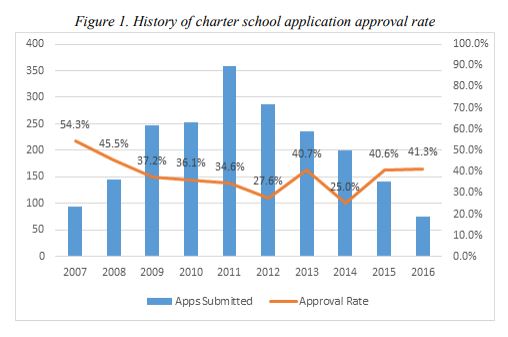
The number of charter school applications have been dropping since 2011.
This summer, the Florida Board of Education overturned the Palm Beach School Board’s rejection of two charter school applications.
And this month the Florida Charter School Appeal Commission voted unanimously to support a new charter school whose application had been rejected by the Leon County School Board.
These recent conflicts speak to a broader trend in both Florida and the nation: Charter school approvals and applications are both dropping. Though student enrollment has continued to increase, reaching 295,814 in Florida, fewer new charter schools are being opened.
According to a new report from the National Association of Charter School Authorizers, school districts authorized 222 fewer new charter schools in 2016 than in 2013.
For the first time in five years, the national report also found that most new charters are approved by entities other than local school districts. The proportion of new charter schools authorized by non-district entities increased 15 percentage points to 59 percent in 2016, according to the report. (more…)
Yesterday, a Florida appeals court handed a charter school group a partial victory.
Some legal complications remain for the Florida Charter Educational Foundation, but it prevailed on the key constitutional question — whether the state has the authority to overturn local school board decisions on charter school applications.
The 4th District Court of Appeal's decision upholding charter school appeals is a big deal. National business and education reform organizations had gotten involved in the case. A statement issued this morning by the National Alliance for Public Charter schools explains what was at stake.
There are many reasons a charter school can be denied their application at the local level – reasons ranging from legitimate concerns to political interests that benefit adults, not students. We are pleased that Florida has upheld the constitutionality of the pathway which allows charter schools that have been denied their application to appeal to the State Board of Education. It is imperative that Florida’s students, and all students, have access to high-quality public school options – and that political interests don’t prevent these options. The State Board of Education will provide an expert and supervisory eye to such appeals processes, and ensure decisions are truly being made with the best interests of students in mind.
There's a school of thought in educational choice that parents exercise the most brutally efficient form of quality control, steering their children clear of institutions that don't teach them well.
That appears to be what happened with Valor and Virtue Academies, a quartet of single-gender charter schools in Duval County, Fla. They launched with hopes of raising achievement for low-income students in the same Northwest Jacksonville neighborhoods targeted by KIPP, but they struggled academically, drew warnings from the district about financial insolvency, and now they'll be closed before Christmas.
According to the Florida Times-Union, the four schools enrolled roughly 360 students, which means they've fallen short of the projections listed when they applied to the school district. Now families are being uprooted in the middle of the school year, the school district is picking up the pieces, and local TV news stations are running segments that aren't exactly advertisements for the school choice movement. (more…)
 Charter schools. The Brevard school board rejects one charter school application while approving two. Florida Today. Parents, teachers and a state representative can't convince the St. Lucie school board to support a Somerset charter middle school. St. Lucie News Tribune. One charter school application succeeds in Volusia; another fails. Daytona Beach News-Journal.
Catholic schools. Gainesville celebrates Pope Francis' visit. Gainesville Sun.
Testing. Are proposed cut scores on the mark? Gradebook. The Manatee school board wants more paper tests. Bradenton Herald. Bay school board members blast the current state of testing. Panama City News Herald.
School boards. Manatee board members talk about improving communication. Bradenton Herald.
Nutrition. Palm Beach schools serve after school meals. Palm Beach Post.
Teacher quality. Angst continues over a bonus program. Orlando Sentinel. (more…)
Two Florida appeals courts recently decided two cases involving the same charter school operator and came to the same conclusion: There are “deficiencies” in the state’s charter school statutes.
The courts indicated that when the state Board of Education overrules school boards on charter school applications, it should be required to spell out its reasoning in greater detail. They also found other "shortcomings" in the state's standards for high-performing charter school appeals.
The state board can hear appeals from charter schools whose applications are rejected by local school boards. It often overturns their decisions, especially in cases involving "high-performing" charters like Renaissance Charter School, Inc., which was rebuffed in two separate efforts to bring its South Florida schools to Central Florida.
State law only allows high-performing charter schools to replicate once per year. If a school board rejects a high-performing charter's application to replicate one of its schools, the school board has to show "clear and convincing" evidence the application failed to meet certain standards spelled out in state law.
In the two recent cases, one in Seminole County and one in Polk, the state board decided the districts did not prove their case. The districts disagreed, and appealed the cases to state courts. Three-judge panels for the Fifth and Second Courts of Appeals both sided with the districts and overturned the state board’s decisions. And in both rulings, the latest of which was issued earlier this month, the courts criticized the state laws that spell out the process for charter school appeals.
The two cases, both decided 3-0, were broadly similar.
Legislature. The Senate Education Committee looks like it's done for the session, meaning bills like Sen. Jeff Brandes' micro-credits idea are stranded and maybe dead. Gradebook.
 Charter schools. About 300 charter schools students lobby lawmakers for charter school funding, reports Naked Politics. Rep. George Moraitis, R-Fort Lauderdale, says he wants to remove a provision in his charter schools bill requiring districts to share unused facilities with charters, reports The Buzz. Pasco district officials debate errors in charter schools applications, reports Gradebook. The teachers at a closed-down Miami-Dade charter school earned state recognition money for an improved school grade, but district officials are having trouble finding them, reports the Miami Herald.
Magnet schools. The Polk school district is considering creating a K-12 arts system with an elementary and middle school in Lake Wales, where all the other schools are community-run charters. Lakeland Ledger.
Class size. Broward's progress in reducing class sizes to meet state law is resulting in some negative tradeoffs, like ballooning AP classes. Miami Herald. More from the South Florida Sun Sentinel. (more…)

