Could this be the year Florida finally finds a way to fund charter school facilities?
A pair of bills, filed by Sen. David Simmons, the Central Florida Republican in charge of the upper chamber's education budget, suggests it might be.
Simmons
One of the bills, first reported by the Gradebook, would increase school districts' optional property taxing authority. The other would guarantee, for the first time, that charter schools would get a fair share of that revenue, based on the number of students enrolled.
Right now, charters rely on uncertain annual appropriations. Funding can fluctuate year to year, but it's recently been stuck at $75 million, far below the amount received by traditional public schools. Under Simmons' proposal, charters could still receive annual appropriations, too.
Taking a closer look, Simmons' proposal offers something for everyone who typically jumps into the annual slugfest over charter school facilities funding.
It has a clear benefit for charters. During the 2015-16 school year, the most recent for which budget data are available, Florida school districts raised $2.3 billion in property tax revenue. Charter schools typically don't share that money right now. A fair pro-rata share for charters, which enroll about one in ten public school students, could yield a revenue stream worth more than three times what they currently receive through annual appropriations. (more…)
A key thread connects many of 2016's biggest political conflicts over school choice: Money.
In Nevada, the nation's most ambitious educational choice program was challenged in court, and technically prevailed, but it may still wither away unless lawmakers agree to fund it.
In Louisiana, lawmakers cut funding to a statewide voucher program, leaving hundreds of students in the lurch and sending state officials scrambling for a temporary fix.
In Massachusetts, opponents blocked a bid to allow one of the highest-performing charter school systems in the nation to expand. A crucial part of the argument was that more charters would undermine the funding of existing public schools.
Episodes like these have many reformers arguing that overhauling education funding could be crucial to the future of the school choice movement.
"Our school funding system in the Unites State for K-12 education is fundamentally broken, and in my opinion it is the biggest barrier to enabling and having a diversity of school choice," Lisa Snell, the director of education and child welfare at the Reason Foundation, said last month during a gathering of education reformers in Washington.
Many private school choice programs — including the D.C. Opportunity Scholarship Program in the nation's capital — are funded through standalone pots of money that insulate them from public schools. That means their backers, and the families that rely on them to pay tuition, have to ask for annual appropriations and leaves them vulnerable to shifting political winds.
The new definition of public education depends on funding systems in which money truly follows individual children and districts are able to thrive even as more students attend non-district schools. Snell said scholarship programs should be designed to avoid this problem. When parents sign up to enroll their children in private schools with the help of a Florida McKay scholarship or a voucher in Indiana, they receive funding automatically — just like public schools, including charters. If lawmakers take no action, families still get scholarships.
Ensuring money follows the child, however, raises another issue: The impact on existing public schools.
A legal battle over new state rules for facilities funding is now over.
But a push by a group of mom-and-pop charter schools to change regulations that determine who qualifies for funding likely isn't.
An administrative law judge on Wednesday dismissed the case in which the Florida Association of Independent Public Schools fought new restrictions that would have prevented schools that earned consectuive D grades from the state from receiving state facilities funding.
A week ago, the state Department of Education withdrew the proposed change. As a result, Judge Darren Schwartz concluded, the case is now "moot."
The department, meanwhile, has proposed a revised rule that would preserve the essence of the original proposal. Charters would get a larger share of facilities funding if they served larger numbers or low-income or special needs students. And they could lose that funding not just if they received F's, but if they received consecutive grades lower than a C. The revised rule wouldn't take effect until next school year, meaning no schools would immediately lose funding if it were adopted. (more…)
Somewhere in the rhetoric swirling around Florida's charter schools, about $3 billion has gone missing.
That's the money the state's school districts bring in each year in local revenue to help pay for construction, building renovations and other long-term investments known as capital spending.
And, at risk of sounding like a broken record, it's money keeps getting ignored in debates over charter school funding, including the one that's flaring in South Florida state legislative races, as reported by the Miami Herald.
“There's a problem when we see that there's so much money that is going for infrastructure for these charter schools in terms of construction capital money when we have such a large number of public schools and the amount of money that's being put into our schools is much, much less,” said Karla Hernandez-Mats, president of United Teachers of Dade.
How much money is going to construction and capital money for charter schools? This year, it's $75 million. Lawmakers also set aside $75 million in capital funding for the state's 67 school districts and added another $75 million to build schools in rural districts where revenue is scarce. The Herald correctly notes that district schools, which enroll roughly nine out of ten public-school students in Florida, receive proportionately less from the state.
But that's just money from the state.
This is where the missing $3 billion — more than $2.3 billion in property tax revenue, and hundreds of millions more in local sales taxes, impact fees and other revenue sources (see page 28 of this statewide schools spending summary) — comes into play. (more…)
Florida will start funding charter school facilities based on the characteristics of the students they serve.
And under new rules approved today by the state Board of Education, charters will have to clear a higher academic bar to qualify.
A new state law requires the state to distribute more capital funding to charter schools where at least 25 percent of students have special needs, or at least 75 percent qualify for free- or reduced-price lunch.
The state rule created in response to that law also disqualifies charter schools from receiving state capital funding if they've received consecutive D's under the state accountability system. The previous rule only disqualified charter schools rated F.
At the state board's meeting in Tampa, that change received pushback from schools that could lose funding as a result.
Right now, more than 400 of the state's roughly 650 charter schools qualify for a share of $75 million set aside for facilities funding. The state is still updating its numbers to distribute funding under the new rule.
Adam Miller, the director of the state's school choice office, told the board that preliminary calculations show 142 charter schools could receive extra funding because more than three-quarters of their students are economically disadvantaged. Of those higher-poverty schools, Miller said current projections show seven could lose funding under the stricter academic requirements. (more…)
FORT LAUDERDALE - Chances are, the annual battle over charter school facilities funding will be back again next year in the Florida Legislature, as will the search for a long-term fix.
That much was clear during a gathering of district and charter school leaders, hosted by the Florida Consortium of Public Charter Schools. What's less clear is how it will be resolved.
Bill Jones, a member of the consortium's board and principal of Manatee School For the Arts, said before lawmakers and education officials attempt to solve issues like giving charter schools access to district-owned buildings, or funding charter school construction, they need to grapple with a philosophical question raised by a new definition of public education that doesn't revolve solely around district-run schools.
"When we look at the local property tax, do you believe that is public tax money that is given to the school district, or is it intended to work for the best interest of every public-school student in the district?" he asked. "Right now, what happens is, there are people who get to decide which students get the benefit of that money."
Florida, he said, has to answer the question: "Do we want that local property tax money to benefit every public-school student?" (more…)
Florida charter schools wouldn't get a new source of construction funding under revisions to a sweeping education bill on the second-to-last day of the legislative session. Under the plan approved by the state House this evening, they also wouldn't face new restrictions on how that money can be spent.
The rewrite of HB 7029, approved on an 81-37 vote, would still change charter school laws, though.
It would require would-be charter school operators to disclose details of their academic and financial track records when they apply to local school boards. It would explicitly ban them from kicking out students based on academic performance. And while it wouldn't make big changes to capital funding for charters, it would change the way that money is divvied up. (more…)
Funding for Florida's charter school facilities would return to 2014 levels under a budget agreement reached this evening.
The agreement between House and Senate negotiators would set aside $75 million for charter school capital outlay.
That would be an increase of $25 million from the current year, but less than charters received in 2013, when they served more than 40,000 fewer students than they do now.
The two legislative budget chairmen, Rep. Richard Corcoran, R-Land O'Lakes and Sen. Tom Lee, R-Brandon, are still hammering out portions of the Legislature's 2016-17 budget. In Sunday talks, they signed off on more than $700 million for education-related construction projects. More than half the total would go to colleges and universities.
In addition to the funding for charters, school districts would get $75 million for building maintenance and another $75 million would be set aside to build new public schools in rural communities. (more…)
On the heels of a brief-but-intense discussion of charter school facilities, the state Board of Education is set to take up a draft spending plan that would restore some funding lost this year.
The state board will take up its legislative budget request today as it meets in Gainesville.
The request seeks to boost charter school facilities funding to $70 million — $20 million more than the current state budget, but less than the previous year's. It also seeks $70 million for building maintenance at district-run schools.
Funding for charter school buildings has stagnated even as the number of schools has grown, which means many of the state's oldest charters have seen their funding erode. Over the past two years, the state's Charter School Capital Outlay shrunk from $100 million to $50 million. (more…)
Florida's charter schools are growing, but state funding that supports their facilities continues to shrink. The budget signed this morning by Gov. Rick Scott will reduce the state's charter school capital outlay by a third, adding financial strain for hundreds of schools that rely on state funding to pay for buildings.
During the 2014-15 school year, school districts raised more than $2 billion in property tax revenue to cover capital costs. Since charters do not share that money in the vast majority of school districts, they rely on the state's school construction fund, which provided $75 million to about three-fourths of the state's nearly 650 charter schools during the fiscal year that ends next week.
Next year's budget, which takes effect July 1, reduces that funding to $50 million.
Tim Kitts, who helped found the Bay Haven charter schools in North Florida, said the reduction leaves the network's schools with less funding to pay their mortgages. The bills still need to be paid, so charters would likely need to dip into their operating budgets, he said.
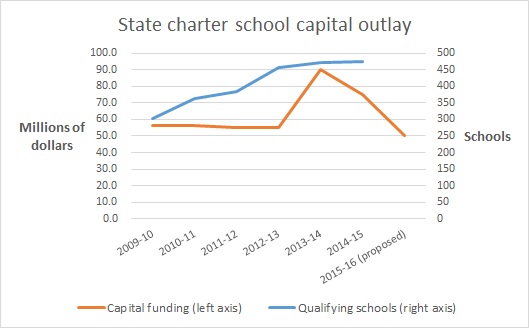
A growing number of charter schools are drawing on a fluctuating, and recently shrinking, pool of state facilities funding (see more details here).
As a result, in the coming year, the funding gap between charter schools and district schools will continue to widen.

