Editor’s note: This guest post is by Chris Lubienski, professor of education policy at the University of Illinois, where he is director of the Forum on the Future of Public Education. He is at twitter.com/CLub_edu

Lubienski
Some social justice advocates are quite enthralled with the possibilities of school choice. While district and enrollment boundaries reflect segregated residential patterns in the U.S., choice allows families to select schools across these artificial barriers, eradicating an important institutional impediment to equity. Moreover, schools then must compete to attract students, just like businesses strive to attract customers.
Charter schools reflect these ideals. It’s worth remembering that some of the early adopters of this innovation were progressive educators frustrated by the disservice that district-run public schools were doing to marginalized children. Charter schools embody the advantages of choice: giving parents alternatives, creating competition with public school districts, and offering the possibility of more socially integrated education based on interest, not race or residence. Compared to, say, vouchers, charters are the choice policy most favored by liberals. (Of course, charters also are embraced by conservative market advocates.)
Since the charter movement began, there have been debates about whether charter schools represent privatization. The recent issue of the Oxford Review of Education, which focuses on privatization, education and social justice, considers such questions and the equity implications.
In the classic sense of the term, it’s difficult to argue that charter schools “privatize” public education. Unlike, say, the transfer of state-run industries to private owners in Latin America in the 1980s and 1990s, ownership of public schools is generally not being shifted to private hands. In fact, one could argue the opposite is happening, as some private schools have opted into the publicly funded system to become charter schools, and many families have left tuition-based private schools for “free” taxpayer-funded charter schools.
Yet it’s also difficult to ignore the large-scale shift in American educational governance. Within a few short years, large swaths of urban systems run by elected school boards have been transferred to private (for-profit and non-profit) management groups. In Los Angeles, 100,000 students are now in charter schools. More than 1 in 3 public school students in Detroit, Kansas City and the District of Columbia now attend privately run charter schools. Policymakers are aggressively shutting down Chicago’s neighborhood public schools and inviting in private charter operators. Louisiana embraced charter schools as the primary reform model for re-making public education in post-Katrina New Orleans, where some 80 percent of students now attend charter schools. This is a remarkable record for a school model that didn’t exist 25 years ago.
So in this broader view, it would seem charters serve as a vehicle for moving governance of public education away from public control. Moreover, the charter movement is serving as the primary entry point for private investment seeking to reconfigure public education into a site for profit-making. (more…)
 Alabama: The Rev. H.K. Matthews, a civil rights icon now living in Alabama, says school choice is an extension of the civil rights movement (AI.com).
Colorado: The Douglas County School District offers private school vouchers for students but some residents, policymakers and journalists can't see anything but conspiracy theories (Our Lone Tree News). Fifteen new charter schools open statewide for the 2013-14 school year (The Gazette).
Connecticut: State Superintendent of Schools William McKersie wants public school choice and more digital learning for students (Greenwich Post).
Florida: Education leaders urge the governor to overhaul the school grading system again (which also applies to charter schools) (Tampa Bay Times). Florida Virtual School is facing hard times as program revenue drops 20 percent (Education Week). Charter schools are under scrutiny from the Department of Education after a ban on charging additional fees and requiring volunteer hours from parents (Tampa Bay Times).
Louisiana: The U.S. Department of Justice files suit to block the state's new school choice program, arguing it violates court ordered desegregation (Atlanta Journal-Constitution, The Advocate). The Black Alliance for Educational Options and Gov. Bobby Jindal both say the scholarship program provides a vehicle for low-income students to escape failing schools and that the Justice Department should drop the lawsuit (Education Week, Huffington Post, Weekly Standard). The Washington Post editorial board calls the DOJ lawsuit "appalling" (Washington Post). "Course choice" is underway in Louisiana (Education Week).
 Last week Diane Ravitch warned her readers not to trust the findings of the latest Center for Research on Education Outcomes (CREDO) report highlighting student achievement in charter schools. To make her case, she cited a review of the CREDO study written by the National Education Policy Center (NEPC). Diane Ravitch citing NEPC struck me as humorous for a very good reason.
As the CREDO study results changed direction in favor of charter schools, both Ravitch and NECP took a u-turn of their own.
Now there is nothing wrong with changing your mind. In fact, I applaud people who review research and reassess their previous held beliefs, because it takes considerable courage to change your mind or admit you were wrong. However, the CREDO research methods didn’t change and neither did the concerns raised by NEPC. The only thing that did change was the CREDO results, and it no longer supported Ravitch’s or NEPC’s professional opinion.
Back in 2009, the CREDO report concluded, “Despite promising results in a number of states and within certain subgroups, the overall findings of this report indicate a disturbing — and far reaching — subset of poorly performing charter schools.”
When Ravitch accepted the National Education Association's “Friend of Education” award in 2010, she cited CREDO findings stating, “five out of six charters will get no different results or worse results than the regular public schools.” Ravitch was still highlighting CREDO findings as late as the summer of 2011, but today she attacks CREDO as part of a corporate education reform plot to privatize education.
Like Ravitch, the NEPC had nice things to say about CREDO back in 2009. Despite very little change in NEPC’s own concerns, or even in the CREDO methodology, the organization’s opinion turned decidedly negative in 2013 when the CREDO results shifted in favor of charter schools. (more…)
A growing body of research suggests charter schools provide a good quality education relative to the traditional district schools from which their students transferred. This is especially true for low-income and minority students – the primary beneficiary of most charter schools nationwide.
A new report by Will Dobbie of Princeton and Roland Fryer of Harvard, shows significant achievement gains for low-income students in Harlem attending charter schools. Importantly, these low-income students are far more likely to attend college than their traditional school peers.
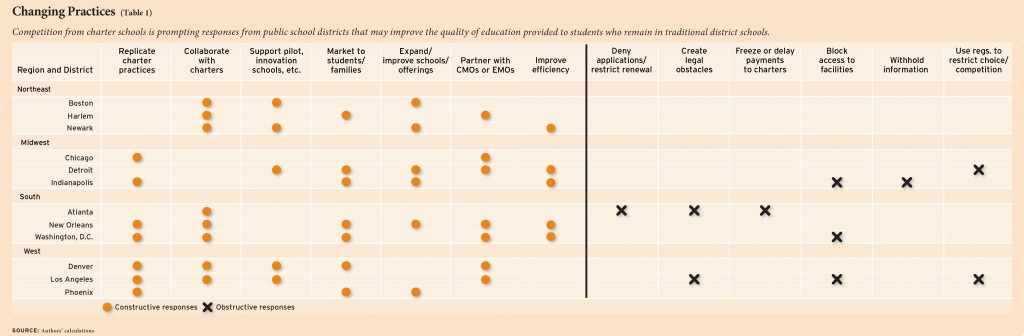
How do school districts respond?
Even the CREDO report from Stanford University now states that charter schools, on balance, provide a slightly higher quality education. The study finds that students in poverty attending charter schools gain an extra 14 days of learning for reading and 22 days of extra learning in math. English language learners in charter schools gain an additional 43 days of learning in reading and 36 days in mathematics. The much misunderstood CREDO report in 2009 also found charter schools had a significant positive impact for students in poverty.
With solid academic achievement and a nationwide enrollment exceeding 2 million students, charter schools are gathering steam. So how do districts react when faced with competition from charters?
A new report in EducationNext, by researchers at the Walton Family Foundation and the Department of Education Reform at the University of Arkansas, attempts to answer that question.
The researchers selected 12 urban areas that had at least 60 percent minority student population and 60 percent low-income to create a more accurate comparison with the typical charter school population. They also limited their research to districts with a charter school enrollment that was at least 6 percent of the overall enrollment within the district. According to the article, Caroline Hoxby of Stanford University believes this threshold is high enough that districts will respond to competitive pressure.
After selecting the districts that met these criteria, the researchers combed through 8,000 newspaper articles to locate instances of districts reacting to competition from charter schools. When they discovered an example, the researchers reviewed district meeting minutes to uncover if and how the district responded.
They divided the responses into 13 action categories, some positive and some negative. Positive responses included replicating charter practices, collaborating with charter schools, creating pilot or innovation schools and expanding or improving school offerings. Negative responses included creating legal obstacles for charter schools, blocking access to facilities and using regulations to restrict choice and competition.
The most common response, found in 8 of the 12 districts, was to collaborate with charters. The most common negative response, found in 3 of the 12 districts, was to restrict access to facilities (i.e., refuse to share unused space or school buildings with charter schools). Overall, the researchers discovered that the districts had more positive responses than negative ones.
Overall this is a good sign, though more research needs to be done as charter schools – and the school choice movement – expand. School districts should always put students first, whether or not they educate the child. By collaborating with and emulating successful charter schools – rather than blocking and fighting – school districts can make an even bigger impact on student achievement.
Arkansas: The U.S. 8th Circuit Court of Appeals dismisses a lawsuit to overturn the state's public school choice law, which will allow public school students to openly transfer to other public schools outside their district (Arkansas Times, Arkansas Online).
Arizona: The state sees an upswing in school districts wanting to convert some of their traditional schools into charters (Arizona Daily Star). Charter schools in Arizona will get greater parity in funding for vocational programs (Arizona Daily Star).
Florida: Charter schools again earn A and F grades at higher rates than district schools under the state's grading system (redefinED). A breakdown provided by the Hillsborough County School District, the eighth largest in the country, shows that in some district schools, 100 or more students have left for charters (Tampa Bay Times).
Louisiana: The U.S. 5th Circuit Court of Appeals partially dismisses the Louisiana Department of Education's appeal on the injunction against the state's new education voucher program in Tangipahoa Parish (The Advocate).
Michigan: Detroit may be shrinking, but charter schools in Michigan are growing (Detroit News).
Nevada: Wait-lists for magnet, charter and private schools grow in the Silver State as demand exceeds the available options to Nevada's public school students (Reason Magazine).
New Jersey: Gov. Chris Christie's administration approves six new charter schools for next fall, bringing the total statewide to 87 (New Jersey Spotlight). Republican U.S. Senate candidate Steve Lonegan says his likely Democratic rival, Newark Mayor C0ry Booker, needs to "man up" and admit whether he is for or against school vouchers (Newsworks New Jersey) (more…)
As they have in the past, Florida charter schools earned both A and F grades at higher rates than district schools this year, according to data released Friday by the Florida Department of Education.
According to our preliminary number crunching, 38 percent of the 340 elementary, middle and K-8 charter schools that received grades earned A’s, compared to 27 percent of 2,278 district schools. Meanwhile, 7 percent of charter schools earned F’s (24 total), compared to 4 percent of district schools (83 total).
High school grades won’t be released until later this year.
Schools in both the charter and traditional sectors earned fewer A’s and more F’s this year due to tougher accountability standards.
Charter school performance is under scrutiny in Florida, as it is in many states. Florida charters have higher rates of minority students than district schools (64 percent to 57 percent), but lower rates of low-income students (47 percent to 57 percent).
Studies have come to different conclusions about their performance. DOE numbers based on 2011-12 data show charter school students outperforming their district peers by most comparisons. On the other hand, a recent study by Stanford’s Center for Research on Education Outcomes, based on 2010-11 data, shows them on par with district peers in math but seven days behind in reading.
Charter schools. Pasco's Dayspring Academy, where state Sen. John Legg is an administrator, puts off expansion plans for a year. Gradebook. An F-rated charter in Flagler shows improvement. Daytona Beach News Journal.
 Magnet schools. The Palm Beach County district considers two arts magnets for the south end of the district. Palm Beach Post.
Testing. Whatever replaces the FCAT as Florida moves to Common Core standards must allow us to compare Florida to the highest performing states, writes Jeb Bush in an op-ed for the Tampa Bay Times.
Grading. Orange high schools are moving to a grading system where 50 is the floor, not zero. Orlando Sentinel.
Common Core. Thousands of South Florida teachers and principals prepare for the all-grades rollout this fall. Palm Beach Post. "Some" Central Florida parents don't like it. Orlando Sentinel.
Parental involvement. A prestigious Palm Beach County magnet is one of 10 schools statewide to be recognized by the Florida Department of Education. Extra Credit.
Parent power. The Tampa Bay Times writes up the new state law that gives parents of disabled students more say over their kids' IEPs. So does the Fort Myers News Press.
School grades. A Jeb Bush-Rick Scott split? Tampa Bay Times. So much for accountability in education. Answer Sheet. The system is a disaster, writes Fund Education Now co-founder Kathleen Oropeza in an op-ed for the Tampa Bay Times. The Daytona Beach News Journal writes up the recent BOE decision on the safety net. (more…)
Charter schools. The charter schools in Pinellas expect to add 1,400 students this fall, for a total of nearly 6,500. Gradebook. A new charter school in Naples is offering a summer camp to boost literacy skills for ELL students entering kindergarten. Fort Myers News Press. The struggling Tiger Academy charter school in Jacksonville shows big improvement in its third grade FCAT results. Florida Times Union.
Private schools. Q&A with the new head of Tampa's Carrollwood Day School. Tampa Tribune.
Teacher transfers. Alexander Russo takes a look at a recent study examining involuntary transfers in Miami-Dade.
School spending. Pasco anticipates $1 billion in capital expenses through 2025 and $711 million from all funding sources. Gradebook. Pasco considers shifting some school start times to save money on bus routes. Tampa Bay Times.
Superintendents. The Tampa Bay Times profiles new Hernando Superintendent Lori Romano.
Porn. Pasco deputies arrest a 15-year-old high school student for possession of child pornography after school officials find a photo on her iPhone of two teens having sex. Tampa Tribune, Tampa Bay Times.
Head Start. The feds uphold the suspension of the Jacksonville Urban League as a program provider, citing health and safety issues. Florida Times Union.
National. A new study from CREDO shows charter schools improving nationally, compared to traditional public schools, but with results varying widely from state to state. National coverage in the New York Times, Washington Post, Hechinger Report, Charters & Choice, Associated Press, Huffington Post. State-level coverage in the Minneapolis Star Tribune, Salt Lake City Tribune, Tampa Bay Times, Detroit News, Newark Star Ledger, The Morning Call, St. Louis Post-Dispatch, New Orleans Times Picayune.
 National. Charter school waiting list nears 1 million nationally, according to a new survey from the National Alliance for Public Charter Schools (The Charter Blog). More from the Los Angeles Daily News.
Ohio. Lawmakers move to expand vouchers statewide for low-income students, beginning this fall with 2,000 kindergartners and expanding one grade level each year. (Friedman Foundation)
Wisconsin: Lawmakers expand vouchers statewide but with an enrollment cap of 500 the first year (Education Week). State Superintendent of Public Instruction Tony Evers criticizes the proposal (Journal Sentinel). Democrats predict a backlash (Wisconsin State Journal). Private schools in Madison consider whether to participate (Wisconsin State Journal). Same with schools in the Wausau area (Wausau Daily Herald). A key lawmaker leaves the door open for another stab at a voucher for special-needs students (Wisconsin Reporter).
Indiana. Voucher supporters are giving a thumbs up to the expansion that begins Monday (Evansville Courier & Press). The Louisville Courier Journal raises questions about whether private schools have the capacity to absorb additional students.
New Jersey: Gov. Chris Christie plans to sign off on the state budget, saying he'll bring back the fight for school vouchers next year (Newark Star-Ledger). Newark Mayor Cory Booker reiterates his support for school choice in his bid for U.S. Senate (Associated Press). Teachers and parents criticize the decision by Education Commissioner Chris Cerf to put the kibosh on a virtual charter set to open this fall (Newark Star-Ledger). (more…)
Common Core. StateImpact Florida: Don't let Common Core squeeze out science. StateImpact Florida: State Sen. John Legg says lawmakers still have a lot to do to get the state ready for Common Core.
Charter schools. New study from CREDO shows charter schools improving nationally, compared to traditional public schools, but with results varying widely from state to state. Coverage in the New York Times, Washington Post, Hechinger Report, Charters & Choice, Associated Press, Huffington Post.
School grades. Gradebook: Miami-Dade Superintendent Alberto Carvalho calls on the state to change how it grades ESE centers.
Summer learning loss. Gradebook: High-poverty schools in Pinellas have the lowest turnout for a new district program to stem summer learning loss. Tampa Tribune: Overall turnout for the Pinellas program is less than expected, too. Tallahassee Democrat: Leon offers a summer course for students who failed the Algebra I end of course exam.
Educator conduct. South Florida Sun Sentinel: A teacher's aide at a Palm Beach County charter school is accused of sexually assaulting a 15-year-old he met at church. Tampa Bay Times: A former Pinellas County elementary school is sentenced to two years in prison for possession of child pornography.
Teacher data. Gradebook: DOE offers help to teachers whose info may have been compromised.The Gainesville Sun writes up the data breach. So does the Pensacola News Journal.
STEM. Northwest Florida Daily News: Parents pack an Okaloosa County School Board meeting to show support for a STEMM (science, technology, engineering, math and medical) academy.

