A growing body of research suggests charter schools provide a good quality education relative to the traditional district schools from which their students transferred. This is especially true for low-income and minority students – the primary beneficiary of most charter schools nationwide.
A new report by Will Dobbie of Princeton and Roland Fryer of Harvard, shows significant achievement gains for low-income students in Harlem attending charter schools. Importantly, these low-income students are far more likely to attend college than their traditional school peers.
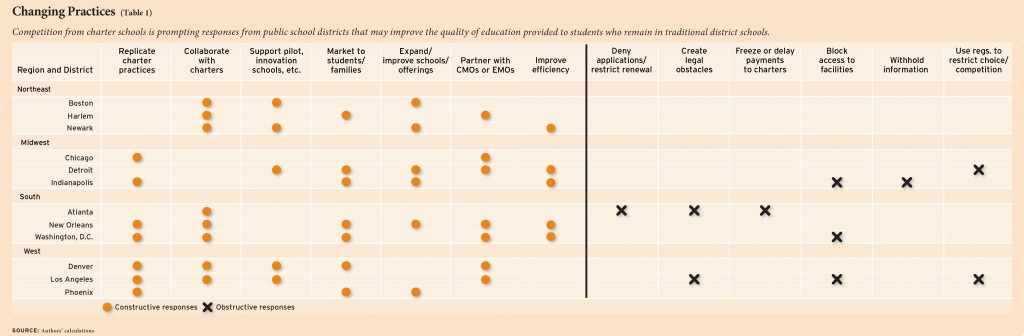
How do school districts respond?
Even the CREDO report from Stanford University now states that charter schools, on balance, provide a slightly higher quality education. The study finds that students in poverty attending charter schools gain an extra 14 days of learning for reading and 22 days of extra learning in math. English language learners in charter schools gain an additional 43 days of learning in reading and 36 days in mathematics. The much misunderstood CREDO report in 2009 also found charter schools had a significant positive impact for students in poverty.
With solid academic achievement and a nationwide enrollment exceeding 2 million students, charter schools are gathering steam. So how do districts react when faced with competition from charters?
A new report in EducationNext, by researchers at the Walton Family Foundation and the Department of Education Reform at the University of Arkansas, attempts to answer that question.
The researchers selected 12 urban areas that had at least 60 percent minority student population and 60 percent low-income to create a more accurate comparison with the typical charter school population. They also limited their research to districts with a charter school enrollment that was at least 6 percent of the overall enrollment within the district. According to the article, Caroline Hoxby of Stanford University believes this threshold is high enough that districts will respond to competitive pressure.
After selecting the districts that met these criteria, the researchers combed through 8,000 newspaper articles to locate instances of districts reacting to competition from charter schools. When they discovered an example, the researchers reviewed district meeting minutes to uncover if and how the district responded.
They divided the responses into 13 action categories, some positive and some negative. Positive responses included replicating charter practices, collaborating with charter schools, creating pilot or innovation schools and expanding or improving school offerings. Negative responses included creating legal obstacles for charter schools, blocking access to facilities and using regulations to restrict choice and competition.
The most common response, found in 8 of the 12 districts, was to collaborate with charters. The most common negative response, found in 3 of the 12 districts, was to restrict access to facilities (i.e., refuse to share unused space or school buildings with charter schools). Overall, the researchers discovered that the districts had more positive responses than negative ones.
Overall this is a good sign, though more research needs to be done as charter schools – and the school choice movement – expand. School districts should always put students first, whether or not they educate the child. By collaborating with and emulating successful charter schools – rather than blocking and fighting – school districts can make an even bigger impact on student achievement.
Legislature. The Senate Education Committee looks like it's done for the session, meaning bills like Sen. Jeff Brandes' micro-credits idea are stranded and maybe dead. Gradebook.
 Charter schools. About 300 charter schools students lobby lawmakers for charter school funding, reports Naked Politics. Rep. George Moraitis, R-Fort Lauderdale, says he wants to remove a provision in his charter schools bill requiring districts to share unused facilities with charters, reports The Buzz. Pasco district officials debate errors in charter schools applications, reports Gradebook. The teachers at a closed-down Miami-Dade charter school earned state recognition money for an improved school grade, but district officials are having trouble finding them, reports the Miami Herald.
Magnet schools. The Polk school district is considering creating a K-12 arts system with an elementary and middle school in Lake Wales, where all the other schools are community-run charters. Lakeland Ledger.
Class size. Broward's progress in reducing class sizes to meet state law is resulting in some negative tradeoffs, like ballooning AP classes. Miami Herald. More from the South Florida Sun Sentinel. (more…)
 Editor's note: Another year, another legislative session, another stack of school-choice bills in Florida. Here's a roundup of choice legislation that lawmakers will consider in the annual session that begins today.
Career Academies:
SB 1076 by Sen. John Legg, R-Lutz. Expands the "Career and Professional Education Act (CAPE)," revising requirements for high school graduation and accelerated high school graduation, and allowing students to earn and substitute certain industry certifications for certain course credits. Also requires districts to make digital materials available to students and to use the Postsecondary Industry Certification Funding List in determining annual performance funding distributions to school districts and Florida College System institutions, etc.
Charter Schools:
HB 373 by Rep. Joe Saunders, D-Orlando. Provides that a contract for a charter school employee or service provider may not extend beyond the school’s charter contract, and that the employee or service provider is not entitled to compensation after the school’s closure. (Identical to SB 780 by Sen. Geraldine Thompson, D-Orlando.)
HB 453 by Rep. Victor Torres, D-Orlando. Requires the compensation and salary schedules for charter school employees to be based on school district schedules. (Identical to SB 784- Charter Schools by Sen. Geraldine Thompson, D-Orlando.)
SB 744 by Sen. David Simmons, R-Altamonte Springs. Requires charter school applications to demonstrate the applicant is financially qualified to open and maintain a high-quality charter school, requires the charter to set forth detailed reporting of the financial operations of the school to ensure employees are not paid unreasonable compensation, and requires that the term of the charter must provide for cancellation of the charter if the school becomes insolvent, fails to provide a quality education, or does not comply with applicable law. The bill also clarifies that a charter school system shall be designated a LEA solely for the purpose of receiving federal funds if certain criteria are met.
SB 828 by Sen. Rene Garcia, R-Hialeah. Grants school districts the ad valorem tax exemption given to charter schools, and restricts the use of capital outlay funds for property improvements if the property is exempt from ad valorem taxes. It restricts charter schools or technical career centers having financial problems from certain activities, and grants flexibility to high-performing school choice districts.
HB 1001 by Rep. Karen Castor Dentel, D-Maitland. Prohibits charter schools from requiring, soliciting, or accepting certain student information before student's enrollment or attendance. Also requires charter schools to submit attendance plans to the school district for students enrolled in school; provide funding to the school district in event of student transfers; and report to the school district certain student enrollment and wait-list information.
SB 1092 by Sen. Geraldine Thompson, D-Orlando. Requires charter school to submit attendance information for each student to the school district, and requires the charter school to provide a prorated portion of per-student funding to the school district if a student transfers to another public school in the school district before the last day of the school year.
SB 1164 by Sen. Kelli Stargel, R-Lakeland. Revises the eligibility criteria for extracurricular activities to include students in charter schools, and revises the criteria for bylaws, policies, or guidelines adopted by the Florida High School Athletic Association. (Compare to HB 1279 by Rep. Larry Metz, R-Groveland.) (more…)

