
During a 1916 football game between Georgia Tech and Cumberland, Georgia Tech coach John Heisman famously urged his players on to victory- “You're doing all right, team, we're ahead. But you just can't tell what those Cumberland players have up their sleeves. They may spring a surprise. Be alert, men! Hit 'em clean, but hit 'em hard!” Cumberland committed 15 turnovers in the game and had one of their players getting tackled for a six-yard loss on an attempt at an offensive rush declared their “play of the game.” Georgia Tech won the game 222 to 0.
This story has repeatedly come to mind repeatedly over the last decade while reading stories about the competition between surging Florida and floundering New York.
The New York Post reports that New York City Schools will spend $42,000 per student this year. Spending $840,000 on a classroom of 20 fourth graders might seem a bit pricey, especially given that judging on their 2024 NAEP performance, nine of them will be reading at “below basic.” New Yorkers must pay sky-high taxes to support the world’s most expensive illiteracy generator/job programs, which is one of the reasons so many New Yorkers keep becoming Floridians. Now, however, it isn’t just people and companies migrating from New York to Florida; New York’s Success Academy schools are also heading south.
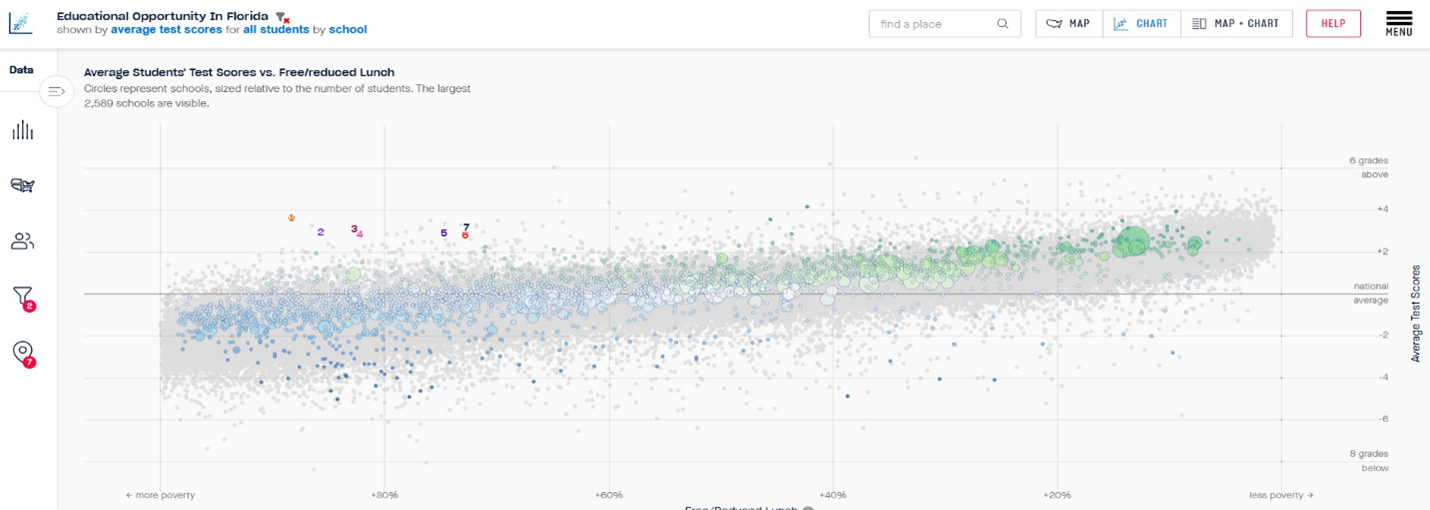
Through the wizardry of Stanford’s Educational Opportunity Project graph generator, I’ve placed New York Success Academies (Marked 1-7) in the graph for the overall state of Florida for academic proficiency. Schools are dots; green dots are higher than average, blue below average, etc.
You don’t see many high-poverty schools (graph runs from low poverty on the right to high poverty on the left) with students scoring 3ish grade levels above average, but that is exactly what Success Academy has consistently delivered in New York.
Being a rational human, you might think that New York policymakers would be falling over themselves to get as many Success Academies operating as possible, but that is just you being silly again. New York lawmakers maintain a statewide cap on the number of charter schools. Apparently, New York lawmakers feel the need to keep safe from, well, learning.
Florida, on the other hand, does not have a cap on charter schools. Rather than treating highly successful schools specializing in educating disadvantaged students as a public menace, Florida is rolling out the red carpet for highly effective school models. Success Academy plans to open 40 schools in Florida over the next 10 years, something which New York law prohibits.
Is it too much? Too much winning? No, Florida, you have to win more! Or to paraphrase Coach Heisman “You're doing all right, Florida; you’re ahead. But you just can't tell what those New Yorkers have up their sleeves. They may spring a surprise. Be alert, men! Hit 'em clean, but hit 'em hard!” Capitalizing on the abject folly of New York policymakers is hitting both clean and hard.

Choice opponents have been known to throw contradictory arguments out against private choice programs. One moment they will claim that the majority of kids using universal choice programs were already going to private schools. A few moments later they will claim such programs are draining district schools of students and money. The irony of these mutually exclusive claims will often escape the person making them, and you can see hints of both in this New York Times podcast titled Why So Many Parents are Opting Out of Public Schools.
Sigh
Choice opponents make all kinds of claims, but not many can withstand even a modicum of scrutiny. Let’s take for instance a widely repeated fable- that Arizona’s universal ESA program has “busted” the state budget.
If you actually examine state reports like this one for district and charter funding and also this one for ESA funding, you wind up with:
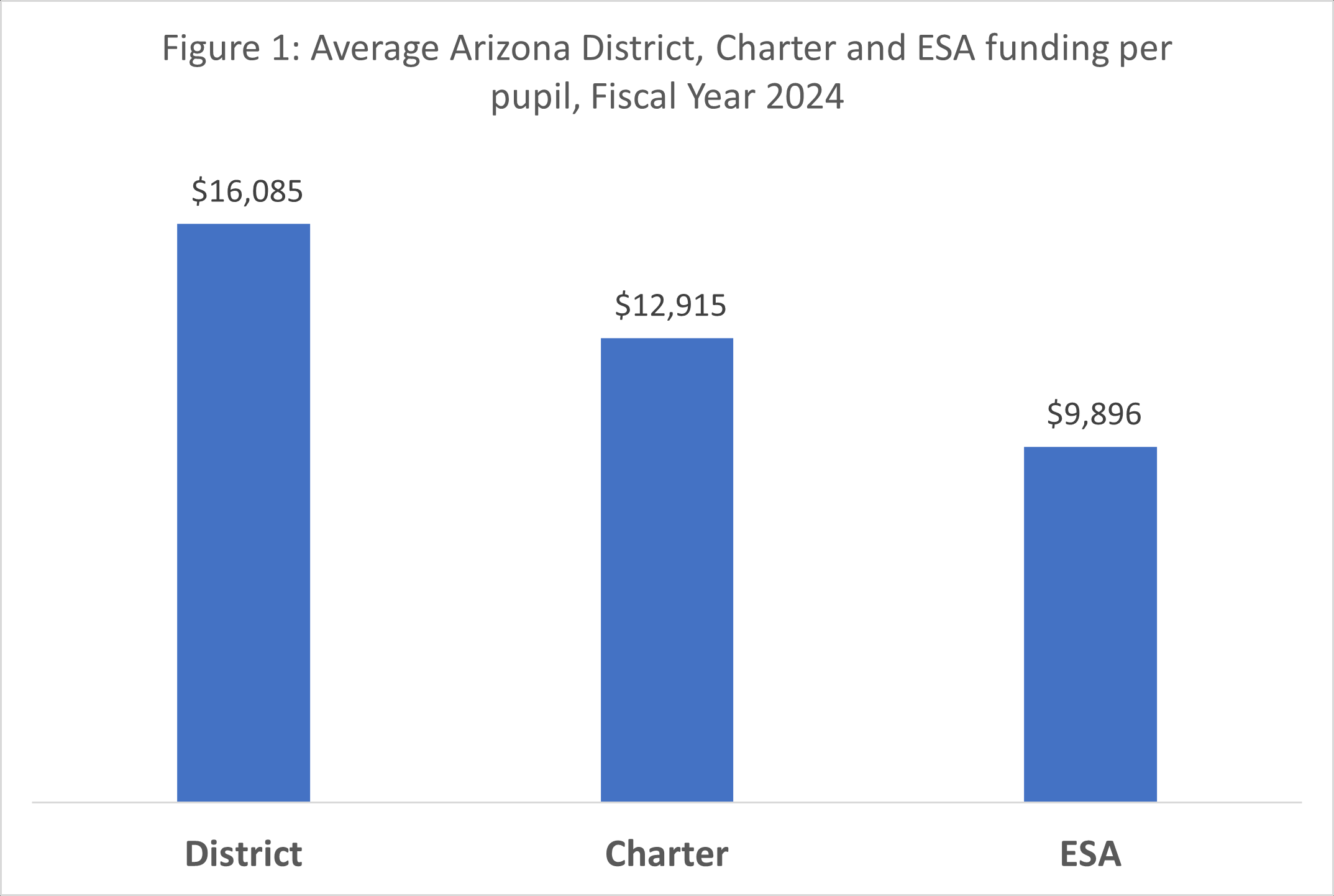
Arizona districts have exclusive access to local funding among other things and are by far the most generously funded K-12 system in the state. Districts, charters and ESAs all use the state’s weighted student funding formula, and ESAs get the lowest average funding despite having a higher percentage of students with disabilities participating than either the district or charter sector.
If you track the percentage of students served by the district, charter and ESA sectors respectively, and the funding used by each as a percentage of the total, you get:

So, there you have it; supposedly the sector educating 6% of Arizona students for 4% of the total K-12 funding is “bankrupting” the state of Arizona. Meanwhile the system, which generated an average of $321,700 for a classroom of 20 ($16,085*20), is “underfunded.”
A group of 20 ESA students receiving the average scholarship amount receive $123,780 less funding, but they are (somehow) “busting the budget.” The fact that a growing number of Arizona students opt for a below $10k ESA rather than an above $16k district education tells us something about how poorly districts utilize their resources. So does the NAEP.
There is a school sector weighing heavily upon Arizona taxpayers, but it is not the ESA program.
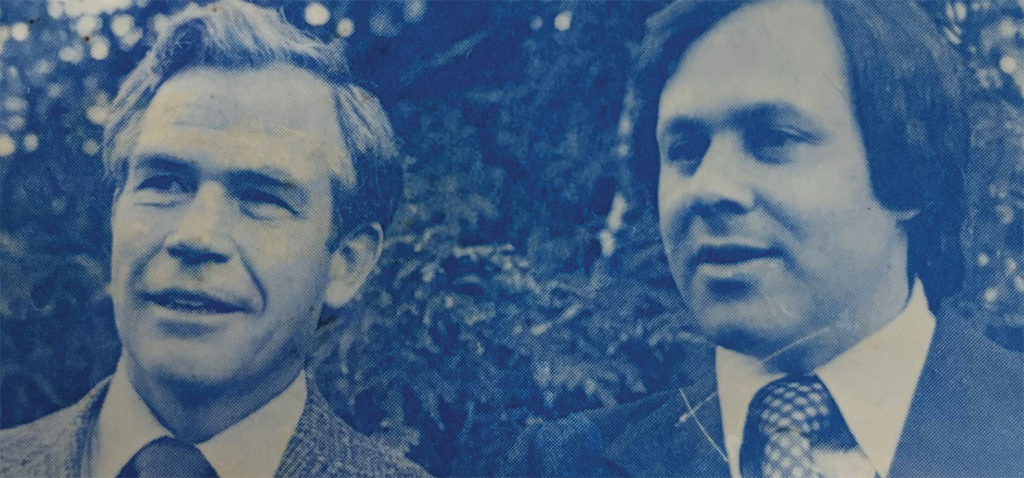
Berkeley law professors Jack Coons (left) and Stephen Sugarman described what we now call education savings accounts - and a system of à la carte learning - in their 1978 book, “Education by Choice.”
John E. Coons was ahead of his time.
Decades before the term “education savings account” became an integral part of the education choice movement, the law professor at the
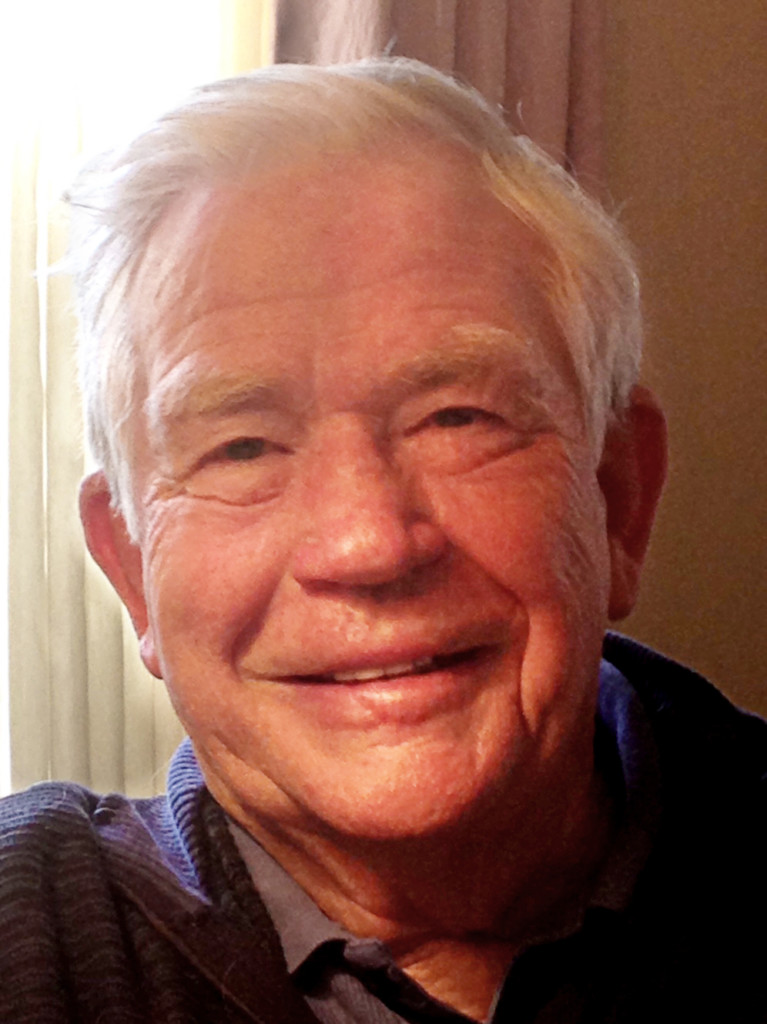
Jack Coons, pictured here, co-authored "Education by Choice" in 1978 with fellow Berkeley law professor Stephen Sugarman.
University of California, Berkeley, and his former student, Stephen Sugarman, were talking about the concept. In their 1978 book, “Education by Choice: The Case for Family Control,” the two civil rights icons envisioned a model drastically different from the traditional one-size-fits-all, ZIP code-based school system inspired by the industrial revolution:
“To us, a more attractive idea is matching up a child and a series of individual instructors who operate independently from one another. Studying reading in the morning at Ms. Kay’s house, spending two afternoons a week learning a foreign language in Mr. Buxbaum’s electronic laboratory, and going on nature walks and playing tennis the other afternoons under the direction of Mr. Phillips could be a rich package for a ten-year-old. Aside from the educational broker or clearing house which, for a small fee (payable out of the grant to the family), would link these teachers and children, Kay, Buxbaum, and Phillips need have no organizational ties with one another. Nor would all children studying with Kay need to spend time with Buxbaum and Phillips; instead, some would do math with Mr. Feller or animal care with Mr. Vetter.”
Coons and Sugarman also predicted charter schools, microschools, learning pods and education navigators, although they called them by different names.
Fast forward to Florida today, where the Personalized Education Program, or PEP, allows parents to direct education savings accounts of about $8,000 per student to customize their children’s learning. Parents can use the funds for part-time public or private school tuition, curriculum, a la carte providers, and other approved educational expenses. PEP, which the legislature passed in 2023 as part of House Bill 1, is the state’s second education savings account program; the first was the Gardiner Scholarship, now called the Florida Family Empowerment Scholarship for students with Unique Abilities, which was passed in 2014.
Coons, who turned 96 on Aug. 23, has been a regular contributor to Step Up For Students' policy blogs over the years. Shortly after the release of his 2021 book, “School Choice and Human Good,” he was featured in a podcastED interview hosted by Doug Tuthill, chief vision officer and past president of Step Up For Students.
 “It is wrong to fight against (choice) on the grounds that it is a right-wing conspiracy,” said Coons, a lifelong Catholic whom some education observers describe as “voucher left.” “It’s a conspiracy to help ordinary poor people to live their lives with respect.”
In 2018, Coons marked the 40th anniversary of “Education by Choice” by reflecting on it and his other writings for NextSteps blog.
He said he hopes his work will “broaden the conversation” about the nature and meaning of the authority of all parents to direct their children’s education, regardless of income.
“Steve (Sugarman) and I recognized all parents – not just the rich – as manifestly the most humane and efficient locus of power,” he wrote. “The state has long chosen to respect that reality for those who can afford to choose for their child. ‘Education by Choice’ provided practical models for recognizing that hallowed principle in practice for the education of all children. It has, I think, been a useful instrument for widening and informing the audience and the gladiators in the coming seasons of political combat.”
Florida gives parents the ability to direct the education of their children. Today about half of all K-12 students in the state attend a school of choice, and 500,000 students participate in state educational choice scholarship programs.
Gov. Ron DeSantis accelerated these trends in 2023, when he signed HB 1 and made every student eligible for a scholarship. No school can take any student for granted, and state funding follows students to the learning options they choose.
Unfortunately, misleading claims amplified in the media have blamed this expansion of parental choice for school districts’ budget challenges.
Sarasota County Schools, for example, recently estimated that scholarships “siphoned” $45 million from its budget, a figure cited in a WUSF article. In reality, most of the $45 million represents funding for students that Sarasota was never responsible for educating, such as those already in private schools, homeschooling or charter schools. It also does not account for students who return to district schools after using a scholarship. Once those factors are considered, the actual impact is considerably smaller than the headline number suggests.
For the 2024-25 school year, Sarasota County lost just 330 public school students to scholarship programs, but only 245 of those students came from district-run public schools. If those students had stayed, they would have brought the district about $2 million, not $45 million. That figure still does not account for the students who returned to district schools after using a scholarship the prior year, so the real impact would be smaller.
Other districts have been vocal about their budget difficulties, often attributing them solely to growing scholarship demand, such as Leon County Public Schools, which in 2024-25 lost 240 students from district-run schools (0.8% of enrollment), and Duval County Public Schools, which lost 1,237 students (1.2% of enrollment).
Statewide, 32,284 students left public schools in 2024-25 to use a scholarship. That is only 1.1% of all public-school students in Florida, and even that total includes those who previously attended charter schools, university-affiliated lab schools, virtual schools, and other public-school options.
Looking at district-run schools alone, just 24,874 new scholarship students left for scholarship programs in 2024-25. Another 5,507 came from charters, and 1,897 came from virtual schools. In fact, as a percentage of their total enrollment, charter schools lost more students to scholarship programs (1.4%) than district-run schools did (1%).
This means that the expanded scholarship program may be having a bigger impact on charter schools than districts. Charter schools, however, haven’t been as vocal about vouchers, and that is likely because charters continue to grow enrollment while district schools have started to shrink.
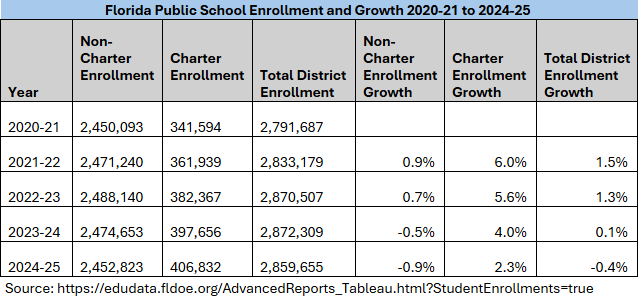
Enrollment declines in some districts have been real, even if the blame on scholarships is misplaced.
Declining enrollment is being driven by parent preferences – but also by shifting demographics and the ebb of the post-Covid population boom. Florida is one of the few states where overall K-12 population is expected to continue growing, but the growth will be uneven, and every school will have to compete for students.
Even as they face intense competition and demographic headwinds, Florida’s charter schools have kept growing. Some innovative district leaders have signaled a willingness to hear the demand signals from parents and create new solutions to meet their needs.
Understanding what parents seek in private and charter schools, and how new public-school models can better meet those demands, would be a good place for districts to start.
Pre-K and Voluntary Pre-Kindergarten (VPK) have also been major feeders for Florida’s scholarship programs. In 2024-25, 53,825 new scholarship students came from pre-K — somewhere between one-third and nearly half of all VPK students statewide.
Public schools have limited Pre-K offerings. Statewide, there are less than one-third as many Pre-K students as kindergartners enrolled in public schools. Private schools, by contrast, have used it as a key pipeline to recruit future students.
Districts have other avenues to respond to changing parent demands. Since 2014, when the Family Empowerment Scholarship for Students with Unique Abilities (FES-UA) was introduced as the Personal Learning Scholarship Accounts, districts have been allowed to offer classes and services to scholarship students.
The passage of HB1 in 2023 transformed every state scholarship into an education savings account. K-12 families now have more flexibility to use scholarships for “a la carte learning,” in which they pick and choose from a variety of educational options. By offering part-time instruction, tutoring, therapy, and other services, districts can win back students and the associated funding. So far, 21 of Florida’s 67 districts have taken advantage of this opportunity, with 10 more in the pipeline.
Florida’s enrollment shifts are real, but data shows the “voucher drain” narrative overstates the impact. The real challenge for districts is not money being “siphoned;” it is families choosing other options. Districts that adapt and compete for students will keep both enrollment and funding – leaving students, families and taxpayers better off.
Recently, someone representing a state official responded to an Arizona media outlet inquiry about the Empowerment Scholarship  Accounts program and referred to “tutoring and babysitting.” Consequently, Arizona’s school district industrial lobbying complex went predictably bananas, even though babysitting is not now, nor ever has been an allowable expense under the program. Even though the official has since clarified their statement to note that babysitting is not an allowable expense. Blah blah blah no age requirements for tutoring yadda yadda yadda (move on to the next manufactured outrage).
This is all to do about nothing, but it is worthwhile to pause a moment to note that tutoring centers with strong reputations do routinely hire high school students for tutoring positions. I am aware of this because two of my children tutored math as high school students, and one became an assistant center director as a high school student. The companies establish the mathematical abilities of tutors before hiring them by testing them and then give them established protocols to follow. If they prove ineffective, they lose customers. A great many Arizona high school students are not only completely capable of math tutoring, but I am also willing to wager that neither me nor m(any) of Arizona’s journalism community would fare well against them in a mathematics contest.
Now…about this babysitting business. The Arizona school district industrial lobbying complex and their oh-so-willing media dupes grousing about “babysitting” is too rich for words.
In the 2024 NAEP, 49% of Arizona fourth grade students attending district schools scored “below basic” in reading. I’m not sure what those students were doing over the past five years, but it did not seem to involve much, well, learning. If we break out Arizona district scores apart from the students attending charter schools, eighth grade reading looked like this in 2024:
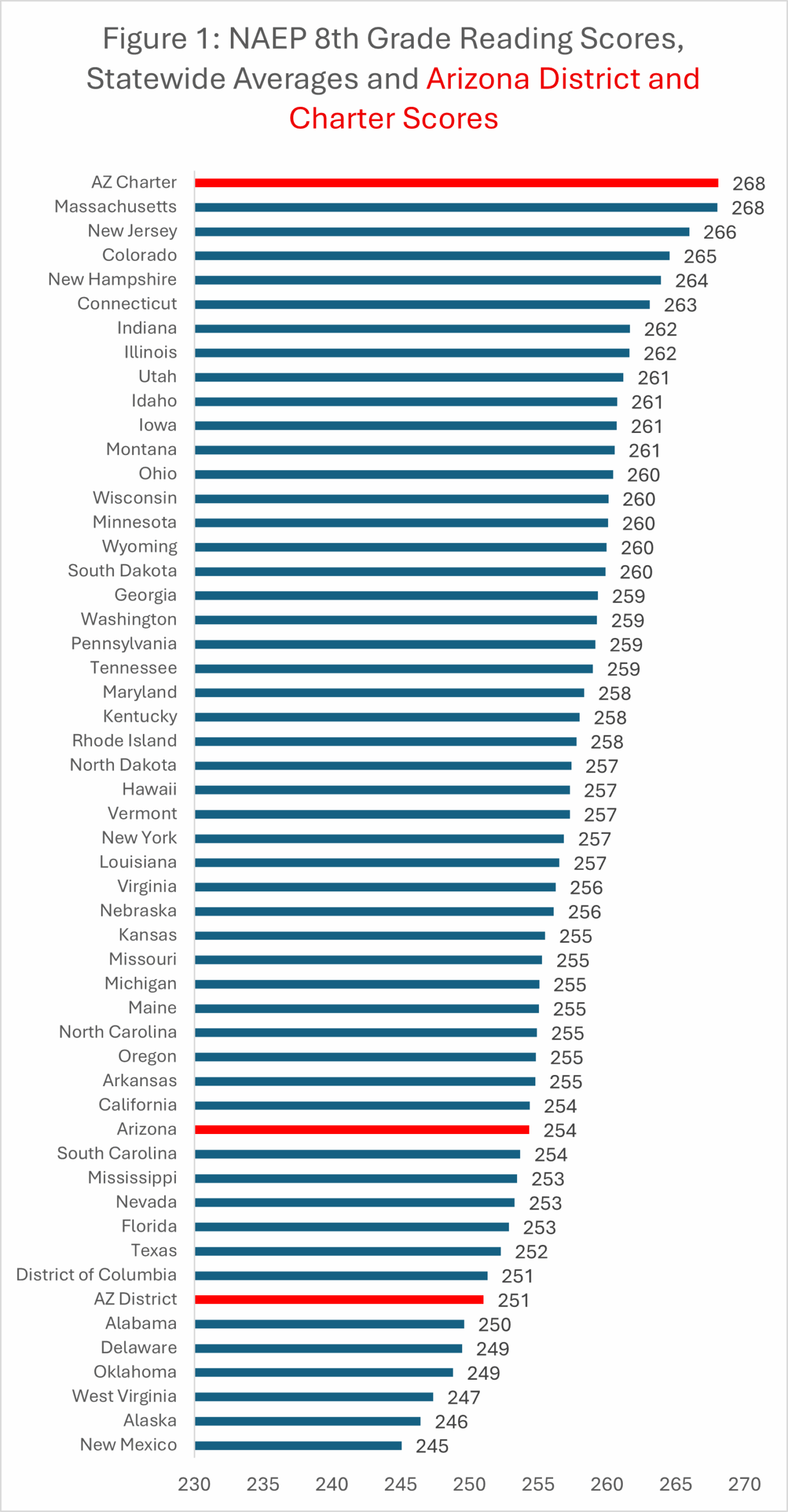
Usual caveats apply (sampling, raw scores imperfect proxy for school quality etc.) but —cough — if anyone is engaged in babysitting, you don’t want to go searching for it in tutoring centers: Arizona school district reading scores seem to indicate that they have jumped into babysitting with both feet.
Speaking of tutoring math, NAEP also tests math. Perhaps things won’t look so bad for Arizona school districts if we examine the math scores. Or then again, maybe not:

So, there is a brisk trade in tutoring in Arizona, and we are in no position to turn up our noses at bright and capable high school tutors for younger students. As for babysitting, it seems to be in mass production in Arizona’s district schools.

**SPOILER ALERT! DO NOT READ IF YOU ARE UNDER THE AGE OF 8**
Western cultures, for some strange reason, involve rituals where we pretend that various “fairy creatures” exist, particularly with children: the Tooth Fairy, a jolly old elf with flying reindeer who brought me an awesome Big Wheel in 1973, egg and goody hiding rabbits, etc. When I became a parent, I played along with these rituals, but then at some point questioned why I was doing it. On the one hand, I didn’t want my children to be those killjoy types who went around bursting the bubbles of other kids. On the other hand, I did not want to train my children not to trust me. I decided to allow the “fun” to go on until they each reached a certain age, then to explain to them that these things are traditions and that it would be best to allow their friends to figure it out on their own.
So, dear reader, I assume that you have reached a certain age and that you are prepared to know the truth about the last fairy creature. Belief in this one tends to persist much longer than the others and is alas, more detrimental. Sorry to be a killjoy, but here goes:
Philosopher kings are not real.
This was my main thought upon reading Mike McShane’s recent entry in a debate about school choice regulation. Go read it. I’ll wait here.
Go on…
Okay, good. My favorite part involved the Gilded Age meat baron, but McShane made several crucial points. Local school boards, state governments and the federal government all regulate public schools in a very active fashion. I could produce multiple graphs from NAEP, PISA, etc., showing what a pig’s breakfast American academic achievement has become, but you have already seen them, so I will spare you. Why are American schools so wretched despite so much regulation? Oh well, that is simple: regulation is not made by philosopher-kings but rather by politics. Politics has an amazingly consistent record of fouling things up.
The philosopher-king fairies, invented by Plato, are a specially trained and educated aesthetic elite who, disinterested in fame or wealth, love only wisdom and justice. Having thus earned the right to rule over us lesser mortals, we proles should feel deferential and deeply grateful for their sacrifice. Again, sorry to burst your bubble, but these people do not exist in the real world. Out here in the real world, mere humans with all kinds of motivations (political and otherwise), limits to their knowledge, greed, stupidity and other normal human failings create regulations. Those of us fortunate enough to live in a democracy get the chance to throw the bums out when we’ve had enough. Just in case you haven’t noticed, a major subtext of politics these days involves bums that voters can’t throw out.
Politics, not philosopher-kings, runs regulation, and politics runs on self-interest far more than on benevolent technocratic wisdom. Choice programs must cope with powerful organized interests that yearn to use regulation as a tool to domesticate choice opportunities and find it in their self-interest to do so. The default position of choice supporters should therefore be to view the calls for regulation with a deep skepticism; it is not paranoia when people really are out to get you.
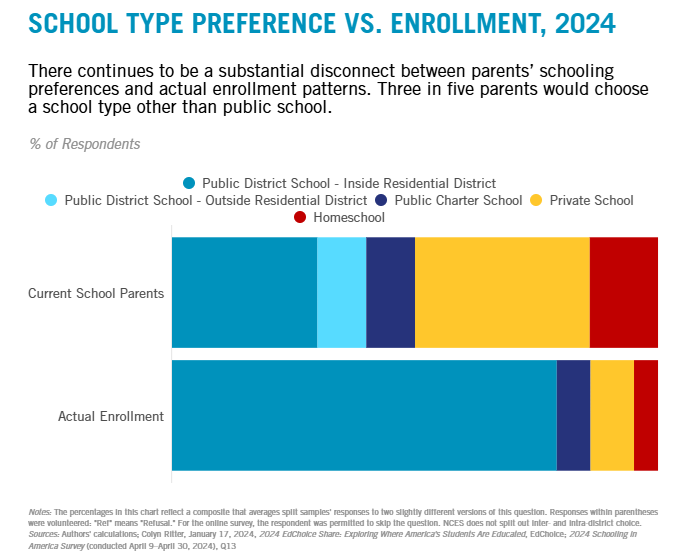
None of this is to say that it is possible to pass choice legislation without regulation; it is not. I am not aware of any program anywhere that operates without some degree of regulation. American parents, however, want a radically different K-12 system than the one government forces them to pay for (see above). The way forward is to allow families to partner with educators to sort through new schools and education methods. Heavily regulated choice systems might get to something close to the K-12 system parents want and deserve before the heat-death of the universe, but then again, they might not.
America’s founders fought a grueling war against the most powerful country in the world based upon what was then a radical idea, that people could live better without royalty to boss them around. The divine right of kings was another myth humanity needed to grow up and discard, and that should include philosopher-kings.
Last week, I had the opportunity to make a presentation about how lawmakers can support teachers who want to start their own schools. The four key features:
2. Formula funding/demand-driven funding: Whoever applies for a choice program should receive funding if eligible.
3. Avoidance of anti-competitive accreditation requirements: Don’t ask your startup schools to operate without funding from the choice program while incumbent/accredited schools receive choice funding.
4. Exempt private schools from municipal zoning: Old hat for charter schools, needed for private schools as well.
Florida is the only state your humble author is aware of that has taken all four of these steps. This makes Ron Matus’ new study "Going With Plan B” all the more important. Despite a statewide increase of 705 private schools, 41,000 Florida families applied for, received, and ultimately did not use an ESA. Matus surveyed thousands of these parents to learn why.

The lack of school space was the No. 1 reason Florida families found themselves as non-participants. Reasons two and three were related to costs, which can also be thought of as a supply issue.
The “Going with Plan B” study is very interesting and should be studied carefully by Florida policymakers. For now, however, let us focus on the other states with choice programs that lack the four critical elements listed above. If FLORIDA has a supply issue, your state, sitting at one out of four, or two out of four, should take note: It is likely to be even worse in a state near you.

Last week, the Heritage Foundation released a study from yours-truly called From Mass Deception to Meaningful Accountability: A Brighter Future for K–12 Education. The basic argument: the good intentions of the No Child Left Behind era were completely undermined by opponents, who both defanged state rating systems and tamed charter school laws. On the first assertion, I offered charts like:

Ooof, and even worse this comparison between Arizona’s school grades in Maricopa County and GreatSchools private ratings for schools within 15 miles of Phoenix (the closest approximation on the GreatSchools site) after converting the GS 1-10 ratings onto a A-F scale:
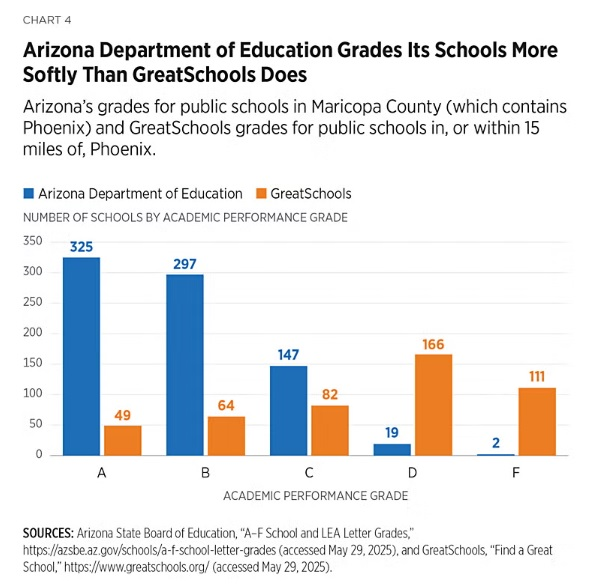
Charter schools always and everywhere had waitlists, ergo, accountability amounted to “trophies for everyone” state systems and charter school sectors that never matched demand with supply. Take a look at the above chart, however, and you’ll see that GreatSchools is a much, much tougher grader than the state of Arizona. The usual suspects have a much tougher time undermining private rating organizations, and they gather reviews (which research shows families value). Ergo the backgrounder makes the argument that we should not rely upon state rating systems in preference to the already superior, more trusted and versatile private efforts. Furthermore, we should expand rating systems into the broader universe of education service providers active in today’s ESA and robust personal use tax credit programs, specifically to gather reviews accessible to families for purposes of navigating the wide world of choice, which we need much more of.
Okay so a couple of reader requests. First, I was asked if I could create something like the Phoenix chart for a district in Florida. I chose Miami:

So not as much of a contrast as Arizona but…if I were looking for a school in Miami, I would look at GreatSchools.
Next, I received a request about this chart from Sandy Kress:

Putting the NAEP improvement numbers in context: In the 2024 NAEP, the total across the four mathematics and reading exams between the highest scoring state (MA) and the lowest scoring state (New Mexico) was 10%. So, the nation-leading 5% improvement in Mississippi scores should be seen as meaningful. Sandy asked me to look at an earlier period from the mid-1990s until 2011 rather than the 2003 to 2019 period, as his contention was that that period saw a lot more academic improvement before the federal law was defanged on a bipartisan basis during the Obama administration.
All states began taking NAEP in 2003, so stretching back to the 1990s loses a number of states. Also, 1996 didn’t include the two reading tests, so I substituted 1998. Nor can we automatically attribute the trends exclusively to standards and accountability (other things also going on), but Sandy is correct that NAEP showed a lot more academic improvement during those earlier years:
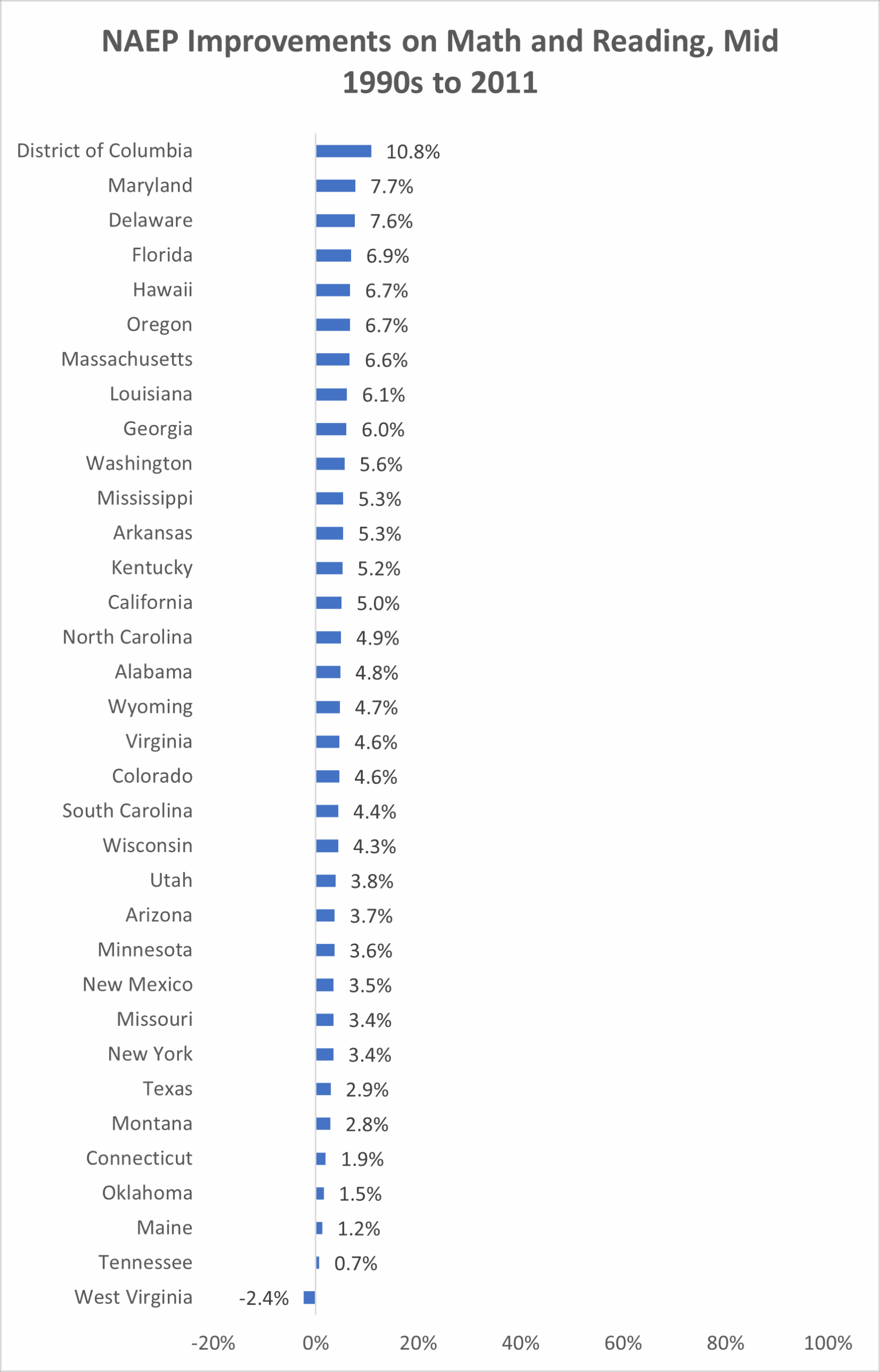
Accountability hawks/the federal government may have indeed coaxed more productivity out of the public school system. Then on a bipartisan basis, Congress removed federal pressure (passed the Senate 85-12 and the House 359-64). Subsequently a large majority if (perhaps?) not every single state merely went through the motions of “accountability” with trophies for (almost) everyone. Kress can justifiably look at these data to claim, “the juice is worth the squeeze” and I can look at the same data to say, “academic transparency is too important to leave to politicians and their appointees.”
Franklin Roosevelt noted ““It is common sense to take a method and try it. If it fails, admit it frankly and try another. But try something.” Every state in the union remains entirely free to adopt tough accountability practices, but apparently few if any have chosen to do so. The next something to try in my opinion are enhanced private rating systems and robust choice programs. Temporarily semi-tough accountability systems run by states and charter school waitlists ultimately proved to be a strategy with limited political sustainability.
By Ron Matus and Dava Cherry
Florida’s choice-driven education system is the most dynamic and diverse in America, but it’s facing new tests. This year, 41,000 Florida students were awarded school choice scholarships but never used them.
We wanted to know why, so we surveyed their parents.
The 2,739 who responded had a lot to tell us. Not only about supply-side challenges, but about the extent to which families are migrating between different types of schools, and their expectations for finding just the right ones.
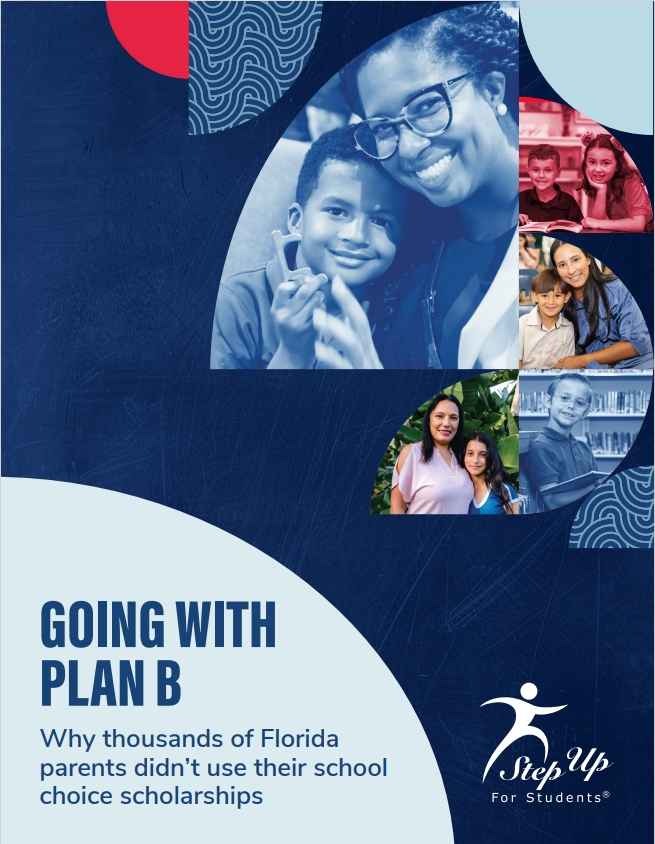
As education choice takes root across America, we thought other states could learn from these parents, which is why we boiled their responses down into a new report, “Going With Plan B.”
We saw three main takeaways:
A third of the respondents (34.7%) said there were no available seats at the school they wanted. This, even though the number of Florida private schools has grown 31% over the past 10 years. Meanwhile, a fifth of the respondents (19.7%) said the scholarship amount wasn’t enough to cover tuition and fees.
Even without scholarships, a third of the respondents (36.5%) switched school types (like going from a traditional public school to a charter school). And between their child’s prior school and the school they ended up in, more experienced a positive rather negative shift in satisfaction (20.4% to 10.5%). We didn’t see that coming.
Two thirds of the respondents said they’d apply for the scholarships again, including 63% of those who switched school types, and 55.5% of those who were satisfied after doing so.
Things got better, it seems, but not better enough.
Perhaps as choice has grown, so too have parents’ expectations.
See the full report here.
Dava Cherry is the former director of enterprise data and research at Step Up For Students, and a former public school teacher.
A recent interview by Tyler Cowen of John Arnold has been making the rounds in ed reform circles, see Michael Goldstein’s write up here. Here is a taste of the interview:
Tyler Cowen: There’s a common impression—both for start-ups and for philanthropy—that doing much with K–12 education or preschool just hasn’t mattered that much or hasn’t succeeded that much. Do you agree or disagree?
John Arnold: I agree. I think the ed reform movement has been, as a whole, a significant disappointment. I think there have been isolated pockets of excellence. It’s been very difficult to learn how to scale that. I think that’s largely true of many social programs or many programs that are delivered by people to people, that you can find a single site that works extraordinarily well because they have a fantastic leader, and that leader might be able to open up a few more sites. But then, when you start to scale it to 50 sites, and start to go across the nation, it all mean-reverts back to what the whole system is providing.
“We’re a dispirited rebel alliance of do-gooders,” Goldstein writes gloomily, but the underlying premises deserve scrutiny, as it strikes me as entirely too pessimistic. Let us for instance look at the academic growth rates for charter schools in Arnold’s home state of Texas as recorded by the Stanford Educational Opportunity Project. Each dot is a Texas charter school, and green dots on or above the zero line display an average rate of academic growth at or above having learned one grade level per year:

This chart deserves a bit of your time to marvel at. While receiving far less total taxpayer funding per student, the Texas charter sector has not only created a large number of schools with high academic growth, but they also place competitive pressure on nearby district schools to improve their academic outcomes. Texas charter schools have not cured the world’s pain, nor have they dried every tear from our eyes. It is hard for me, however, to view it as anything other than a tremendous academic success, and Texas is not alone. Here is the same chart for charter schools in Arizona:
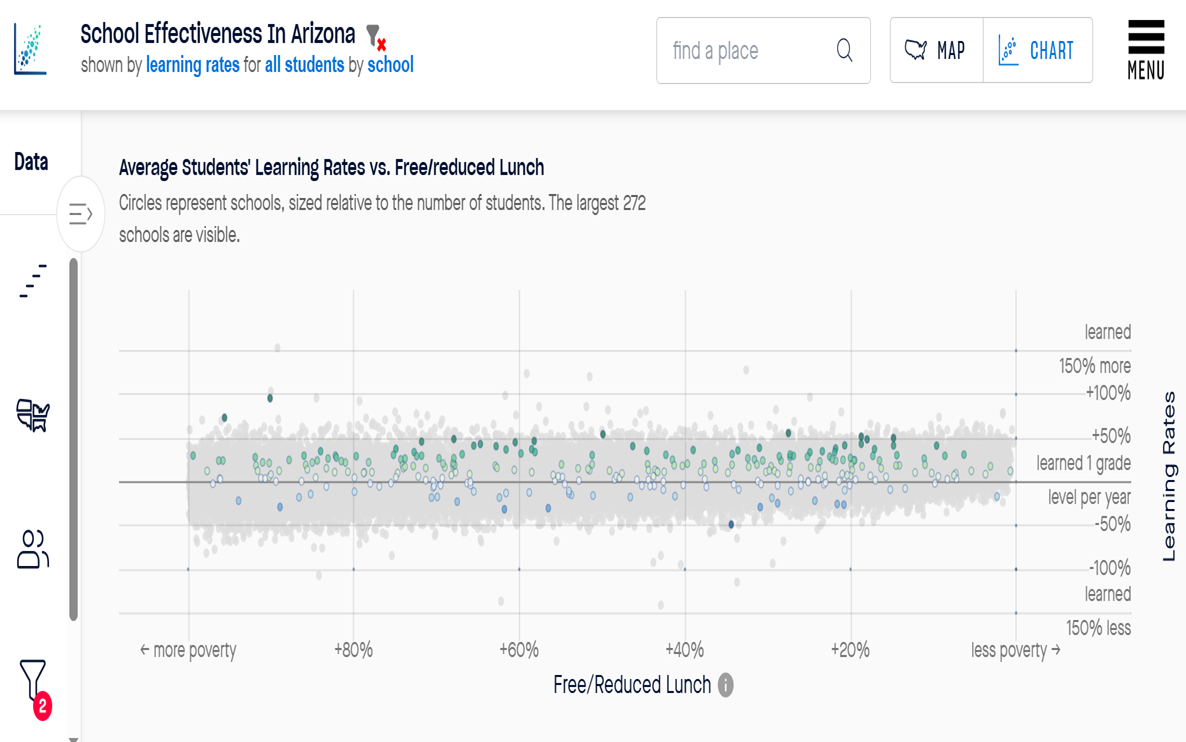
Again, we see far more high academic growth green-dot schools than low academic growth blue-dot schools. Once again, this sector is a bargain for taxpayers, and the sector placed competitive pressure on districts to improve. By the way, Arizona has a larger number of charter schools in low-poverty areas than Texas. That helped crack open high-demand district schools to open enrollment, which is why a real Fresh Prince can go to school in Scottsdale but not in Bel Air or Highland Park in Texas, which opened a vast new supply of choice seats in school districts. The do-gooder rebel alliance, it turns out, made a serious political and educational error when they effectively in a variety of ways excluded suburban areas.
You live and (hopefully) learn. Speaking of Bel Air, behold the magnificence of the academic growth of California’s charter school sector:

Oh, and then there is the 2024 NAEP to consider:

If you do not live in a state whose name starts and ends with the letter “o” you are likely to be happy with your charter sector’s performance vis-à-vis districts, which admittedly, is a low bar. Of course, all this data is messy and neither the growth measures developed by Stanford nor the NAEP proficiency data above capture long-term outcomes- such as do schools produce good and productive people who are well-prepared to exercise citizenship. We are looking through a glass darkly.
The do-gooder education reform alliance should indeed take stock of which efforts produced meaningful results, and which proved to be costly quagmires, and recalibrate their efforts accordingly. To paraphrase the Bard: the education reform movement has 99 problems, but the inability to scale success in choice programs ain’t one.

