Charter schools. A circuit judge denies a Pasco charter school's expansion plan. Tampa Bay Times.
 Virtual schools. A Fort Myers charter tells parents, wrongly, that they must pay $425 if their kids fail to complete Florida Virtual School classes. Associated Press.
Class size amendment. Students down, teachers up. Intercepts.
Ed schools. Florida State College at Jacksonville, one of five state schools rated substandard in NCTQ's new report, says the group got it wrong. StateImpact Florida.
Science. Florida should adopt science standards from California and/or Washington D.C. (and not the Next Generation Science Standards), says state Board of Education member John Padget. Gradebook.
Tech. Broward says it only has $16 million for $59 million worth of technology needs, reports the South Florida Sun Sentinel. Miami-Dade adopts a $63 million plan to ensure every student has access to a digital device by 2015, reports the Miami Herald.
Teacher conduct. A Hernando teacher is suspended for 10 days without pay for allegedly yelling at a student for several minutes, making disparaging racial remarks and throwing a backpack at his chest, reports the Tampa Bay Times. A Venice charter school principal accused of intimidation and bullying has resigned, reports the Sarasota Herald Tribune.
Tutors. Alachua opts to stop giving low-income parents the ability to choose private tutors. Gainesville Sun. (more…)
 For the second time this week, a credible, independent analysis shows Florida students leading the pack in progress.
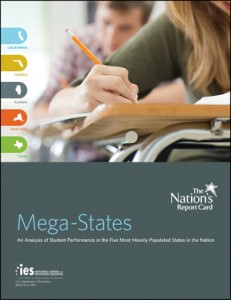
Between 1992 and 2011, Florida students made bigger gains than students in four other “mega states” in fourth- and eighth-grade reading and fourth-grade math, according to a report released Thursday by an arm of the U.S. Department of Education. In each case, they moved from below the national average to meeting or exceeding it. Low-income and minority students in particular showed traction.
“There is something real going on there,” said Jack Buckley, commissioner of the National Center for Education Statistics, according to Education Week.
The center’s comparison followed Wednesday’s College Board report that showed Florida continues to climb the charts on Advanced Placement exams. The Sunshine State now ranks fourth in the percentage of high school graduates passing AP exams. Over the past decade, it ranks second in progress.
Broken-record alert No. 1: Florida’s trend lines shouldn’t be a surprise, given reports like this, this, this, this and this in the past year alone. Yet there remains a lingering perception, cultivated by critics, that Florida’s public schools are sub par and stagnant.
For Thursday’s report, the center for the first time compared scores from Florida, California, Texas, New York and Illinois – the states with the biggest student populations and arguably the biggest challenges. It used results from the National Assessment of Educational Progress, a battery of tests better known as “The Nation’s Report Card” and considered the gold standard among standardized assessments.
In eighth-grade math, Florida students made gains but remain below the national average. Elsewhere in the report, they were singled out often. (more…)

Editor's note: This is the fourth installment of "A Choice Conversation," a dialogue between Doug Tuthill, president of Step Up For Students, and John Wilson, a former National Education Association leader who writes the Unleashed blog at Education Week.
Doug Tuthill: John, I’d like your feedback on some ideas I have about privatization in public education.
For me, privatization in public education occurs when government allows private interests to usurp the public good. Public education would not exist without the products and services individuals and private corporations provide. So the fact that local and state governments contract for these products and services is not a concern. The problem occurs when government officials sign contracts that put private concerns over the public interest.
When I was a teachers union leader, I was regularly criticized for placing the private interests of teachers above the public good. While I gladly pleaded guilty to advocating for our union members, which I was legally and morally obligated to do, I rejected the charge I was trying to privatize public education. If the school board agreed to a contract that put the interests of our union members above the public’s interest, that was the board’s fault. Their job in contract negotiations was to represent the public; my job was to represent the teachers.
All the individuals and corporations that contract with school boards - textbook publishers, charter school providers, teachers unions, builders, bus drivers - have private interests they advocate for when they negotiate contracts. If any of these contracts contribute to privatizing public education, it’s the school board’s responsibility.
John Wilson: Doug, while I agree private interests should not usurp public good, I do not accept that teachers as public employees have private interests within their professional responsibilities or collective bargaining agreement. Salaries, benefits, working conditions, and teaching and learning responsibilities are all in the interest of the public as taxpayers or in the interest of the public as to the impact on assuring a quality teacher for every child. The union may be private, but the members are public; therefore teacher interests cannot be compared to the interests of private sector and for-profit vendors.
I would also add that many of my union colleagues define privatization more broadly as turning over to a private provider a job that has been previously done by a public employee. I would contend this is the single factor that causes mistrust of charter schools and private management organizations. For those of us who believe public money is for public schools, we will have to reconcile how we create choice and customization under the public domain. (more…)

