
Last day of school this year at Sunset Sudbury School in Davie, FL.
Editor's note: Dionne Ekendiz founded the Sunset Sudbury School in South Florida. In her own words, here's why she did it.
I always wanted to become a teacher and make a difference in the lives of children. I truly believed in public education and wanted to be part of making it better. But like many “smart” students, I was dissuaded from that career path, especially by my math and science teachers. They encouraged me to do something “more” with my life, so I went off to MIT and pursued a degree in engineering. After 12 years as an engineer, computer programmer, and project manager in the corporate world, I finally had the confidence and courage to make a change. Others thought I was crazy to leave a great career, but I was driven to pursue my own passion.
 I entered a master’s of education program and sought to get the most of my experience there. When I heard about a professor who was conducting research in the “best” public schools in the area, I volunteered to be his graduate assistant. This took me into the schools twice a week. I loved working with the students, but there were things I didn’t like about the environment. One of the most disturbing was how teachers and aides would yell at students to “stay in line” and “don’t talk” in the hallways. Those were the times that schools felt most like prisons to me. But still, I believed a good teacher could learn to control his/her students in a more humane way, so I didn’t let it bother me so much.
A year into my education program, I gave birth to my first child. Watching her grow and learn on her own, especially during her first years, made me see the true genius inside her. Indeed, it is a genius that exists in all children. She was so driven to master new skills like walking, talking, and feeding herself. I was always there with love, support, and encouragement, but my instincts told me to stay out of her way as much as possible and let her own curiosity guide her. Because of my own experiences with schooling and well-meaning teachers, I was determined to let my daughter make her own choices. I knew that with curiosity and confidence intact, she could do and be anything she wanted to.
It slowly dawned on me that everything I was learning about teaching was contrary to the philosophy I was using in raising my own daughter. The goal of teachers, in the traditional setting, is to somehow stuff a pre-determined curriculum into students’ heads. Some teachers do it more gently than others and make it more fun, but the result is the same. Teachers must stifle their students’ own interests and desires to meet the school’s agenda. Simply put, regardless of how nice a teacher is, s/he must coerce students into getting them to do what s/he wants them to do. What I was once willing to do to other people’s children, I wasn’t willing to do to my child. That was a huge wake-up call for me. (more…)
Charter schools. A circuit judge denies a Pasco charter school's expansion plan. Tampa Bay Times.
 Virtual schools. A Fort Myers charter tells parents, wrongly, that they must pay $425 if their kids fail to complete Florida Virtual School classes. Associated Press.
Class size amendment. Students down, teachers up. Intercepts.
Ed schools. Florida State College at Jacksonville, one of five state schools rated substandard in NCTQ's new report, says the group got it wrong. StateImpact Florida.
Science. Florida should adopt science standards from California and/or Washington D.C. (and not the Next Generation Science Standards), says state Board of Education member John Padget. Gradebook.
Tech. Broward says it only has $16 million for $59 million worth of technology needs, reports the South Florida Sun Sentinel. Miami-Dade adopts a $63 million plan to ensure every student has access to a digital device by 2015, reports the Miami Herald.
Teacher conduct. A Hernando teacher is suspended for 10 days without pay for allegedly yelling at a student for several minutes, making disparaging racial remarks and throwing a backpack at his chest, reports the Tampa Bay Times. A Venice charter school principal accused of intimidation and bullying has resigned, reports the Sarasota Herald Tribune.
Tutors. Alachua opts to stop giving low-income parents the ability to choose private tutors. Gainesville Sun. (more…)
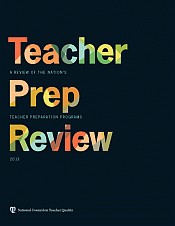
The National Council on Teacher Quality released its first Teacher Prep Review today, and the findings show only a handful of colleges and universities adequately train aspiring teachers.
 Which means many of the programs are leaving new teachers ill-equipped to keep up with the growing rigor of public instruction – and that’s bad news for a country about to raise the bar on education benchmarks with the adoption of the Common Core State Standards.
“The problem is worse than we thought,’’ said Brian Kelly, editor and chief content officer of U.S. News & World Report, which published the study. “The data show that the academic caliber of many incoming students is quite low, and what they are taught often has little relevance to what they need to succeed in the classroom.
“Very few schools meet even a minimum standard of quality when it comes to using the best practices for educating teachers,’’ he said in a prepared statement.
If the goal is to help all teachers succeed, “we not only need to change what happens in the schools where they work, we must also address the preparation of the next generation of educators,’’ said Kate Walsh, president of the national council. “New teachers deserve training that will enable them to walk into their own classroom on their first day ready to teach, but our review shows that we have a long way to go.’’
The study looked at 1,130 institutions, including 32 in Florida. Among the findings:
Rick Scott. Gov. Rick Scott vetoes about $400 million in spending and a proposed tuition hike, reports the Associated Press and South Florida Sun Sentinel. (Tampa Tribune columnist Joe Henderson gives him a thumbs up.) Vetoes other ed-related items, reports StateImpact Florida. Vetoes $1.5 million for a STEM project in Pasco, reports Gradebook. Vetoes $14 million for a new building at Gulf Coast State College, reports the Panama City News Herald. Vetoes a $7.5 million "innovation hub" at Florida Gulf Coast University, reports the Naples Daily News. Doesn't veto a wind tunnel at Embry-Riddle Aeronautical University, reports the Daytona Beach News Journal.
Dual enrollment. Gov. Scott signs into law a measure that requires districts to pick up the cost. Orlando Sentinel.
Teacher merit pay. Pinellas is about to roll out a pilot at seven schools. Gradebook.
Teachers unions. A glimpse at the financial picture for United Teachers of Dade. Intercepts.
Ed schools. The Hechinger Report uses the University of Central Florida as the lead for a story about more scrutiny and accountability coming to colleges of ed.
School spending. Projected layoffs reach 282 in Manatee, including 182 teachers, reports the Bradenton Herrald. About 100 rally to show support for the teachers, the Herald also reports. More from the Sarasota Herald Tribune. (more…)
I wish the education reform movement would put more focus on the broken schools of education that fail to attract highly qualified students or to train them to perform well in the nation’s classrooms.
 Six years have passed since The Education Schools Project, headed by Arthur Levine, former president of Teachers College at Columbia University, issued a comprehensive and scathing indictment of the nation’s schools of education. The report found an overwhelming lack of academic standards and understanding of how teachers should be prepared. It determined that “most education schools are engaged in a ‘pursuit of irrelevance,’ with curriculums in disarray and faculty disconnected from classrooms and colleagues.” Moreover, schools of education have become “cash cows” for universities. The admissions standards are low. The research expectations and standards are far below those expected in other disciplines. And there is no pressure to raise student academic outcomes because, at least in part, school districts often only care about a “credential” and not the learning it represents.
Have things improved since Levine’s report? Speaking at a panel during the recent Excellence in Action National Summit on Education Reform, Kate Walsh, president of the National Council on Teacher Quality, previewed the results of a comprehensive study to be published in U.S. News & World Report in April 2013. It affirms little has changed. For example, only about 20 percent of schools of education have admission standards that even require applicants to be in the top 50 percent of their high school graduating class. Only 25 percent of schools of education require their students to be placed with an “effective” teacher when student teaching. (more…)
After more than a decade working in education reform I learned long ago that if I stopped to kick every snapping dog along the pathway, I would never arrive where I needed to go. But every now and then I read something, such as Diane Ravitch’s latest op-ed on CNN.com, and have to take a breath and ask “Really?” One of my earliest resources as I was starting in education reform back around 2000 was her book, “Left Back: A Century of Failed School Reforms.” But now it appears she’s utterly abandoned that historical analysis in favor of status quo incrementalism and apologies for failure.
Let’s just think about Dr. Ravitch’s assertions:
The NAEP test scores of American students are at their highest point in history: for black students, white students, Hispanic students, and Asian students.
They are at their highest point in history in fourth grade and in eighth grade, in reading and math.
I tend to agree with Dr. Ravitch that the National Assessment of Educational Progress (NAEP) test is the most valid measure of academic performance. But why is that? Primarily, as my American Center for School Choice colleague, Alan Bonsteel, recently reminded us, it is because most states have catered to their own self-interest, aligning examinations to weak standards to give the appearance of academic achievement rather than actually increasing the amount of learning necessary for student success in this century. So for most of the last 10 years, under No Child Left Behind, we permitted widespread creation of dysfunctional and often meaningless standards aligned to dysfunctional and meaningless tests. Logically, this history does not make for a persuasive indictment of the value of legitimate standards and assessment tools.
But beyond that, let’s look at Dr. Ravitch’s assertion:
The “highest point in history” while true, is relative to what?

With the exception of the Asian/Pacific Islander group, I doubt anyone is throwing a parade for the educational system’s accomplishments over the last 20 years. Are 7-point gains over 20 years for African-Americans and Hispanics and a 9-point gain for white students really the kind of progress we expect after multiple billions of real increased educational spending? Yet this seems to be what Dr. Ravitch finds acceptable performance. (more…)
Don’t like what an education reformer has to say? Just call them a teacher basher.
Increasingly, that’s what teachers and others are doing, with this recent blog post on CNN – “When did teacher bashing become the new national pastime?” – being the latest in a long list of examples.
Most of these articles set out straw men. There’s the frequent assertion that we only want to judge teacher performance by one standardized test score (few do). And another that teachers simply face an impossible job with students who are too damaged or too unmotivated to learn (a myth Education Trust dispelled long ago.) Most reformers assert quite properly that a teacher is the heart of the education system and the key to improving it. They should be treated better. They should be valued more highly. But the conundrum seems to be that teachers just don’t seem to believe that anyone can fairly measure what they do, so they collectively have resisted all efforts to implement meaningful performance standards. I find that odd, however, because I have never met a teacher who couldn’t tell me in a couple of minutes who the best and worst teachers in the school are
If we assume a good teacher enables a student to advance quickly and a poor teacher does the opposite, then it becomes difficult to dispute that the teaching profession is horribly broken. (more…)

