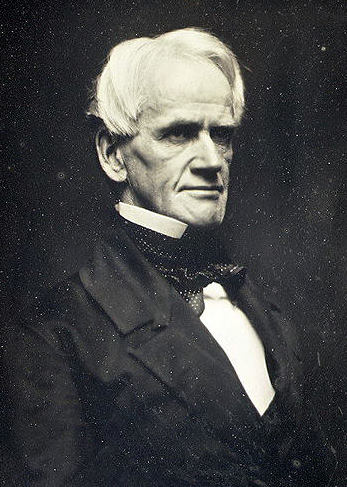
Horace Mann (Source: Wikimedia Commons)
The first-ever state supreme court ruling finding charter schools unconstitutional continues to stir debate all over the country, and has inspired some choice opponents to raise questions about other charter school laws, including the nation's oldest.
While there is little reason to think the Washington State Supreme Court's legal reasoning could spread to many other states, it is the latest illustration of how an idealized past that never was continues to create barriers to a 21st-Century education system.
Opponents try to cast a romantic vision of free, universal public education as a foil against school choice, relying on a mythical conception of "common schools" that has rarely squared with reality.
Getting American common schools to serve all students required more than a century of political turmoil, countless lawsuits and no shortage of attempts — from Dust Bowl-era California farm towns to the Freedom Schools launched by the Civil Rights Movement — to create separate educational opportunities for religious and ethnic minorities who were excluded from, or under-served by, traditional public school systems.
In many ways, the fight for inclusion and equity continue to this day.
“[P]eople too frequently forget that those schools were at different times not open to blacks, religious minorities, or, until the 1970s, students with special needs and disabilities,” Andrew Rotherham and Richard Whitmire wrote in a recent piece for The 74.
Common schools were first popularized in the mid-1830s by Massachusetts education reformer Horace Mann. The idea spread through out the U.S. over the next few decades during a time when anxiety over waves of immigrants, many of them from Ireland and other predominately Catholic countries. (more…)
Jay Bookman at The Atlanta Journal-Constitution is among the more faithful opponents to school vouchers and has frequently criticized a Georgia measure, as he did today, as representative of "another step in an incremental, largely undeclared assault on public education ..." Leaving aside Bookman's hyperbole, his current argument is a useful entry point for discussing the historical nature of public education. Specifically, the emergence of additional public and publicly funded private learning options brings us largely full circle to the educational choices at the "beginning of the American experiment" that the AJC columnist romanticizes about. More to the point, Bookman isn't quite accurate when he writes:
From the beginning of the American experiment, public schools have been understood as a mechanism of assimilation and a means of giving us a shared understanding. They have been the 'common schools,' the place where as children we are exposed not just to a common curriculum but to others unlike ourselves.
Would that it were so. American education evolved within the American experiment into the early 19th century as an enterprise that recognized little distinction between "public" and "private." Efforts to centralize education into the "common school" we know today did not proceed without challenges. Indeed, the earliest attempts in administering a public education in New York took root in the state's "permanent school fund," which supported church schools and charitable groups that provided free education for the neediest children. The idea of a common school didn't emerge until Horace Mann, toward the middle of the 19th century, embarked on what educational historian Lawrence A. Cremin called a "campaign of public education about public education." (more…)

