Editor's note: Last week, former U.S. Secretary of State Condoleezza Rice presided over her first national policy summit as chairwoman of the Foundation for Excellence in Education. Her opening keynote address served as a statement of purpose for the school choice and education reform movement.
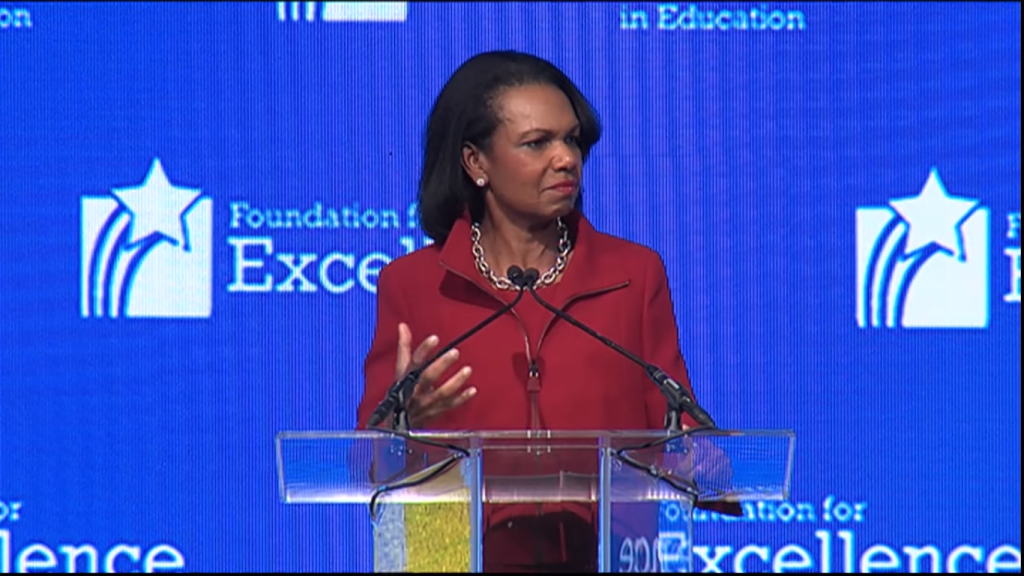 Like in her speech at the foundation's previous gathering, she drew on her family background and her experience growing up in the South. The full video is not yet available online, but a short clip is embedded below and more can be found here. Below is an excerpt from her remarks, edited for length.
This is a great movement, and great movements are built on a core premise. They're built on a sense that something's not right, and that it has to be made right.
What we really should be doing, is to not accept the world as it is, but to work for the world as it should be.
The world as it is, is a world in which I can look at your ZIP code and I can tell whether you're going to get a good education.
The world as it should be is one in which every child's life is worthy and fulfilled.
Education is the key to so many of the ills that we face.
I know that poverty and broken families and social immobility and joblessness are critical issues, but education has always been our best intervention, our best lever to make sure that those evils do not produce another great evil: Two societies, one capable, and one not.
This is an article of faith, and it has been in my family for many years ... They understood the transformative power of education ... Education gives you horizons ... you would never otherwise have. But we know that if it doesn't start now for each and every child, it will never happen. We won't accept that.
At the RNC in Tampa this week, a small but bright constellation is scheduled to line up on education reform. Democrat Michelle Rhee, who famously tangled with teachers unions as schools chief in Washington D.C., will share a spotlight with Jeb Bush, who has praised President Obama’s ed initiatives, and Condoleezza Rice, who co-authored a Council on Foreign Relations ed report with Democrat Joel Klein. The panel will be moderated by Campbell Brown, the former CNN anchor who just got into a Twitter spat with Randi Weingarten. All will come together after a private screening of “Won’t Back Down,” a new movie that shows even Hollywood has embraced parental empowerment in education.
This will be a remarkable little event – a hopeful symbol of a centrist political coalition, in the midst of a red partisan sea, that is poised to take advantage of historic opportunities to re-shape the nation’s schools.
Poised, that is, unless it get chewed up by the fringes.
The Republican Party may be tilting even more right, but on education the centrists still hold sway. Jeb Bush, who supports a federal role for education, and backs national academic standards, remains one of the party’s leading lights on ed reform. His prime-time speech will likely generate more ink about education than anything else that happens at the RNC.
But obviously, there is tension. Rising Tea Party currents want to erode recent federal activism in ed reform – a position that so ironically leaves them pitching tents next to teachers unions. Their passion is well-meaning; their arguments worth considering. But their timing is especially bad: Reform-minded Republicans and Democrats are getting close when it comes to a common vision for public education – a vision that includes a healthy dose of school choice and bottom-up transformation. This rare alignment is mostly intact because the GOP led on education, and enough Democrats bucked their own fringes to shift the GOP’s way.
In a recent op-ed for redefinED, Margaret Spellings, the secretary of education under George W. Bush, didn’t call out Tea Party groups by name, but she didn’t mince words when it comes to the potential consequences of their aims: “This ‘unholy alliance’ between the unions and those who want no role for the federal government in education is propping up the status quo on the backs of our most vulnerable children,” she wrote. “It’s shameful beyond words.”
Mitt Romney and the ed centrists won a quiet victory in Tampa last week. They beat back attempts to restore an old plank in the GOP platform – eliminating the U.S. Department of Education. Tea Party linked groups got almost everything else they wanted. But according to Politico, instead of using the word “eliminate” in the draft language regarding the U.S. DOE, a subcommittee voted to replace it with a call to “support the examination and functions of.”
That’s a breather, but a temporary one. It should give added urgency to those in both parties who want to see constructive change and know more will get done, quicker, if centrists work together and find ways to grow their ranks. It’s important to remember that today, at the start of the storm-delayed RNC, before the spin makes every crack between Romney and Obama on education look like a canyon.
As a former U.S. Commerce Department Foreign Service officer, as well as someone who worked extensively in international trade and economic policy earlier in my career, I was especially interested to read the Council on Foreign Relations new report, "U.S. Education Reform and National Security." The council’s task force was chaired by former Secretary of State Condoleeza Rice and former New York City schools chief Joel Klein. For anyone who spends time thinking about international competitiveness and security issues, the important link to a successful education system is readily apparent. But for many, education remains a domestic issue separate from foreign activities.
For us education policy wonks, most of the data is not new or surprising. An exception for me: the fact that now 75 percent of U. S. citizens between 17-24 are not qualified for military service because they are physically unfit, have criminal records or have inadequate levels of education. Among recent high school graduates who are eligible to apply, 30 percent score too low on the Armed Services Vocational Aptitude Battery to be recruited. The achievement gap is alive and well in the military also: African American applicants are twice as likely to test ineligible as white applicants.
The report quotes from a U.S. military report that found in a staff of 250 at an intelligence headquarters in Iraq, “only 4-5 personnel were capable analysts with an aptitude to put pieces together to form a conclusion.” This included both officers and enlisted personnel. Suddenly, it becomes more plausible to understand how a military unit in Afghanistan thought burning Korans would be a good way to dispose of them! Unfortunately, data raising questions about the critical thinking and educational background of some in the officer corps correlates with the huge numbers of seemingly strong high school graduates that require remediation in college.
Rather than a long litany of recommendations, the report makes only three. And one of them is to restructure education to provide students with good choices. The task force wants parents to have a wider range of options and wants to see a system that encourages and supports innovation. (more…)

