 School construction: K-12 schools and colleges and universities will be competing for school construction money during the next legislative session, which begins in March. Florida Senate President Joe Negron, R-Stuart, says higher education is a top priority, but it's unclear how much money will be available and how it will be shared. Orlando Sentinel.
Principal program: The Florida Board of Education expects to detail the rules outlining the autonomy principals will be given in turning around struggling schools. The pilot project could be rolled out in seven districts: Miami-Dade, Broward, Palm Beach, Pinellas, Duval, Jefferson, Madison and Seminole counties. The board meets Jan. 17. Gradebook.
Gifted programs expand: In the past three years, the Seminole County School District has doubled the number of black, Hispanic, English-learning and low-income youngsters in its gifted program. Orlando Sentinel.
Middling grades: Florida is given a C grade, slightly below the U.S. average, in the annual Quality Counts report from Education Week's Research Center. Florida's score was 72.5, while the U.S. average was 74.2. The grades are calculated from a success index, spending on education, spending equity across state districts and an achievement index. Massachusetts is the top state with a score of 86.5 and a grade of B. Education Week. (more…)
Lawsuit dismissed: Florida has not failed to fulfill its constitutional mandate to provide a quality education for all public school students, a circuit court judge has ruled. Judge George Reynolds III dismissed the suit brought by Citizens for Strong Schools and others against the State Department of Education and legislative leaders. The plaintiffs charged that the state's racial achievement gap, emphasis on testing and lack of adequate funding kept the state from satisfying the terms of a 1998 constitutional amendment. Reynolds disagreed. "The weight of the evidence shows that the state has made education a top priority both in terms of implementation of research-based education policies and reforms, as well as education funding," he wrote. Gradebook. Palm Beach Post. Orlando Sentinel. Gainesville Sun. WFSU. Politico Florida. News Service of Florida. Associated Press. redefinED.
Bush is back: Former presidential candidate Jeb Bush is elected chairman and president of the board of directors of the Foundation for Excellence in Education. He replaces Condoleezza Rice. Bush formed the foundation in 2007 after two terms as Florida governor. He suspended his presidential campaign three months ago. The Hill. Miami Herald. Tampa Bay Times. Florida Politics. Sunshine State News.
Discrimination query: Federal grants are being withheld as the Polk County School District's harassment and discrimination policies are under review by the Office of Civil Rights and the Department of Justice. School Board attorney Wes Bridges says the move is most likely tied to the Obama administration directive saying transgender students should be allowed to use the restroom of their gender identity. Lakeland Ledger.
Bathroom rights: The Obama administration directive on allowing transgender students to use the bathroom conforming to their gender identity could lead to a boom in school bathroom construction. In an email to his colleagues, Sumter County School Superintendent Richard Shirley wrote: "Students will be expected to use group restroom facilities based on their birth gender until necessary remodeling takes place to insure the safety, privacy and comfort of all students in single unisex restroom facilities." Gradebook.
District sex survey: Citing teen pregnancy and sexually transmitted diseases rates, the Hillsborough County School Board agrees to survey students about their sexual behavior. Parents can have their children opt out. Tampa Bay Times. (more…)
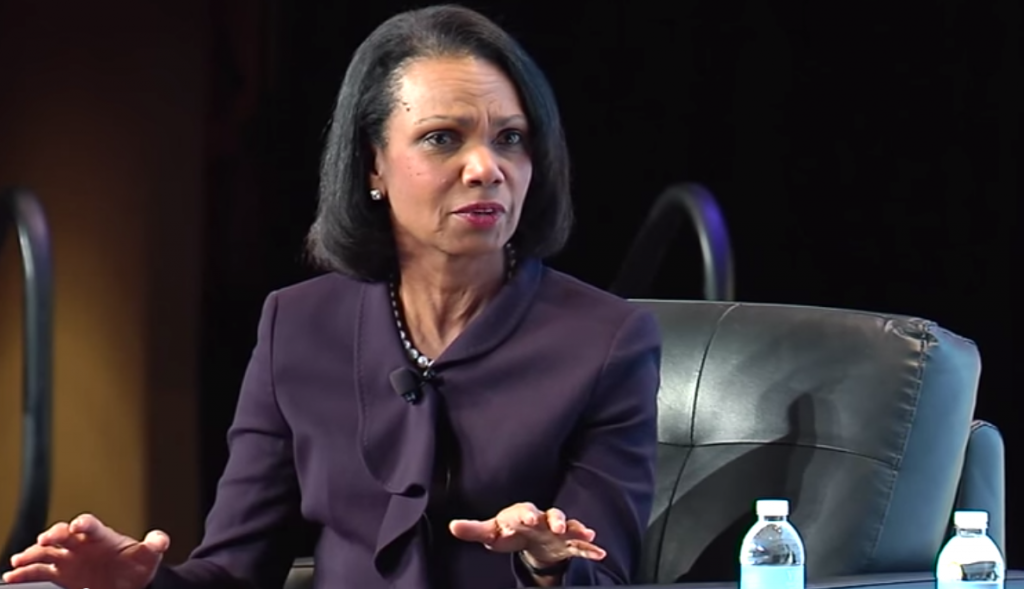
Former Secretary of State Condoleezza Rice was tapped Thursday to succeed former Florida Gov. Jeb Bush at the helm of the Foundation for Excellence in Education. She’s no stranger to the education reform movement. She’s long been an advocate for school choice.
This fall, during a keynote discussion at the foundation’s annual conference in Washington, she discussed issues from growing up in the segregated South to trusting parents to make decisions about their children's education.
In this excerpt, transcribed and lightly edited, she explains how she supports both improving existing public schools, and giving parents more choices.
 I'm a great believer in public schools and public education. It's one of the foundational institutions of our democracy.
But who are we kidding?
The problem today is that we have a public school system that is, in its very essence, unequal. If you are a parent or a family of relative means, you will move to a district where the schools are good. That's why houses are expensive in Palo Alto, where I live. That's why houses are expensive in Fairfax County, near here. That's why they're expensive in Hoover, Ala., right outside of Birmingham.
If you are really of means, you will send your kid to a private school. And so who's stuck in failing neighborhood schools? Poor kids, many of whom are minority kids. So we already have an opt-out system in the public school system. And all that those of use who believe in school choice are saying is, give parents who don't otherwise have the means a chance to send their children to a school that might work for them.
Education savings accounts. Bills filed Friday and Saturday would create a new mechanism for funding school choice options. Tallahassee Democrat.
 Charter schools. Some 1,200 students apply for 650 slots at a new charter in Viera, reports Florida Today. An overwhelming majority of parents and teachers vote against the proposed conversion of a Key Biscayne school into a charter, reports Miami Herald. The Palm Beach school district is recommending that its board shut down three charters, reports the Palm Beach Post. The Pepin Academies, a charter that serves disabled students in Tampa, wants to open a campus in Pasco, reports the Tampa Bay Times.
School choice. Pasco Superintendent Kurt Browning is merging the district's choice programs - open enrollment, charters, career academies, etc. - in one department. Gradebook.
Parents. At Jacksonville's first-ever ed summit, Duval Superintendent Nikolai Vitti reiterates that he wants to transform how the district views parents. Florida Times Union.
Common Core. Tampa Bay Times overview of what's coming - and whether it can happen according to schedule. Part one here. Part two here.
Legislative preview. "Reforming school reform." Tampa Bay Times.
New faces. Former Secretary of State Condoleezza Rice and Laurene Powell Jobs have joined the board of directors for the Foundation for Excellence in Education. EdFly Blog. (more…)
 At Jeb Bush’s National Summit on Education Reform in Washington, D.C. last week, two prominent education reformers from the center-left and the center-right joined to make a remarkable statement about parental choice. Asked from the audience to name their “No. 1 idea” to improve public education, former New York City school chancellor Joel Klein and former U.S. Secretary of State Condoleezza Rice answered with a remarkably united voice.
Their three minutes of extemporaneous remarks are well worth your time, and are available through C-SPAN.org here.
In brief, Klein spoke of the way various types of learning options, including charter schools, have helped spur improvements in New Orleans and Harlem: “About a third of the kids in Harlem in the third grade are in charter schools. What’s amazing is the Harlem District went up, and this is apples to apples, went up dramatically from when we started this intensive choice process there to now. … Not only did the charter schools outperform almost everybody, but the public schools … actually moved up significantly themselves.”
Rice spoke to how competitive pressures have produced a “catalytic” effect in higher education, and noted that only wealthier families tend to have choice in a K-12 system where pupil assignment is determined only by geography: “So the only people stuck in neighborhood schools are poor people, and that’s the height of inequality. And that’s why I’ve called it a civil rights issue.”
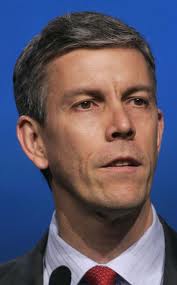 The next few years are critical for education reform, with the implementation of higher standards likely to put tremendous pressure on political leaders to abandon course, U.S. Education Secretary Arne Duncan said Wednesday.
“The idea of implementing higher standards, the adoption in 46 states of higher standards, is clearly a huge step in the right direction. (But) that’s the easy part,” Duncan, referring to Common Core standards, said at a national education summit organized by Jeb Bush’s Foundation for Excellence in Education. “Will our political leaders have the courage when test scores drop 20, 30, 40, 50 percent? … Will they have the courage not to backpedal and dummy down standards like political leaders did under No Child Left Behind?”
Despite the challenges, Duncan said he was optimistic that state and local leaders would rise to meet them, and in bipartisan fashion. He pointed to recent reforms as proof.
“I’m actually extraordinarily hopeful,” he said in response to a question from moderator Andy Rotherham. “When I look at what states did, local legislative leaders, chief state officers, what they have done over the past couple of years, no one predicted that would happen. No one predicted that 46 states would adopt higher standards. No one predicted that three dozen states have taken teacher evaluations and principal support to a very different level. No one predicted that we would have 44 states working on the next generation of assessments. Frankly, we’ve had almost no rollback. And honestly, if a couple states choose to roll back, that would not be the end of the world.”
Duncan was a keynote speaker at the fifth annual summit, which drew about 800 participants from nearly every state. He made a pitch for continued investment in early childhood education and stressed teacher quality and teacher equity. He said the fact that not a single district has methodically moved to align its best teachers with its most struggling students is a sign of how far reformers have yet to go. (more…)
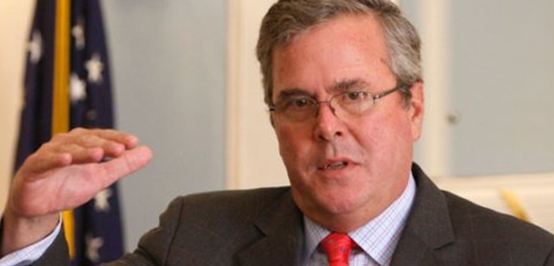 Jeb Bush may or may not seek the presidency in 2016, but those who dismiss his education foundation as a political prop are simply out of touch. What the Foundation for Excellence in Education is showing once again, with its fifth annual national summit, is that it is creating a sense of urgency and national purpose around our most fundamental commitment to each new generation.
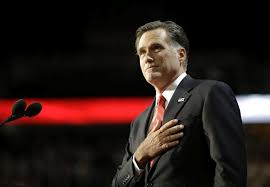 Choice at the RNC: Mitt Romney drops a line about school choice in his big speech, while Jeb Bush and Condoleezza Rice say more (redefinED). A former voucher student from Florida joins Jeb Bush on stage, saying in an interview later, "Because I had choice in my education, I was granted a better life (redefinED). (Image from minnesota.publicradio.org)
Louisiana: A statewide teachers union accuses the Black Alliance for Educational Options and other school choice groups of supporting a pro-KKK educational curriculum. (Choice Media)
Washington: The political landscape around charter schools has changed as voters get ready to vote on a charter measure for the fourth time. (Seattle Times)
Florida: A powerful lawmaker and school choice supporter is puzzled by charter schools that want to set up in one of the school districts in his legislative district. (St. Augustine Record)
Ohio: Hundreds of special needs students are benefiting from a voucher program. (Cincinnati.com) (more…)
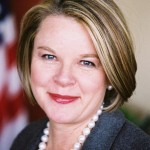
Sec. Spellings
As the RNC wound down today, it took a sharp turn back towards partisanship in education reform, with former U.S. Education Secretary Margaret Spellings offering the week’s hardest knock on President Obama’s education record.
Former President George W. Bush reached across the aisle to work with the late U.S. Sen. Ted Kennedy and other Democrats to pass No Child Left Behind, said Spellings, who Bush appointed. And it’s no surprise, she said, that former Florida Gov. Jeb was the most successful education governor in recent times.
“That’s because of leadership,” Spellings said at an education panel sponsored by Bloomberg Link and the 2012 Tampa Bay Host Committee for the RNC. “We have not seen that from President Obama on this topic.”
“If half the minority kids in this country were not getting out of high school on time, we ought to be marching in the streets,” she continued. “If half the school lunches served next week in these schools were tainted, we would be marching in the street. Michelle Obama would write a cookbook.”
Spellings criticized some aspects of Race to the Top, Obama’s signature education program, and panned his administration’s decision to grant No Child flexibility to a number of states.
“The Obama administration has given waivers out like candy,” she said. And the result has been a return to lower standards for poor kids.
Jeb Bush, who was part of the panel discussion, did not criticize Obama. But he also did not praise him as he has in the past, including earlier this week. He directed his fire at teachers unions. (more…)
From the speech by Condoleezza Rice speech at the RNC tonight:
Your greatest ally in controlling your response to your circumstances has been a quality education. But today, today when I can look at your zip code and I can tell whether you’re going to get a good education, can I honestly say it doesn’t matter where you came from, it matters where you’re going? The crisis in K-12 education is a threat to the very fabric of who we are. My mom was a teacher. I respect the profession. We need great teachers, not poor ones and not mediocre ones. We have to have high standards for our kids because self-esteem comes from achievement, not from lax standards and false praise. And we need to give parents greater choice, particularly, particularly poor parents, whose kids, very often minorities, are trapped in failing neighborhood schools. This is the civil rights issue of our day. If we do anything less, we condemn generations to joblessness and hopelessness and life on the government dole. If we do anything less, we will endanger our global imperatives for competitiveness. And if we do anything less, we will tear apart the fabric of who we are and cement the turn toward entitlement and grievance.

