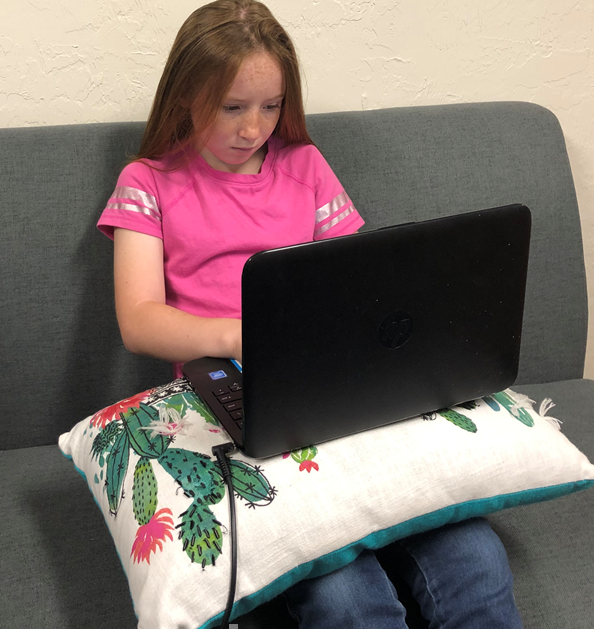
Miley Parks, 10, a fifth-grader at Riverside Christian School in Trenton, Florida, works on a school assignment on her laptop.
As the COVID-19 pandemic forced the statewide shutdown of school campuses, Riverside Christian School principal Ginny Keith knew she’d have to act quickly to develop a game plan for distance learning.
“I didn’t know much about technology,” admitted Keith, principal of the 140-student K-12 school in Trenton, Florida, at the heart of rural Gilchrist County. Half of the students receive a Florida Tax Credit Scholarship for lower-income and working-class families; three attend on a Gardiner Scholarships for students with unique abilities. Both programs are administered by Step Up For Students, which hosts this blog.
Keith took a leap of faith and asked for help from what some would consider an unlikely ally: public school district staffers who made it possible for Riverside to be up and running with a distance learning program that included live online instruction.
Joe Mack Locke, who works in IT for the Levy County School District, didn’t hesitate to come to Riverside’s assistance.
“It doesn’t matter if they’re my kids or Dixie County kids or Gilchrist County kids,” Locke told Keith.
Gilchrist County and its closest neighbors, Levy and Dixie counties, form a close-knit rural community where ties are strong, especially among educators. Riverside teacher Donna Goodson-King used to work with Locke in the Dixie County School District and once taught Locke’s daughter at a district high school. She also was married to Locke’s late cousin. So naturally, Goodson-King reached out to Locke when the school needed help.
“Education is a family in itself,” Goodson-King said.
With his school district’s approval, Locke helped set up Riverside’s Google infrastructure. A former colleague of Goodson-King’s from another neighboring county volunteered to teach staff how to use Google resources.
“Educating children is educating children, and we’re going to help them no matter who they are,” said Locke, who spent 17 years working in IT for the Florida Department of Corrections and saw firsthand the consequences of a poor education. “I’m in technology, but my job is to educate children using technology.”
Keith and her team soon were ready to launch. Count parent Judy Parks among the grateful.
“Everything is going pretty smoothly, and everyone is going with the flow,” said Parks, whose son, Kody, 15, and daughter, Miley, 10, attend Riverside, where Parks works as the school secretary.
The school uses a curriculum called Accelerated Christian Education Paces, which allows students to work at their own speed in each subject. Teachers initially gave quizzes along with a pre-test and a test for each unit but dropped the quizzes because they became too much to keep up with. Tests are given orally to remove any temptation for students to be less than rigorously honest.
Each school day, the Parks kids wake up, eat breakfast, make their beds, and then start their school day. Classes at Riverside are self-contained for younger students, while a small team of teachers educate students in higher grades. Attendance is taken by requiring each student to check in with his or her assigned teacher each day by Facebook, text or email.
The method doesn’t really matter, Keith said; turning in assignments also serves as proof of attendance. Those who haven’t been heard from by 3 p.m. each day get a phone call, she added.
Teachers host live teleconferences on Zoom and Google Meet and communicate via text or FaceTime.
“The teachers are available any time throughout the day and that makes it a blessing,” Parks said.
The live instruction has been the biggest hit with the kids.
“They can see one another, and they just get excited to see their friends and be social for a few minutes,” she said.
Locke, who also is a representative for Fellowship of Christian Athletes, isn’t stopping there. He’s now helping Riverside form its own FCA chapter.
“Whether these kids are living in your community, if you’re an educator, you don’t care,” Keith said. “They’re all our kids.”
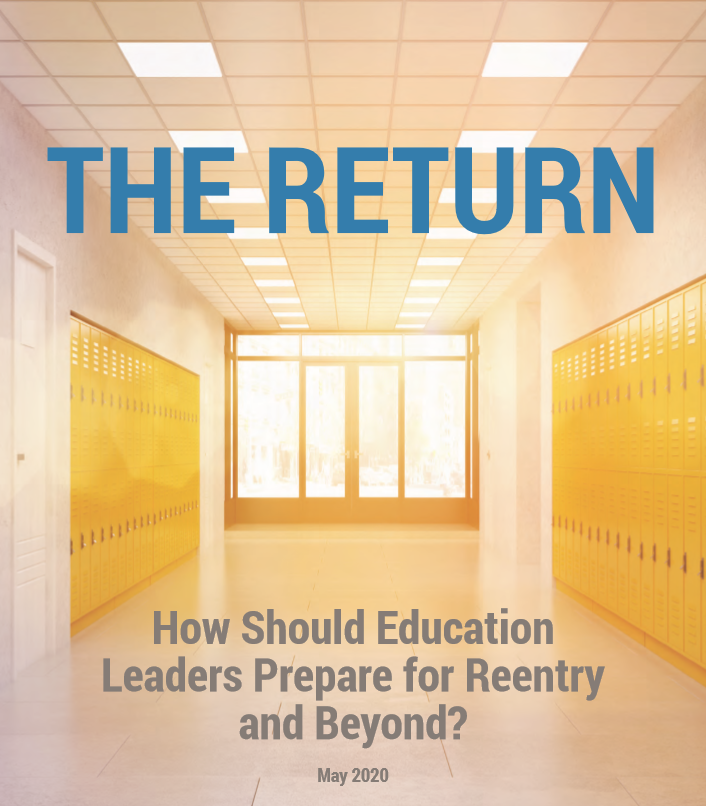 Editor’s note: redefinED guest blogger Ashley Berner, deputy director of the Johns Hopkins Institute for Education Policy and associate professor at the Johns Hopkins School of Education, and David Steiner, the institute’s executive director, comment on their new report, jointly released with Chiefs for Change, that outlines relevant research and provides key recommendations for reopening K-12 schools when public officials deem it safe to do so.
COVID-19 brought face-to-face learning around the world to an abrupt halt. Now, after weeks and months of remote learning, some countries are beginning to open the schoolhouse. Others, including most U.S. systems, will not resume brick-and-mortar operations until August or September. The first order concern is, of course, the health of our families and teachers.
But education leaders already are wrestling with critical issues that are next in line, such as: How will we structure instruction to maximum effect? What additional supports should we build into the school year to prepare for abrupt changes in the future? And, most importantly, what is the best way to accelerate, rather than remediate, student learning in the wake of COVID-19?
To answer these questions, our team at the Johns Hopkins Institute for Education Policy partnered with Chiefs for Change to evaluate the research on interventions that work for students in normal times and in the wake of crises such as SARS in Hong Kong or tsunamis in Japan. The result is The Return: How Should Education Leaders Prepare for Reentry and Beyond?
Our guidance is evidence-based, represents the collective wisdom of our country’s forward-thinking chiefs, and offers concrete steps to scale up excellence. It is also sector-agnostic; the changes we suggest apply to district, charter, and private schools alike. A summary is below.
First, add hours and days of learning time to the school calendar, in line with international norms. Students in many countries take shorter summer holidays (6-8 weeks instead of 12!) and experience more days of instruction. Extending the academic year has lots of benefits, such as stanching the summer learning loss that particularly affects low-income children, and allows more young people to hold part-time jobs throughout the year.
Second, redesign staffing models to maximize instruction and social-emotional support. Teachers have different strengths. Some possess extensive content-knowledge expertise and deliver highly effective instruction; others are incredibly adept at connecting with kids and making them feel known and seen. Changing the model makes sense. Instead of aiming for smaller class sizes across the board, we should let “master teachers” lead larger classrooms, while teachers who are demonstrably excellent at providing individualized academic support and personal relationships can lead smaller mentor groups.
Third, help students build habits of self-direction and self-regulation. There are many ways to promote these capacities, but two that we mention in the paper are building in practice time for remote learning models and allowing meaningful consequences for academic success and failure. Too few American classrooms enable the “productive struggle” of letting students wrestle with a problem until it’s satisfactorily solved; too many assessments lean heavy on teachers without placing commensurate responsibility on students to learn the material. This needs to change.
Fourth and finally, use this opportunity to ramp up the rigor of classroom instruction. Remediation toward grade-level reading or math does not work in the aggregate; students who start behind usually stay behind. Instead of addressing students’ missing skills, we should be accelerating their access to knowledge-rich materials that challenge and delight them. Skills can be learned along the way. Teachers’ professional development should meanwhile revolve around excellent use of high-quality materials – the ones they actually use in the classroom. For their part, leaders should embrace – and incentivize - content-rich assessments that are integrated with strong curricula, in every tested subject, thus creating a virtuous circle around student learning.
We know that “high expectations” matter for student success. But copious studies from around the world lead us to the much more profound, and much more specific, nature of the “high expectations” that really do narrow achievement gaps and accelerate social mobility: expect students to master, synthesize, and deploy knowledge-rich content. (For more on why curriculum matters, see recent posts on this blog (here, here, here, and here). And keep in mind that two things matter: what we teach and how effectively we teach it.
COVID-19 has been devastating for entire domains of American life. There is much we cannot control as we look ahead to Fall 2020. One thing we can do, together, is use the unexpected pause on business as usual to design education for the better.
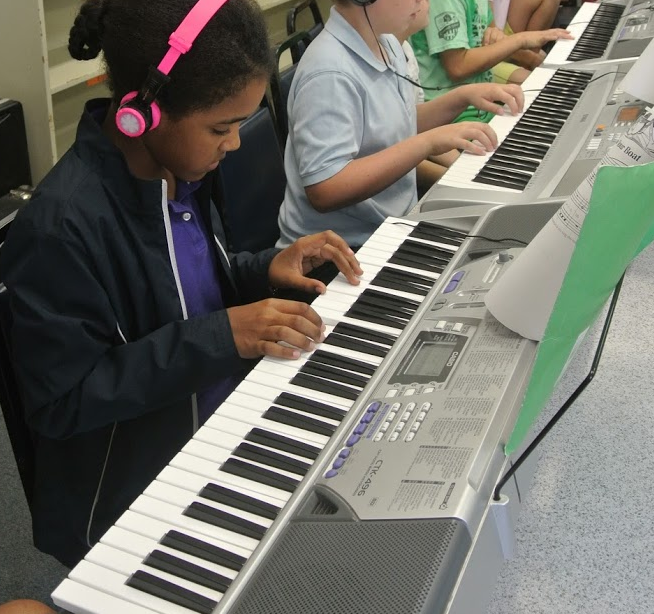
As the coronavirus pandemic continues to exert economic pressure on private school families like those whose children attend Crestwell School in Fort Myers, where about 20 students use a state choice scholarship, four-dozen private school and choice organizations have reached out to Congressional leaders for relief.
Federal pandemic relief efforts must include help to private school families to stave off closure of an “alarming number” of private schools and mitigate the financial stress those closures will inflict on public schools, private school leaders told Congressional leaders Wednesday.
Providing “immediate and direct aid to families” in the form of tuition payment relief will help students remain in private schools, rather than flooding district schools that are facing their own massive financial challenges, 48 private school and school choice organizations said in this letter.
“Private school closures would be devastating for families, students and communities,” said the letter, which was also signed by Step Up For Students, the Florida nonprofit that hosts this blog. “It will be equally devastating, financially, for public school districts.”
“If private schools are shuttered because families aren’t paying tuition for an extended period of time, the increase of public education expenditures for millions of new students coming back into the district systems would be staggering,” the letter continued. “If 20 percent of private school students have to be reabsorbed into the public system, it would cost the public system roughly $15 billion.”
To date, little federal relief targeted to K-12 education has offered meaningful help to private schools. Some private schools have secured funding from the Paycheck Protection Program, which was designed to help small businesses and nonprofits. But that help is a two-month respite. Growing numbers of parents are telling private schools they won’t be able to afford tuition in the fall, and surveys suggest many private schools fear the economic downturn and continued closure of brick-and-mortar operations could bring their demise.
Besides assurances that federal relief is equitably distributed, the private school groups offered a list of other potential long- and short-term remedies. Among the ideas (which you can read about in the letter): emergency education tax credits and a means-tested federal education savings account.
The groups suggested 10 percent of any new federal education relief be targeted toward private school parents, in line with the national proportion of private to public school students.
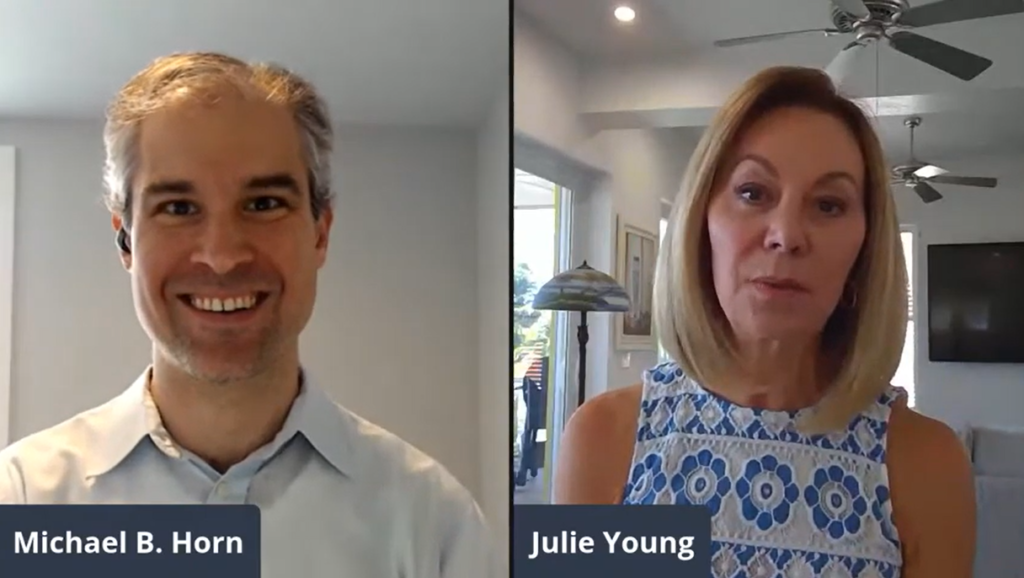 In this video special to redefinED, author and education reformer Michael Horn talks with education pioneer Julie Young, the founder of Florida Virtual School, a student-centered online-learning provider that focuses on competency based education rather than traditional seat time. Julie is now the CEO of Arizona State University Prep Digital, an online high school that offers an accelerated path toward college admission and the chance to earn concurrent high school and university credit.
Horn and Young discuss the ways in which COVID-19 is a moment for teachers and families to transform learning. They also discuss a new online learning case study Young co-authored that has been published by the Pioneer Institute.
“Right now, it's about the fundamentals. Anything that is remotely filler needs to go away. What are the standards we need to meet to feel as if we have accomplished what we need for this school year? Let's look closely at that and focus our plans around it."
EPISODE DETAILS:
· How Arizona State University moved to full remote learning within 48 hours and the active role the university has taken in lending support to other schools
· What states and school districts should be doing to move from the crisis of shifting to distance learning toward a more stable, sustained distance learning future
· Preparing for a variety of fall schooling scenarios based on the virus’ effect, including continuing full-time remote learning for those who want it
· The benefits of mastery-based education models for students with unique abilities
· Incorporating social and emotional learning into the distance-learning model
LINKS MENTIONED:
ASU for You: Resources for every learner, at any age
Pioneer Institute – Case Study for Transition to Online Learning
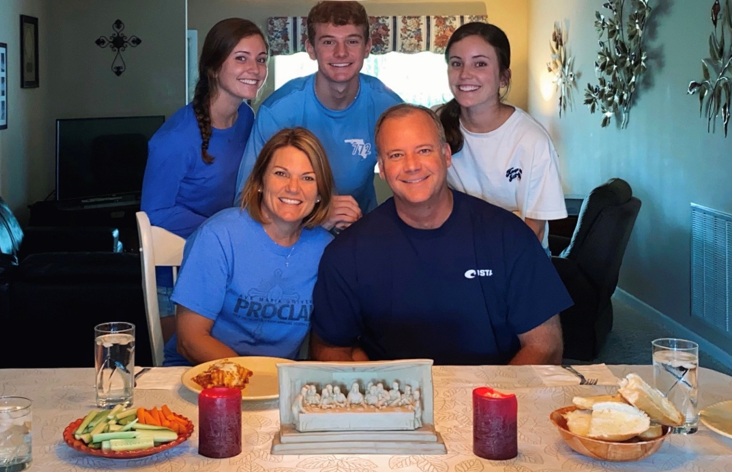
The Capezza family: Jennie and Louis Capezza, seated; and their children, Kate, Luke and Abbey.
Editor’s note: redefinED guest blogger Jennie Capezza is director of campus ministry at John Carroll High School in Fort Pierce, Fla., and mother to three John Carrol students. She writes here of her efforts to juggle caring for her students as well as for her children during the COVID-19 crisis.
Even pre-COVID-19, our family routine was hectic. Raising three teenagers and juggling our careers required my husband and me to hold family meetings on Sunday evenings in an attempt to get a handle on the week ahead: which children had practice games, which work- and school-related meetings must be attended, and last but not least, which evenings could be set aside for family dinners with everyone at the table.
Even our best intentions to make it all work sometimes resembled a glorified fire drill.
Everything intensified five years ago when I took a giant leap of faith and left my job as a second-grade teacher to become an English teacher at John Carroll High School in Fort Pierce. That move required both a professional and personal adjustment, but it’s a decision I’ve never regretted.
Our school serves roughly 400 students in grades 9-12. We are the only Catholic school within a one-hour radius of Fort Pierce. Since 2012 when we began accepting students who are eligible for a Florida Tax Credit Scholarship, a program that provides the means for families with limited financial resources to attend private schools, our student body has become more representative of our community. We currently serve 77 tax credit scholarship students, as well as three students who qualify for a Gardiner Scholarship for students with unique abilities. Two students attend on the new Family Empowerment Scholarship, which extends support to middle-income families.
(All three scholarship programs are administered by Step Up For Students, which hosts this blog.)
In my years at John Carroll, I have become fully vested in our school’s mission to inspire students in the pursuit of educational excellence, foster character formation, develop a commitment to serve and affirm the dignity of each student entrusted to our care. Certainly not a small undertaking, but one that our administration, faculty and staff embrace wholeheartedly and without reservation.
In my role as director of campus ministry, I’ve observed students, families and teachers consumed with their daily routines. Now that we’ve been unexpectedly pulled away from the school we love due to COVID-19, things are different for my colleagues and friends, and for my own family as well.
At the outset of this time of isolation, we discussed what our days would look like. We decided that the kids’ weekdays would be filled with Zoom classes, practice tests, essay revisions and vocabular reviews. My husband, who is a financial adviser, would work from home. I would continue to explore creative ways to stay connected to my students. At the weekends, we would enjoy fishing, playing tennis, trying new recipes, working in the yard, and praying together.
We’ve been able to stay true to this intention. But along the way, I’ve begun seeing our three teenagers in a different light as we’ve engaged in conversations we’ve never had before. Conversations about their dreams and the lessons they’ve learned in self-defining moments. Meanwhile, my husband and I have had the chance to share more about our life experiences than we ever have.
We all are realizing there is value in setting aside time to talk, to think, to reflect. To reminisce about the past and to set goals for the future.
This realization in turn has led me to begin thinking about what drives our lives as a family. My husband and I have always wanted the best for our children. Additionally, I’ve maintained a focus on doing whatever I can to create the best environment for my students. But it’s occurred to me that perhaps we’ve been so focused on staying busy that we’ve lost opportunities for spending and enjoying quality time with each other – time for self-expression and honest communication.
None of us know when our lives will return to “normal,” but I do know this: The opportunity to fully engage as a family over the past month has been a priceless gift. It’s one I intend to cherish and carry into whatever comes next.
 Editor’s note: In this commentary, Jawan Brown-Alexander, Chief of Schools for New Schools for New Orleans, proposes that it's possible to take what has been learned from the coronavirus pandemic and use it to reimagine what schools could look like in two, five or even 15 years. The piece originally published April 29 on Education Post.
I am a former school leader and a current educational strategist who works with charter leaders from across New Orleans. Together, we have been thinking about the intersection of educational inequity and the disparate impact of COVID-19. With so much instability in our children’s educational experience, we know that high-quality curriculum matters more than ever before. We are considering what to do now to support our children, as well as what comes next.
Scientists continue to work on ways to stop this pandemic—and when they finally do, we will turn the page and look to the future. It’s hard to believe now, but folks will get back to work, restart the economy, and begin to see past this horrifying time in our nation’s history. When we rush back to our lives, however, we will still face the reverberating impacts that are coming from this crisis, especially in our minority communities.
Congresswoman Ayanna Pressley said it best in a recent tweet—“Our Black and brown communities face a crisis within a crisis.” In Louisiana, for instance, while Black residents make up around 30% of the state’s population, as of April 20, 56% of Louisianans who have died from COVID-19 have been Black.
That inequity is not only found in the toll of the virus itself. We will also see an impact on those people of color who faced insecurity in jobs, food or housing even before this moment. And we will see an impact in our education system, too. In Louisiana, as in many states, school buildings will be closed through the end of the school year; the learning loss that normally occurs during the summer is now a real risk even before summer begins. The cost of a slow rollout of distance learning could be significant, and take the greatest toll on children of color.
When the virus hit, schools and districts with mostly White and affluent students could have the confidence that most of their students would be able to fully engage with online distance learning right away. For districts like New Orleans, with mostly students of color and students who are economically disadvantaged, quick efforts to roll out online distance learning faced a significant barrier: Many children lacked the technology needed to connect.
Taking action to keep kids connected and learning
Our district leadership took immediate action to purchase the materials those students needed, but it takes time to procure, safeguard and distribute technology citywide. Many of our students were—and are—also dealing with housing and food insecurity that makes it more difficult to launch and maintain an at-home learning environment.
This is not unique to New Orleans. Across our nation, districts that serve mostly students of color, and those with high rates of economically disadvantaged students, will face a steeper climb than others when it comes to distance learning. But by having a strong, clear distance learning plan, we can make sure closed buildings do not mean closed schools and drastic educational losses.
This means connecting students with technology, if at all possible. It also means continuous engagement with students and families, through the phone, the internet, or both. And it remains as important as ever to provide a high-quality, standards-aligned curriculum. We cannot fully control that students may take in less material than usual right now. We can control whether or not that material is the highest quality it can be.
Many Tier-1 curriculum vendors are providing updated materials for a distance learning context online. Schools can take advantage of this, lowering the lift of translating existing materials for a new kind of delivery. Schools can also continue to provide their teachers with (virtual) professional development around their Tier-1 curriculum, so they can better adjust to this “new normal.”
Academics are only one part of the response
Academics are just one part of this, though. A strong distance learning plan also takes students’ basic needs and mental health into account. During this pandemic, Black and Brown children will lose loved ones at a disproportionate rate compared to their White peers; this will take a deep emotional toll. An incredibly high number of New Orleans’ children had already experienced trauma prior to this event, and this horrible crisis could cause those numbers to increase.
It is imperative, then, that our distance learning plans involve connecting mental health experts, like social workers, to provide support to students, families, and school staff members who have been heavily impacted by this crisis. Resources for physical health care, food, shelter, and more remain critical as well. We can leverage external partnerships to help do so—they are more important than ever. Making certain that students receive vital supports is key to the strength of our community and the growth and health of our students.
We can reimagine what school looks like
We must maintain our focus on the present moment and through the close of the school year. But we must also look even further ahead. There is much we will learn from this crisis—from how to support students experiencing trauma, to how to connect children to local resources, to how to best leverage technology. We can take what we have learned to reimagine what school will look like in the next two, five, or even fifteen years. We can also join in conversations with our families, community members, fellow educators and students themselves about what we will need from federal, state, and local officials as we re-open schools.
Together, we can keep this crisis from digging even wider educational divides. Our children of color already face great inequities. If we focus on distance learning and whole-child support, and keep an eye on the future, we can help keep them safe and learning today and expand their opportunities tomorrow.

