Somewhere around four years ago, public school systems around the country began “temporarily” shutting down as a reaction to the COVID-19 pandemic. The United States had a plan, an allegedly best in the world plan, to deal with a pandemic. Well…
I recall the fiasco unfolding in my home state of Arizona. A panicked consensus in favor of school shutdowns grew based upon…other panicked moves to close schools in other states. Perhaps that is unfair. We also had the famed epidemiological sagacity of a group called “Arizona Educators United” to inform us.
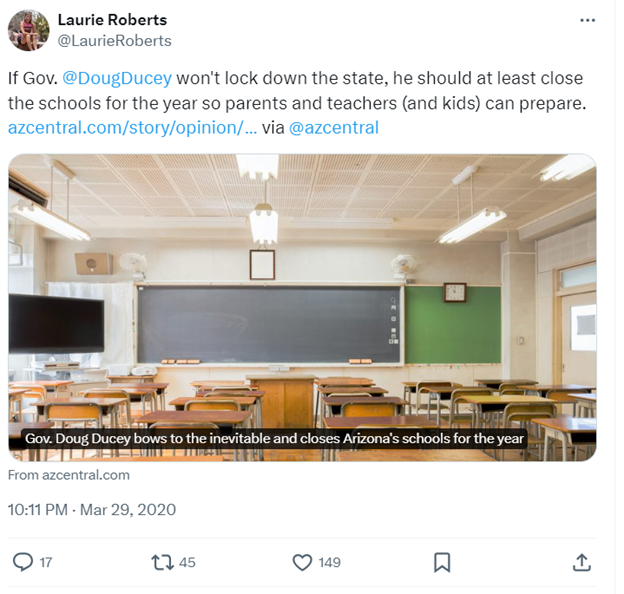
This column read in part:
Arizona Educators United on Sunday issued a call for Ducey and Hoffman to close the schools for the rest of the year.
“Without immediate, large-scale, serious interventions, like closing schools for the remainder of the school year, the coronavirus outbreak is projected to overrun medical facilities by early to late May,” the group said.
Panic did not grip everyone in Arizona. I will never forget speaking to a friend of mine who worked in the Arizona Department of Education. I glumly noted that school closure seemed inevitable, and she told me “I would not do it.” When I asked her why, she responded:
How indeed?
Fifty-thousand or so Arizona students disappeared from school. Further evidence that students interpreted closures as having made schooling optional can be found in data showing that the rate of chronic absenteeism more than doubled for Arizona students. Academic achievement declined. It was even worse in many other states.
John Chubb and Terry Moe explained that the central problem with K-12 is politics, and the COVID-19 fiasco made that sad fact blindingly obvious. The task ahead lies in recovery and in fiasco-proofing your family as best you can for the future.
Some people claim that there is school choice to blame, but we know, it’s all Randi’s fault.
The nonprofit research organization Northwest Evaluation Association, also known as NWEA, released an analysis recently called Education’s long COVID: 2022–23 achievement data reveal stalled progress toward pandemic recovery showing that students suffered a pronounced slowing of academic growth during the 2022-23 school year. This is incredibly sad but not incredibly surprising; kids that don’t learn to read during their K-3 window tend to fall further and further behind grade level as they age through the system. Such students grow increasingly frustrated and tend to begin dropping out of school entirely starting in late middle school. In addition, following the example of many adults, legions of students seem to have developed the idea that school attendance is optional.
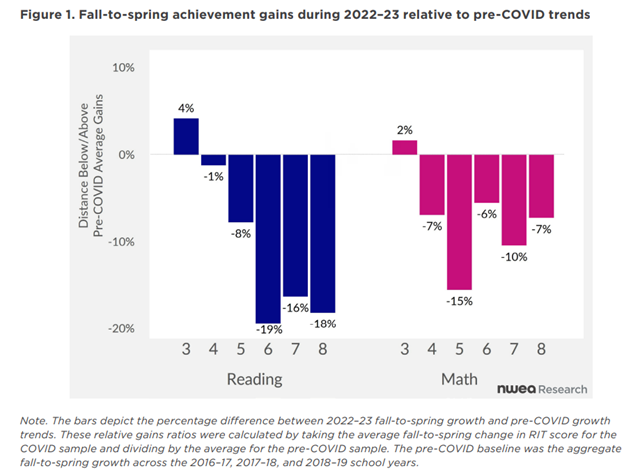
The key thing to appreciate about the above chart would be the school year: 2022-23, post-COVID shutdowns and during the period in which the federal government literally gave schools more money than they could figure out what to do with. If you are waiting for an academic bounce back or delayed reaction recovery, stop being silly: it’s not in the cards. If they create a Pulitzer Prize for understated headlines, the New York Times is in the running with this recent gem:
Schools Received Billions in Stimulus Funds; It May Not be Doing Enough
How are all those billions of dollars in K-12 education funds being spent as un-remediated students fall ever further behind grade level work? The Times very helpfully supplies examples:
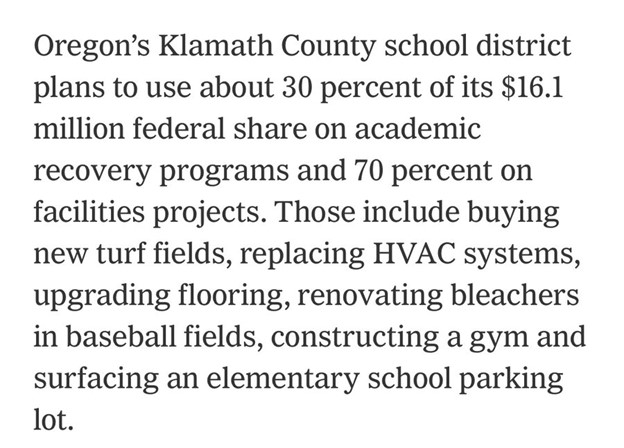
The districts have it coming and going: their ZOOM-school era kids are likely to begin dropping out in higher numbers. Year by year a baby-bust cohort of kindergarteners will replace the diminished cohorts exiting. Enrollment will shrink, but at least we’ll have those new baseball bleachers.
Years ago, a wildly mistaken group of people began talking about “peak oil.” Sometimes you’ll hear someone drop an ideological catchphrase like “late capitalism” as your cue to stop taking them seriously. “Peak school district enrollment” however is a thing, and it is a thing that lies in the past. Ironically, it lies in the past because the unions inflicted it upon themselves.
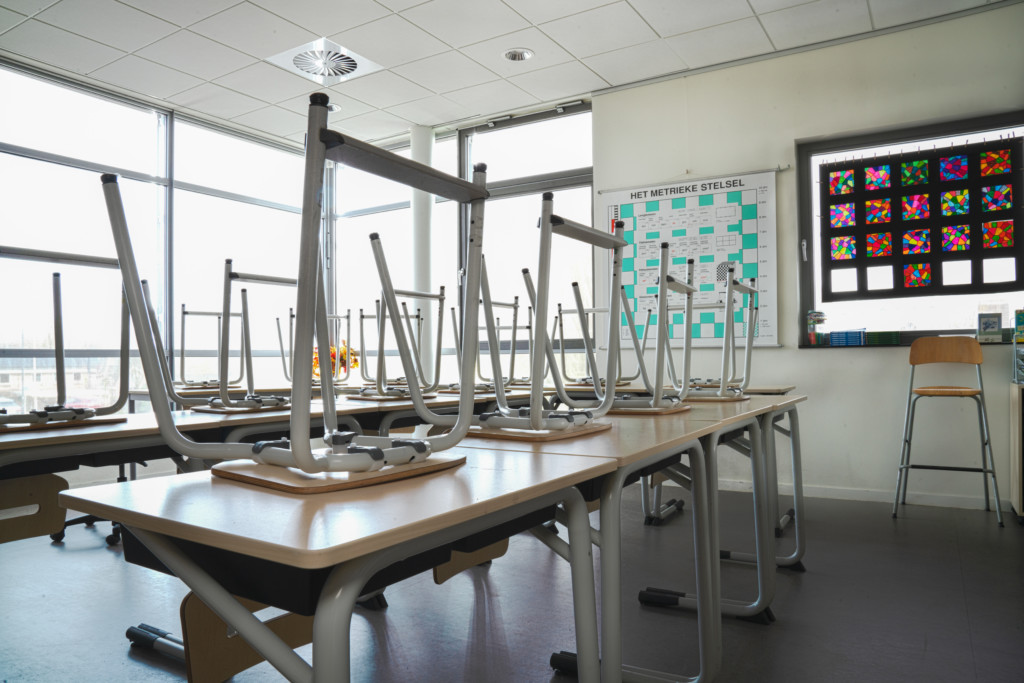
Was pandemic learning loss a necessary evil to create a more just society?
One teachers union representative from Richmond, Virginia seems to think so. In an interview with ProPublica, Melvin Hostman, who serves on the Richmond Education Association’s executive board, remarked that “the whole thing about learning loss I found funny is that, if everyone was out of school, and everyone had learning loss, then aren’t we all equal? We all have a deficit.”
When confronted with evidence that learning loss disproportionately affected already-disadvantaged populations, Hostman doubled down, pinning the blame on American society’s intrinsic inequities. “Now people are saying, ‘We’re going back to the way things were before,’” Hostman added. “But we didn’t like the way things were before.”
It’s worth noting that Hostman’s position is extreme and uncommon. The vast majority of educators — including those affiliated with prominent unions — are not only worried about learning loss, but also support traditional methods (like extra instructional time and targeted tutoring) of overcoming it.
However, a disturbing number of union representatives and advocacy groups see the pandemic’s aftermath as an opportunity for social and educational re-engineering. In other words, terms like “learning loss” and merit” are now considered old-fashioned at best and something far more sinister at worst.
If union representatives like Hostman want an honest conversation about reform, they have to stop trying to put lipstick on a pig. School closures were incredibly harmful — particularly for disadvantaged students who needed in-person education the most.
More specifically, learning loss, at least in the 2020-2021 school year, was by no means an inevitability. Kids didn’t fall behind because of structural inequities in the American educational system; kids fell behind because many states and districts made a conscious decision to keep them out of school for extended periods of time.
Salt Lake City didn’t even start reopening their schools until February 2021. Students in other places endured even greater turmoil — for New York City, Washington DC, and many school districts in states like California and Illinois, full reopening wouldn’t come until the 2021-2022 school year.
As a result, private schools, which were much more likely to be open for in-person instruction, saw an influx of students. The greater awareness of alternatives helped fuel parents' demand for more choices and led many states to establish or expand education choice programs.
The results speak for themselves. A Harvard study released last year, which analyzed data from more than 2.1 million students, found that school districts that employed remote learning for longer suffered a higher degree of learning loss. In contrast, students in states like Texas and Florida, which resumed in-person learning as quickly as possible, “lost relatively little ground.”
“Interestingly, gaps in math achievement by race and school poverty did not widen in school districts in states such as Texas and Florida and elsewhere that remained largely in-person,” said Thomas Kane, one of the study’s authors, in an interview with the Harvard Gazette. “Where schools remained in-person, gaps did not widen…where schools shifted to remote learning, gaps widened sharply.”
Taken to their logical end, Kane’s comments directly contradict Hostman’s claim, and confirm that America’s children’s experiences were not “all equal.” Children, many from already disadvantaged backgrounds, were kept out of school unnecessarily and suffered disproportionate learning loss as a result.
I’m not about to claim that the chaos was intentional. I’m sure most school closures were done in good faith, even though the scientific research overwhelmingly backed reopening. However, all policy choices have consequences, and these consequences were particularly severe.
Simply put, Hostman’s claim was just plain wrong. Any debate regarding what to do next must start there.
Garion Frankel is an incoming doctoral student in PK-12 education administration at Texas A&M University. He is a Young Voices contributor, and frequently writes about education policy and American political thought.
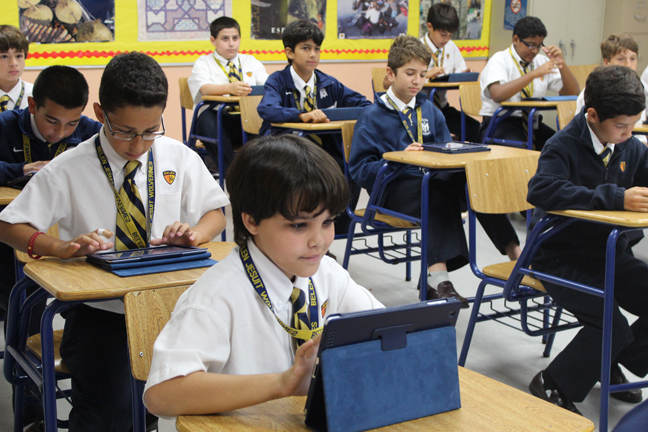
Editor’s note: This commentary from Paul E. Peterson, a senior fellow at the Hoover Institution and a member of the Koret Task Force on K-12 education, appeared last week on thehill.com. You can read a reimaginED post about private school enrollment growth in Florida here.
The National Assessment of Educational Progress has just reported steep drops in student achievement at the nation’s public schools. How will parents respond to the news? Is the downward trend in private education enrollments about to be reversed?
Before COVID-19, private school enrollments were headed downhill. Between 1964 and 2019, the percentage of students attending private schools fell from 14% to 9% of all school-age children, an all-time low.
Then, in fall 2020, most public schools kept their doors closed. Only 24% of public school students attended school in person, compared to 60% of private school children, according to Education Next parental survey (which I helped design).
The following May, nearly 80% of private schoolers were in class every day, as compared to only half of those at public schools.
Learning online was not good for students. Parents reported learning losses for 64% of children at public schools but only 43% of children at private ones. Private schools also had greater success in curbing adverse effects on children’s social relationships, emotional well-being and physical fitness.
When they opened, private schools were accused of gambling with their students’ health. Tom Carroll, superintendent of the Catholic archdiocese in Boston, recalls he “started getting letters, people saying, ‘Well, are you going to go to the funeral of every single child that you killed by opening all the schools?’”
Kathleen Porter-McGee, head of a Catholic school network in New York, remembers, “it was a scary time…the fear was palpable.”
When COVID spread at school proved minimal and mild, the private school bet paid off. “From the point [when schools announced closures] to roughly the middle of October, the phones kept ringing,” Carroll recalls. “So we gained about 4,400 students,” Our poll indicates a 2 percent gain in private school share between 2019 and 2022. If the survey is on the mark, it means a shift of 1 million students from the public to the private sector.
To continue reading, click here.
 On Sept. 1, U.S. Education Secretary Miguel Cardona claimed that the Biden administration had a plan to “focus on safely getting back to in-person learning” last year. On the same day, White House press secretary Karine Jean-Pierre told reporters that school re-openings were “the work of Democrats in spite of Republicans.”
But after the release of student test scores that are nothing short of dismal, parents and taxpayers deserve a reminder of what actually transpired in the waning months of school closures due to the pandemic.
Claims that the administration was focused on a return to in-person learning are dubious at best. In August 2021, Cardona wanted to mandate that all K-12 teachers be vaccinated, while at about the same time, administration officials were busy colluding with the National School Board Association to intimidate parents from speaking at school board meetings.
Watchdogs uncovered evidence of collusion again earlier this year. A report from Republicans on the House Select Subcommittee on the Coronavirus Crisis details how the American Federation of Teachers edited important sections of a Centers for Disease Control report on school re-openings to make it easier to close schools.
The report found that the CDC sent the AFT a copy of their draft recommendations weeks before their release. The union then sent “line-by-line” edits to portions of the report that recommended schools close based on more stringent guidelines than the CDC had initially drafted.
Cardona’s comments came on the heels of a USA Today column in which he tried to put a positive spin on the newly released Nation’s Report Card, commonly called the NAEP Long Term-Trend, or NAEP LTT. That study found that student achievement had regressed badly. As Matthew Ladner explained on this blog, the results for black children set them back nearly 30 years.
Other research essentially forecast these results. One study published by the National Bureau of Economic Research November 2021 found that student math and reading scores in 12 states had both declined, but—and this is the most important part of this report—the learning losses were smaller for the students who returned to in-person classes faster than their peers.
So when the New York Times announced long-term NAEP scores with the headline, “The Pandemic Erased Two Decades of Progress in Math and Reading,” we should set the record straight: The White House and special interest groups were playing politics instead of getting teachers and students back to class.
AFT president Randi Weingarten claimed last week that advocates for parent choice in education are trying to “create great distrust in public schools.” Yet, the AFT’s own actions—such as its secret missives to the CDC—are responsible for creating distrust.
And parents only have to scroll through the AFT archives to July 2020 to find that Weingarten endorsed teacher strikes unless public officials met the union’s demands for school re-openings. (“Nothing is off the table,” she told an audience of union members).
In fall 2020, union chapters around the country were striking even before the first day of school as part of a “National Day of Resistance.” Their demands went well beyond health and safety concerns. Indeed, their radical demands stretched from housing benefits (“cancel rent and foreclosures”) to universal unemployment benefits (“unemployment benefits for all”).
Not all Americans have short memories, fortunately. The latest edition of the Education Next survey finds that respondents’ perceptions of both local schools and the school system as a whole have steadily declined since 2020—which helps explain why the increase in new homeschooling families nationwide still far outpaces the share of families who have returned to assigned schools.
Thousands of Arizona families applied for education savings accounts in just the first two weeks of the application season after Gov. Doug Ducey and lawmakers expanded student eligibility for the accounts. Meanwhile, public school enrollment declined by 2 million students from 2020 to 2021.
No amount of gaslighting can hide the fact that the Biden administration and his union allies put power ahead of student achievement during the pandemic. To make sense of the import of these NAEP results and student enrollment figures, Americans deserve more than the political spin coming from Washington and interest groups.

