
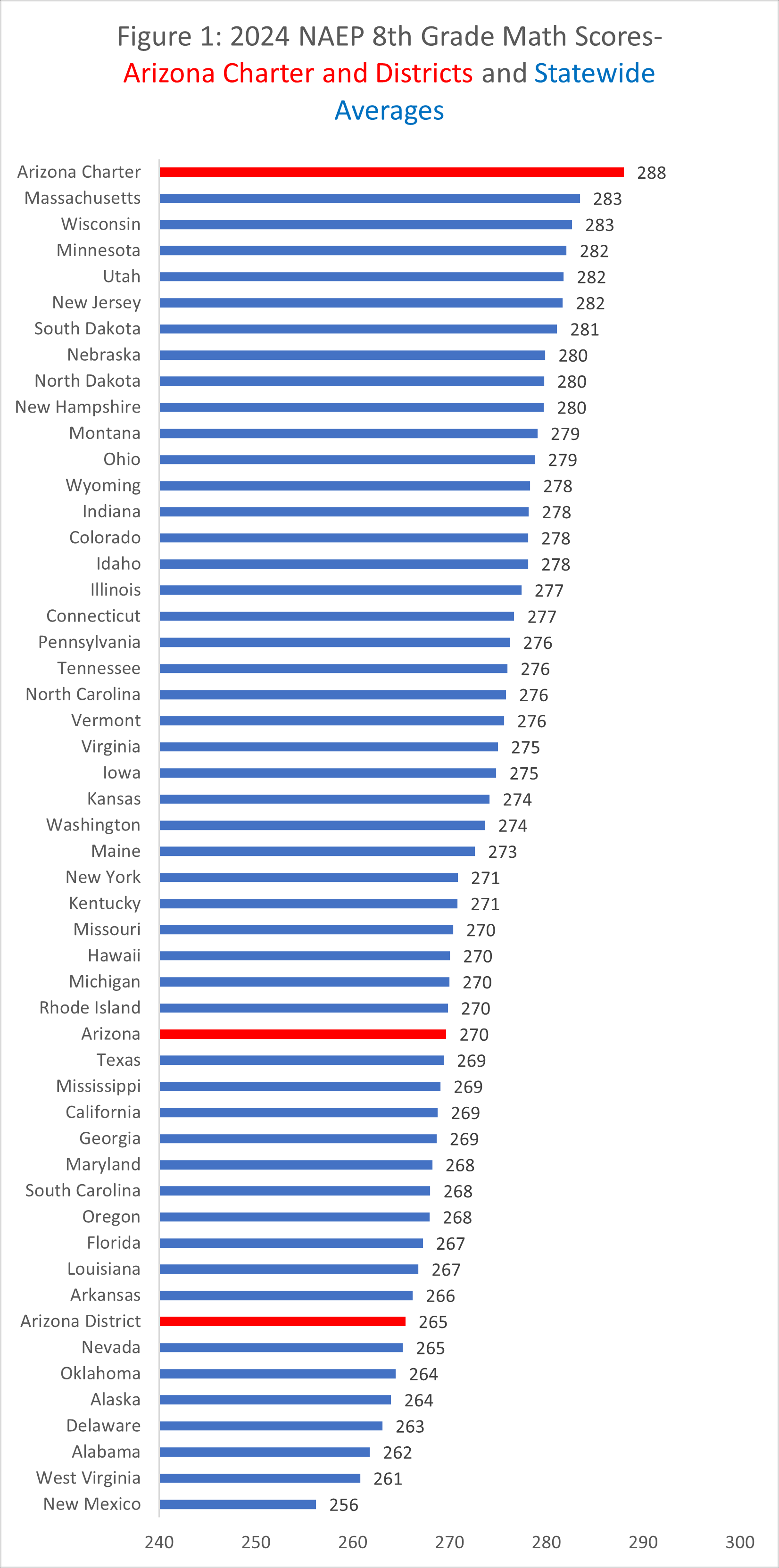
In examining the 2024 NAEP results for Arizona, a rather stark picture emerged that Arizona charter and Arizona districts had strongly diverged- Arizona charter schools show academic recovery, whereas Arizona district scores sank, in some cases, to all time lows. This came despite district spending standing not only higher than charters on a per pupil basis and standing at or near record high levels. Arizona charter schools still have an incentive to attract students, whereas during the federal money printing extravaganza districts of the COVID-19 debacle often spent a lot more money even as their enrollments shrank. The NAEP shows the scale of the academic gulf between Arizona charter school students and Arizona district students placed into context with statewide average scores on the 2024 eighth grade math exam:
Drowning districts in cash even as their enrollments shrink may have turned off the positive competitive impact of choice programs, and data published by the Common Sense Institute Arizona shows just how stark this has been. Kamryn Brunner and Glenn Farley of the Common Sense Institute Arizona have been tracking the enrollment and expenditure trends of school districts that have announced school closings since January 2025. I used their data to make Figure 1:

So, the word cloud that pops in my head when looking at this data prominently features “RECKLESS” and “IRRESPONSIBLE” and “UNSUSTAINABLE.” A few months ago the Arizona State Board of Education put the Isaac School District into financial receivership. This enrollment loss was not driven by Arizona’s ESA program, as the state’s open enrollment report shows 2,319 students who reside within the borders of Isaac attend public schools outside of the district (through open enrollment and charter schools) and the ESA quarterly report shows only 82 ESA students reside within the Isaac school district. The number of students who transferred from an Isaac district school to the ESA program will be smaller still, as these students may have previously been attending other districts, charter schools or private schools.
The districts in Figure 2 have announced a total of 13 school closings. Another chart from the Common Sense Institute Arizona shows far more is needed. The Arizona district system has physical capacity to serve almost 1.3 million students, but only 850,000 enrolled.

So how did Arizona districts wind up with a spare 450,000 spaces? There is not a single culprit. A baby bust started in 2008, but this seems not to have informed the decisions of districts. Part of the story is that Arizona families have less demand for district schools. The main culprit however is the usual suspect: politics. The Arizona Center for Investigative Reporting (AZCIR) and KJZZ reported in 2017 on financial relationships between a small group of architects, construction companies and subcontractors and the school districts in Maricopa County. They found that architects, construction firms and subcontractors accounted for nearly all the financial contributions made to Maricopa County districts’ bond and override campaigns from 2013-2016. This is dubious enough in a fast-growing district with clear facility needs, but it has also been happening in districts with shrinking enrollments.
Arizona should collect K-12 capital funding statewide, rather than on a local basis and provide it on an equitable per pupil basis to students. District and charter schools should be free to spend these funds in whatever fashion they feel furthers their educational mission, whether that is building a new school, patching a leaky roof, or paying their teachers. Districts with large amounts of underused space should, however, not receive these funds until such time that they return or offload such space to some sort of productive use.
Arizona is likely not the only state where the positive impact of competitive effects drowned in a sea of COVID cash. With the 2024 election having hinged largely upon an inflationary spiral coinciding with federal money printing, and 10,000 Baby Boomers reaching the age of 65 per day until 2030, the reckless level of spending on K-12 seems all but certain to reverse.

“Sweet are the uses of adversity,
Which, like the toad, ugly and venomous,
Wears yet a precious jewel in his head;
And this our life, exempt from public haunt,
Find tongues in trees, books in the running brooks,
Sermons in stones, and good in everything.”
— William Shakespeare, “As You Like It”
Arizona students led the nation in improvement on NAEP between 2009 and 2015. During this period, Arizona students uniquely made statistically significant improvements on all six NAEP exams (fourth and eighth grade reading, mathematics and science). When your author stumbled upon the Stanford Educational Opportunity Project data, it found that Arizona students had the fastest rate of academic growth between 2008 and 2018. This improvement did not last, but it may be coming back.
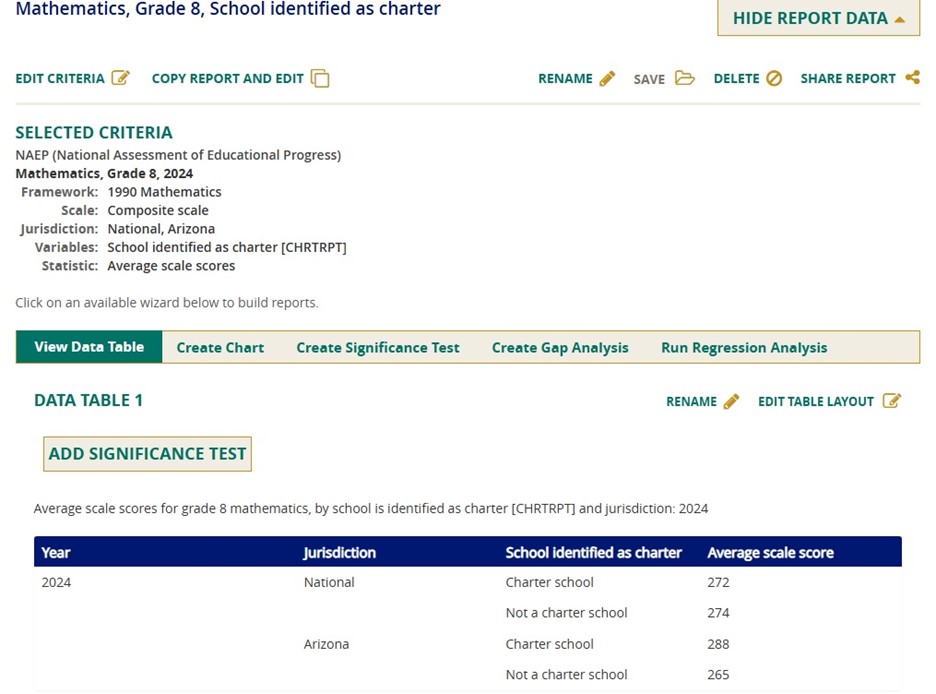
Fast forward from these happy times to the 2024 NAEP and the improvement era is looking like a lost golden age. While Arizona’s charter schools show clear signs of academic recovery, Arizona’s school districts are a hot mess. For example, in eighth grade math the average Arizona charter student was comfortably a grade level ahead of the national average for district students, whereas Arizona district students were embarrassingly a grade level behind the average for district students, and approximately two grade levels behind Arizona charter students:
Oooof. What happened?
Well one can never be certain about the relationships between policy and outcomes, but here is your humble author’s working theory. First off, Arizona’s top-down accountability system is a joke. We grade schools A-F, but the formula makes no sense and hands out approximately 120 “A” grades for every “F” grade. Our lawmakers also passed a third grade retention law years ago, but the Arizona State Board of Education has seen to it that effectively no one gets retained. “Accountability” of the testing sort is approximately as firm as a soft-serve ice cream cone that has been sitting out in the Phoenix heat.
It is not as though it used to make sense/have some firmness to it: these policies have sadly never been either firm and/or made much sense, best I can tell. It used to not matter, however, because choice served as the de-facto accountability system.
During the 2009-2015 period, Arizona charter school enrollment surged as high-demand operators were able to access inexpensive property during the Great Recession. Arizona lawmakers expanded the state’s scholarship tax credit programs, and then created the nation’s first ESA program, which started small but steadily grew.
All of this triggered a virtuous cycle during the housing bust aftermath. High demand districts, even fancy ones like Scottsdale Unified, became increasingly open to and aggressive about open enrollment. Open enrollment remains the largest form of choice in Arizona. The financial impact of students transferring between schools and districts mirrors that of other forms of choice, with the state funding following the child. The ready availability of seats in high demand districts spurred a positive feedback loop into the charter school sector whereby high demand charter schools replicated and expanded, but low demand charter schools closed. Not many district schools closed, but many felt the pinch of lowering enrollment. Statewide academic achievement, as noted above, surged; the uses of our Great Recession induced adversity proved to be sweet.
So, what went wrong during the COVID-19 adversity? Basically, the influx of federal COVID relief funding turned off competitive effects, which left us solely reliant on our top-down accountability system, which is ineffectual to say the least.
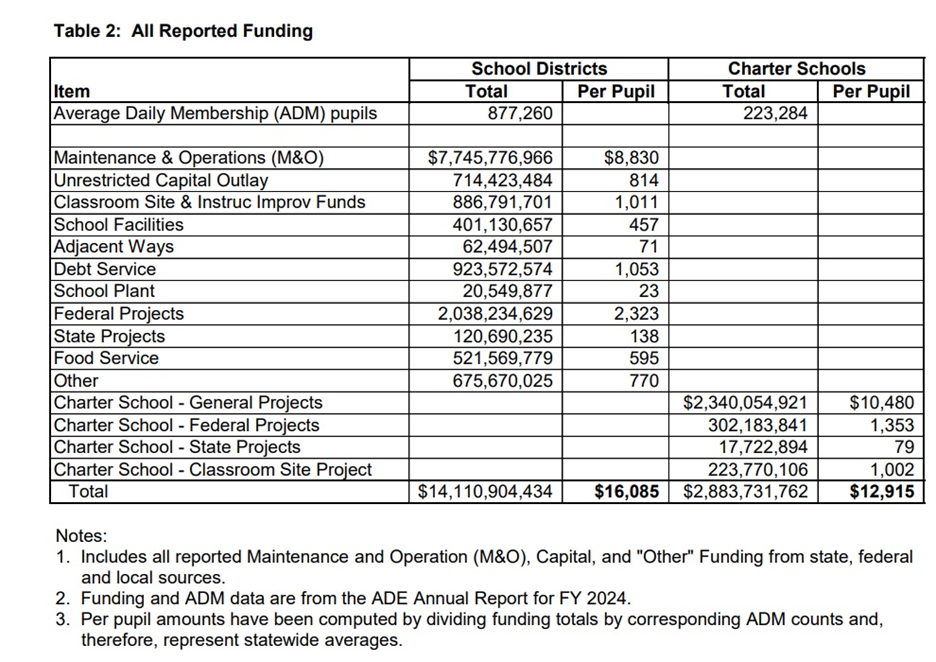
Why did competitive effects go away? Between the 2019-20 school year and the 2022-23 school year, Arizona school district enrollment dropped by 5%. Arizona school district total revenue, however, increased by 36 percent (see page 3). Arizona school districts received more money to (mis)educate fewer students — not exactly a recipe for competitive pressure. Quite the opposite, actually. Arizona charters meanwhile get less money per pupil, and unlike Arizona districts, show signs of recovery in the NAEP:
Can Arizona regain the lost mojo? Possibly. The federal funny money is washing out of the system, meaning that competitive pressure will return. The advent of the Baby Bust in 2008 means that there are fewer students to go around despite the state’s growing overall population. Arizona has some very talented and competitive people working in school districts, and the competition knob is about to get turned to “11.”
Stay tuned to this channel to see what happens next.
An episode of Paul MM Cooper’s outstanding documentary podcast series "The Fall of Civilizations" recounts the history of Carthage, which includes details of wars fought between the Carthaginians and Syracuse during the 300s BC. Carthage, a highly successful sea-trading nation, fought a number of wars with Greek colonies in Sicily prior to later wars with Rome.
Cooper describes how the Carthaginians made extensive use of mercenary armies, to spare themselves from the dirty business of fighting wars. During a Carthaginian siege of Syracuse, the Syracusans turned the tables on their attackers and sailed to attack Carthage. The wealthy but martially inept Carthaginians made impromptu efforts at fielding an army. This didn’t go well. The Carthaginians brought shackles in hopes of enslaving the Greeks, but instead found themselves routed in the field. Having scrambled behind their walls, the Carthaginians attempted to generate divine favor by sacrificing children to their gods.
Contemporaneous Greek accounts, and later archeological evidence, indicate that the Carthaginians may have been the last Mediterranean civilization to practice human sacrifice. As if this were not odious enough, wealthy Carthaginians would purchase and sacrifice other people’s children.
At first these rituals seem to have been an authentic sacrifice, giving up the life of your own children in the hope of receiving favor from the gods, but before long, wealthy Carthaginians found a way around this. In fact, they seem to have developed a macabre industry, a trade in other people’s children for sacrifice.
Fortunately, sensibilities have evolved in intervening millennia, and we don’t go in for either human or for that matter, animal sacrifice, these days. Still this account struck me as unsettling. We manage to field our own military here in the United States. The decades of scandal related to politically connected Americans avoiding the draft has, however, more than a faint echo of the Carthaginian elite sending someone else to fight for them. Dodging military service inevitably entailed sending someone less connected, less fortunate than yourself to fight and sometimes to die in your place.
The phrase “a trade in other people’s children for sacrifice” is perhaps a bit strong to describe what happened to students during the COVID-19 debacle, but perhaps not, especially considering the minimal value derived from billions of federal education dollars. No small number of Americans benefited from choice schools as children, benefited from choice schools as parents, but oppose programs to provide K-12 choice to others. Like Carthaginians of old, these people are willing to sacrifice someone’s children for one reason or another, just not their own.
Between damaging their demographic prospects by sacrificing children to statues and mercenary forces turning on them in the Second and Third Punic wars, the Carthaginians hit the dustbin of history.
Praeterea dico exercitia Carthaginiensium in America delenda est.
A poll of more than 1,762 registered voters conducted earlier this month by RealClear Opinion Research shows that nearly three-quarters support school choice, with 16% opposed and 10% unsure.
The findings were consistent across party lines, with 83% of Republicans, 69% of Independents, and 70% of Democrats saying they strongly or somewhat support school choice.
Additionally, 66% of respondents said some or all the COVID funds the federal government set aside for K-12 education should be directed by parents. Most voters in both parties agreed parents should direct all or some of the funding.
The results represent a marked increase in support for school choice since similar polling was conducted in April 2020, with overall support increasing 10 percentage points. Support among public school parents has increased from 68 to 80%, while Democrat support has increased 59% to 70%.
American Federation for Children CEO observed that with public support for school choice at an all-time high, “a new story is unfolding” as the nation recovers from unprecedented nationwide school closures due to COVID-19.
“Parents are rising up and demanding the freedom to choose the best educational environment for their children,” Schultz said. “Thankfully, more and more lawmakers are listening. Already in 2021, 17 states have passed legislation to improve, expand, or create new school choice programs.”
Another nationwide poll conducted prior to the RealClear Opinion Research poll revealed similar results.
 Editor’s note: This commentary from Ben DeGrow, director of education policy for the Mackinac Center for Public Policy in Midland, Mich., published Monday on The Hill.
The once-forecasted political “blue wave” offered labor leaders and their partisan allies the hope of rolling back educational choice, but that wave never arrived. With Democrats unable to take over new state levers of power, they and union officials instead may be facing a torrent of new initiatives to give students and families more opportunities.
In this most unusual year, the coronavirus pandemic has opened many parents’ eyes to the brutal shortcomings that pervade K-12 education, and voters returned to office more policymakers who are willing and able to take a stand on parents’ behalf. Labor leaders and bureaucrats accustomed to running the school system should brace themselves for a jolt of parent power.
Using emergency CARES Act funds, some states already have revealed new strategies to fund students directly during the pandemic. For example, Texas and Ohio authorized $1,500 microgrants to families to help them supplement the special education services their disabled children receive while in-person instruction is unavailable.
Friendly leaders in the nation’s capital have demonstrated an unprecedented level of backing for choice over the past four years. It’s one issue that increasingly resonates with voters across the political spectrum — almost 70 percent favor expanding choice.
Ten years ago, a “red wave” handed over the keys to many state legislatures and governors’ mansions to a political party not beholden to teachers unions. That fresh burst of lawmaking energy turned 2011 into the Year of School Choice, as state leaders across the country adopted 18 new voucher, tax-credit scholarship and education savings account programs. Many thousands of students experienced new opportunities as a result.
This month, dozens of pro-school choice officials won election in a number of key states, according to the American Federation for Children. A growing and diverse coalition of frustrated parents may prompt these lawmakers to open new approaches to help children succeed. They could expand private school choice programs like the ones formed a decade ago, and add fresh kinds of aid that enable families with lesser means to work directly with teachers in setting up learning pods.
Parents’ hopes are also backed by a powerful legal precedent. Last June’s groundbreaking Espinoza ruling at the U.S. Supreme Court bars state courts from using archaic constitutional provisions to block parents from choosing private, religious schools when they use publicly funded scholarships. In fact, the state where the Espinoza case originated soon may be part of the vanguard. The election of a new Montana governor places state control entirely in Republican hands, opening up possibilities for more robust programs than the small 2015 scholarship initiative that triggered the case.
As states take up the cause, choice supporters should look to Florida to see where legislative work could lead. A statewide nonprofit there recently handed out the millionth scholarship to a low-income K-12 student, in a story that stretches back nearly 20 years. Those scholarships are funded by corporate donations that receive tax write-offs, the result of a 2001 law adopted under then-Gov. Jeb Bush. The scholarships help many academically struggling students rise to the educational level of their more advantaged peers.
The votes of Black mothers whose children benefit from Florida’s K-12 scholarships put Republican Gov. Ron DeSantis over the finish line during the 2018 election. With lawmakers from both parties, he has worked to deliver more choice to families in a state where accessible education options already are common.
While a few states may be ready to follow in Florida’s steps, school choice survived an onslaught in a different state. The union-supported “Red for Ed” movement aimed to scale back one of the nation’s most robust array of educational choices in Arizona. Yet voters, who appear to have narrowly rejected both the president and the incumbent Republican U.S. senator, also dashed Democratic hopes of taking over either chamber of the legislature.
Across the continent, in a state President-elect Joe Biden won easily, New Hampshire completely reversed a 2018 Democratic takeover that, last year, prompted efforts to squash a smaller version of a Florida-style scholarship tax-credit program. With the proposed repeal now on ice, a fresh batch of legislators soon will have the chance to expand educational opportunity in the Granite State.
Newly energized by students and parents in need, reform-minded policymakers across the nation are poised to expand the bounds of learning opportunities. If their actions make possible a new wave of successful students and satisfied parents, they could transform education in the U.S. for decades to come.
 More than three months after the CARES Act appropriated billions of dollars to aid the education of low-income students in public and private schools, most eligible private schools in Florida have yet to see financial relief according to a recent survey of participating private schools conducted by Step Up for Students, which hosts this blog.
The nation’s largest state-approved nonprofit scholarship funding organization helps administer five scholarship programs in Florida, including two that are income-based programs, the Florida Tax Credit Scholarship and the Family Empowerment Scholarship, as well as the Gardiner Scholarship for students with unique abilities.
The Step Up survey asked more than 1,000 schools that participate in Florida’ scholarship programs questions about the Elementary and Secondary Emergency Relief Fund (ESSER), declining enrollment, and distance learning. Participants returned 662 completed surveys and 140 partial surveys.
Of 683 schools that provided responses regarding ESSER funding, 61%, or 415 schools, reported they qualified for the funding. But of those schools, nearly three-quarters – 74% – said they have not received any emergency funds.
Congress made available $13.2 billion to help stabilize K-12 education funding this summer amidst a global pandemic and rising unemployment. The U.S. Department of Education subsequently was sued over its directive on how to calculate the share provided to private schools. Though the U.S. Department of Education declined to appeal, it noted that local education agencies still were required to share the funds based on the enrollment of low-income students attending private schools.
Fifty-seven percent of survey respondents reported enrollment declines. “Unable to afford tuition” was cited in 63.7% of cases as to why parents no longer were enrolling their child. Forty-five percent of schools (298) expressed concern about losing new students because of the Family Empowerment Scholarship’s prior-year public school attendance requirement.
Additionally, the survey found that 54% of private schools worried that declining enrollment would impact their viability.
Though troubling, these findings nevertheless are more positive than those reported earlier in the pandemic. In April, 73% of private schools reported declining enrollments.
Overall, private school enrollment among lower-income students remains steady. For 2020-21, approximately 130,000 students are utilizing income-based scholarships, up slightly from last year, although these are preliminary enrollment figures.
The Florida Department of Education is expected to release its first-quarter enrollment reports either this month or in November.
 Editor’s note: This commentary from Jude Schwalbach, a research assistant at The Heritage Foundation, first published on The Daily Signal.
When COVID-19 brought the school year to an abrupt halt early this year, few anticipated that the global pandemic would be the impetus for private school choice reforms across the nation.
As is the case with so many other sectors, many private schools struggled after losing tuition and other funding resources due to the strains of COVID-19.
In fact, the Cato Institute reported that as of this month, 115 private schools had announced permanent closures.
That means that more than 15,400 children lost their schools. The estimated transfer cost of these students to public schools is more than $278.3 million.
Recognizing what the loss of education options would mean for families, policymakers in six states proposed emergency private school scholarships in response to the crisis. Four of those states—Florida, New Hampshire, Oklahoma, and South Carolina—used emergency federal funding from the Coronavirus Aid, Relief, and Economic Security (CARES) Act to expand private school choice options.
The CARES Act, signed into law by Donald Trump in June, authorized $3 billion for the Governor’s Emergency Education Relief Fund, or GEER, a flexible grant that governors can use for education-related programs.
Oklahoma Gov. Kevin Stitt, a Republican, used a portion of his state’s GEER funds to craft “Stay in School” scholarships, providing $10 million to cover tuition at Oklahoma’s 150 private schools for children from low-income families whose incomes have been affected by the coronavirus pandemic. More than 1,500 Oklahoma children could receive a scholarship worth $6,500 each.
That covers all or most of the average annual cost of private school tuition in Oklahoma, which is about $5,000 for elementary students and about $7,000 for secondary students. The scholarship amount, however, is still less than the average per-pupil amount, $8,778, spent annually by Oklahoma public schools.
Oklahoma students also will have access to the $8 million Bridge the Gap Digital Wallet education savings account-style funding, which is funded by GEER and will provide more than 5,000 children living in poverty with $1,500 grants to “purchase curriculum content, tutoring services and/or technology.”
In the era of pandemic pods, this is critical policy.
Likewise, South Carolina used its GEER funds to create a private school scholarship program for children from low- and middle-income families. Children living at or below 300% of the federal poverty line could be awarded a scholarship of about $6,500.
Other states used these funds to bolster existing private school choice programs such as tax credit scholarships.
New Hampshire under Gov. Chris Sununu, a Republican, boosted funding for the state’s tax credit scholarship by $1.5 million. The state’s tax credit scholarship allows individuals and businesses to receive tax credits for donating to nonprofits that fund private school scholarships.
Since 2015, New Hampshire’s tax credit scholarship has allocated $3.8 million to help 1,377 children attend private schools of their choice. The additional emergency funds will help 800 children receive scholarships valued at $1,875 each. That amount covers more than 22% of the average cost of tuition at a private elementary school in the state.
Like New Hampshire, Florida used $30 million of its GEER funds to stabilize its tax credit scholarship. At the same time, Florida Gov. Ron DeSantis, a Republican, also put $15 million toward the Private School Stabilization Grant Fund. Private schools are eligible for this grant if they were hard hit by the pandemic and if more than 50% of the student body uses school choice scholarships.
Never missing a beat, special interest groups have alleged that efforts in those states to use GEER funds to support families accessing education options of choice will hurt public schools. Yet, public schools in Florida, New Hampshire, Oklahoma, and South Carolina received a combined $1.1 billion from the CARES Act. Of that, the total governors’ discretionary funds accessible to children enrolled in private schools in the respective states totaled $96.5 million.
Taxpayers and state policymakers are right to balk at the new federal education funding. The $13.5 billion CARES Act, along with the $3 billion in GEER funding, is significant new federal spending, representing more than 25% of what the federal government spends yearly on K-12 education through the Department of Education’s discretionary budget.
But as The Heritage Foundation’s Jonathan Butcher wrote: “If the funds already are appropriated for education, as it is with CARES spending, then there is no more effective purpose than to give every child a chance at the American dream with more learning options.”
Moving forward, state policymakers should make sure that the emergency private school scholarships become permanent, funding them through changes to state policy. Rethinking how education funding is delivered, through more nimble models such as education savings accounts, should remain a permanent feature of the education policy landscape.
Moves in these states are steps in the right direction.
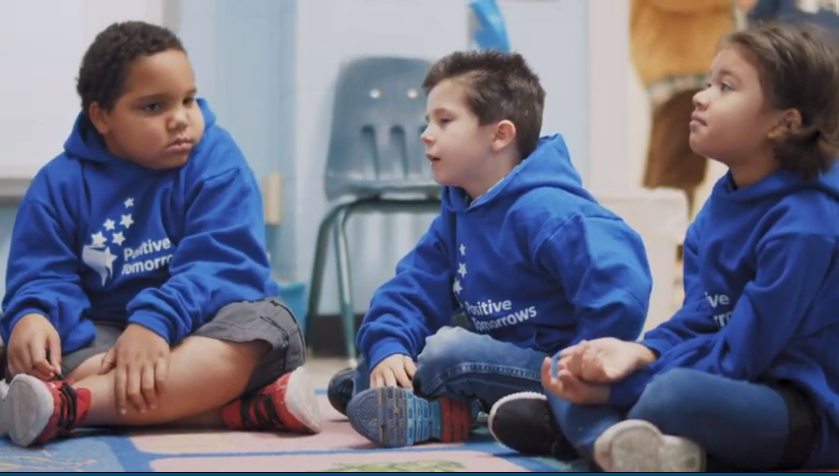
Positive Tomorrows, a private school in Oklahoma City, serves homeless students using a multi-pronged approach to address education and social service needs.
Susan Agel wants her students to gain experience. Silicon Valley internships and trips abroad would be nice, but for the students she serves, the needs are more basic.
Like riding in a car. Or going to a store — any store.
Agel’s school, Positive Tomorrows, is a private school serving homeless children in Oklahoma City. She says they enrolled one student who “had never been in a retail establishment. He had never seen his parents buy anything.” His only transportation was the occasional trip on a city bus.
“We’re a little different than most private schools,” Agel says, with a touch of understatement. One out of every five students at Positive Tomorrows is “couch homeless,” which means students sleep in motels, cars, on floors and do not have a home of their own, while another two-thirds live in homeless shelters.
“It’s these children who are living in deep poverty and are bouncing around [from] place to place and attend multiple schools in a school year,” Agel says. “They fall behind academically, they fall behind socially.”
Agel’s school specializes in providing wrap-around services for students and their families. She wants to help families out of homelessness and poverty and set them on their way to financial independence while students pursue academic independence.
“We help them find housing, make sure there is food and clothing and identify some goals that [parents] want to accomplish,” Agel explains — goals such as earning a GED or learning marketable skills.
“Once the families are stable and the kids are doing well in school, we will help them transition back into a public school,” Agel says.
Positive Tomorrows serves the “poorest in our community,” she says, and so her school “scholarships everybody for everything.” This nearly constant state of fundraising makes the uncertain economic times ushered in by the pandemic especially challenging.
“We turn away kids every year, and we don’t want to do that. We don’t like to do that,” Agel says.
Enter Oklahoma Gov. Kevin Stitt’s decision to use a portion of federal COVID relief spending for K-12 private school scholarships. Stitt set aside $10 million for these scholarships, while traditional schools received $161 million from the federal pandemic stimulus bill enacted in March. The governor’s office estimates that 1,500 students will have access to scholarships worth up to $6,500. Stitts set aside another $8 million for “digital wallet grants,” allowing 5,000 low-income families to use up to $1,500 for “curriculum content, tutoring services and/or technology.”
Gov. Stitt specifically recognized the need to help homeless students and the private schools that serve their families when he announced the scholarships.
Parents also are paying more attention to private schools this summer as traditional districts — such as Oklahoma City Public Schools — reopen exclusively online, while private schools such as Positive Tomorrows are preparing to open in-person. Given these decisions, national media have been quick to cite equity concerns, to which Positive Tomorrows and the new Oklahoma scholarships appear to answer.
“With the students we are serving, it’s highly important for them to be face-to-face in school,” Agel says. Most of the families in her school do not have internet access, nor do they have room to create temporary classrooms in homeless shelters.
Positive Tomorrows has a new facility built with the idea of expansion in mind — Oklahoma has some 26,000 homeless children, and Agel’s school enrolls 118 — so Agel hopes to use the extra space this fall to keep students in small groups.
As explained on redefinED, South Carolina Gov. Henry McMaster created similar K-12 private school scholarship options using federal COVID spending measures. New Hampshire Gov. Chris Sununu has also done so. Fiscal hawks (the few who still exist) should be concerned about current congressional debates for more pandemic spending since lawmakers toss around figures such as $3.5 trillion as though there is more to be found in between the cushions of the couch in the speaker’s office.
If more federal spending is coming, policymakers would do well to watch Oklahoma’s example. Such learning options should dominate educational equity discussions, turning the name of Agel’s school from an aspiration to a promise.

