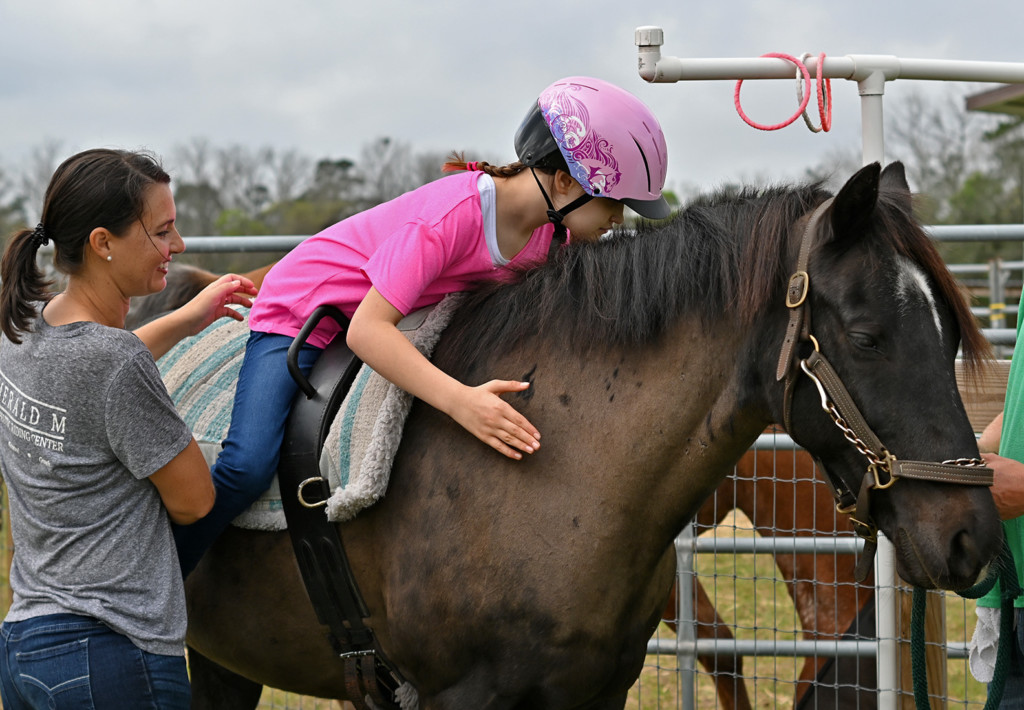
Sarah Clanton, blind and developmentally delayed since birth, gives commands to her horse, Cappy, at the Emerald M. Therapeutic Riding Center as owner and therapist Lisa Michelangelo, left, lends support. Horse therapy, which makes Sarah stronger and improves her sensory skills, is eligible for reimbursement for families using the Family Empowerment Scholarship for students with Unique Abilities.
Emily Hamilton’s two kids learn most things best by doing.
For science, that means making smears on slides, dissecting everything from seeds to mollusks, and conducting chemistry experiments with beakers and flasks. For her daughter’s math, that means using manipulatives such as dominoes, blocks or games.
The costs for those supplies add up quickly for Hamilton, who with her husband homeschools their two children, Wesley, 12, and Holly, 8. Both receive the Family Empowerment Scholarship for students with Unique Abilities, which allows families to personalize their students’ education by directing funds to where they’re needed most.
The funds can be used for a combination of programs and approved expenses including therapists, specialists, curriculum, private school, and more.
“Having unique learners often requires unique approaches to learning, and oftentimes that is through hands-on problem solving, experiential methods that require all of kinds of components to bring to life,” said Hamilton, who pays out of pocket to cover costs that are more than the scholarships are worth. For students with disabilities, scholarships average about $10,000 per student.
This year, new legislation extended the flexibility enjoyed by parents like Hamilton to all the state’s K-12 scholarship programs.
That increased flexibility can be a boon for families who choose to assemble a range of different learning options for their children. But it can also create risks of confusion or costly mistakes. For example, a family might make a purchase they think is reimbursable, only to learn later that it isn’t considered an eligible expense.
To help families make the best possible use of their increased flexibility, and minimize risks and confusion, the new legislation required scholarship funding organizations to create new purchasing guides that would provide clarity to parents on what education-related expenses are eligible expenses for their respective scholarship.
“We wanted to provide clarity,” said Doug Tuthill, president of Step Up For Students, Florida’s largest scholarship funding organization and host of this blog.
“We want to provide as much flexibility as possible for families so they can customize the education of their child but at the same time, we want to protect the public good and make sure the tax dollars are being spent in the most efficient and effective way possible.”
Parent needs, legislative intent and continuous feedback
There are now two purchasing guides. One is for the Family Empowerment Scholarship for Educational Options and Florida Tax Credit Scholarships. These programs are open to all students and include those choosing the new Personalized Education Program. The other guide is for families using the Family Empowerment Scholarship for students with Unique Abilities. The latter program, aimed at students with special needs, offers larger funding amounts and a wider range of eligible uses.
Florida, which has offered ESAs to families of students with unique abilities since that program was created in 2014, has always had rules for how those families could use the money.
“We had nine years of learning to help us develop the new purchasing guides,” said Tuthill. To develop the purchasing guides, the team also examined programs in other states, such as Arizona, which passed ESA legislation in 2011 and offered universal eligibility in 2022.
Step Up For Students also offers an online purchasing platform for families. The goods and services on the platform are offered by approved vendors. Families don’t have to use the online marketplace and can be reimbursed for expenses if they find other items that fit their child’s needs, or identical items available through other vendors for a lower price.
“A lot of our families do and will continue to receive funds through reimbursement,” said Catherine Bridgers, senior director for process improvement and risk management at Step Up For Students and leader of the teams that produced the guides. “We don’t want to put families in the position of interpreting statutes themselves or not having clear guidance in making purchases.”
Tuthill said the guides also help families avoid costly purchases that aren’t allowed and end up being denied.
“We want to minimize disputes between families and their scholarship funding organizations,” he said. However, he added that the guides are “living documents” and will continue to be revised.
Among states with ESA programs, Florida is unique in the way it relies on scholarship funding organizations to determine which uses of scholarship funding are allowed under state law. In other states, government agencies make those determinations
The new law requires scholarship funding organizations to agree on purchasing guidelines that will be shared with the state Department of Education and published by the end of the year. Step Up For Students is coordinating with the state’s other scholarship funding organization, AAA, to produce high-level guidelines. However, eligible expenses may differ based on each organization’s policies. Families should check with their scholarship organizations to determine whether an expense is eligible before they make a purchase. The guides include links on the Step Up For Students website for families using the Educational Options and Unique Abilities scholarships to offer feedback.
“We use that feedback for continuous improvement,” Tuthill said.
Each week, Bridgers and her team meet to examine parent feedback and purchases that fall into gray areas in state law.
A parent recently expressed concern when Step Up asked for more information about a day program for her child, who has Down syndrome. Florida law does not expressly authorize spending scholarship funding on day programs not operated by schools.
However, Bridgers’ team researched the provider and learned that the founder was certified in recreational therapy. That meant the program met the specifications for part-time tutoring under Florida law, which is eligible for scholarship funding.
As a result of that feedback, Step Up For Students now approves reimbursements for full-time day programs that meet state specifications for students 16 and older with intellectual disabilities.
“For this population, these programs are absolutely critical to those students’ development,” Bridgers said.
Can I get it at a district school?
Florida’s scholarship laws outline the types of purchases parents are allowed to make with their accounts. Some, like private school tuition, are straightforward. Other provisions of the law, such as one that allows parents to purchase instructional materials, leave more room for interpretation.
To help determine whether a good or service would be covered by education savings accounts being administered by Step Up, Bridgers and her team asked a key question: Is it offered in a Florida public school?
“We looked at our own statutes, but we also looked at other state statutes and policies and tried to come up with a public-school equivalency test,” Bridgers said. The team also examined statutes governing back-to-school tax holidays to help guide decisions on supplies.
“The spirit of this is that these students on ESAs have the same opportunities as public-school students,” Bridgers said.
That can include sports equipment, such as basketballs. But the guides set limits. The goal is to balance giving families access to a wide range of learning materials (including those a public school might purchase for gym class) while preventing uses of scholarship funds that stray beyond reasonable education-related purchases. Sports equipment can be replaced every two years, according to the guide.
“You couldn’t get 600 basketballs like the public school district could,” Bridgers said. “We really tried to be comprehensive and thoughtful.”
Field trips, including tickets to Florida theme parks, are also included as eligible instructional materials for families whose scholarships are managed by Step Up. However, the guide allows reimbursement of only the scholarship student’s ticket.
“We had a lot of debate about theme parks, Tuthill recalled. “Is a trip to Animal Kingdom at Walt Disney World that educational? Well, it was when I went. We said, okay, if a family wants to go to Animal Kingdom, and it’s a field trip, and they built some learning activities around it, how would you manage it? It’s not unusual for public schools to take field trips to a theme park.”
After all, Tuthill said, “learning can happen in all kinds of situations.”
Bridgers and Tuthill hope the listings in the Step Up purchasing guides will encourage families to get creative when designing their child’s learning plans.
That could include an evening at the Florida Orchestra concert or a community theater production. Research has found that taking students to live theater productions is an effective way to teach academic content, increase tolerance by providing exposure to a more diverse world, and improve students’ abilities to recognize what others are thinking or feeling.
“Our hope is that guardians will sit down with their student learning plans and their students as they look through the guides and they get more ideas to use their funds to create a better experience for their families,” Bridgers said.
For Hamilton and other parents whose customized programs have not relied heavily on co-ops or other offerings of outside groups, the guides have brought much needed clarity, especially to areas that once were considered gray.
“This scholarship was started from a place of true understanding of the intersection of learners with unique abilities and the benefits of alternative schooling opportunities, including homeschooling for their ultimate success,” Hamilton said. “I expect that the end result of all the feedback is a guide that is more robust and clear and can be consistently interpreted by the SUFS processors that review all the reimbursement requests, and continues to allow the unique learners on the scholarship to continue to learn in the way that suits them best and be reimbursed for it.”
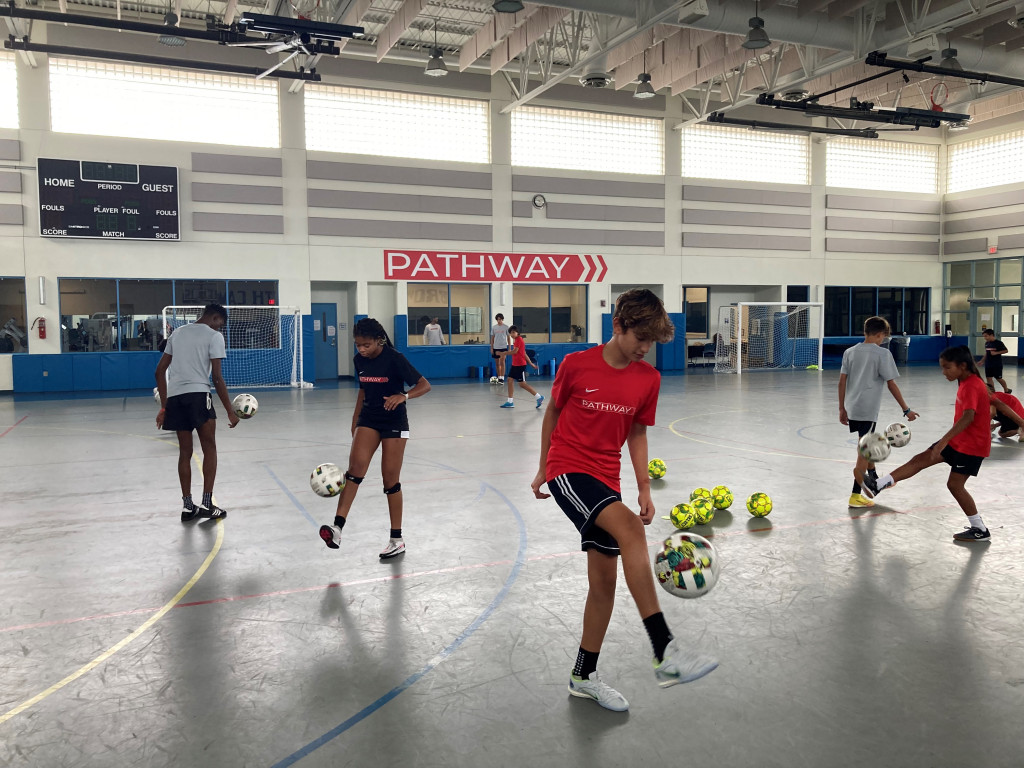
Sixteen of the 24 students who attend Pathway Schools’ Pembroke Pines site in Broward County, Florida, use income-based school choice scholarships. The other two campuses hope to accept scholarship students next year.
PEMBROKE PINES, Fla. – Danny Villegas knew that if South Florida wanted to develop the kind of elite soccer talent found in Europe, it would have to offer more than the usual part-time coaching and training – and reach more than just the kids from wealthier families.
So five years ago, he joined his friend Djems “DJ” Lima, who had come up with a concept that, in this era of increasingly customized education, is still surprisingly kind of rare: A K-12 school for athletes.
At the soccer-focused Pathway Schools, “We’re making better humans, better students, and better players,” said Villegas, a high school soccer star in Miami who went on to play professional soccer in Mexico, Brazil and the U.S.
The idea for Pathway “came out of me realizing I can’t develop a high-level athlete without working on all the components,” said Lima, who played soccer in college and earned a degree in business management. “With eight hours in a focused environment, we can really cater to the kids’ needs. Not just the athletic aspect, but the academic aspect and the mental aspect.”
A school for athletes can take promising young players to the next level.
School choice can help ensure even more promising young players have that opportunity.
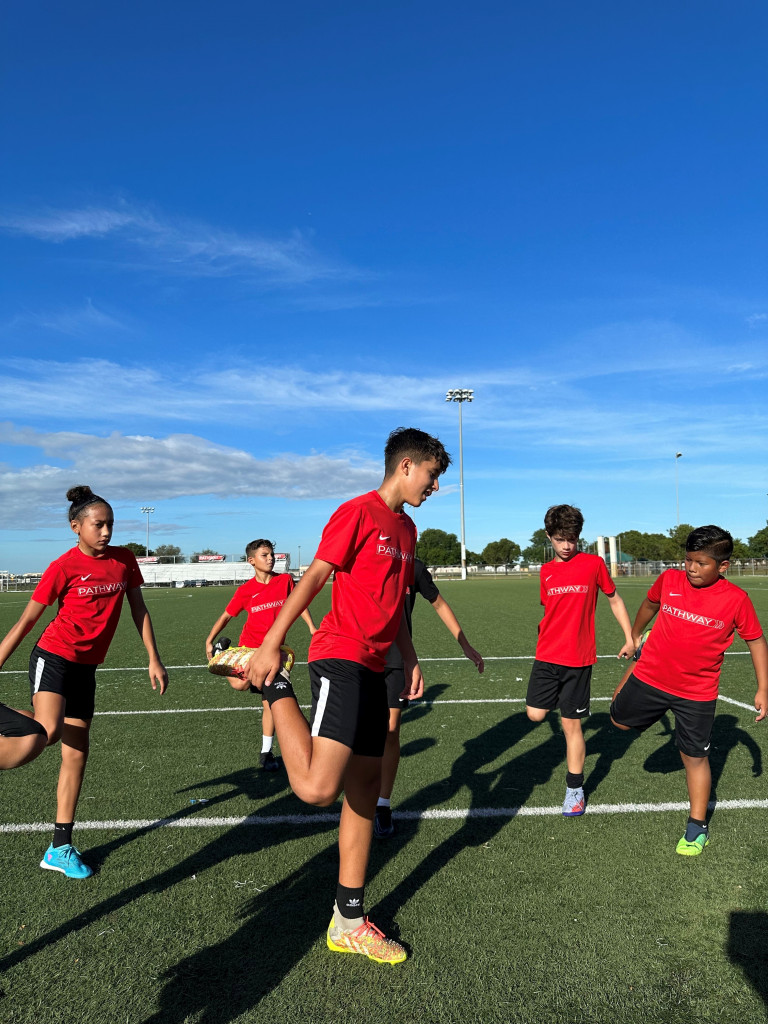
Pathway Schools students start their day with soccer training followed by four hours of academics, then participate in more soccer training in the afternoon.
Pathway has three campuses in South Florida that share the brand but have separate owners. Altogether, they serve about 75 students, most of them in middle and high school.
Villegas owns the one in the city of Pembroke Pines, in the vast patchwork of semi-tropical suburbia that is Broward County. It’s hard to imagine how he could have secured a better facility.
Pathway rents space on the south campus of Broward College, a state college that decided in 2020 to end its athletic programs. Pathway students have access to the college’s academic and athletic facilities, including its gym, locker rooms and soccer field.
Thanks to school choice, Pathway Schools will be financially accessible to a broad range of students.
Sixteen of the 24 students at the Pembroke site use income-based school choice scholarships. (Those scholarships are administered by nonprofits such as Step Up For Students, which hosts this blog.) The other two campuses are in the process of meeting state regulations for educational facilities so they can accept scholarship students next year.
Having those students “will make our impact that much greater,” Villegas said. “Some of the most talented soccer kids often don’t have the money.”
Marilyn Hawthorne said without a choice scholarship, she probably wouldn’t have been able to enroll her 16-year-old son, Emerson Butcher. Hawthorne is a nurse and single mom with two other children, both of them in college.
Pathway is perfect for Emerson, she said, and not only because he’s getting expert coaching. The 11th-grader is also getting the preparation and motivation he needs to excel academically, something he wasn’t doing at his prior school.
“My son is very bright, but he didn’t have much interest in school,” Hawthorne said. Pathway turned out to be “the right place at the right time. He has 100 percent turned it around.”
For its core academic curriculum, Pathway relies on Florida Virtual School. FLVS is the nation’s largest state-run virtual school, and it has long enjoyed an excellent reputation for academic quality. Pathway supplements FLVS with a team of on-site instructors who can offer one-on-one help.
The typical day’s schedule is soccer training in the morning, followed by four hours of academics, followed by soccer training in the afternoon. The school does not field its own club or travel teams – “We’re club neutral,” Villegas said – but all of its students play on top teams in soccer-rich South Florida.
The goal for Pathway students is to play at least at the college level – and to earn college scholarships in order to do that. To that end, Pathway students can’t participate in soccer training unless they maintain As and Bs in every class.
“When they’re motivated by what they love, which is soccer, they’ll do what they need to do,” Villegas said. “They realize, ‘Whoa, they’re holding me accountable.’ We’re a soccer school. But grades are important.”
Pathway Schools also put a lot of focus on non-academic skills, including self-discipline, emotional maturity, and mental toughness. At his campus in another Broward city, Coconut Creek, Lima has his students read Angela Duckworth’s “Grit,” about resolve and resilience, and the motivational business classic “Who Moved My Cheese?”
The schools are not only proving popular with hard-core soccer players in South Florida. They may be a template for education entrepreneurs in Florida and other choice-rich states who want to cater to their own athletic niches.
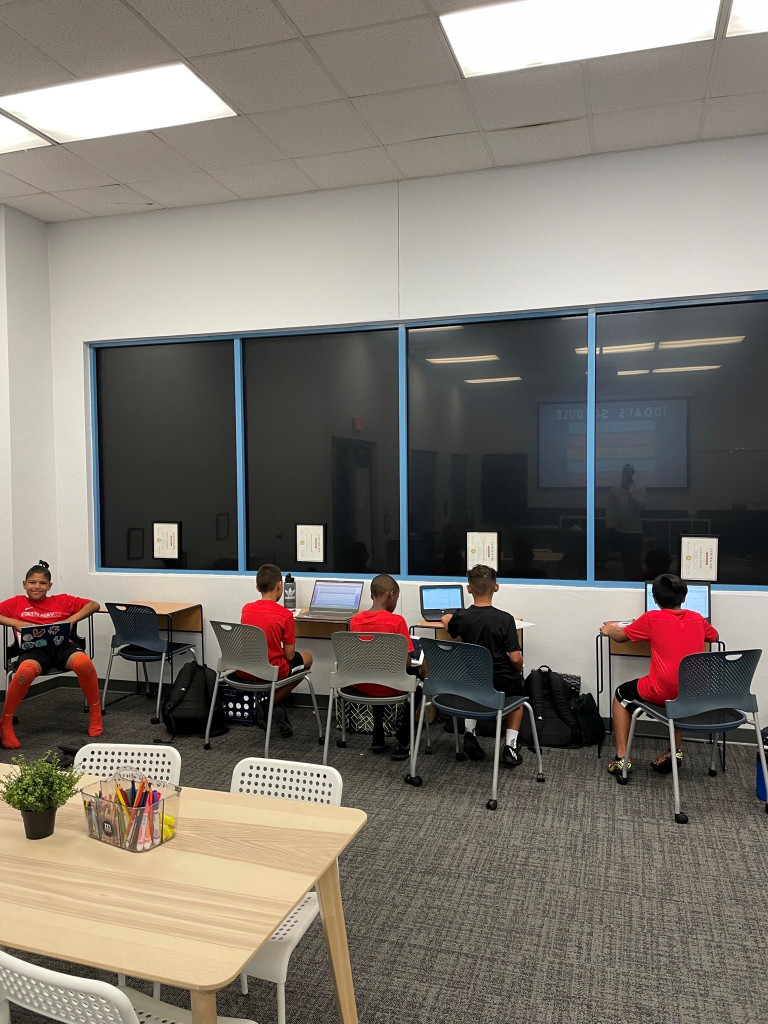
Pathway Schools evolved from the philosophy that developing high-level athletes requires a focus on academics as well as athletics. Pathway relies on Florida Virtual School for its core academic curriculum.
“When we meet kids where they’re at, and we align with their passions, it’s their dream school,” Villegas said. “They never thought this could be a reality.”
Eleventh-grader Zoe Burger was in a traditional private school before she enrolled in Pathway last year. She recently traveled to Peru after getting an invitation to play with the 17-year-old-and-younger Peruvian national team. She has also traveled to Europe to watch top-tier soccer there. She said she loves the training and competition at Pathway, and the flexibility that comes with FLVS.
“I don’t have to stress about assignments being done the same day,” Zoe said. “If I was in a regular school, I would get kicked out.” (To be clear, Zoe is no slacker. She’s already taken two Advanced Placement classes and plans to take more her senior year.)
Ninth-grader Madison Stewart was in a district school two years ago, and in FLVS full time last year. The latter was good academically but left a void. “I missed the social aspect,” she said. “It was hard doing school alone.”
When her mom told her about Pathway, Madison thought it was too good to be true. “I want to go as far with soccer as I can,” she said. “If there’s a school for it, why would I not go there?”
Emerson Butcher said the atmosphere at Pathway has been especially good for him.
His grades weren’t the best in his prior public school, he said. But now he has no choice but to make A’s and B’s.
“I’m going to be honest: I’m a class clown. But here, I’m more focused,” Emerson said. “There’s a lot of motivation because I love playing soccer.”
 In a recent interview with Sal Khan, former Florida Gov. Jeb Bush suggested we need a common term for concepts such as mastery-based learning, personalized learning, competency-based learning, individualized learning and customized learning.
“We need to come up with a name that everyone uses,” Bush told Khan at a recent education reform conference in San Diego. “When you figure it out, send a memo out to the rest of us.”
Governor, I recommend we use the term ”customized education.” Here’s why.
All learning is personal. Thirty students sitting quietly in rows taking detailed notes of their teacher’s lecture are engaged in personalized learning. No two students assimilate the teacher’s words in the same way. We all interpret incoming stimuli through the lenses of our previous experience and knowledge. Since no two people have lived identical lives, no two people interpret information, such as a lecture, in identical ways. Consequently, all learning, including how well someone masters a competency, is personal.
When people use terms such as personalized learning, they are really referring to teaching, not learning. While 30 students sitting in rows taking lecture notes are engaged in personalized learning, the teacher is not engaged in personalized instruction. The teacher is using one-size-fits-all group instruction. This group instruction is what reformers want to replace with instruction that is customized to each child’s needs.
Progressive educators have been advocating for personalized instruction for at least 150 years. Public education adopted one-size-fits-all batch instruction in the late 1800s because it was scalable and personalized instruction was not. Our inability to scale personalized instruction has thwarted us ever since. What’s different today is technology. Technology that did not exist 30 years ago is now enabling entities such as the Khan Academy to make customized education possible for every child globally.
So why do I prefer customized education over personalized instruction?
Khan Academy does not provide personalized instruction for every child. But it does provide content and tools that make it possible for learners to customize their education.
Education is more than instruction. Many of my most powerful learning experiences have come while doing yard work. I listened to a thought-provoking discussion between Sal Khan and Jeb Bush, thought about their exchange while working in the yard, and then clarified my thoughts by writing this blog post. This is why the term you are searching for, Governor, should be broad enough to encompass external instruction and self-guided learning activities. And why I prefer customized education.
So why customized education and not personalized education?
The term personalized learning has become so ubiquitous that trying to explain why it is redundant and misleading seems overly complex and onerous. I’d rather reboot, dump the word “personalized,” and go with customized.
Customized education – the future of public education, workforce education, and civic education.
I have spent more than 35 years working to help public education fulfill the promise of equal opportunity, but two recent New York Times articles illustrate how far we are from achieving that moral and societal imperative.
David Brooks, in a recent column entitled “The Opportunity Gap,” reviews the research on the gap between the haves and have-nots and concludes, “The children of the more affluent and less affluent are raised in starkly different ways and have different opportunities.” Brooks further reports this gap is growing: “Over the last 40 years upper-income parents have increased the amount they spend on their kids’ enrichment activities, like tutoring and extracurriculars, by $5,300 a year. The financially stressed lower classes have only been able to increase their investment by $480, adjusted for inflation.”
I see this opportunity gap daily in our racially and economically diverse neighborhood in south St. Petersburg. The affluent kids in my neighborhood are attending a variety of enrichment camps this summer. Meanwhile, the low-income kids are sleeping till noon and then wandering the streets in the afternoon trying to avoid boredom and arrest - and generally failing on both counts. Many of the low-income black teenagers I know are going to get picked up and questioned by the police this summer, and occasionally get arrested. Whether or not they’ve committed crime is irrelevant. They’ll all plead out, go into a diversion program that is a well-intentioned waste of time and money, and the whole cycle will start again.
In a second Times article, “Two Classes, Divided by ‘I Do,’” Jason DeParle chronicles how the differences between one- and two-parent families help explain this growing cultural dichotomy. DeParle writes that, “Changes in marriage patterns - as opposed to changes in individual earnings - may account for as much as 40 percent of the growth in certain measures of inequality … About 41 percent of births in the United States occur outside marriage, up sharply from 17 percent three decades ago … Less than 10 percent of the births to college-educated women occur outside marriage, while for women with high school degrees or less the figure is nearly 60 percent.” While many children raised by single parents do well as adults, DeParle concludes that overall, children raised by single parents are significantly disadvantaged: “They are more likely than similar children with married parents to experience childhood poverty, act up in class, become teenage parents and drop out of school.”
None of this is news in my neighborhood. The vast majority of low-income children wandering our streets this summer are being raised by a single mom or grandmother. They have no fathers in their lives.
The traditional neighborhood district school has little or no chance of overcoming these obstacles, which is why new models of publicly-funded education are emerging. (more…)
by Star Kraschinsky
Florida Virtual School® (FLVS®) opened its virtual doors in August 1997 as the country’s first Internet-based public high school with seven teachers and 77 students. Today, the statewide, public virtual school serves more than 122,000 public, private, charter and home-schooled students in Kindergarten through 12th grade and provides e-solutions to all 67 Florida school districts, the remaining 49 states and to 57 countries.
Through FLVS and online learning solutions, curriculum and scheduling choices are no longer limited to local school offerings or a student’s zip code. Access is offered 24/7/365 from any place with Internet connection. Fast forward 10, maybe even just five years, and this paradigm shift on how to best serve students – where they are and not where we want them to be – will be almost complete.
The fundamental belief of FLVS that every student is unique and learns at a different pace is as true today as it was 15 years ago. It’s all about personalized learning and instruction.
In the future, when funding completely follows a child, he/she will be able to be zoned to one “home” school, but take courses from various schools. Students and their parents will have educational choices; they will be able to map out their own personalized learning journey.
With funding following the student, the bottom line will not be at the center of all decisions made; the student will be at the center – as he/she should be. (more…)

