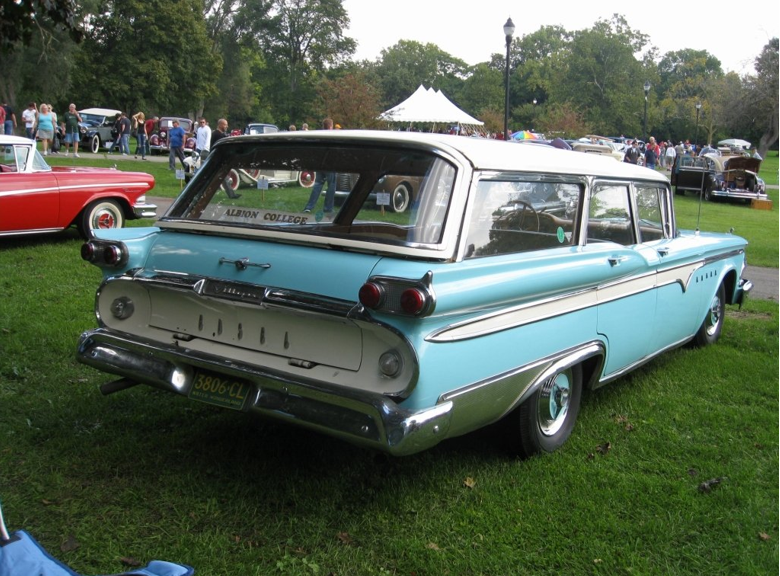
While 1958 Edsels boasted multiple advanced features, the launch of the model line became symbolic of commercial failure; introduced in a recession that catastrophically affected sales of medium-priced cars, Edsels were considered overhyped, unattractive and of lower quality.
The central problem in American K-12 education, as John Chubb and Terry Moe instructed us years ago in their book, “Politics, Markets, and America’s Schools,” is politics.
In most human endeavors, we make more of what people want. If people want less of something, they stop purchasing it, quickly sending a signal to producers to make less of it.
Americans are fairly unsentimental about producers who ignore their instructions.
Henry Ford once said his customers could have one of his cars in any color they like, as long as it was black. Ford apparently imagined himself operating in a market without viable competitors, but the American public collectively disabused him of this notion by purchasing other vehicles. The Ford Motor Company lost its status as a market leader and was forced to retool its efforts/attitudes in order to survive.
Now imagine if the American automobile industry functioned like the American K-12 system. In this scenario, states draw car purchase boundaries around car manufacturing plants. Residents within this boundary pay taxes to their local plant, which is overseen in theory by an elected board. In practice, these elections are low-profile, non-partisan and often attract 10% or fewer of eligible voters. The United Autoworkers find it relatively easy to influence these elections.
Imagine a world in which the Ford Motor Company was able to utilize politics to keep making Edsels and Model Ts and Model As for decades on end.
Tiebout choice still exists, however.
If you want a car other than an Edsel, that’s no problem; you can move to a Corvette zone if you like. Yes, real estate is pricier in the Corvette zone, but your friends and neighbors intimate to you that you get what you pay for, and it’s for the children.
You also can buy a vehicle from an independent car company, but you must pay your Edsel taxes regardless, placing such vehicles out of the financial reach of most Americans.
Run this story forward a few decades. Wealthy families have long since departed from the Edsel districts and their like, having paid a real estate premium for fancy districts. The car districts continually claim they need more money to produce better cars, and taxpayers continuously provide it.
They really want a good car, and it is difficult to imagine a different system. Academic improvement generally happens at a rate nothing like the increase in spending.
Highly segregated by income and race, the public car system and the now very politically powerful interests with a stake in the status-quo become quite adept at opposing and/or undermining efforts to improve productivity in the industry. The system stands rigged in favor of the wealthy and in favor those who make Edsels; Edsels today, Edsels tomorrow, Edsels forever.
Just in case you suspect embellishment, let’s take a look at just how rigged the K-12 system is against the poor. Data from the Educational Opportunity Project at Stanford University will do the trick.
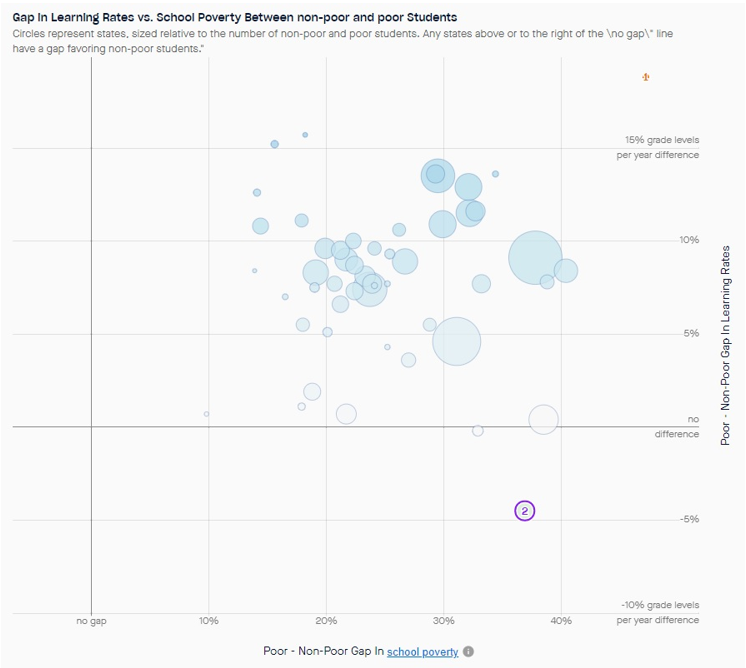 This chart will take some decipherment, but it is worth it, so stick with me.
Every dot is a state. The chart shows the differences in academic growth between non-poor and poor students. Every state above the horizontal “no difference” line has a faster rate of academic growth for middle and high-income students than low-income students. Yes, it is almost everywhere.
Way at the top right, marked “1,” is the District of Columbia with the largest gap in favor of the non-poor and rich. The District of Columbia, after turning a large portion of the education of low-income D.C. students to charter schools, managed to get the academic growth rate for poor students to the national average.
Low-income students in D.C. need a faster rate than average if they are to close achievement gaps, but one suspects matters were even worse in decades past.

May the odds be ever in your favor, rich D.C. kids!
Non-poor D.C. students, meanwhile, learn at a rate 18.5% faster than the national average. Buying into that Telsa, sorry, Georgetown attendance zone will cost you a fortune, but it runs like a charm for your little darling and will take him where he wants to go.
District of Columbia Public Schools have become remarkably adept at one thing: serving the academic needs of the wealthy. The poor, not so much.
Returning to the chart, a small number of states are near the horizontal “no difference” line. None of them, however, have an impressive rate of academic growth for either non-poor or poor students.
The lone outlier, marked “2,” has a fast rate of academic growth for non-poor students and an even faster one for poor students. The learning rate for non-poor students is 11.4% higher than the national average. The learning rate for poor students, however, is 17.4% above the national average, so there was gap-closing happening in this state in the period covered (2007-2018).
Arizona, which spends perhaps one-third of the per-pupil amount spent in D.C., is state 2 on the chart. Arizona has the largest state charter school sector (around 21% of students statewide); an unusually active system of open-enrollment between district schools (about one-third of Phoenix-area students attend a non-zoned district school); and private choice programs. When the Education Freedom Index was updated after two decades, Arizona ranked first for choice in both studies.
This did not happen overnight.
The Stanford Educational Opportunity Project data does not show that Arizona students had high rates of proficiency during this period, rather that students learned more than those in any other state per year. An “Edsel district” in Arizona faces real consequences for dissatisfied families, who can move to other districts, to charters, or to a still limited but nevertheless meaningful extent to private schools with financial assistance.
School districts still educate a large majority of students, but they also are the most active choice players. Districts still have low turnout, the United Auto Workers still lobby for more money, but from an academic growth standpoint, they largely stopped making Edsels before the pandemic.
Florida, Indiana and West Virginia all look poised to make major choice advancements this year. The key to a virtuous cycle of improvement in my view will be getting the Corvette districts the right incentives to lower the drawbridges to let Edsel district kids past their moats and into their schools.
When they do, you just might see those districts produce something better than an Edsel.
Arizona: A former school teacher criticizes the state superintendent of public instruction for his support of Common Core and school choice (East Valley Tribune). The Sierra Vista Herald editorial board says the state superintendent's support of ESAs hurts public schools. Applications for Empowerment Scholarship Accounts doubles (Heartlander). The Arizona Republic editorial board opposes allowing public funding to go to private schools, especially now that the state support for ESAs exceeds the state support for public schools (note: the editorial board's calculation excludes local support for public schools). A consultant at a scholarship organization is indicted for stealing $529,000 in scholarship money (Arizona Republic).
California: Vanila Singh, a professor and physician at Stanford University and congressional candidate, says school choice is the key to student success (Mercury News). The California Charter Schools Association has sued the West Contra Costa School District for withholding tax revenue intended to fund charter schools (Contra Costa Times). Charter schools struggle with online assessments (FSRN Radio).
D.C.: Two charter schools allegedly under federal investigation for possible discrimination say they have never received a complaint from a student or parent (Washington Post). President Obama sends his daughters to Sidwell Friends, an elite private school that refuses to release information on student course completion and graduation rates (Washington Post).
Florida: The tax-credit scholarship expansion will allow the program to serve higher-income families (Education Week, Tampa Tribune, WJHG TV). More low-income families will benefit from the tax-credit scholarship program if the Governor signs the bill into law (Florida Times-Union). The state passes the nation's second education savings account program (Foundation for Excellence in Education). Daphne Cambell (D-Miami-Dade) says she voted to expand the program because giving poor kids more options is the right thing to do (Miami Herald). The Tampa Tribune editorial board says the scholarship expansion is justified because every student deserves to find a school that works well for them. Brian Tilson, owner of a communications firm in Boca Raton, says the scholarships are unpopular and are hurting public schools (Gainesville Sun). Ron Matus, the editor of redefinED, says more progressive Democrats support parental choice (Gainesville Sun). The scholarship program helps families afford Jewish day schools (Chabad News). State Impact talks with Sen. John Legg about the legislative session including the passage of the scholarship bill. Marc Yacht, a retired physician, say charter schools should be more regulated and held to the same standards and rules as traditional public schools (Sun Sentinel).
Georgia: The Southern Education Foundation helps file a suit to overturn the state's tax-credit scholarship program (Watchdog). A former reporter sends her daughter to a charter school and says each school is so different it is difficult to compare them to each other let alone public schools, and that is a good thing (Atlanta Journal Constitution). (more…)

