KIPP Jacksonville became Florida's first successful attempt to lure a nationally recognized charter school organization thanks, in large part, to local benefactors.
Jacksonville Greyhound Racing donated a dog track, and the charter organization gradually converted the clubhouse into classrooms. Wealthy board members helped fund the renovation, and today they're financing a second building at far below the market rate. The small collection of schools enrolls close to 1,000 students and is still growing, adding as many as 200 a year. It has 1,400 children on its waiting list.
But the largess of its wealthy donors is running thin. And it's out of dog tracks to renovate.
On Wednesday, Tom Majdanics, KIPP Jacksonville's executive director, told state lawmakers he hopes the national charter school organization can bring "sibling" schools to more Florida cities. For that to happen, they'll need to address the barrier his schools already butt up against: A shortage of funding for charter school facilities.
While lawmakers have increased funding for public schools in recent years, Florida remains ranked near the bottom for per-student spending. Combine that with eroding facilities funds, and the state may start to look inhospitable to national charter school organizations with a reputation for getting results in underserved communities. State officials have long sought to attract more of them.
This graph, prepared for Wednesday's Senate Education Appropriations Subcommittee meeting by the state Department of Education, illustrates what Majdanics described as a key problem.
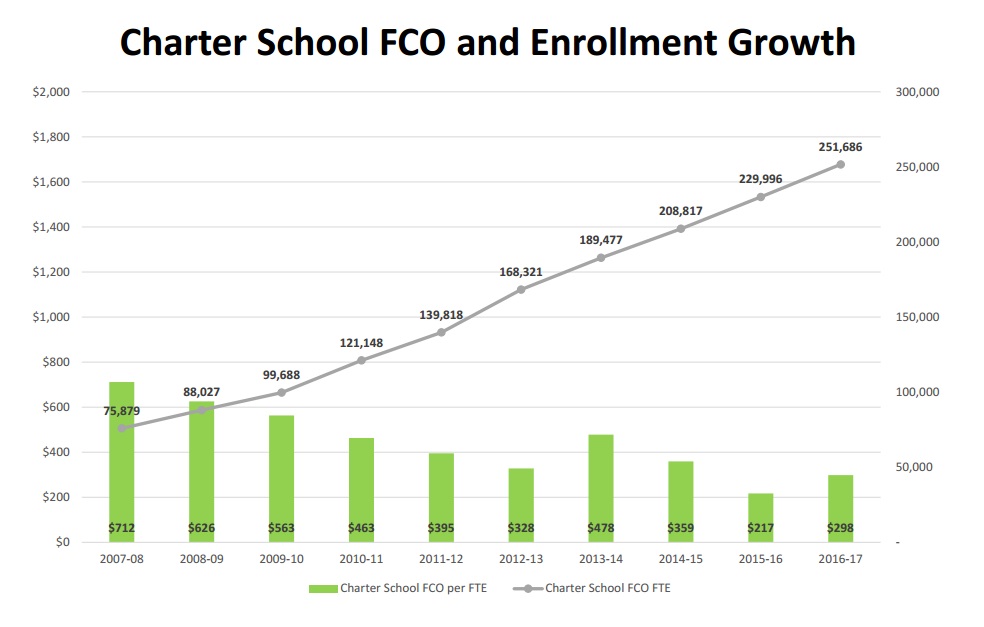
Charter schools rely on an annual appropriations from the state Legislature. That funding has fluctuated between $50 million and $100 million in recent years. But Florida's charter schools enroll more students each year. That means the same pool of money is being spread across more students and schools. Majdanics told the panel that the roughly $300 per student KIPP Jacksonville receives from the state "barely covers the interest on our loans" for capital expenses.
Could this be the year Florida finally finds a way to fund charter school facilities?
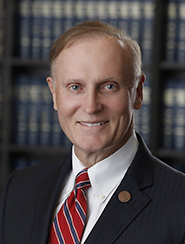
A pair of bills, filed by Sen. David Simmons, the Central Florida Republican in charge of the upper chamber's education budget, suggests it might be.
Simmons
One of the bills, first reported by the Gradebook, would increase school districts' optional property taxing authority. The other would guarantee, for the first time, that charter schools would get a fair share of that revenue, based on the number of students enrolled.
Right now, charters rely on uncertain annual appropriations. Funding can fluctuate year to year, but it's recently been stuck at $75 million, far below the amount received by traditional public schools. Under Simmons' proposal, charters could still receive annual appropriations, too.
Taking a closer look, Simmons' proposal offers something for everyone who typically jumps into the annual slugfest over charter school facilities funding.
It has a clear benefit for charters. During the 2015-16 school year, the most recent for which budget data are available, Florida school districts raised $2.3 billion in property tax revenue. Charter schools typically don't share that money right now. A fair pro-rata share for charters, which enroll about one in ten public school students, could yield a revenue stream worth more than three times what they currently receive through annual appropriations. (more…)
Parent trigger history repeated itself in Florida's Senate today. After deadlocking last year on a plan to let parents vote to take over struggling public schools, the Senate was offered a milder approach this year that put the parent trigger finger in the hands of the elected School Board in each county. It didn't matter. The bill again went down on a 20-20 vote.
Given that the Legislature is scheduled to adjourn on Friday and a parent trigger bill that passed earlier this month in the House contains more explicit language, the Senate vote likely signals an end to the fight for 2013.
The bill had been amended on Monday by a moderate Republican, David Simmons, to vest the final decisions about school turnaround strategies with school boards -- and not with parents. Sponsors were hoping the change would clear the way for approval on the floor. But key Republicans still voted against it. Most telling was the opposition of Jack Latvala, who voted in favor of the more stringent parent trigger bill last year as he was in the midst of fighting for votes to be elected Senate president. To date, Latvala has failed in that quest.
Florida’s parent trigger bill is headed to the Senate floor after another predictable party-line committee vote. But odds are rising that this year’s model will bring as much last-minute drama as its predecessor did last year, when several Republicans broke rank to kill the measure.
In the Senate Appropriations Committee on Tuesday, bill sponsor Sen. Kelli Stargel, R-Lakeland, said a recent amendment giving school districts - and not the state - the final say in a school’s turnaround plan likely would be modified.
Proposed by Sen. David Simmons, R-Altamonte Springs, the amendment altered the original bill’s final arbiter, the state Board of Education, and made it more acceptable to parent trigger critics. But parent trigger supporters said it watered down the bill’s intent, which is to let parents have a bigger role in determining the best way to improve their children’s schools.
Stargel said Tuesday that neither she nor Simmons – nor the majority of the education appropriations committee that passed it April 11 - really wanted that language in the bill.
“We would not want parents to come together to work so hard to get 50 percent of the parents (to support a turnaround plan), and just have their voices taken under advisement, if you will,’’ she said.
Still, she said, any changes would happen after Tuesday's vote. That raised concerns among some committee members, most notably Sen. Jack Latvala, R-Clearwater.

Sen. Jack Latvala
“So that would lead me to conclude that you’re going to remove that exemption at some point in time – or attempt to remove it,’’ he said.
Answered Stargel: “We’re going to modify this bill going forward, but we’re not sure in what way.”
The committee voted 12-6 in favor of the measure, with Sen. Lizbeth Benacquisto absent. The Fort Myers Republican had filed an amendment the day before, calling for the state to remain the final arbiter, but Stargel withdrew the proposal. (more…)
Parent trigger. The parent trigger bill is amended in the Senate so school boards have the final say. Coverage from redefinED, Associated Press, SchoolZone, The Buzz. StateImpact Florida talks to Sen. Bill Montford, D-Tallahassee, about why he's opposed to parent trigger. The Orlando Sentinel highlights the amendment sponsor, Sen. David Simmons. Palm Beach Post columnist Frank Cerabino sees the specter of mass privatization: "The parental trigger bill is designed to lead to the widespread conversion of traditional public schools in Florida to charter schools."
 Online education. The bills being considered by this year's Legislature, including Sen. Jeff Brandes' course choice bill, are about profits and privatization, not choice and competition, editorializes the Tampa Bay Times.
Data. Lawmakers are dealing with data issues related to teacher evaluations and access to researchers, the latter being complicated by critics raising fears of privatization, reports the Tampa Bay Times. A group called Liberty in Action protests the access bill outside the office of bill sponsor Sen. Bill Galvano, reports the Bradenton Herald.
Remediation. The Senate approves a bill that would end a requirement that college students take remedial courses for no credit. StateImpact Florida.
School spending. The Seminole school is scrambling to explain why it decided to spend $100,000 to send 176 teachers and school administrators to a teacher training program when a cheaper alternative was available. Orlando Sentinel.
Employee conduct. Three staffers at a Collier County school are under investigation for some kind of impropriety with FCAT testing. Naples Daily News.
Florida lawmakers made a big change to the parent trigger bill Thursday, passing it on another party-line vote but only after diluting the initial proposal to give parents more power to improve struggling schools.
The Senate Appropriations Subcommittee on Education approved an amendment that gives school boards – not the state - the final say on a school turnaround plan.
The original wording in Senate Bill 862 made the state Board of Education the final arbiter if parents and school boards didn’t agree on the best way to improve a school.
Among a list of options is converting the district school into a charter school, a plan that might have more support from parents and the state board than district leaders.
The amendment comes at the request of Education Commissioner Tony Bennett, who asked sponsors of the House and Senate parent empowerment bills to hold elected school board members accountable.
“School boards should not have the ability to push the decision to the state,’’ Bennett wrote in a recent letter. “They owe it to parents to consider what they have to say without being able to avoid the tough decisions.’’
Bennett also suggested the turnaround process was “overly burdensome’’ with formal notices, votes and petitions required to kick-start a plan. He said the school board should have to explain at a public hearing why it didn’t think the parents’ approach was best.

Sen. Simmons
The amendment, introduced by Sen. David Simmons, R-Altamonte Springs, made that a requirement.The final outcome should be determined locally, not in Tallahassee, Simmons said. He also said parents are as culpable as school boards when it comes to so-called failing schools.
Sen. Bill Montford, a Tallahassee Democrat and head of the state superintendents association, said he supported the amendment and might be able to support the bill if “we continue to move the way we are now.’’ For now, he joined three other Democrats on the subcommittee in voting against it.
The eight Republican senators present at the meeting voted in favor. The next stop for SB 862 is the Senate Appropriations Committee, which is expected to consider the bill on April 18.
The House version of the parent trigger bill, which passed earlier this month, still gives the Board of Education the final word.
 Editor's note: Another year, another legislative session, another stack of school-choice bills in Florida. Here's a roundup of choice legislation that lawmakers will consider in the annual session that begins today.
Career Academies:
SB 1076 by Sen. John Legg, R-Lutz. Expands the "Career and Professional Education Act (CAPE)," revising requirements for high school graduation and accelerated high school graduation, and allowing students to earn and substitute certain industry certifications for certain course credits. Also requires districts to make digital materials available to students and to use the Postsecondary Industry Certification Funding List in determining annual performance funding distributions to school districts and Florida College System institutions, etc.
Charter Schools:
HB 373 by Rep. Joe Saunders, D-Orlando. Provides that a contract for a charter school employee or service provider may not extend beyond the school’s charter contract, and that the employee or service provider is not entitled to compensation after the school’s closure. (Identical to SB 780 by Sen. Geraldine Thompson, D-Orlando.)
HB 453 by Rep. Victor Torres, D-Orlando. Requires the compensation and salary schedules for charter school employees to be based on school district schedules. (Identical to SB 784- Charter Schools by Sen. Geraldine Thompson, D-Orlando.)
SB 744 by Sen. David Simmons, R-Altamonte Springs. Requires charter school applications to demonstrate the applicant is financially qualified to open and maintain a high-quality charter school, requires the charter to set forth detailed reporting of the financial operations of the school to ensure employees are not paid unreasonable compensation, and requires that the term of the charter must provide for cancellation of the charter if the school becomes insolvent, fails to provide a quality education, or does not comply with applicable law. The bill also clarifies that a charter school system shall be designated a LEA solely for the purpose of receiving federal funds if certain criteria are met.
SB 828 by Sen. Rene Garcia, R-Hialeah. Grants school districts the ad valorem tax exemption given to charter schools, and restricts the use of capital outlay funds for property improvements if the property is exempt from ad valorem taxes. It restricts charter schools or technical career centers having financial problems from certain activities, and grants flexibility to high-performing school choice districts.
HB 1001 by Rep. Karen Castor Dentel, D-Maitland. Prohibits charter schools from requiring, soliciting, or accepting certain student information before student's enrollment or attendance. Also requires charter schools to submit attendance plans to the school district for students enrolled in school; provide funding to the school district in event of student transfers; and report to the school district certain student enrollment and wait-list information.
SB 1092 by Sen. Geraldine Thompson, D-Orlando. Requires charter school to submit attendance information for each student to the school district, and requires the charter school to provide a prorated portion of per-student funding to the school district if a student transfers to another public school in the school district before the last day of the school year.
SB 1164 by Sen. Kelli Stargel, R-Lakeland. Revises the eligibility criteria for extracurricular activities to include students in charter schools, and revises the criteria for bylaws, policies, or guidelines adopted by the Florida High School Athletic Association. (Compare to HB 1279 by Rep. Larry Metz, R-Groveland.) (more…)

Sen. Simmons
Big payout to charter school principal. The principal of a failed charter school gets a $519,453 check from the school’s board, reports the Orlando Sentinel, prompting outrage from Orange County school district officials and a call for an investigation from state Sen. David Simmons: “There's no room for abuse by charter or traditional schools," Simmons, a strong supporter of school choice, told the paper. "All it does is hurt children."
Lax oversight of charter school funding. An audit finds the U.S. Department of Education did not properly monitor how states were spending hundreds of millions of federal dollars for charter schools, reports the Associated Press. The audit also looked at charter funding oversight in Florida, California and Arizona. In Florida, according to the story, “state officials had no records of which schools received federal grant money nor which schools received on-site monitoring and audits.”
Charters, IB and a level playing field. The charter school system in Lake Wales complains the Polk County school district isn’t playing fair in recruiting students to the district’s IB programs, reports The Ledger.
Tax credit scholarships helping private schools. Growth in Florida’s tax credit scholarship program is giving private schools a boost, reports the Daytona Beach News-Journal.
Teacher who likes Mitt Romney. StateImpact Florida interview here.
Lesson from Miami-Dade. In winning the Broad Prize, the Miami-Dade school district showed “poverty does not have to be an obstacle to success,” editorializes the Miami Herald.
Pick up the pace. Florida needs to put even more focus on education and accelerate improvement, editorializes the Fort Myers News Press.
A closer look. Pinellas Superintendent Mike Grego says the district’s state-directed teacher evaluation system, which has caused widespread frustration, needs a review, reports the Tampa Bay Times.

