School choice programs are routinely demonized as nameless, faceless programs. Catherine Durkin Robinson of Florida Parent Network says it's past time to #SayTheirName
As an activist, voter and resident who leans way to the left, I read the news daily and find myself asking, out loud and with more than a bit of frustration:
“Can I get a left-leaning candidate for governor who knows something about educational choice in Florida?”
Is that too much to ask?
I run the Florida Parent Network – a dedicated team of organizers who travel this state listening to thousands of parents about why they choose something other than district-run schools. We listen … to hopes and dreams, triumphs and tragedies.
We see our parents’ love for their children shining through in every choice they’ve ever made.
We help them protect and defend those choices.
I am officially inviting candidates running for governor in this year’s Democratic primary to step outside their neighborhoods, circles and worlds of privilege and meet some of our parents too.
Maybe they’d learn something. (more…)
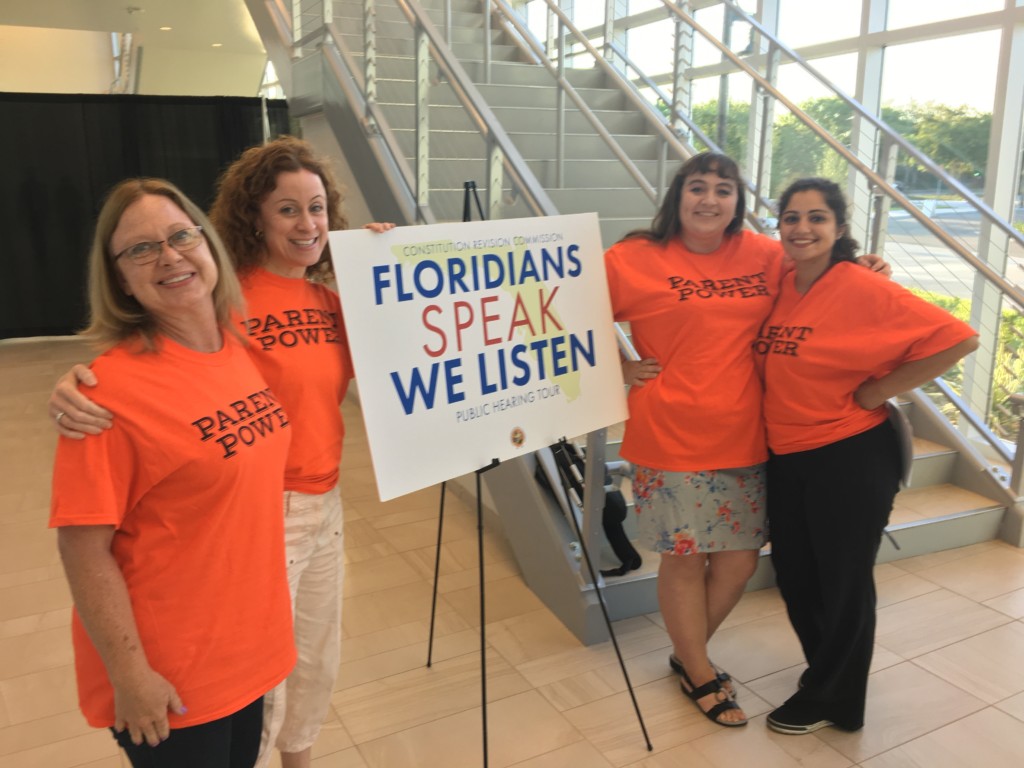
Catherine Robinson (second from left): "The next time my colleagues on the left yell and scream about Republicans turning on their values to support President Trump, I would like them to look in the mirror. You, too, are turning on your values to support a union and a system that limits opportunities for the people you claim to care about the most."
I’ve been a militant advocate, organizer and member of the Democratic Party for 30 years. A few months ago, I quit identifying as a Democrat.
It had been building within me for a while. I could no longer stomach the Democratic Party’s support for an education system that hurts so many poor and working-class families.
Democratic Party politicians have repeated their lies about educational options so long, they’ve begun to believe those lies. And they do this while so many of them can afford to move into desirable neighborhoods with good schools, or send their children to private schools.
I wonder how they sleep at night.
As far back as I can remember, I’d been raised to firmly identify and side with the poor and working class. My relatives were teamsters, union members and union organizers, Irish immigrants who fought for everything they got.
In college, I officially began my activism career by joining Students Against Apartheid. That led to gigs with Amnesty International, Greenpeace, Jerry Brown for President, Tampa AIDS Network, Florida Public Interest Research Group, and Sierra Club.
I worked as a counselor where I helped women choosing to end their pregnancies, sometimes holding their hands as they endured the most difficult moment of their lives. I marched on Washington and appeared on local talk shows, insisting that women had a right to control their reproductive lives.
I was almost arrested three times: protesting nuclear power, demanding an end to the war in Kuwait and demonstrating against animal cruelty.
For my 21st birthday, more than anything, I wanted an FBI file.
After college, I taught at alternative high schools and helped mostly young men, who had been expelled or arrested, turn their lives around. I also taught in district schools for students with special needs. All the while, I organized and advocated to repeal the Second Amendment, ensure marriage equality for all, protest armed conflict, provide for universal health care, expand voting rights, oppose private prisons and put out of business all circuses, rodeos and Sea World.
Six years ago, I met Michelle Rhee. I took a job with her national non-profit, organizing parents in several states to lobby for laws that put children’s needs ahead of adults’. Much to my surprise, Democratic friends and colleagues didn’t support this career move. (more…)
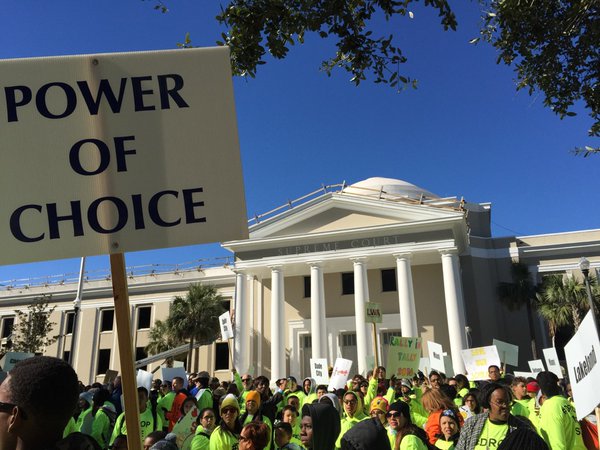
About 10,000 people, most of them black and Hispanic, rallied in Tallahassee in 2016 against the lawsuit that sought to kill the Florida Tax Credit Scholarship. Do Democrats running for governor understand who they are really criticizing when they reject school choice?
If you asked parents of students victimized by bullying (like this one, this one and this one) to describe the school choice scholarships that helped their kids find some educational peace, they’d probably offer words like “life-saving” and “miraculous.”
To Gwen Graham, though, the word that comes to mind is “diabolical.”
“Diabolical” is how Graham, a Democratic candidate for governor in Florida, described Florida’s new Hope Scholarship, which lawmakers engineered to give options to all bullying victims. “It is another move by the Legislature to decrease the funding in Tallahassee and increase the funding for their private and charter schools,” she told the Tallahassee Democrat editorial board. “It is diabolical. It truly is.”
That Democratic candidates might feel obliged to condemn school choice is no surprise, given the fact that teachers unions, whose members work almost exclusively in district-operated schools, contribute heavily to the Democratic Party. That’s even true in Florida, arguably the most choice-friendly state in America. But unlike many other states, where school choice is still an abstraction, candidates who denounce choice in Florida are also explicitly denouncing the hundreds of thousands of parents who choose. Here, growing numbers of parents in core Democratic constituencies freely choose charter schools and private school scholarships, and surveys show they like what they have found.
I’m no political analyst. But the basic math would seem to be a caution flag for Democrats. Since the last gubernatorial election in 2014, the number of students using the Florida Tax Credit Scholarship, the largest private school choice program in America, has climbed more than 50 percent, to 107,000. The number of charter students has increased by about 20 percent, to nearly 300,000.
Judging by the demographics, their parents lean heavily Democratic. The average family income of a tax credit scholarship student is $25,360 a year, and 68 percent of the students are black or Hispanic. In Florida charter schools, 62 percent of students are black or Hispanic.
Florida has also created a major new choice program since the last election – the Gardiner Scholarship, an education savings account for students with special needs such as autism and Down syndrome. It now serves more than 10,000 students. I couldn’t hazard a guess about their parents’ politics, but I know they’re signing up so quickly the scholarship now has a waiting list, and they are the kind of parents who aren’t likely to be amused by politicians who want to take away education tools that are helping their children.
Remember, too, that Florida’s past two gubernatorial elections were squeakers. (more…)
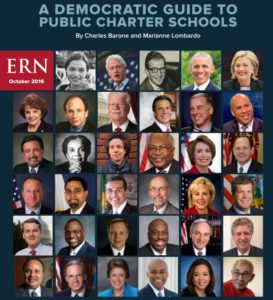 Civil rights activists and teachers union leaders helped lay the intellectual foundations for charter schools. Since they were first created in the early 1990s, charters have gotten federal backing from both Democrats who held the White House. They're now supported by strong majorities of key Democratic constituencies, including parents of color. With one notable exception (Miami), the cities with the largest numbers of charter school students are all led by Democratic mayors.
In short, there are deep strands of support for charter schools on the left side of the political aisle that belie recent stances taken by institutional Democratic parties at the state and national levels.
A new report by Education Reform Now (a sister organization of Democrats for Education Reform) documents the many ties between the charter school movement and progressive politics, from historical roots to present-day polling data.
It also makes a case that Democrats have a unique role to play in the charter school debate.
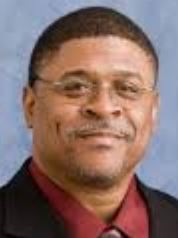
Rev. Sykes
If there's one thing Republicans have right, it's about the power of competition to shake up unresponsive bureaucracies, including those that oversee public school systems.
So says prominent African-American pastor Manuel Sykes, who had Tampa Bay political circles buzzing last week amid an announcement that he would be moving to the Republican Party. The move may have been precipitated by local issues like local Democrats' efforts to stifle his run for Congress, but it's also another indicator of political crosswinds that have buffeted left-leaning school choice supporters for years.
Sykes, the longtime pastor at Bethel Community Baptist Church in St. Petersburg, has long been a school choice supporter - and, until recently, an active Democrat. His church runs a school that caters to low-income students on scholarship programs, many of whom struggled in the schools they left behind.
"If the Democrats take a stand against vouchers, to me, that's too one-sided," Sykes says during a podcast with redefinED. "It shows a lack of analysis, because we have children that have been failing in school since I arrived on the scene back in 1993."
Back then, he says, he was working with a group of religious leaders who were trying to bring programs developed by the National Institute of Direct Instruction into public schools. After being rebuffed by school district officials, he saw the potential benefits of giving people options outside the traditional school system.
"Many times a bureaucracy has its own internal self-preservation instinct," he said, adding: "One thing that I truly believe that Gov. (Rick) Scott got right is that competition makes people do better. When they know that they're not the only show in town, they tend to do better if they want to stay in business."
But that doesn't mean he's all-in for unfettered free markets. He says people still need to be protected, and that he's going to continue to support social programs like Medicaid that can help improve life for poor people and help them transition into jobs. Drawing a contrast with fellow Republicans, he says, "When you are helping corporations to thrive, you also have to help people to survive."
Our interview also touches on his decision not to endorse Scott for governor, his dispute with the state NAACP, and the "sense of betrayal" in some quarters when news of his party change began to make the rounds. To understand some of his comments on political maneuvers related to his scuttled run for Florida's thirteenth congressional district, see more background here.
This month, former Senator George McGovern frames his beau ideal of the crusading and committed progressive in his new book, What It Means to Be a Democrat. Addressing issues as varied as education, defense spending and universal healthcare, McGovern reminds the reader that “if there ever was a moment to define ourselves boldly, to stick to our ideals, it is now.” But now, McGovern’s ideal Democratic defense of public education is much narrower than it was when he ran for president 40 years ago.
“Yes, I’m sure that some private academies offer students more one-on-one attention and perhaps more intellectual stimulation than the neighborhood public school,” he writes. “But that doesn’t change my strongly held view that public funds should be invested in public education … Voucher programs that use public money to send kids to private school only divert money away from the overall goal of making U.S. public schools as robust as possible.”
When he ran for president in 1972, however, McGovern’s support for education was drawn more broadly. As Election Day neared, McGovern proposed his own tuition tax credit plan to help the parents of elementary and secondary schoolchildren offset the costs of a private or parochial education, just as advisers to Richard Nixon had done. Politically, McGovern wanted the Catholic vote, but this pretends that he was a maverick among liberal Democrats in wanting to aid families choosing a private, even faith-based, education. He was not.
Hubert Humphrey proposed his own tuition tax credit plan when he ran against Nixon in 1968. And McGovern joined 23 Democratic senators in 1978 to co-sponsor a plan championed by one of the nation’s most prominent Democrats, Daniel Patrick Moynihan, offering $500 in tax credits to families paying private school tuition.
“We cannot abandon these schools and we will not,” McGovern announced to a throng of Catholic high school students in Chicago in the fall of 1972, according to the Washington Post. Catholic schools, McGovern added, are a “keystone of American education," and without government help, families would lose the right to give their children an education in which spiritual and moral values play an important role.
Presidential candidates were born to flip-flop, but McGovern’s newest manifesto reminds us how far Democrats have strayed from a movement they once breathed life into. Moynihan was prophetic in 1981 when he wrote that as vouchers become more and more a conservative cause, “it will, I suppose, become less and less a liberal one.”
If that happens, he added, “it will present immense problems for a person such as myself who was deeply involved in this issue long before it was either conservative or liberal. And if it prevails only as a conservative cause, it will have been a great failure of American liberalism not to have seen the essentially liberal nature of this pluralist proposition.”
NOW: From the book, What It Means to Be a Democrat, published this month by Blue Rider Press, former Senator and presidential candidate George McGovern writes:
Yes, I'm sure that some private academies offer students more one-on-one attention and perhaps more intellectual stimulation than the neighborhood public school. But that doesn't change my strongly held view that public funds should be invested in public education. Especially now, with a growing array of public charter schools, parents have more choice than ever if they don't like what they see at the traditional school down the street. But voucher programs that use public money to send kids to private school only divert money away from the overall goal of making U.S. public schools as robust as possible.
THEN: From the Sept. 20, 1972, Washington Post, "McGovern Pledges Support For Aid to Private Schools":
CHICAGO, Sept. 19 -- Sen. George McGovern, calling Roman Catholic schools a keystone of American education, pledged his support today of federal tax credits to help offset tuition costs at parochial and other "bona fide" private schools.
"We cannot abandon these schools and we will not," the Democratic presidential candidate said here this morning before a bubbling crowd of Catholic high school students.
Without government help, he told them, their parents would lose the right to give their children an education in which spiritual and moral values play an important role.
A Monday New York Times story headlined, “As Physicians’ Jobs Change, So Do Their Politics,” suggested that as doctors increasingly abandon their private practices and become employees of large health care institutions, they are no longer thinking like Republican-learning owners and instead thinking like Democratic-leaning workers. “Doctors were once overwhelmingly male and usually owned their own practices,” the article states, “but as more doctors move from business owner to shift worker, their historic alliance with the Republican Party is weakening.”
The parallels with public education are instructive. A primary rationale for government taking over public education in the mid-1800s was the need for universal access to quality education. Horace Mann and other state political leaders argued that too much decentralization was undermining quality and allowing too many children to go uneducated. Their answer was a more centralized, uniform public education system owned and managed by local governments under the guiding hand of state governments.
The industrial revolution that transformed our way of life in the 1800s also transformed how the government organized and managed public education. By the early 1900s public education had become a government-run factory with educators being assembly line workers. In the late 1950s and early 60s, teachers began organizing industrial-style unions to protect themselves from the abuses of these politically-run factories, and in doing so became a core constituency of organized labor and the Democratic Party, which is where they remain today.
According to the Times story, health care and doctors are beginning to follow a similar path. But, ironically, while doctors are abandoning their private practices to join large health care factories, teachers and parents are increasingly using charter schools, homeschooling cooperatives, dual enrollment programs, publicly-funded private school options and virtual schools to create smaller, decentralized teaching and learning options. Schools, or learning networks, with fewer than 50 students are still rare, but they're proliferating. Perhaps in a decade or two more teachers will own private practices than doctors. Then political debates over tenure, merit pay and employee evaluations will be more common in medicine than education.
Finding the proper balance between contradictory forces is a challenge we all face in our daily lives, so it’s not surprising to see doctors and educators struggling to balance big versus small, centralized versus decentralized, and government-owned versus practitioner-owned. Despite the power of ideology, pragmatic concerns will ultimately control how these tensions are managed, although doctors should spend time in school districts talking with teachers before abandoning their medical practices and joining large health care factories. Working on an assembly line has its downsides.
by Kenya Woodard
Now into their third day of a self-imposed exile in neighboring Illinois, Indiana’s House Democrats say they want another 11 Republican-backed bills soon to come up for a vote to be “killed” along with the proposed “right-to-work” legislation that initially prompted their flight from the state.
Republicans have offered to dump the latter, but are refusing to yield on any of the other bills, including a proposal to allow low- and middle-income families a public means to choose a private school for their children. House Minority Leader Patrick Bauer, a Democrat from South Bend, told reporters that the tax credit scholarship proposal and a bill that limits teachers' collective bargaining rights are “dealbreakers.”
While it’s common for Democratic leaders to distance themselves from tax-credit and voucher programs, it’s interesting to see Indiana’s Democrats do so. After all, in Indiana, such programs had their roots in the Democratic Party, and those roots don't go back far. (more…)
UPDATED: New Jersey's proposed Opportunity Scholarship Act won unanimous approval Thursday in the state assembly's Commerce and Economic Development Committee. Of the five members who approved the plan, three were Democrats, including the committee chairman, Albert Coutinho. While Coutinho acknowledged there are concerns over the measure within his party's caucus, he said the vote was "a sign that we're serious about education reform and considering all options."
Newark Mayor Cory Booker testified in favor of the proposal: "This bill doesn’t remove our moral obligation to fix the failing public schools in New Jersey, nor does it relieve the crime that’s happening every day when we fail our children. [But] it’s about time we give some small sliver of immediate hope for parents who are desperate in our city."
Before approving the plan, Coutinho said the overall size of the program would be reduced from nearly $1 billion over five years to $360 million, the Asbury Park Press reported. Proponents said they expect further amendments as the bill heads to the assembly's Budget Committee.

